


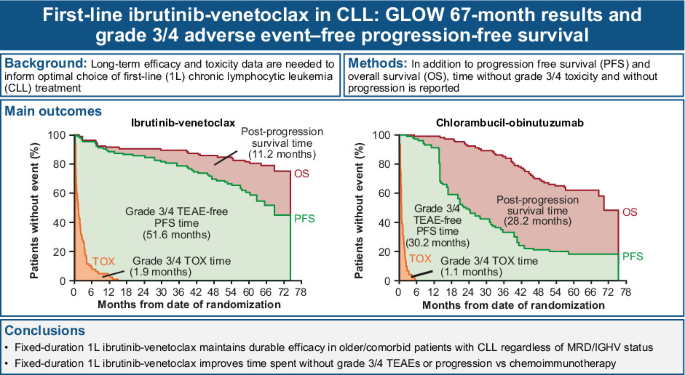
In this long-term analysis of GLOW, with a median of 67 months of follow-up, fixed-duration ibrutinib-venetoclax continued to demonstrate durable response vs chlorambucil-obinutuzumab in older and/or comorbid patients with previously untreated CLL. Although the GLOW trial was designed at a time when chlorambucil-obinutuzumab represented the standard first-line treatment for older and/or comorbid patients with CLL and this regimen is no longer the preferred option in the current treatment landscape, the mature long-term follow-up data from GLOW remain important in demonstrating the durability of disease control and OS after fixed-duration ibrutinib-venetoclax. In this analysis, fixed-duration ibrutinib-venetoclax reduced the risk of death by 54%, significantly decreased need for subsequent therapy by 77%, and significantly improved grade 3/4 TEAE-free PFS, with 21.4-month longer grade 3/4 TEAE-free PFS vs chlorambucil-obinutuzumab. The PFS benefit for ibrutinib-venetoclax observed in the primary analysis was maintained with this longer follow-up, with estimated PFS rates of 84% at 24 months [12], 75% at 42 months, and 52% at 66 months. In the current analysis, landmark PFS at 54 months after treatment completion was 64% in patients with uMRD and 50% in those with dMRD, illustrating the durability of disease control after fixed-duration treatment even for patients not achieving uMRD.
As expected, outcomes reported for a fixed-duration BTKi and venetoclax regimen across studies in a previously untreated population differ due to variations in patient populations, study design, follow-up duration, MRD methodology, and the timing of study conduct, including the impact of the COVID-19 pandemic. Therefore, direct comparison between studies is troublesome. Nonetheless, long-term follow-up from GLOW, CAPTIVATE, CLL17, and AMPLIFY collectively demonstrate that fixed-duration BTKi-based combinations provide durable disease control across different clinical settings [4, 6, 23, 30], although head-to-head comparisons are lacking. In CLL17, similar 3-year PFS and OS rates were observed for fixed-duration ibrutinib-venetoclax, continuous ibrutinib monotherapy, and venetoclax-obinutuzumab (PFS: 79.4%, 81.0%, and 81.1%; OS: 96.0%, 95.7%, and 91.5%, respectively) [4]. In the longer follow-up report of CLL14 (median age, 77 years), 6-year PFS and OS rates of 53% and 79% were reported with fixed-duration venetoclax-obinutuzumab [20]. In the phase III AMPLIFY study, in fit and younger patients (median age, 61 years) with previously untreated CLL [6], 36-month PFS rates of 76.5% for acalabrutinib-venetoclax, 83.1% for acalabrutinib-venetoclax-obinutuzumab, and 66.5% for chemoimmunotherapy were reported [6], highlighting improved outcomes with the triplet regimen, albeit with increased toxicity, as also observed with the triplet ibrutinib-venetoclax-obinutuzumab regimen in the GAIA/CLL13 trial [21, 22]. Long-term follow-up results from other studies also demonstrate durable OS with first-line ibrutinib-venetoclax. In FLAIR, the 60-month PFS and OS rates were 94% and 96% in patients treated with MRD-guided ibrutinib-venetoclax (median age, 62 years; median duration of treatment, 35 months) [26]. In the phase 2 CAPTIVATE FD study, in a relatively young patient population (median age, 60 years), 5.5-year PFS and OS rates were 66% and 97% [30, 31]. In a pooled analysis of CAPTIVATE and GLOW, patients receiving first-line fixed-duration ibrutinib-venetoclax had OS rates comparable with an age-matched general European population, regardless of age or IGHV status [32]. Despite the influence of early deaths in the ibrutinib-venetoclax group in patients who were frail and/or had increased cardiovascular risks on the immature OS data [10, 16], the durability of PFS and OS observed here at this long-term follow-up supports the use of fixed-duration combination therapy in elderly/unfit patients, as also demonstrated by subgroup analyses in unfit patients from the CLL17 trial [4]. Fixed-duration therapy is preferred over continuous BTKi as recommended in the recent European Society for Medical Oncology guidelines; however, treatment selection should take patient comorbidity burden and molecular phenotype into consideration [8].
The prognostic value of uMRD was explored in the current 67-month analysis of GLOW. Overall, differences in PFS between the MRD groups were modest after fixed-duration ibrutinib-venetoclax. Exploratory subgroup analyses suggested that uMRD was associated with longer PFS primarily in patients with uIGHV, whereas patients with mIGHV maintained favorable long-term outcomes irrespective of MRD status. These findings suggest that the prognostic value of MRD may depend on underlying disease biology, with a greater discriminatory effect in uIGHV than in mIGHV disease. OS rates in the ibrutinib-venetoclax group were numerically higher among patients with dMRD than uMRD at end of treatment, and 66-month OS rates in patients in the ibrutinib-venetoclax arm with mIGHV were higher than those for uIGHV. In the ibrutinib-venetoclax group, non–CLL-related events impacted OS (Supplementary Table 4), thus leading to no clear impact of IGHV and MRD status, in contrast to the chlorambucil-obinutuzumab group in which more CLL- and infection-related deaths were reported. This may indicate that, even for patients with dMRD at end of treatment, CLL control with ibrutinib-venetoclax treatment is sufficient for non-CLL causes of death to impact outcome more than the CLL disease itself. Patient numbers in these MRD/IGHV subgroups are limited to those with available MRD status, and these findings are strictly exploratory; therefore, caution should be taken when interpreting these results.
Overall, relatively few patients in GLOW required subsequent therapy after fixed-duration ibrutinib-venetoclax. Subsequent BTKi- and venetoclax-based therapies remained effective in patients that had disease progression in the ibrutinib-venetoclax arm, showing that first-line fixed-duration ibrutinib-venetoclax did not compromise later treatment options. The median duration of response with second-line single-agent ibrutinib therapy was 38 months, although this finding is limited by both patient numbers and follow-up period. In CAPTIVATE at a median follow-up of 68.9 months [30], an objective response rate of 76% was observed in the 25 patients who received retreatment with single-agent ibrutinib at 28.4-month median follow-up. Evidence of successful retreatment after fixed-duration therapy from the GAIA/CLL13 study supports these results. Retreatment of 112 patients with venetoclax-based regimens following ibrutinib-venetoclax-obinutuzumab or venetoclax-obinutuzumab therapy was associated with 2-year treatment-free survival rates of over 77.9% for BTKi-based therapy, 81.4% for venetoclax-based therapy, and 100.0% for BTKi and venetoclax combinations [21, 22, 33]. These data show that clinically meaningful responses to ibrutinib-based and/or venetoclax-based retreatment can still be achieved in a proportion of patients who relapse after first-line combination treatment.
Efficacy and safety results are usually reported separately, limiting assessment of the overall benefits and risks associated with a treatment or intervention. For patients, treatment benefit is not determined by either PFS or specific toxicities alone, but by disease burden and the severity and duration of treatment-related side effects. In GLOW, with the caveat that AEs were only considered treatment-emergent until 30 days after treatment cessation unless considered related to study treatment by investigator, treatment-related AEs could potentially impact a patient’s daily life [34, 35]. The grade 3/4 TEAE analysis, conducted as per the approved protocol, showed a clear net gain of more than 21 months in toxicity-free survival with ibrutinib–venetoclax vs chemoimmunotherapy (51.6 vs 30.2 months). This was despite double the length of treatment duration, thus double the length of AE reporting, in the ibrutinib-venetoclax arm with an average 0.9 months’ longer time with grade 3/4 AEs. The patient-reported outcomes in GLOW indicate that AEs do impact quality of life during treatment, and this impact is reduced following treatment cessation. Traditionally, the burden of toxicities has been reported in clinical studies based on their highest grade, and the use of measures that consider duration of grade 3/4 TEAEs provides information on the real burden of toxicities during and following treatment. Extending AE collection to the first year after end of treatment, and for similar lengths in treatment groups receiving different lengths of treatment, would aid similar analyses in future trials and potentially minimize under-reporting of TEAEs. For example, the more recent CLL17 and GAIA/CLL13 trials collected serious AEs and AEs of interest at least until the end of the study or start of next treatment [4, 22].
Although this study does not directly compare fixed-duration and continuous treatment, the grade 3/4 TEAE-free PFS analysis provides clinically relevant information, as treatment decisions in CLL increasingly involve weighing time-limited combination regimens against continuous therapy. In this context, the observed prolongation of toxicity-free disease control with ibrutinib-venetoclax, which benefits patients, highlights a key difference of fixed-duration treatment as compared with continuous monotherapy, which is a clinical advance. Additionally, as most TEAEs occurred during the treatment period, time off treatment with fixed-duration therapy is of additional benefit to patients, while a subgroup analysis from the CLL17 trial indicates that the benefit from fixed-duration therapy may be particularly clear for unfit patients [4].
Treatment selection should take into account the established cardiovascular toxicity profile of ibrutinib, particularly in older patients and those with pre-existing cardiovascular disease or relevant comorbidities [8, 36]. In GLOW, all grade 5 cardiac AEs occurred during the treatment phase, and no additional grade 5 cardiac AEs were reported after treatment completion during extended follow-up. These data indicate that the known increased risk of cardiovascular toxicities associated with ibrutinib/BTKi treatment diminishes following treatment cessation. However, the present study was not designed to compare cardiovascular toxicity between different BTKis. Results from GLOW, which was specifically designed for an older and/or comorbid patient population, along with data from all-comer trials, confirm the suitability of fixed-duration ibrutinib-venetoclax as a tolerable treatment for most older and/or unfit patients.
The long-term data from GLOW confirms fixed-duration ibrutinib-venetoclax as an effective and durable first-line treatment option in CLL. The grade 3/4 TEAE-free PFS analysis demonstrates more than 21 months gained without grade 3/4 TEAEs and without progression, offering critical patient-centered evidence that extends beyond traditional efficacy measures, providing a comprehensive view of both the duration and quality of time patients spend in different health states. While appropriate patient selection remains important, particularly with respect to the established cardiovascular toxicity profile of ibrutinib, these findings show that fixed-duration ibrutinib-venetoclax is an effective first-line treatment option for older and/or comorbid patients with CLL. Ibrutinib-venetoclax provides durable disease control, even for patients not achieving uMRD at end of treatment, while preserving future treatment options in terms of repeated time-defined combination treatment as well as BTKi monotherapy.
Data sharing statement
Johnson & Johnson’s data sharing policy is available at https://innovativemedicine.jnj.com/our-innovation/clinical-trials/transparency.
