


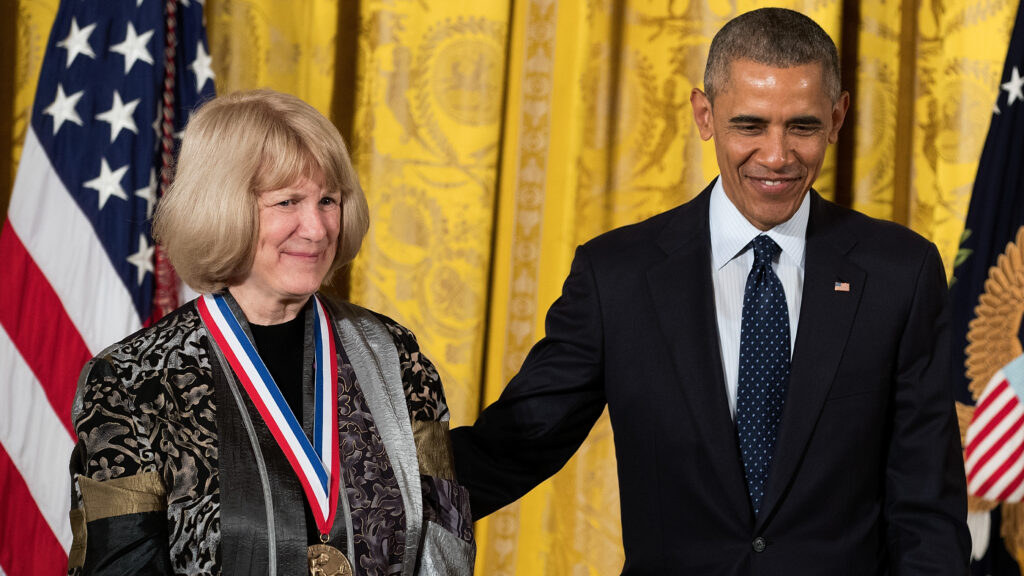
Some 20 years ago, Mary-Claire King was asked to hold a seminar at the Karolinska Institutet in Stockholm.
The invite, the geneticist soon learned, was code for: You are being considered for a Nobel Prize. She traveled to Sweden, held the seminar, then spoke about her work with interested experts who she later understood to be the prize committee.
She couldn’t have been too surprised: Her work has saved hundreds of thousands of lives, and changed cancer therapy.
In 1994 and 1995, King, then a professor at the University of California, Berkeley, showed that breast and ovarian cancer could be hereditary, and identified that mutations in the BRCA1 and BRCA2 genes dramatically increased the risk of developing breast and ovarian cancer.
There is actionable power in this knowledge: Women who test positive for the mutations can have preventive mastectomies, or get their ovaries and fallopian tubes removed. Many have decided to do so, and preventive surgeries have reduced cancer mortality for thousands of women.
2025 Nobel Prize in medicine goes to Mary Brunkow, Fred Ramsdell, and Shimon Sakaguchi for immune system discoveries
Naturally, when Nobel Prize predictions are made, King’s name is often on the list. Ahead of this year’s announcements, starting with the medicine and physiology prize on Monday, STAT spoke to her about what it feels like to be a finalist of sorts in the highest-profile intellectual competition in the world. Now 80 and at the University of Washington, she also talked about her work, her advice to young women scientists, and her favorite mantra — which she invented.
This interview has been edited for clarity and length.
So, the Nobel announcement is next week.
Oh, my God, it’s next week already. I can’t believe it.
Your name has been among the possible winners for many years. Do you have a routine? Do you set an alarm to check the winner?
I think if it were at any time other than truly the middle of the night, I might. But I’m on the Pacific Coast, so it is the middle of the night.
It’s not worth setting an alarm for 2 a.m. in the morning?
It’s not that it’s not worth it! It’s just that it’ll still be there, and the chances of any one year are extremely low.
Still, it’s hard to predict.
That’s true. The year that Katalin Karikó won [with Drew Weissman for work that led to the mRNA Covid vaccines], I think, was the most predictable. I mean, she saved the planet, it’s hard to argue that anything else could have surpassed that. It was the world’s largest experiment. But my guess would be GLP-1 this year.
STAT Plus: How one scientist’s determination made Novo Nordisk an obesity-drug powerhouse
It must be an interesting process. It’s certainly a tiny filter, and there’s a lot of stochastic features involved.
Do you remember the first time that you heard your name among the possible winners?
It was when they invited me to the Karolinska Institutet to give a seminar. They were very open about saying that they do this with people who are under consideration, and that anyone in this position should bear in mind that these things take years to sort through, and they just want to have the information and be able to talk to us personally.
I had a lovely time. I gave a seminar. I interviewed with what I’ve now recognized in retrospect are the members of the committee, and it was fine. There was no feedback.
That was the first time I realized that it was even a possibility.
What were the discussions like?
It varies a lot within the course of the visit. I think it’s largely about the personality of the individual and their belief in the work and their knowledge about the work. In my case, the individual discussions ranged from totally fascinating with someone who totally understood the work … and then another person who was very open about being skeptical about how genetics could possibly solve such a problem. He was extremely polite, absolutely delightful, and charming — but very skeptical.
In a way it’s like going for any other interview: You just have to be prepared for a variety of levels of skepticism and questioning. It was an interesting experience.
What does it feel like to know your work is so impactful that not only does it get noticed by the Nobel Committee, but becomes common knowledge?
I don’t think that scientists are necessarily aware of how important the positive impact that we have on other people is. It just boosts you. It just makes you feel so much stronger and so much more confident and so much more able to continue in rough patches, of which there are of course many.
It’s been a half-century now that I’ve been working on this, and I think when it comes up it’s more like a secret handshake. Thousands of women, or their husbands, fathers, brothers write to me for clarification, for information. It’s a huge network of women all over the world, multiple languages which I don’t speak, and we work together on this.
I got a letter a few years ago, which I’ll treasure forever, from a woman. It was a physical letter, just a note on a little piece of paper and with a photograph of her and her daughter. She said, “My mother died of breast cancer when I was 14. It was way before testing. I’ve since discovered I have a mutation in BRCA1. I’ve had the necessary surgeries. I have not had breast or ovarian cancer. As you see, my daughter just graduated from high school: I thought you’d like to know.” What can you say? I was in tears. I’m in tears telling you about it.
So that’s it, it’s a secret handshake, and we all know what it means, and we can help each other out.
STAT Plus: In a rarity, Nobel Prize in medicine celebrates a fruitful and durable partnership
You went into a line of work that didn’t have many women in it, and did work that benefited, first and foremost, women. You encouraged female scientists, and advocated for greater diversity in the field. What do you think of the state of women in research now?
An enormous amount has changed for the better. We are a far greater proportion of the research pool. We’re a far greater proportion of senior faculty. We’re a far greater proportion of policymakers in the health arena.
What hasn’t changed is that the time of a woman’s life when she has small children is the same as the time of her life when her career is getting off the ground, and until we accept that responsibility as a society and have structured high-quality subsidized childcare, it’s not gonna be equal. It’s simply not.
But over the years, generation after generation, what I tell younger women is that careers are long, and children grow up quickly. So it’ll be OK if you just do what you can now. But as one physician-scientist said to me, “All that’s true, but while they’re growing up, there’s a lot going on [in the lab].”
What is your advice for young scientists — perhaps women — looking to make a big discovery, something that can change the course of medicine, as you did?
What’s most important is picking problems that are important to you. That will, for many of us, be problems that are important to many people — but they have to be important to you, they have to involve ways of thinking and experiment approaches that appeal to you, that you like doing every day.
I think that’s the way to go because these things have a way of growing. What begins as a small problem becomes a larger problem and a larger problem and a larger problem, and if you still like it, and if it still seems plausible, stick with it and and accept the encouragement from people who care, both people who might be affected by it and, especially at the beginning, people that you see every day, that are right there in the lab with you.
When did you start realizing how major your discovery was going to be for medicine?
It was quite abrupt, because the whole time I was working on the problem, it was a 17-year period. I came out of evolutionary biology and genetics, and then when it was clear that that way of thinking applied just fine to proving that breast cancer was inherited, and furthermore there was a gene, and furthermore, here’s where it was — that was a huge creative leap. And as soon as that happened, all sorts of people who cared about breast cancer from a medical perspective as well as genetics realized its importance. And that’s when I did too.
You have done a lot of work since the BRCA discoveries. What is it like, emotionally and intellectually, to continue doing research after you’ve found something this big?
It’s something I think about a lot. One can apply the same way of thinking with new tools to problems that are as old as people but haven’t been tackleable before. My favorite mantra — which I confess to having invented — is, genetics is a way of thinking, genomics is a set of tools, so then problems that one can tackle are ever more challenging. The kinds of approaches that we can use now are just fabulous. We can ask genetic questions that we could not have asked even a decade ago, or three years ago.
And then, within the area of inherited predisposition to cancer, where do I see myself having a long-term niche? I think that’s in two ways. One is a kind of public-facing way. But the other is in what I’m really good at, which is figuring out how to use genetics in really tricky areas, and we still do that a lot.
When this [the BRCA discovery] clearly became a major issue in medicine, and far greater than I would have ever guessed, Bernie Fisher, who was the father of modern breast cancer treatment, said to me: “You’re not going to be able to control this. You need to, on the one hand, let it go, but on the other hand, be there for people when they have questions.”
What are you working on now in your lab?
I have a nice group, and we’re all all involved in all our projects. We’re working on de novo mutations in schizophrenia, we’re working on expanding repeats in bipolar disorder, we’re working on cryptic mutations, structural variations leading to inherited predisposition to breast and other cancers. We’re working on congenital abnormalities.
It’s a wide swath.
