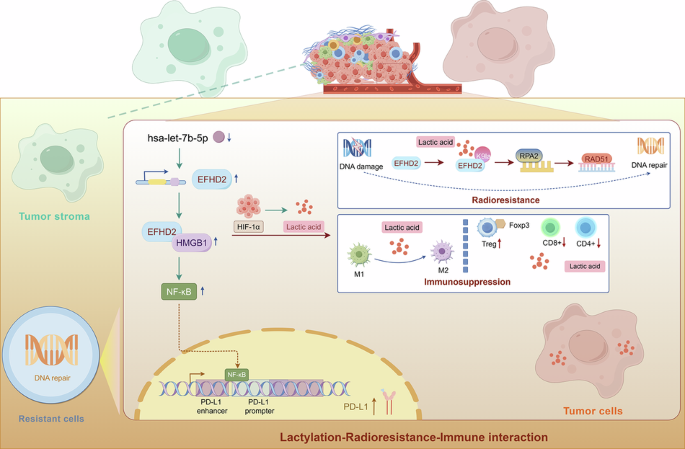
Radioresistance in colorectal cancer (CRC) remains a critical clinical challenge, with underlying mechanisms involving deoxyribonucleic acid (DNA) damage repair, metabolic reprogramming, and immune evasion. Here, we employed multi-omics approaches, including ribonucleic acid (RNA) sequencing, proteomic profiling, and lactyl-proteomics of radioresistant CRC cell models, combined with co-immunoprecipitation, molecular docking, spatial transcriptomics, and single-cell RNA sequencing. Functional validation included production of an EF-hand domain family member D2 (EFHD2) lysine 9 (K9) lactylation-specific antibody, T cell and macrophage co-culture assays, and multiplex immunofluorescence analyses, performed in vitro and in vivo using immunocompetent and immunodeficient mice, alongside patient-derived rectal cancer samples collected from our institution. We found that hsa-let-7b-5p was significantly downregulated in radioresistant CRC cells and tissues, correlating with poor prognosis. Restoration of hsa-let-7b-5p inhibited EFHD2, impaired homologous recombination through reduced activation of RAD51 recombinase (RAD51) and replication protein A2 (RPA2), prolonged phosphorylated histone H2AX at serine 139 (γH2AX) foci persistence, and increased oxidative stress and apoptosis after radiation. Mechanistically, EFHD2 interacted with high mobility group box 1 (HMGB1), enhancing lactate metabolism via hypoxia-inducible factor-1 alpha (HIF-1α) stabilization, with K9 lactylation of EFHD2 being essential for its DNA repair function. Elevated EFHD2-driven lactate reshaped the tumor immune microenvironment by promoting M2 macrophage polarization, suppressing antigen presentation, activating nuclear factor kappa-B (NF-κB) signaling, and upregulating programmed death-ligand 1 (PD-L1). Flow cytometry and immunohistochemistry revealed reduced CD4⁺/CD8⁺ T cell infiltration and increased forkhead box P3 positive (Foxp3⁺) regulatory T cells (Tregs) in EFHD2-high tumors, confirmed by spatial and single-cell transcriptomics showing immunosuppressive signatures. Importantly, combining EFHD2 knockdown with immune checkpoint blockade synergistically enhanced radiosensitivity and restored antitumor T cell responses. Collectively, these findings demonstrate that EFHD2 drives lactate-mediated immunosuppression and DNA repair to promote radioresistance in CRC, suggesting that targeting the EFHD2 axis may restore antitumor immunity and improve therapeutic outcomes.
Trending
- Chemo hair loss doesn't define me
- As assisted dying bill returns to Commons, families recall loved ones’ battle to ‘go out on own terms’ | Assisted dying
- Maryam Moshiri: BBC News presenter reveals she has blood cancer
- Cancer survivors living with chemo hair loss celebrate resilience
- Scientists find breast cancer cells hiding behind protective “shields”
- Why Investigate Implant Upsizing in a Mastectomy Skin Flap Necrosis Study?
- Real-World Data Reveals Underdiagnosis of SCLC-Associated LEMS
- In vivo photoacoustic breast imaging and the interactive effects of skin tone, wavelength, beamformer, and depth on target detectability


Monday, September 7
EFHD2 drives lactate-mediated DNA damage repair and immunosuppression via HMGB1 and HIF-1α to confer radioresistance in colorectal cancer
 By NewsCancer