


Blinatumomab has significantly improved survival in patients with relapsed or refractory (R/R) B-cell acute lymphoblastic leukemia (B-ALL) [1,2,3], particularly those with measurable residual disease (MRD) positivity [4]. Recently, it has been integrated into first-line therapy of B-ALL patients [5,6,7]. Clinical trials typically evaluated the efficacy of blinatumomab over 2‒3 cycles; while most complete remission (CR) and MRD negativity were achieved during the first cycle, only a minority of patients attained additional responses in subsequent cycles [1,2,3, 8]. Prolonged continuous exposure to bispecific T-cell engagers may induce T-cell exhaustion, limiting their effectiveness [9, 10]. Prospective studies in China have reported that a short-course blinatumomab following low-dose chemotherapy as first-line treatment achieved early effectiveness comparable to standard courses [11, 12].
Although guidelines recommend a 28-day course, it remains unclear how a 14-day short course of blinatumomab compares with longer or standard courses.
To address this, we retrospectively analyzed patients with R/R or MRD-positive B-ALL from two Chinese hospitals: The Affiliated Cancer Hospital of Zhengzhou University & Henan Cancer Hospital and The First Affiliated Hospital of Zhejiang University School of Medicine, from March 2022 to August 2025. Patients received at least 12 consecutive days of blinatumomab reinduction (9 µg on days 1‒4/7, followed by 28 µg/day), with treatment duration ranging from 12 to 28 days; Philadelphia chromosome (Ph)-positive patients concurrently received a BCR-ABL tyrosine kinase inhibitor. All patients underwent bone marrow (BM) aspiration on the last day of treatment (Supplementary Fig. 1), and were followed from the time of blinatumomab infusion until death or the data cut-off date (August 31, 2025), with a minimum of 3 months of follow-up. The main reasons for shortening blinatumomab treatment duration were financial constraints, followed by disease progression, severe toxicity, etc. Attending clinicians informed patients of the potential risks of early discontinuation compared to the standard 28-day course in all cases.
125 eligible patients were divided into two cohorts: blinatumomab treatment duration of ≤14 days (12‒14 days, n = 55) and > 14 days (15‒28 days, n = 70), including 21 days (15‒21 days, n = 38) and 28 days (22‒28 days, n = 32). Of these, 74 had R/R disease: 38 with a high leukemia burden ( > 50% BM blasts), 36 with an intermediate burden ( > 5‒50%); 51 had MRD positivity (low burden): 18 with MRD-positive relapse, 33 with persistent MRD positivity during first-line chemotherapy. Patient characteristics were detailed in Table 1. Although they were statistically balanced between the ≤14-day and > 14-day cohorts (all p-values > 0.05), propensity score matching was performed on the entire cohort (Supplementary Fig. 2) and on the R/R and MRD-positive subgroups (Supplementary Figs. 3 and 4) to rigorously control for potential confounding factors and validate the robustness of the results.
Table 1 Characteristics of 125 patients with R/R or MRD-positive B-ALL.
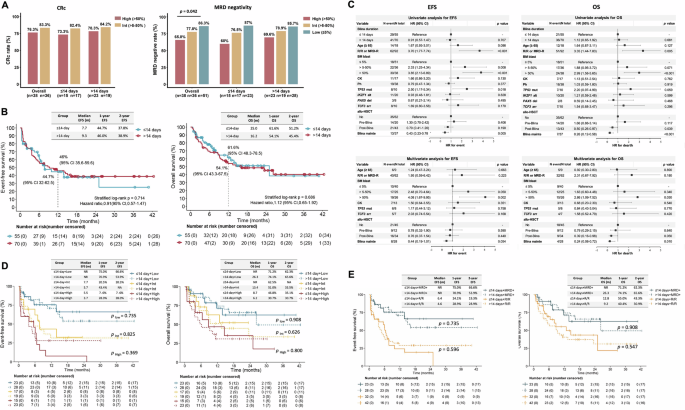
This study compared the efficacy and safety of ≤14-day versus > 14-day courses of blinatumomab in clinical practice in China. Among 74 R/R patients, composite CR (CRc, including CR and CR with partial hematologic recovery) rates (78.1% vs. 81.0%) and flow cytometry (FCM) MRD-negative rates (68.8% vs. 73.8%) did not differ significantly between the two cohorts (Fig. 1A). Similarly, FCM MRD-negative rates (87.0% vs. 85.7%) were comparable between cohorts for 51 MRD-positive patients. Patients with low burden showed a significantly higher MRD-negative rate than those with high burden (86.3% vs. 65.8%; p = 0.042). Neither Ph-negative nor Ph-positive patients demonstrated significant differences in CRc and MRD-negative rates between the two cohorts (Supplementary Fig. 5).
Fig. 1: Comparison of response and survival between the ≤ 14-day and > 14-day blinatumomab duration cohorts.
A Comparison of CRc and MRD-negative rates stratified by leukemia burden prior to blinatumomab therapy between the ≤14-day and > 14-day blinatumomab duration cohorts. B EFS and OS of ≤14-day versus > 14-day cohorts, uncensored for allo-HSCT. C Univariate and multivariate analyses of EFS and OS in the entire cohort. D EFS and OS stratified by blinatumomab duration and pretreatment leukemia burden, uncensored for allo-HSCT. E EFS and OS stratified by blinatumomab duration and disease status prior to blinatumomab, uncensored for allo-HSCT. allo-HSCT or HSCT allogeneic hematopoietic stem cell transplantation; alt alteration; arr rearrangement; Blina blinatumomab; Blina mainte blinatumomab maintenance; BM bone marrow; CI confidence interval; CK complex karyotype; CRc composite complete remission; del deletion; EFS event-free survival; High high leukemia burden; HR hazard ratio; Int intermediate leukemia burden; Low low leukemia burden; m month; mut mutation; MRD measurable residual disease; MRD-R MRD positive relapse; NA not available; NR not reached; OS overall survival; Ph Philadelphia chromosome; Post-blina after blinatumomab; Pre-blina before blinatumomab; R/R relapsed or refractory.
Among the 70 patients in the > 14-day cohort, 43 (29 R/R and 14 MRD-positive) underwent an intermediate evaluation at day 14 (Supplementary Fig. 1), with CRc and MRD-negative rates of 69.0% and 58.6% in the R/R subgroup, and MRD negativity of 78.6% in the MRD-positive subgroup. These early responses were comparable to the endpoint assessments at days 12–14 for all patients in the ≤14-day cohort (all p-values > 0.05; Supplementary Table 1). Extending treatment beyond 14 days yielded only marginal numeric increases in CRc (75.9% [22/29]) and MRD negativity (72.4% [21/29]), with no significant difference compared to day 14. Likewise, among 14 MRD-positive patients, extending therapy provided limited benefit, with MRD-negative rates increasing non-significantly from 78.6% (11/14) at day 14 to 85.7% (12/14) by days 21–28 (Supplementary Fig. 6). Notably, seven patients experienced disease progression during the extended blinatumomab therapy.
With a median follow-up of 13.9 versus 20.1 months ( ≤ 14-day vs. > 14-day cohorts), no significant differences in the duration of response, event-free survival (EFS), and overall survival (OS) were observed between the two cohorts (Supplementary Table 2; Fig. 1B). Median EFS was 7.7 versus 9.3 months for the ≤14-day versus > 14-day cohorts [Hazard Ratio (HR) 0.91; 95% CI 0.57‒1.47; p = 0.714]. One-year EFS was 44.7% (95% CI 32.0‒62.5) versus 46.0% (95% CI 35.6‒59.6). Similarly, median OS was 25.0 versus 16.2 months (HR 1.12; 95% CI 0.65‒1.92; p = 0.686). One-year OS was 54.1% (95% CI 43.3‒67.5) versus 61.6% (95% CI 48.3‒78.5).
Subgroup analyses of 125 patients demonstrated consistent efficacy across key clinical characteristics. No significant interactions were observed between treatment duration ( ≤ 14-day vs. > 14-day) and Odds Ratios (ORs) for CRc/MRD-negative rates or HRs for EFS/OS (all p-values > 0.05) (Supplementary Fig. 7). Multivariate analyses identified high leukemia burden as an independent risk factor for worse EFS (HR 4.80; 95% CI 1.67‒9.95; p = 0.002) and OS (HR 2.86; 95% CI 1.09‒7.52; p = 0.030); intermediate burden was linked to lower EFS (HR 2.48; 95% CI 1.00‒6.15; p = 0.050). In contrast, blinatumomab maintenance and bridged allo-HSCT were independently associated with improved OS (HR 0.24; 95% CI 0.08‒0.72; p = 0.010, and HR 0.39; 95% CI 0.16‒0.98; p = 0.050, respectively) (Supplementary Table 3). Notably, treatment setting (i.e., ≤14-day vs. > 14-day blinatumomab) had no significant impact on EFS or OS (Fig. 1C).
Patients with low tumor burden had significantly longer median EFS and OS compared to those with high tumor burden (both p-values < 0.001). Moreover, they showed better median EFS (p = 0.006) and a trend toward improved OS (p = 0.064) compared to patient with intermediate burden (Supplementary Fig. 8). Notably, no significant differences in EFS or OS were observed between the ≤14-day and > 14-day cohorts within any leukemia burden stratum (Fig. 1D). Patients with MRD positivity had significantly better EFS and OS than those with R/R disease, with a 1-year EFS of 72.0% versus 27.6% (p < 0.001) and 1-year OS of 73.0% versus 46.0% (p = 0.002), respectively (Supplementary Fig. 9). Consistent with the overall analysis, treatment duration ( ≤ 14 days vs. > 14 days) did not significantly affect EFS or OS in either MRD-positive or R/R subgroups (Fig. 1E). Patients who successfully bridged to allo-HSCT after blinatumomab achieved significantly longer OS compared to those treated for relapse post-allo-HSCT (p = 0.040) or those who did not proceed to allo-HSCT (p = 0.001). EFS did not differ significantly among the three groups (Supplementary Fig. 10). Subgroup analysis indicated that the improvement in OS for bridging to allo-HSCT was significant in R/R patients (p = 0.006), but not in MRD-positive cohort (Supplementary Fig. 11).
All therapy-related toxicities were summarized in Supplementary Table 4. No fatal toxicity occurred in either cohort. However, the > 14-day cohort exhibited significantly higher rates of Grade 4 lymphopenia (10.0% vs. 0.0%; p = 0.018) and infections (48.6% vs. 29.1%; p = 0.043) than the ≤14-day cohort. Other toxicities were comparable between the two cohorts.
Blinatumomab treatment has become an essential step toward curing patients with B-ALL. Bridged allo-HSCT with blinatumomab remains a critical option for patients with R/R B-ALL, with longer EFS and OS, in this study and previous research [13, 14]. Moreover, long-term survival without allo-HSCT is possible in MRD-positive patients following blinatumomab therapy. Notably, in this study, most responders achieved CR and MRD negativity by day 14 of blinatumomab; extending therapy to 21 or 28 days provided only limited additional benefit for patients with poor early response, aligning with prior research findings [15], except for a slight upward trend in patients with high leukemia burden. Additionally, no significant differences in treatment responses or survival were observed between the ≤14-day and > 14-day cohorts, whether in the entire cohort or in subgroups stratified by leukemia burden or disease status (e.g., R/R or MRD-positive). Overall, although guidelines recommend a 28-day cycle, our study demonstrates that a 14-day short-course blinatumomab regimen offers a feasible, effective, and safer option for most patients, achieving clinical outcomes comparable to longer courses ( > 14 days) while reducing rates of severe lymphopenia and infection. Moreover, shortening treatment duration reduces hospital stays, improves life quality, and lowers costs, thereby enhancing accessibility in resource-limited settings.
This retrospective study has some limitations. The non-randomized allocation of treatment duration may introduce selection bias, and unmeasured confounders (e.g., socioeconomic factors) could influence results. Additionally, the limited sample size and incomplete molecular profiling preclude definitive conclusions regarding the association between genetic abnormalities and blinatumomab treatment duration. Prospective randomized trials are warranted to confirm the non-inferiority of the short-course regimen.
In summary, these real-world data suggest that a 14-day short-course blinatumomab achieves response rates and survival outcomes comparable to longer regimens in R/R or MRD-positive B-ALL, with improved safety and reduced costs, thereby supporting its clinical feasibility and accessibility.
