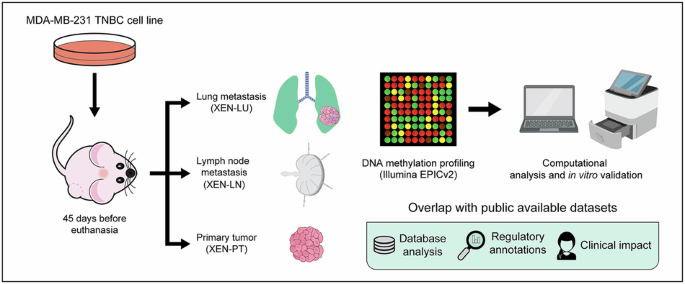
Triple-negative breast cancer (TNBC) is a major cause of cancer mortality, with distant metastases, particularly to the lungs, presenting a significant clinical challenge. While epigenetic mechanisms like DNA methylation (DNAm) are known to influence TNBC progression, their association with lung metastasis remains underexplored. To address this gap, we analyze epigenomic and transcriptomic profiles from TNBC cells, xenograft models, and patient cohorts. DNAm profiling of primary tumors, lymph nodes, and lung metastases in our xenograft model reveals significant genome-wide hypomethylation in lung lesions, consistent with findings on patient samples from the AURORA US cohort. Promoter-methylation changes are enriched in pathways linked to invasion and proliferation, and transcriptomic integration identifies 22 regulated genes, with outcome effects varying according to the histone chromatin context. In vitro demethylation in TNBC cells partially recapitulates the expression changes of several candidate genes. Beyond promoters, enhancer elements are also dysregulated in lung metastases, potentially affecting the expression of their associated genes. Among others, elevated AK1, TPI1, and ENO1 expression correlates with a higher risk of lung dissemination in primary TNBC tumors. These findings highlight DNAm alterations associated with TNBC lung colonization and identify candidate prognostic markers, emphasizing DNAm reprogramming as a feature of breast-to-lung-metastatic progression.
Trending
- Chemo hair loss doesn't define me
- As assisted dying bill returns to Commons, families recall loved ones’ battle to ‘go out on own terms’ | Assisted dying
- Maryam Moshiri: BBC News presenter reveals she has blood cancer
- Cancer survivors living with chemo hair loss celebrate resilience
- Scientists find breast cancer cells hiding behind protective “shields”
- Why Investigate Implant Upsizing in a Mastectomy Skin Flap Necrosis Study?
- Real-World Data Reveals Underdiagnosis of SCLC-Associated LEMS
- In vivo photoacoustic breast imaging and the interactive effects of skin tone, wavelength, beamformer, and depth on target detectability


Monday, September 7
DNA methylation reprogramming of gene regulatory elements is associated with lung metastasis in triple-negative breast cancer
 By NewsCancer