


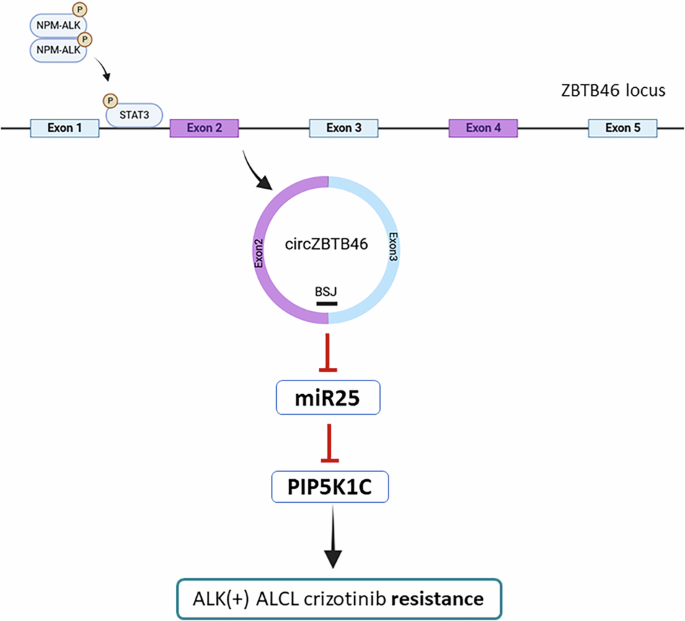
Aberrant expression of circRNA and mRNA ZBTB46 in NPM1::ALK(+) lymphoma cells
This work was initiated by investigating genome-wide circRNA expression profiles in ALK( + ) ALCL via various approaches.
First, a ribo-minus RNA sequencing (RNAseq) dataset, previously generated from a cohort of 39 ALK( + ) ALCL biopsies, was analyzed, with 9 reactive lymph nodes (RLNs) as controls [18] (Supplementary Table S1). A circRNA expression landscape was established in ALK( + ) ALCL (log2Fold Change ≥2 and a P value < 0.05, Supplementary Table S2 and Fig. 1A). Among upregulated circRNAs, circZBTB46 displayed the highest expression (L2FC: 3.6, base mean expression 498.3; Fig. 1A). This circRNA stood out for several reasons. First, using long-read Oxford Nanopore RNA-seq, our group has already identified circZBTB46 as one of the most abundant circRNAs expressed in four human ALK( + ) ALCL cell lines [19]. Second, the expression of its host gene, ZBTB46 (also known as BTBD4, zDC, BZEL, RINZF, and ZNF340) is a transcription factor belonging to the BTB-ZF (broad complex, tramtrack, bric-à-brac, and zinc finger) family of transcription repressors and considered to be restricted to human progenitor and conventional dendritic cells but has not been reported in T-lymphocytes [20,21,22]. Finally, using the RNAseq dataset, it was found that both ZBTB46 circRNA is undetectable in RLN (Fig. 1B). In a second step, published microarray data from peripheral T-cell lymphomas (PTCL) [18] were analyzed. ZBTB46 mRNA levels were compared in samples from ALCL (n = 61), PTCL-not-otherwise specified (PTCL-NOS, n = 71), angioimmunoblastic T-cell lymphoma (AITL, n = 83) and ALK negative anaplastic large cell lymphoma (ALK(-); n = 17) [23, 24]. The linear ZBTB46 transcript was found to be significantly upregulated in ALK( + ) ALCL compared with other PTCL subtypes (Fig. 1C). Notably, no significant difference in ZBTB46 mRNA expression was observed between ALK-positive (ALK + ) and ALK-negative (ALK-) samples within ALCL cases (Fig. 1C).
Fig. 1: Expression of circZBTB46 and ZBTB46 mRNAs in ALK( + ) ALCL primary tumors and normal tissues.
A Volcano plot of circular RNA expression comparing ALK( + ) ALCL primary biopsies (n = 39) and healthy tissues (reactive lymph nodes, RLN, n = 9). Size of each point is proportional to the mean expression of the corresponding circular RNA (B) expression of circZBTB46 (left) and ZBTB46 mRNA (right) assessed by RNA-Seq in ALK( + ) ALCL primary samples versus RLN. C ZBTB46 mRNA expression (RMA) from microarray datasets in ALK( + ) ALCL (n = 61), angioimmunoblastic T-cell lymphoma (AITL, n = 83), peripheral T-cell lymphoma not otherwise specified (PTCL-NOS, n = 71) and ALK(-) ALCL (n = 17) primary biopsies. D ZBTB46 mRNA expression (log2 of the transcript count per million (lenghScaled TPM) from RNA-Seq data in five ALK( + ) ALCL cell lines (KARPAS-299, SU-DHL-1, SUP-M2, PIO, COST), two ALK(-) ALCL cell lines (FEPD, MAC-2A) and CD3(+) lymphocytes stimulated (S, n = 3) or not (NS, n = 3). E Quantitative real-time PCR (RT‒qPCR) analysis of circZBTB46 and ZBTB46 mRNAs in the same cell types. MLN51 was used as an internal control. Values are expressed as 2^(–Δ)Ct relative ratios. Experiments were performed at least in triplicate. Statistical significance was assessed via an unpaired two-tailed Student’s t test with Welch’s correction: P < 0.01 (**), P < 0.001 (***), P < 0.0001 (****), ns = not significant. Data are expressed as means ± SD. F ZBTB46 mRNA expression across malignancies in the Cancer Cell Line Encyclopedia (CCLE) from RNAseq dataset. G Representative immunohistochemical image of an ALK( + ) ALCL primary tumor showing ZBTB46 (brown, arrowhead) and CD68 (red, arrow) expression. Cell nuclei were counterstained with hematoxylin (blue). Original magnification, ×24.6.
Next, expression levels of ZBTB46 RNA were analyzed in four ALK( + ) ALCL cell lines (COST, SU-DHL-1, SUPM2 and KARPAS-299), two ALK(-) cell lines (FEPD and Mac2a) as well as in stimulated (S) and non-stimulated (NS) normal CD3+ lymphocytes (n = 3 donors). Both RNAseq (Fig. 1D) and RT‒qPCR (Fig. 1E) analyses revealed no significant difference in linear ZBTB46 mRNA expression between ALK(+) and ALK( − ) ALCL cell lines, whereas both ALK(+) and ALK(−) cell lines showed a strong upregulation of ZBTB46 circRNA compared with ALK(-) cell lines and normal CD3+ lymphocytes, independently of stimulation.
In addition, RT-qPCR analysis showed a marked overexpression of circZBTB46 in ALK( + ) ALCL cell lines compared with controls (Fig. 1E). These findings were confirmed at the protein level via Western blotting (Supplementary Fig. 1A).
Using the Cancer Cell Line Encyclopedia (CCLE) database portal [25] we found again that expression of the linear ZBTB46 transcript was far the highest in ALK( + ) ALCL cell lines among cancer cell lines (Fig. 1F).
Finally, immunohistochemistry on primary biopsies from 19 ALK(+) and 8 ALK( − ) ALCL cases revealed that ZBTB46 protein was strongly and uniformly expressed in 100% of tumor cells in all ALK(+) cases (Fig. 1G), whereas ALK(−) tumor cells displayed more heterogeneous and generally moderate staining (Supplementary Fig. 1B), consistent with our qRT-PCR results (Fig. 1C–E). No ZBTB46 protein was detected in CD68+ cells (macrophages and dendritic cells) within the tumor biopsies (Fig. 1G). In contrast, reactive lymph nodes; i.e non-tumoral tissue, displayed moderate ZBTB46 staining in sinusoidal macrophage-like cells and in endothelial cells, consistent with previous reports on normal human lymphoid tissue [26, 27].
Collectively, these findings show that both circZBTB46 and its linear counterpart are strongly expressed in all tumor cells of ALK( + ) ALCL, highlighting their predominant association with this lymphoma subtype.
Basic information and characteristics of circZBTB46 in ALK(+) lymphoma cells
As previously reported [19], circZBTB46 is a 1255-nucleotide-long circRNA produced by backsplicing exons 2 and 3 of the linear ZBTB46 transcript (ENST00000245663.9, Fig. 2A and Supplementary Table S3). CircZBTB46 is listed in circBase and circBank as hsa_circ_0002805, and mapped to the genomic coordinates chr20:62407030-62422143 (hg19). Moreover, it is annotated as circZBTB46(2,3).1 according to the standardized nomenclature for eukaryotic circular RNAs [28]. The circular nature of circZBTB46 in the ALK( + ) ALCL cell line SU-DHL-1, was confirmed by resistance to exonuclease digestion (RNase R), unlike linear ZBTB46 mRNA (Fig. 2B). Furthermore, upon transcription arrest by actinomycin D, circZBTB46 remained stable for 8 h while its linear counterpart declined rapidly (Fig. 2C). Finally, subcellular fractionation revealed that circZBTB46 was predominantly localized in the cytoplasm (Fig. 2D).
Fig. 2: Characterization of circZBTB46 in the SU-DHL-1 ALK( + ) ALCL cell line.
A Schematic representation of the circZBTB46 structure with Sanger sequencing of the back-splice junction. B Quantitative real-time PCR (RT‒qPCR) analysis of circZBTB46 and ZBTB46 mRNA expression in cells treated or not with RNase R, a 3′-5′ exonuclease that degrades linear RNAs but spares circular RNAs. C RT‒qPCR analysis after treatment with actinomycin D, an inhibitor of RNA synthesis, to assess transcript stability. 18S rRNA was used as an internal control. Expression values are displayed as 2-∆∆Ct relative ratios. D Subcellular localization of circZBTB46 and ZBTB46 mRNAs determined by cellular fractionation. MALAT1 and GAPDH mRNAs were used as nuclear and cytoplasmic controls, respectively. All experiments were performed in triplicate. Statistical significance was assessed via an unpaired two-tailed Student t test with Welch correction: P < 0.05 (*). Data are expressed as means ± SEM.
Collectively, these results support that circZBTB46 is a bona fide circular RNA transcript with a cytoplasmic localization.
The NPM1::ALK/STAT3 axis is responsible for the aberrant accumulation of circRNA and linear ZBTB46 transcripts in ALK(+) lymphoma cells
The consistent upregulation of both circRNA and linear ZBTB46 transcripts in NPM1::ALK(+) cell lines and patient primary biopsies suggests that the NPM1::ALK fusion protein plays a central role in driving this overexpression. This was investigated by analyzing ZBTB46 linear mRNA levels in T-cells ectopically expressing NPM1::ALK, using two complementary models, i) primary human CD4+ T-lymphocytes transduced with a lentiviral vector encoding NPM1::ALK (M1 model) [29] and ii) T-cells engineered to carry the canonical t(2;5)(p23;q35) translocation via CRISPR-Cas9 genome editing (ALKIma1 model) [19]. In both models, previously generated RNAseq datasets were used to demonstrate robust induction of ZBTB46 mRNA following immortalization and transformation of CD4+ T-cells by the NPM1::ALK oncogene (Supplementary Fig. 2A and 2B). To further determine whether the tyrosine kinase activity of NPM1::ALK is required for this regulation, the ALK( + ) ALCL cell line COST was treated with crizotinib. TKI treatment indeed efficiently inhibited ALK kinase activity, as indicated by the loss of NPM1::ALK autophosphorylation (p-ALK). A concomitant reduction in STAT3 activation was evidenced by decreased p-STAT3 levels in Western blot (Fig. 3A). RT‒qPCR and Western blot further demonstrated a significant downregulation of both circZBTB46 and linear ZBTB46 transcripts (Fig. 3B), as well as reduced ZBTB46 protein levels. (Fig. 3C). siRNAs against NPM1::ALK (siALK) or STAT3 (siSTAT3) were then used in two ALK( + ) ALCL cell lines, COST and SUP-M2. Efficient knockdown of NPM1::ALK and STAT3 was confirmed at the protein level (Fig. 3D and Supplementary Fig. 2C). RT‒qPCR analysis demonstrated that knockdown of either NPM1::ALK or STAT3 strongly decreased circZBTB46 and linear ZBTB46 expression in both cell lines (Fig. 3E and Supplementary Fig. 2D), indicating that NPM1::ALK-dependent STAT3 signaling is critical for driving ZBTB46 accumulation and circZBTB46 production. Whether STAT3 binds directly to the ZBTB46 locus was investigated by analyzing publicly available STAT3 ChIP-seq datasets (GSE117164) generated from two ALK( + ) ALCL cell lines (JB6 and SU-DHL-1) exposed or not to crizotinib [30]. As a positive control, strong STAT3 binding peaks were observed at the regulatory regions of IRF4, a known direct STAT3 target in ALK( + ) ALCL cells [31]. Two main STAT3 binding peaks were detected in the ZBTB46 locus in untreated cells, whereas TKI treatment significantly reduced STAT3 occupancy at these sites, consistent with the loss of STAT3 activation (Supplementary Fig. 3A). ChIP‒qPCR, using a STAT3-specific antibody in the ALCL cell lines SUP-M2 and COST, and two independent primer pairs within the ZBTB46 locus, allowed for precise quantifications of STAT3 binding (ZBTB46_1 and ZBTB46_2, Fig. 3F). Enrichment of STAT3 binding at its two binding sites was confirmed in the ZBTB46 locus (Fig. 3G and Supplementary Fig. 3B).
Fig. 3: Regulation of circZBTB46 and ZBTB46 expression by ALK and STAT3 signaling in ALK( + ) ALCL.
A Western blot analysis of total and phosphorylated ALK (ALK, p-ALK) and STAT3 (STAT3, p-STAT3) protein levels in COST cells treated for 48 h with crizotinib (400 μM). B RT‒qPCR analysis of circZBTB46 and ZBTB46 mRNA levels following crizotinib treatment (Crizo). C Western blot analysis of ZBTB46 and p-ALK protein expression under the same conditions. D Western blot and (E) RT‒qPCR analysis of ZBTB46, ALK, and STAT3 expression in COST cells transfected for 48 h with control siRNA (siCTL), ALK-targeting siRNA (siALK), or STAT3-targeting siRNA (siSTAT3). GAPDH or actin were used as a loading controls. MLN51 served as an internal control for RT‒qPCR. mRNA expression values are shown as 2-∆∆Ct relative ratios. Experiments were performed at least in triplicate. F STAT3 ChIP-seq data from the JB6 cell line showing enrichment of STAT3 at the ZBTB46 locus (data from GSE117164; [30]). G ChIP‒qPCR analysis using two primer pairs (ZBTB46_1 and ZBTB46_2) showing STAT3 enrichment at the ZBTB46 promoter in COST cells, represented as % input. STAT3 was a positive control and ALK and GAPDH were used as negative controls. IgG was used as a nonspecific binding control. Experiments were performed at least in triplicate. Representative Western blots from three independent experiments are shown. Statistical significance was assessed via an unpaired two-tailed Student t test with Welch correction: P < 0.05 (*), P < 0.0001 (****). Data are expressed as means ± SEM.
Together, these data support a direct regulatory role of the NPM1::ALK/STAT3 axis in the aberrant accumulation of linear and circRNA ZBTB46 transcripts in ALK ( + ) ALCL cells.
CircZBTB46 promotes crizotinib resistance in ALK(+) lymphoma cells
To dissect the respective roles of circZBTB46 and its linear mRNA counterpart, CRISPR-Cas9 knockout models were generated in the COST cell line. Since both the zinc finger domain (ZNF) and nuclear localization signal (NLS) of ZBTB46 are encoded by exon 4, two guide RNAs targeting exons 4 and 5 were used, to induce loss of function of the ZBTB46 protein (Fig. 4A). Deletion of exon 4 in three independent clones, Del4-5#C2, #C5 and #E2, was confirmed via genomic PCR (Supplementary Fig. 4A) and RT‒qPCR (Fig. 4B). This strategy resulted truncated ZBTB46 protein expression, as confirmed in Western blot, using an antibody directed against an epitope encoded by exon 2 (Supplementary Fig. 4B). Additional clones lacking both the functional protein (i.e. mRNA) and circZBTB46 were generated using guide RNAs targeting exons 2 and 5 (Fig. 4C), resulting in the deletion of exons 2 to 4. DNA PCR and RT‒qPCR confirmed successful deletion in three clones, Del2-5#A2, #A3, and #E2 (Fig. 4D and Supplementary Fig. 4A). As expected, these clones exhibited loss of both ZBTB46 protein (Supplementary Fig. 4B) and circRNA (Fig. 4D). In immunofluorescence, the full-length ZBTB46 transcription factor was localized in the nucleus of parental wild-type COST cells (Fig. 4E), while it was in the cytoplasm of Del4-5 clones (Supplementary Fig. 4C) and absent in Del2-5 clones (Fig. 4E and Supplementary Fig. 4B, C). The proliferation and survival rates of parental Del4-5 and Del2-5 clones were comparable (Supplementary Fig. 4D, E). However, after 48 h of treatment with crizotinib, both Del4-5 and Del2-5 clones exhibited increased survival compared with parental wild-type cells (Fig. 4F). Importantly, Del2-5 clones, lacking circZBTB46 expression, presented significantly less TKI resistance than clones retaining this circRNA (Del4-5). To gain deeper insight into this observation, selective siRNA downregulation of circZBTB46 in the COST and KARPAS-299 cell-lines, was designed to target the back-splice junction and specifically deplete circZBTB46 without affecting the linear ZBTB46 transcript (siCircZBTB46#1 and #2; Supplementary Fig. 5A). After 48 h of crizotinib treatment, both cell lines transfected with circZBTB46-targeting siRNAs exhibited reduced survival compared with control siRNA-treated cells (Fig. 5A and Supplementary Fig. 5B), supporting the involvement of circZBTB46 in crizotinib resistance in ALK( + ) ALCL.
Fig. 4: Generation and characterization of ZBTB46 CRISPR/Cas9 knockout models.
A Schematic representation of the genomic deletion between exons 4 and 5 (Del4–5). B Relative expression levels of circZBTB46 and ZBTB46 mRNAs determined by RT‒qPCR in COST Del4–5 clones. C Schematic representation of the genomic deletion between exons 2 and 5 (Del2–5). D Relative expression levels of circZBTB46 and ZBTB46 mRNAs determined by RT‒qPCR in COST Del2–5 clones. MLN51 was used as an internal control for RT‒qPCR. Data are expressed as 2-∆∆Ct relative values. All experiments were performed with at least three biological replicates. E Immunofluorescence analysis of ZBTB46 protein expression in parental (wild-type) COST cells and Del4–5#A2 and Del2–5#E2 clones. Nuclei were counterstained with DAPI (blue). Original magnification, 63×. F Cell viability was assessed by Annexin V-Pacific blue/PI staining (flow cytometry) in parental COST cells and Del4-5 and Del2-5 clones treated with increasing concentrations of crizotinib (1, 2, 3, 5 and 10 µM) for 48 h.
Fig. 5: Functional effects of circZBTB46 depletion and sensitivity to crizotinib.
A Viability (Annexin V-Pacific Blue/PI flow cytometry) of COST cells transfected with siCircZBTB46#1 or #2 and subsequently treated with crizotinib (3 µM, 48 h). B Viability (Annexin V-Pacific Blue/PI flow cytometry) of COST cells transduced as described in (Supplementary Fig. 5A) and treated with crizotinib (200 nM) for 7 days. Cell viability assessed by Annexin V-Pacific Blue/PI staining (flow cytometry) in crizotinib-resistant cells established from MTK PDX-derived cells transfected with siCircZBTB46#1 or #2, without treatment (C) or after crizotinib exposure (D) (400 nM, 48 h). E Viability of COSTR200 cells determined by Annexin V/PI staining (flow cytometry) after transduction with circZBTB46 shRNA and subsequent treatment with crizotinib (1000 nM, 7 days). MLN51 was used as an internal control for RT‒qPCR. Expression data are displayed as 2-∆∆Ct relative values. Statistical significance was assessed via an unpaired two-tailed Student t test with Welch correction: P < 0.05 (*), P < 0.01 (**), P < 0.0001 (****), ns = not significant. Data are expressed as means ± SEM.
Based on these results, a CRISPR/Cas13 lentiviral system was used to stably suppress the expression of circZBTB46 (Cas13_circZBTB46) in the COST, SUPM2 and PIO cell lines. This approach resulted in an approximately 50% reduction in circZBTB46 levels without affecting ZBTB46 mRNA or protein expression (Supplementary Fig. 5C, D). Stable circZBTB46 knockdowns were used to assess the effect of prolonged crizotinib exposure (7 days, 100 or 200 nM). Compared with controls (Cas13_CTL), the three transduced cell lines (Cas13_circZBTB46) exhibited significantly reduced viability upon treatment (Fig. 5B and Supplementary Fig. 5E), indicating increased sensitivity to TKI.
Loss of circZBTB46 restores the sensitivity of resistant ALK( + ) ALCL cells to crizotinib
To explore the therapeutic potential of targeting circZBTB46 in crizotinib-resistant ALK( + ) ALCL, siRNA-mediated inactivation of circZBTB46 was performed in MTK PDX-derived cells, obtained from a patient with crizotinib-refractory disease [32]. Two independent siRNAs targeting circZBTB46 were used to ensure specificity of the observed effects (Supplementary Fig. 5F). Silencing circZBTB46 did not affect cell viability in the absence of treatment (Fig. 5C). However, after 48 h of crizotinib exposure, transfected cells showed increased sensitivity to crizotinib compared with those treated with control siRNAs (Fig. 5D). We next generate stable circZBTB46-knockdown cell lines via shRNA lentiviral transduction (shCircZBTB46). Owing to the low transduction efficiency of MTK PDX-derived cells, a previously established crizotinib-resistant derivative of the COST cell line (COSTR200), was used [33]. The effective and specific downregulation of circZBTB46 was confirmed (Supplementary Fig. 5G). As expected, circZBTB46 knockdown sensitized COSTR200 cells to crizotinib in vitro (Fig. 5E).
CircZBTB46 induces crizotinib resistance by modulating PIP5K1C gene expression in ALK( + ) ALCL
To identify molecular pathways regulated by circZBTB46, RNA-Seq was performed after the transfection of two independent siRNAs targeting circZBTB46 in crizotinib-resistant MTK PDX-derived cells. Both siRNAs induced comparable transcriptional changes, particularly downregulation of PIP5K1C and DHRS9 ( | log₂Fold Change | ≥ 0.5, P < 0.05) (Fig. 6A and Supplementary Table S4). The downregulation of PIP5K1C was validated by RT‒qPCR and Western blotting, confirming reduced expression at both mRNA and protein levels in all cellular models previously described (Fig. 6B–D and Supplementary Fig. 6A). By contrast, DHRS9 downregulation was not consistently observed (data not shown).
Fig. 6: circZBTB46 modulates PIP5K1C by sponging miR-25.
A Volcano plot showing differentially expressed genes in crizotinib-resistant cells established from MTK PDX-derived cells transfected with control siRNA (siCTL) or siRNAs targeting circZBTB46 (siCircZBTB46#1 and #2). B Expression of PIP5K1C at the mRNA (top panel, RT‒qPCR) and protein (bottom panel, Western blot) levels in MTK-PDX ALK( + ) ALCL cells after circZBTB46 siRNA transfection (48 h). C Expression of PIP5K1C at the mRNA (top panel) and protein (bottom panel) levels in stable COSTR200 cells expressing either control shRNA (CTL) or shRNA targeting circZBTB46, as assessed by RT‒qPCR and Western blot, respectively. D Expression of PIP5K1C in PIO ALK( + ) ALCL cells stably expressing Cas13 with control gRNA (CTL) or gRNA targeting circZBTB46, as determined by RT‒qPCR (top panel) and immunoblotting (bottom panel), respectively. E Volcano plot showing in the COST cell line differentially enriched RNAs in circZBTB46 pull-down compared to control, highlighting specific microRNAs enriched in the circZBTB46 fraction. F Relative expression of miR25-3p in crizotinib-sensitive (PIO) and resistant COSTR200 cells transfected with a negative control mimic (mimicCTL) or mimic_25-3p measured by RT-qPCR. Snord44 was used as an internal control. Data are shown as 2-∆∆Ct relative values. G Western blot analysis of PIP5K1C protein levels in PIO and COSTR200 cells transfected with a miR_25-3p mimic or control mimic. GAPDH served as a loading control. Experiments were performed in triplicate. Data are presented as mean ± SEM. Statistical significance was determined using an unpaired two-tailed Student t test with Welch correction: P < 0.05 (*), P < 0.001 (**), ns = not significant.
Contribution of PIP5K1C to crizotinib resistance in ALK( + ) ALCL was explored by CRISPR interference (CRISPRi) technology. COSTR200 cell line were transduced with dCas9-KRAB-MeCP2 fusion proteins using guide RNAs targeting the PIP5K1C promoter to achieve transcriptional silencing. As shown in Supplementary Fig. 6B, gRNA-mediated silencing of PIP5K1C resulted in a significant reduction in PIP5K1C protein expression. Compared with control cells, PIP5K1C-silenced cells exhibited a slight decreased viability in vitro, when grown in the presence of 1 µM Crizotinib (Supplementary Fig. 6C).
These results indicate that regulation of PIP5K1C by circZBTB46 participates in promoting resistance to ALK inhibition in ALK( + ) ALCL.
CircZBTB46 regulates PIP5K1C by sponging miR25-3p in ALK( + ) ALCL cells
After RNA pull-down was performed using a back-splice junction-specific probe in ALK( + ) ALCL cells, RT‒qPCR (Supplementary Fig. 7A) confirmed a successful enrichment of circZBTB46. Mass spectrometry analysis of associated proteins did not reveal any specific interactors (data not shown), whereas small RNA sequencing identified four miRNAs (cutoff of |log2Fold Change | ≥ 2 and a P value < 0.05), namely, hsa-miR-22-3p, hsa-miR-222-5p, hsa-miR-10a-5p, and hsa-miR-25-3p, that were significantly enriched in the circZBTB46 pull-down compared with control conditions (Fig. 6E, Supplementary Tables S5 and S6). With the exception of hsa_miR_222-5p, the other three miRNAs were expressed in ALK( + ) ALCL patients (Supplementary Fig. 7B), hsa-miR-25-3p being notably overexpressed compared with RLN ([34]. Using miRNA–mRNA interaction prediction algorithms (miRDB, TargetScanHuman and miRTargetLink 2.0), PIP5K1C was identified as a putative target of miR-25-3p (Supplementary Fig. 7C, D). Consistently, transfection of a miR-25-3p mimic in crizotinib-sensitive (PIO) and crizotinib-resistant (COSTR200) cells, as validated by RT‒qPCR analysis (Fig. 6F), led to a reduction in PIP5K1C protein level (Fig. 6G). Conversely, transfection of a miR-25-3p inhibitor significantly increased PIP5K1C mRNA and protein levels as observed in in COSTR200 cells, further validating this regulatory pathway (Supplementary Fig. 7E, F). Together, these data indicate that circZBTB46 modulates PIP5K1C levels via miR-25-3p sequestration, uncovering a novel competing endogenous RNA axis in ALK( + ) ALCL.
Targeting circZBTB46 in ALK( + ) ALCL cells reduces tumor growth in vivo
In vitro experiments revealed that circZBTB46 is involved in crizotinib resistance in ALK( + ) ALCL cells. To evaluate its potential as therapeutic target, the effect of circZBTB46 targeting on tumor growth was analyzed after subcutaneous injection in NSG mice.
First, CRIPSR/Cas9 crizotinib-sensitive models were engrafted. Del2-5 and Del4-5 clones formed tumors at comparable rates (Fig. 7A). Daily administration of crizotinib, started five days after transplantation, initially reduced the tumor volume in all groups. However, by day 15, all tumors derived from ZBTB46 RNA-depleted clones resumed growth, whereas those derived from parental (WT) cells continued to regress (Fig. 7B). Notably, tumors derived from Del2-5 clones lacking circZBTB46 exhibited slower growth than those derived from circZBTB46(+) clones (Del4-5), corroborating in vitro findings. Next, Cas13-modified crizotinib-sensitive PIO cells were xenografted into NSG mice and treated daily with crizotinib since nine days after injection. Tumor growth was delayed in mice bearing circZBTB46-deficient tumors (Fig. 7C). As PIP5K1C was identified as a downstream target of circZBTB46, PIP5K1C CRISPRi models were also injected in NSG mice. This resulted in a slight reduction of tumor growth upon crizotinib administration (Supplementary Fig. 8A). This highlights the role of PIP5K1C as a mediator of the ITK resistance phenotype. Finally, the crizotinib resistant shCircZBTB46 models were injected to determine whether targeting circZBTB46 in crizotinib-resistant cells could restore drug sensitivity. We confirmed that PIP5K1C protein expression was efficiently reduced in tumors after shCircZBTB46 (Supplementary Fig. 8B). Mice were daily treated with crizotinib or vehicle. In the absence of TKI treatment, tumor growth did not differ between the groups. However, upon crizotinib treatment, tumors derived from shCircZBTB46 cells exhibited significantly reduced growth (Fig. 7D). All these results support the contribution of circZBTB46 to crizotinib resistance in ALK( + ) ALCL and identify circZBTB46 as an interesting therapeutic target of TKI-resistance to in ALK( + ) ALCL disease.
Fig. 7: circZBTB46 modulates crizotinib resistance in vivo.
Tumor growth in NSG mice (n = 8) injected subcutaneously (A-B) with COST cells (A) untreated or (B) treated with crizotinib (5 mg/kg/day); C) with PIO cells expressing Cas13 with either a nontargeting control gRNA (Cas13_CTL) or a gRNA targeting circZBTB46 (Cas13_circZBTB46) and (D) with COSTR200 cells transduced with or without circZBTB46 shRNA with or without crizotinib treatment (100 mg/kg/day). Parental cells were included as a control. Experiments were performed in triplicate. Tumor volume was monitored over time via calipers and is expressed as the mean ± SEM.
