


Building From One Chair
Haffty arrived at what is now Rutgers Cancer Institute in 2005, recruited from Yale by the opportunity to build rather than inherit. At the time, radiation oncology at the institution consisted of two or three community physicians and a single infusion chair. He recruited a chief of physics, a chief of radiation cancer biology, and three faculty members from Hopkins, Yale, and Harvard. All of them are still there. “I knew what I needed,” he says. “I just had to recreate what I had at Yale, as long as the institution was committed to giving us the resources.” Under his leadership, the program grew into New Jersey’s only NCI-designated comprehensive cancer center radiation oncology program. He went on to lead ASTRO, chair the American Board of Radiology, and serves as past president of RSNA.
Where Radiation Oncology Goes Next
The episode’s clinical conversation centers on a field at a genuine inflection point. Haffty argues that radiation technology has reached near-peak development — the margins are tighter, the dose delivery more precise, the fractionation schedules dramatically shorter — and that the next frontier lies in biology rather than equipment. “I see the future as being able to use radiation in combination with molecular agents, targeted agents, chemotherapy — combining radiation with other agents to really take advantage of the biology of the tumor.”
Sayan, whose research includes the Prostate IQ trial using AI models to stratify patient benefit from treatment intensification, describes the rapid evolution from 44-fraction prostate regimens to 5-fraction ultra-hypofractionated protocols — and the clinical trials now determining which patients benefit from which approach.
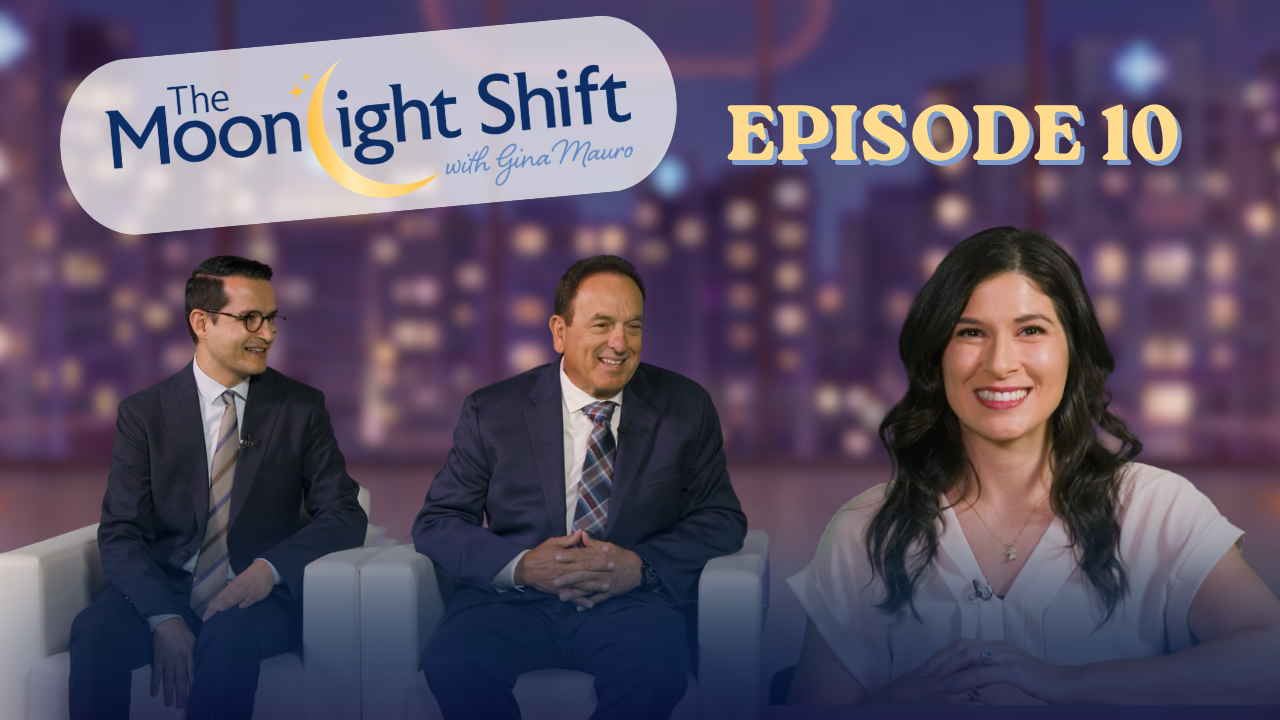
Bruce Haffty and Mutlay Sayan Play “Then and Now”
The episode’s game segment walks through five prostate cancer scenarios, with Haffty anchoring the historical approach and Sayan describing current practice. The final scenario — a man in rural eastern Turkey, newly diagnosed with prostate cancer, unable to miss the harvest season for eight weeks of radiation — lands differently after an hour of Sayan’s own story. His answer is specific, honest, and one of the most quietly powerful moments the show has produced.
The Moonlight Shift is available on YouTube and across MJH Life Sciences’ oncology platforms. New episodes, released bi-weekly, feature leading and early-career oncologists from the Tri-State corridor and beyond in peer-level conversations about where the field is going — and what it still has to work out.
