


This study profiled BRCA1 and BRCA2 variants in Egyptian breast cancer patients, including those with a family history, and examined their associations with tumor grade, hormone receptor status, and the presence of oncogenic viruses (HPV and HMTV). The findings highlight interactions between genetic and viral factors, offering new insights into disease pathogenesis and supporting more precise risk assessment, early detection, and personalized management in this population.
Our study revealed a diverse spectrum of BRCA1 and BRCA2 pathogenic variants, several of which were not represented in the major reference databases available during the analysis period, including ClinVar, dbSNP138, Cosmic, VarSome, and BIC. These findings underscore the distinct genetic architecture of breast cancer in the Egyptian population and highlight the need for greater representation of underrepresented populations in genomic databases. Furthermore, integrated statistical and rule-based analyses identified both risk-conferring variants and variants exhibiting inverse associations with familial breast cancer and viral status (HPV and HMTV DNA positivity). The recurrence of several variants across multiple clinical and virological outcomes suggests potential shared biological mechanisms underlying genetic susceptibility and virus-associated breast carcinogenesis. Notably, we observed intriguing correlations between BRCA variant status, clinicopathological characteristics, and the presence of some oncogenic viruses, though some associations did not reach statistical significance. Together, these findings underscore the multifactorial nature of breast cancer genetics in young women and highlight the need for further research into gene–environment interactions within Egyptian population. Elucidating these associations may ultimately contribute to improved risk stratification and the development of targeted screening and therapeutic strategies for risk individuals.
Variant spectrum and novel BRCA1/BRCA2 variants in Egyptian breast cancer patients
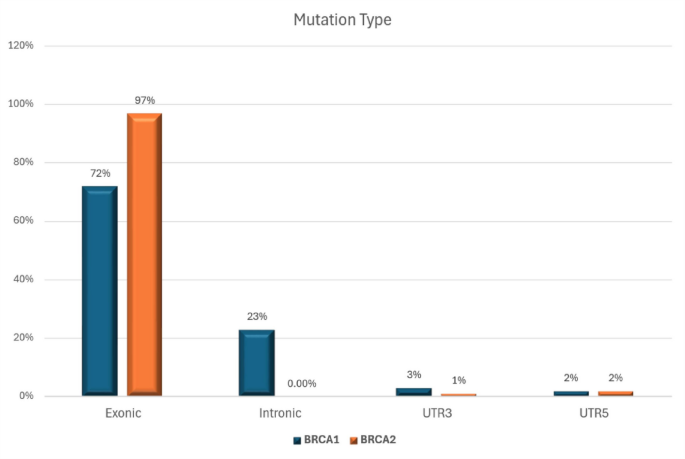
Using targeted next-generation sequencing, we found that exonic variants predominated in both genes, accounting for 72% of BRCA1 variants and 97% of BRCA2 variants. In contrast, intronic variants represented 23% and 1% of the detected variants in BRCA1 and BRCA2, respectively.
A major contribution of this work is the identification of several previously unreported pathogenic variants, including frameshift deletions and stop-gain variants absent from commonly used databases. These findings expand the known BRCA variant spectrum associated with breast cancer risk and highlight the importance of population-specific genetic studies.
Our results are consistent with previous reports from the Middle East and North Africa (MENA) region, which have demonstrated distinct BRCA1/BRCA2 variant profiles compared with Western populations27,28.Studies in Morocco, Algeria, Tunisia, Lebanon, and other Arab countries have identified both novel and recurrent founder variants, emphasizing the limitations of relying solely on global variant databases for accurate risk assessment in these populations29,30,31,32. Recent Egyptian data further support the presence of unique variants, underscoring the need for localized genetic databases and tailored screening strategies15.
Analysis of variant distribution provided important functional insights. In our cohort, exons 9 and 10 of BRCA1 and exon 11 of BRCA2 were the most frequently affected regions. Exon 11 of BRCA2 is a large, functionally critical exon that harbors more than half of all reported pathogenic variants worldwide33. Frameshift variants in this region are expected to disrupt the BRC repeats required for RAD51 binding and homologous recombination repair33,34 similarly, pathogenic variants in BRCA1 exons 9–10 frequently affect the serine-rich region and the BRCT domains, which play a key role in DNA damage response signaling35. The recurrent missense variant p.A1789D identified at high frequency in this cohort is of particular interest and may represent a population-enriched or founder variant, warranting further functional investigation.
The targeted NGS approach used in this study, based on the Devyser BRCA kit, enabled comprehensive analysis of all coding exons of BRCA1 and BRCA2, allowing detection of single-nucleotide variants, small insertions/deletions, and larger genomic rearrangements. This strategy effectively identified variants in this research setting, but diagnostic implementation would require further validation.
Pathogenic BRCA1/2 variants were detected in 39.6% of patients, with BRCA1 variants being more frequent than BRCA2 variants. This pattern is consistent with findings from other Arab populations and neighboring regions, including Turkey and Israel11,13,36, but contrasts with lower variant frequencies reported in East Asian populations37. Such differences in variant profiles along with higher variant frequencies reported in Arab populations have been attributed to several factors such as genetic makeup, demographics, consanguinity, reproductive patterns, and environmental influences underscoring the importance of population-specific studies27.
A high proportion of variants of uncertain significance (VUS) was also observed, similar to reports from other underrepresented populations37. While the clinical relevance of these variants remains unclear, their prevalence highlights gaps in variant annotation and reinforces the need for continued data sharing and functional studies. Accordingly, the present work focused on pathogenic variants and their potential contribution to breast cancer pathogenesis.
Association between BRCA variants and clinicopathological features
In the present study, no significant association was observed between BRCA1/2 variant carrier status and age at diagnosis, consistent with findings reported by Zayas-Villanueva et al.38. Nevertheless, a tendency toward younger age at diagnosis (< 45 years) was noted among variant carriers, a feature commonly associated with hereditary breast cancer37. In contrast, Fang et al. reported that younger patients were more likely to be BRCA1/BRCA2 non-carriers than carriers, a discrepancy that may reflect differences in cohort selection and genetic risk profiles, as their study focused on hereditarily high-risk young39.
Notably, BRCA1 and BRCA2 variants were observed more frequently in non-familial breast cancer cases within our cohort, a finding that differs from reports in Chinese cohorts, where these variants have been identified more commonly among patients with a familial history of breast cancer29. This discrepancy may reflect population-specific genetic variation as well as limitations in current testing methods, including underrepresentation of regional populations in reference databases. A substantial proportion of familial breast cancer cases lack identifiable pathogenic BRCA variants, a phenomenon that may be attributed to presence of variants of uncertain significance, polygenic interactions, or involvement of other susceptibility genes. All these observations emphasize that BRCA-based risk management depends heavily on accurate variant interpretation within a broader genetic context.
Regarding tumor characteristics, BRCA1/BRCA2 variant carriers in our cohort tended to be presented with larger tumor sizes (> 2.5 cm) and higher histological grades (II–III) compared with non-carriers, although these differences did not reach statistical significance, likely due to the limited sample size. Similar trends have been reported by Fang et al., who also noted higher tumor grades among carriers, though with stronger statistical39. These findings are consistent with the established phenotype of BRCA-associated breast cancer, which often presents with more aggressive pathological features37.
Notably, and in contrast to many Western studies where BRCA1-associated tumors are frequently triple-negative, the majority of carriers in our cohort were hormone receptor–positive. This pattern aligns with reports from regional studies, including work by Bujassoum et al.40. In Qatar, suggesting that hormonal profiles of BRCA-associated tumors may differ across populations. Such variation may be influenced by genetic modifiers, environmental exposures, or differences in tumor biology, underscoring the need for caution when applying management guidelines derived from other ethnic groups.
A significant association (p < 0.05) was observed between variant carrier status and tumor laterality, with left-sided tumors being more common among carriers in this exploratory analysis. Although the biological basis of this laterality preference remains unclear, similar observations have been sporadically reported in the literature41. Additionally, microcalcifications were more frequently detected in BRCA1/2 variant carriers (60%) than in non-carriers. This radiological feature has been previously associated with BRCA-related tumors and may reflect altered mammary epithelial proliferation and tissue density resulting from impaired tumor suppressor function41,42.
Association between oncogenic viral presence (HPV and HMTV DNA) and BRCA1/BRCA2 variants
In this exploratory analysis, specific pathogenic BRCA1/BRCA2 frameshift variants were detected exclusively in patients who tested positive for HPV or HMTV DNA. For example, BRCA2 c.5946delCT and BRCA1 c.1016delAC were detected only in HPV-positive patients, while a homozygous BRCA1 c.1129delC variant was observed exclusively in an HMTV-positive case. These observations suggest a possible interaction between presence of viral DNA and defects in DNA repair pathways, pointing toward a synergistic model of carcinogenesis. HPV oncoproteins E6 and E7 are known to disrupt p53 and pRb function, and emerging evidence indicates that they may also promote genomic instability and interfere with DNA repair mechanisms. In this context, a germline BRCA variant could create a permissive environment for viral integration or amplify virus-induced DNA damage, while chronic viral infection and inflammation might increase somatic variant rates, potentially unmasking the effects of BRCA haploinsufficiency43.
Findings related to HMTV are particularly intriguing given the ongoing debate regarding its role in human breast cancer. Naccarato et al. (2019)44 reported that HMTV-like sequences were more frequently detected in non-familial breast cancer than in hereditary cases44. Consistent with this, our study found that BRCA1/2 variant carriers were predominantly negative for HPV and HMTV (P < 0.001 and P = 0.004, respectively), with only two variant carriers mention the variants showing viral positivity. Similarly, Naccarato and colleagues detected HMTV-like sequences in only 4.2% of hereditary breast cancer cases, compared with 30.3% of sporadic tumors, suggesting that hereditary breast cancer driven by strong genetic predisposition may not require viral involvement. However, the exclusive co-occurrence of specific BRCA variants with viral positivity in our cohort adds complexity to this relationship and raises the possibility that certain viral agents may preferentially interact with specific genetic backgrounds.
The presence of a homozygous BRCA1 variant in an HMTV-positive patient is particularly striking, as complete loss of BRCA1 function would result in profound genomic instability, potentially facilitating viral persistence or integration. Nevertheless, these findings must be interpreted with caution. The sample size is limited, and the observed associations are purely correlative. The direction of causality whether presence of viruses contributes to the emergence of these variants, whether BRCA dysfunction facilitates viral oncogenic effects, or whether both are influenced by an unmeasured factor remains speculative.
Overall, these observations should be considered hypothesis-generating. They underscore the need for larger, well-powered studies incorporating genomic, transcriptomic, and viral integration analyses to clarify the potential role of viral co-factors in BRCA-associated breast tumorigenesis, particularly in populations with higher viral prevalence.
A notable finding of this study was the identification of several variants exhibiting inverse associations with viral DNA detection and familial breast cancer. Among these, the BRCA2 variant c.4916T > C (p.Pro1639Ser) demonstrated a strong inverse association with HMTV positivity in the analyzed cohort (p = 2.82 × 10⁻⁷), although this observation requires validation in larger, independent studies. Similarly, the BRCA1 variant c.2612 A > G (p.Gln871Arg) was inversely associated with both family history (OR = 0.09, p = 9.04 × 10⁻³) and HMTV positivity (OR = 0.04). In addition, the BRCA2 variant c.1909 C > T (p.His637Tyr) showed recurring inverse associations across both family history (OR = 0.14) and HMTV-related outcomes (OR = 0.07). The biological and clinical significance of variants exhibiting inverse associations in this exploratory dataset remains uncertain. First, they may generate hypotheses about genetic factors that could influence viral detection, warranting investigation in future studies. Second, understanding the mechanisms underlying these inverse associations such as enhanced DNA repair capacity, altered protein–viral interactions, or modified immune responses could generate hypotheses for mechanistic studies. Third, the presence of inverse associated variants may explain some of the heterogeneity observed in BRCA-associated breast cancer penetrance, suggesting a need for validation in larger cohorts before any predictive modeling.
These findings align with emerging literature documenting protective genetic modifiers in BRCA carriers45,46. However, to our knowledge, this is the first report describing BRCA1/2 variants exhibiting inverse associations with viral-associated breast cancer risk. Functional studies, including protein structure modeling and CRISPR-based cellular assays, are essential to validate these observations and elucidate underlying mechanisms.
Among the variants associated with HMTV status in this exploratory analysis, the BRCA2 p.Lys3326Ter stop-gain variant emerged as a notable finding, showing associations with both family history (OR = 7.80) and HMTV positivity (OR = 18.00). While these effect sizes were considerable, they should be interpreted cautiously in light of the study’s limited sample size, lack of an unaffected control population, and absence of independent replication. Although these observations raise the possibility of an interaction between host genetic susceptibility and HMTV-associated breast cancer risk, the current study design does not permit causal inference or formal assessment of gene–environment interactions. Therefore, validation in larger independent cohorts and mechanistic investigations will be necessary to clarify the role of this variant in virus-associated breast carcinogenesis.
The BRCA2 p.Lys3326Ter variant has been proposed as a low-penetrance susceptibility allele, although its clinical significance remains debated47. In the current cohort, this variant was more frequently observed among cases with detectable HMTV DNA. Nevertheless, the biological relevance of this observation remains uncertain and requires confirmation in larger studies incorporating appropriate control populations, correction for multiple testing, and functional validation.
The observed association of BRCA2 p.Lys3326Ter with both family history and HMTV status may warrant further investigation in larger cohorts. However, given the exploratory nature of the present study, the limited sample size, and the absence of functional validation, no conclusions can be drawn regarding its biological effect, clinical significance, or interaction with viral factors.
The BRCA2 p.Lys3326Ter variant has been proposed as a low-penetrance susceptibility allele, although its clinical significance remains controversial47. In our cohort, it was more frequently observed among cases with detectable HMTV DNA and was associated with both family history and HMTV status. However, given the exploratory nature of the study, limited sample size, and lack of functional validation, these findings should be interpreted with caution and require confirmation in larger, independent cohorts.
Additional variants demonstrated nominally significant associations with multiple clinical and virological parameters. Notably, the BRCA1 stop-gain variant p.Tyr978Ter was associated with both a positive family history of breast cancer (OR = 6.91) and HMTV positivity (OR = 15.30). Furthermore, several variants located within exon 11 of BRCA2, including the stop-gain variants p.Gln1683Ter and p.Ser871Ter, showed nominal associations with HMTV positivity, with odds ratios of approximately 13.1. While these findings require cautious interpretation and independent validation, the concentration of associated variants within BRCA2 exon 11 is noteworthy, given the critical role of this region in homologous recombination repair. The relatively high number of variants identified in exon 11 in the present cohort may reflect the large size and functional importance of this exon, which harbors a substantial proportion of reported BRCA2 sequence variants33,34.
In summary, these findings provide preliminary evidence of associations between BRCA1/2 variants and viral DNA detection in this cohort of Egyptian breast cancer patients. While the biological significance of these observations remains uncertain, the identified variants may represent candidates for future investigation in larger, independent studies. Further research incorporating genetic, virological, and clinical data, together with functional validation, will be necessary to determine whether these associations reflect underlying biological mechanisms relevant to breast cancer development and progression.
HPV-negative signature: insights from association rule mining
Association rule mining using the Apriori algorithm was performed to explore relationships among BRCA1/BRCA2 variants, HPV status, and clinicopathological characteristics in breast cancer patients. This data-mining approach has been widely applied to uncover hidden patterns and co-occurrence relationships in complex biomedical and genomic datasets.
The ten highest-ranking association rules, based on lift values, were all associated with HPV-negative tumors, suggesting distinct patterns of co-occurrence between specific BRCA1/BRCA2 variants and the absence of HPV infection.
Notably, the strongest association rule involved the BRCA2 variant 32370494_T_G, which was consistently associated with HPV-negative status and favorable clinicopathological characteristics, particularly the absence of lymph node involvement. This rule exhibited one of the highest lift values among all identified associations, indicating a notable co-occurrence of these features within the study cohort.
Several additional variants were recurrently identified across the highest-ranking rules. The BRCA1 variants rs56187033 and rs56012641 were consistently associated with HPV-negative status and favorable clinicopathological features, including earlier-stage disease and smaller tumor size. In contrast, BRCA1 rs587781771, BRCA1 c.2791 A > G, and BRCA2 c.10,009 A > T were repeatedly observed in association with HPV-negative tumors and larger tumor size.
Overall, the identified association rules suggest distinct patterns linking BRCA1/BRCA2 variants, HPV-negative status, and clinicopathological characteristics within the study cohort. These findings illustrate the utility of association rule mining for uncovering complex co-occurrence patterns in clinical-genomic datasets that may not be readily detected using conventional statistical approaches26,45,46. However, given the exploratory nature of the analysis and the limited sample size, the observed patterns should be interpreted with caution and require validation in larger, independent cohorts before any biological or clinical significance can be inferred.
Mortality analysis: (exploratory and underpowered)
No significant associations were observed between BRCA1/BRCA2 variants and vital status in the present cohort. Although two BRCA2 variants, c.8506 C > A and c.4563 A > T, exhibited the highest odds ratios and among the lowest p-values observed, neither reached statistical significance. Therefore, no conclusions regarding their potential association with vital status can be drawn.
Interpretation of these findings is further limited by the small sample size, absence of longitudinal follow-up and treatment data, and lack of a formal survival analysis framework. Consequently, the results should be considered exploratory and hypothesis-generating. Nevertheless, reporting these negative findings is important to provide a balanced assessment of variant–outcome relationships and to reduce publication bias. Future studies involving larger, well-characterized cohorts with comprehensive follow-up and survival data are required to clarify the potential prognostic significance of BRCA1 and BRCA2 variants in breast cancer.
Study strengths and limitations
This study provides a comprehensive evaluation of breast cancer by integrating clinicopathological, genetic, and viral data within a single analytical framework. The application of multiple complementary approaches, including variant annotation, association analyses, association rule mining, and advanced visualization techniques, enabled a multidimensional assessment of BRCA1/BRCA2 alterations and their potential clinical and virological correlates. In addition, the identification of putative novel BRCA2 variants expands the mutational spectrum of breast cancer in the Egyptian population and provides a foundation for future investigations.
However, several limitations should be considered when interpreting the results. First, the relatively modest sample size (n = 48) limits statistical power and restricts the ability to draw definitive conclusions, particularly in subgroup analyses. Second, the cross-sectional design precludes causal inference, especially in relation to viral associations. Third, the lack of functional validation for the identified variants means that their biological significance remains to be elucidated. Fourth, DNA was extracted only from tumor tissue (fresh and FFPE) without matched normal samples (blood or saliva). Therefore, even though some variants are reported as germline pathogenic in databases such as ClinVar, we cannot confirm their germline status in this cohort. Consequently, our findings do not directly inform hereditary predisposition, genetic counseling, or familial risk management. Additionally, although samples were collected from two centers, the study population remains limited in scope, which may affect the generalizability of the findings to broader Egyptian or MENA populations. Finally, the absence of longitudinal follow-up data prevents assessment of clinical outcomes such as survival or disease progression.
Despite these limitations, the study provides valuable preliminary insights into the genetic and virological landscape of breast cancer in Egyptian patients and establishes a framework for future large-scale, longitudinal, and functionally oriented investigations.
Potential research directions
The findings of this exploratory study suggest several avenues for future research. First, the identification of novel, population-specific BRCA variants supports the need for larger genetic studies to establish region-specific reference data. Second, the observation of variants with inverse associations (e.g., BRCA2 p.Pro1639Ser) generates hypotheses for functional investigations into possible mechanisms underlying inverse associations. Third, the co‑occurrence of viral DNA with specific BRCA variants warrants further research using larger cohorts and integration of viral integration site analysis. Fourth, the association of rule mining results provides hypotheses regarding molecular subtypes in HPV‑negative breast cancer. All such directions require validation in independent, well‑powered studies before any clinical consideration.
Future work should validate and extend these findings in larger, independent Egyptian and wider MENA cohorts to confirm the identified variants and their clinical associations.
