


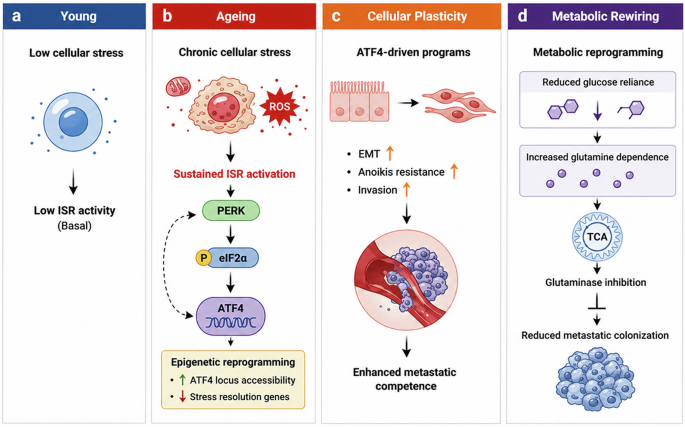
In a recent study published in Nature, Angana A. H. Patel and colleagues revisit the role of physiological ageing in cancer and show that ageing can actively reshape tumour progression. Their work suggests that ageing promotes metastatic dissemination through sustained activation of the integrated stress response (ISR)–activating transcription factor 4 (ATF4) signalling axis, thereby providing a mechanistic link between age-associated cellular stress and metastatic competence.1
Ageing and cancer share several fundamental features, including proteostasis imbalance, epigenetic drift, mitochondrial dysfunction, and altered nutrient sensing.2 However, how these changes are integrated into tumour-intrinsic signalling networks is still not fully understood. This issue is particularly relevant in lung cancer, where most patients are elderly, while experimental models are typically based on young animals. Given that metastasis accounts for the majority of cancer-related deaths,3 identifying signalling pathways that connect ageing to metastatic progression remains an important challenge.
One of the most important conceptual advances of this study is that it challenges the traditional assumption that tumour progression is primarily coupled to proliferative expansion. Using physiologically aged KRAS-driven lung cancer models, Patel et al. demonstrate that ageing can suppress primary tumour growth while simultaneously enhancing metastatic dissemination.1 This finding is particularly significant because it recapitulates a clinically observed phenomenon in which metastatic dissemination can occur independently of aggressive primary tumour expansion. Previous clinical and evolutionary studies, including findings from the TRACERx framework, have suggested that metastatic progression may become partially uncoupled from primary tumour growth during tumour evolution.4 In this context, the study by Patel et al. is especially notable because it demonstrates that physiologically aged tumour models can reproduce this dissociation, whereas such features are less apparent in younger models.
Rather than functioning as a passive background condition, ageing appears to actively reshape tumour evolutionary trajectory toward a dissemination-prone state. In this context, metastatic competence emerges not simply as a late consequence of tumour growth, but as an adaptive phenotype favoured under age-associated stress conditions. Consistent with this interpretation, aged tumour cells exhibited increased epithelial–mesenchymal transition (EMT), enhanced anoikis resistance, and greater invasive potential, all of which are hallmarks of metastatic plasticity.
Mechanistically, the study further advances the concept that ageing-associated cellular stress is not merely a bystander phenomenon, but a tumour-intrinsic force capable of reshaping metastatic behaviour. Patel et al. identify the unfolded protein response (UPR)–integrated stress response (ISR) axis, particularly the PERK–eIF2α–ATF4 pathway, as a central regulatory programme linking chronic stress adaptation to metastatic plasticity.1,5
Importantly, ISR activation in aged tumour cells does not appear to be transient. Instead, aged tumour cells seem to exist in a chronically stress-primed state characterised by sustained ATF4 activity and reduced stress resolution capacity. Epigenetic reprogramming likely contributes to this phenotype by increasing chromatin accessibility at the ATF4 locus while limiting accessibility at genes involved in stress termination. In this framework, persistent ISR–ATF4 signalling may actively direct tumour cells toward phenotypic states that favour survival, dissemination, and metastatic colonisation under adverse microenvironmental conditions.
Equally notable is the observation that this metastatic programme creates a distinct metabolic liability. By shifting tumour cells toward glutamine dependency, ageing-associated ISR activation generates a therapeutically actionable vulnerability, raising the possibility that metastatic competence and metabolic fragility may arise simultaneously during tumour evolution. This metabolic rewiring is consistent with adaptive metabolic reprogramming observed in cancer. Taken together, these findings support a model in which ageing acts as a chronic source of cellular stress that favours the selection of tumour cells capable of maintaining ISR activity. In this context, ATF4 may function as a central integrator of stress signals, coordinating transcriptional and metabolic adaptations that enable tumour cells to survive and disseminate under adverse conditions. From this perspective, metastasis may, at least in part, represent an adaptive response to persistent stress rather than simply a late stage of tumour progression.
Several questions remain. It is not yet clear whether ISR–ATF4 signalling plays a similar role across different tumour types or whether its effects are context-dependent. In addition, the extent to which tumour-extrinsic factors, such as the ageing microenvironment or immune system changes, contribute to ISR activation will require further investigation.
Overall, this study suggests that ageing should be considered an active regulator of tumour signalling rather than a passive risk factor. By identifying ISR–ATF4 signalling as a key link between ageing, metastasis, and metabolic adaptation, it highlights a potentially actionable pathway that may be particularly relevant for older patients. These findings may also have broader implications for how ageing is incorporated into experimental design and therapeutic strategies in cancer research. These concepts are summarised schematically in Fig. 1.
Fig. 1
Ageing-activated integrated stress response–ATF4 signalling drives metastatic plasticity and metabolic vulnerability in lung cancer. Physiological ageing increases chronic cellular stress and sustains activation of the PERK–eIF2α–ATF4 axis, supported by epigenetic reprogramming that enhances ATF4 locus accessibility and limits stress resolution. Persistent ATF4 activity promotes epithelial–mesenchymal transition, anoikis resistance, invasion, and metastatic competence. In parallel, ageing-associated ISR–ATF4 signalling rewires tumour metabolism by reducing glucose reliance and increasing glutamine dependence, thereby creating a metabolic vulnerability that can be targeted by glutaminase inhibition to suppress metastatic colonisation. The figure was created by the authors and does not contain third-party copyrighted image resources
