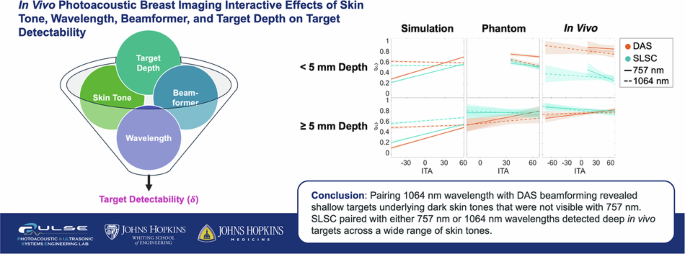
Photoacoustic imaging is promising for breast cancer diagnosis. However, image quality diminishes with greater melanin content with delay-and-sum (DAS) beamforming, which can be resolved with short-lag spatial coherence (SLSC) beamforming. We investigated the applicability of SLSC beamforming to photoacoustic breast data acquired from 29 patients with skin tone individual typology angles (ITAs) ranging −78° (dark) to 71° (very light), acquired with 757 nm and 1064 nm wavelengths. In shallow targets (<5 mm), with 1064 nm wavelength, target detectability (defined as a scaled average of generalized contrast-to-noise and signal-to-noise ratios) decreased from a mean of 0.80 with DAS beamforming to a mean of 0.33 with SLSC beamforming (p < 0.05). Shallow targets were not visible with 757 nm wavelength when ITA < 14°. In deeper targets, when ITA ≤ 0°, the mean target detectability aggregated across both wavelengths was 0.74 and 0.85 with DAS and SLSC beamforming, respectively. Results were validated with simulated and/or phantom data, and statistical significance was demonstrated with a linear mixed-effects model (p < 0.05), providing the first known tripartite analysis to assess competing interactions among beamformers, wavelengths, and target depths in clinical photoacoustic imaging.
Trending
- Unpacking Iberdomide’s FDA Approval and The Future of CELMoDs
- BBC News presenter Maryam Moshiri reveals she has incurable blood cancer | Cancer
- Chemo hair loss doesn't define me
- As assisted dying bill returns to Commons, families recall loved ones’ battle to ‘go out on own terms’ | Assisted dying
- Maryam Moshiri: BBC News presenter reveals she has blood cancer
- Cancer survivors living with chemo hair loss celebrate resilience
- Scientists find breast cancer cells hiding behind protective “shields”
- Why Investigate Implant Upsizing in a Mastectomy Skin Flap Necrosis Study?


Monday, September 7
In vivo photoacoustic breast imaging and the interactive effects of skin tone, wavelength, beamformer, and depth on target detectability
 By NewsCancer