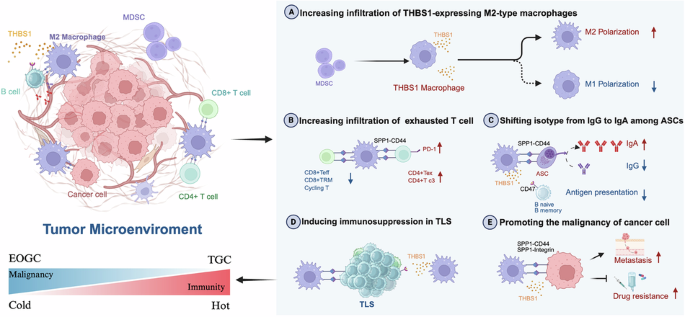
Early-onset gastric cancer (EOGC) is characterized by aggressive clinical behavior and poor prognosis; however, the immunological features underlying its progression remain incompletely understood. Here, we performed single-cell RNA sequencing on EOGC tumors, matched adjacent mucosa, and traditional gastric cancer (TGC) samples, integrating these data with publicly available gastric cancer datasets to comprehensively characterize the EOGC tumor microenvironment. Our analyses revealed that EOGC exhibits an immunosuppressive “cold” microenvironment characterized by increased exhausted CD4+ T cells, impaired anti-tumor effector T-cell activity, and enhanced B-cell isotype switching from IgG to IgA, suggesting immune evasion. Notably, we identified a THBS1-expressing macrophage subset with prominent M2-like polarization that was associated with tumor progression and unfavorable prognosis. Functional experiments demonstrated that THBS1-overexpressing THP-1-derived macrophages promoted M2 polarization and enhanced malignant phenotypes in gastric cancer cell lines, whereas inhibition of THBS1 suppressed tumor growth in vivo. Together, these findings delineate a distinct immunosuppressive ecosystem in EOGC and provide insight into the potential role of THBS1+ macrophages in EOGC progression.
Trending
- Why cancer, not cost of living, may be the biggest issue in Iowa’s midterm elections | Iowa
- East Surrey and Crawley Hospitals increase scalp cooling for cancer patients
- MICAL2 as a key effector of β-catenin signaling driving melanoma progression and therapeutic resistance
- Spatial analysis of head and neck cancer identifies two ecosystems with distinct modes of epithelial-to-mesenchymal transition
- NCAM1 potentiates small cell lung cancer stemness and resistance to NK cell-mediated cytotoxicity
- Loss of CD44 re-educates pancreatic cancer-associated fibroblasts modulating their fibrotic and immunosuppressive functions
- Defining the Objectives of an Analysis of Tarlatamab in Brain Metastases
- Imbalanced p53–RB signaling triggers cGAS–STING–mediated immune activation in early oral cancer development


Sunday, August 16
THBS1+ macrophages drive an immunosuppressive tumor microenvironment and promote progression in early-onset gastric cancer
 By NewsCancer