


Patient characteristics
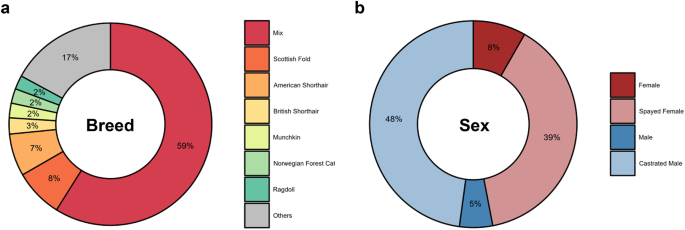
A total of 813 cats were included in this study. The most common breed was mixed (59%), followed by Scottish Fold (8%), and American Shorthair (7%). Following them, British Shorthair, Munchkin, Norwegian Forest Cat, and Ragdoll were observed in relatively similar, lower proportions (each representing approximately 2–3%). This breed distribution aligns with the reported ranking of popular cat breeds in Japan (Fig. 1a). Females accounted for 47%, of which 82.5% were spayed and 90.3% of male cats were castrated (Fig. 1b). The age of cats ranged from 0 to 20 years old.
Fig. 1
Characteristics of cats in this study. (a) A pie chart of cat breed distribution in this study. Others breed included Abyssinian, American, Curl, Bengal, Birman, Bombay, Burmese, Chartreux, Cornish Rex, Devon Rex, Egyptian Mau, Exotic, Shorthair, Himalayan, Japanese Bobtail, Khao Manee, Kurilian Bobtail, Lambkin, Maine Coon, Minuet, Ocicat, Persian, Ragamuffin, Russian Blue, Savannah, Siamese, Siberian, Singapura, Snowshoe, Somali, and Tonkinese. (b) A pie chart of sex and reproductive status in this study.
Development of a multiplex PCR–based targeted sequencing method for cats
In this study, we established a multiplex polymerase chain reaction (PCR)–based targeted sequencing method for cats to analyze the 27 candidate cancer-predisposing genes by modifying those previously developed for the human or dog genome in our laboratory12,13. In total, 99.6% of all targeted regions across the 27 genes (85,629 bp) were covered by at least 20 sequencing reads (≥ 20×), indicating that nearly all germline variants within the targeted regions could be reliably detected. Across individual cats, the average proportion of target regions with ≥ 20× coverage varied between 5.22% and 99.2% (98.86% ± 4.47%, mean ± SD). As quality control, 792 cats with at least 95% of the target regions covered at ≥ 20× were retained for reliable variant detection for further analysis.
Finally, 784 germline variants were identified in the 792 cats. The total number of variants in each of the 27 genes varied substantially between 1 variant in PTEN and 125 variants in ATM (Fig. 2a). A statistically significant positive correlation was observed between transcript length and the number of variants (Spearman’s ρ = 0.813, P = 7.93 × 10− 7), consistent with findings from our previous human study14, and supporting the validity of the multiplex PCR–based targeted sequencing approach.
Fig. 2
Association between each gene length and the number of germline variants in each gene, and workflow for defining putative pathogenic variants (PVs). (a) Variant counts and transcript lengths per gene. Red bar and black dashed line present the total number of variants identified in 27 genes and transcript lengths, respectively. This statistically significant positive correlation between transcript length and the number of variants detected demonstrated the validity and effectiveness of the multiplex targeted sequencing method developed in this study. (b) Workflow for putative PV identification. First, among the 784 input variants, protein-truncating variants were identified using SnpEff as criterion 1. All 784 variants were nonetheless subjected to LiftOver for genome coordinate conversion; 318 failed conversion and were excluded, leaving 466 converted variants. Comparison of pre- and post-LiftOver coordinates removed a further 143 non-matching calls, yielding 323 matched variants used for downstream analyses. For missense variants within this matched set, putative PV identification then applied criterion 2 and criterion 3.
Determination of pathogenic variants
Among the 784 variants identified, 11 were loss-of-function variants including nonsense variants, frame-shift variants, and variants in 2 bp-canonical splice sites, 427 were non-synonymous variants, and 346 were synonymous variants. From this list, putative PVs were determined according to the three criteria described in the Materials and Methods section (Fig. 2b) because there are no standard guidelines in cats to determine PV among germline variants such as the American College of Medical Genetics and Genomics and the Association for Molecular Pathology (ACMG/AMP) guidelines used in human15. According to criterion 1, eleven loss-of-function variants were classified as PVs initially, however, three were excluded for the following reasons. One ATM variant (c.7539 + 2C > T) could affect a canonical splice donor site (5’ splice site); however, the substitution from C to T in this splice donor site created a more common consensus splice motif (GT), this variant would be unlikely to be a putative PV due to splicing abnormality. One TP53 variant (c.1222 C > T), although located within the coding region of the canonical transcript (ENSFCAT00000065820.2) used in this study, was excluded because it fell within an intronic region in alternative transcript isoforms (ENSFCAT00000055487.1 and ENSFCAT00000009625.4). A third variant in NBN (c.28 C > T) was also excluded because it was annotated within an NBN transcript in the felCat9 reference but had no transcript annotation at the corresponding genomic position in the alternative assembly (F.catus_Fca126_mat1.0), resulting in inconsistent gene assignment. In addition, three distinct TP53 variants and one CHEK2 variant classified as putative PVs were examined carefully because somatic variants related to clonal hematopoiesis of indeterminate potential can occur in these genes could be observed in genomic DNA from peripheral blood DNA16. All these variants showed variant allele fractions close to 0.5 as shown in IGV (Supplementary Fig. S1), while clonal hematopoiesis of indeterminate potential is generally characterized by variant allele fractions that are markedly lower than those of germline variants. Therefore, these were considered germline putative PVs. Finally, we identified eight variants as pathogenic.
Two variants met criterion 2. One BRCA1 variant (p.Ala1791Val) in cats corresponded to p.Ala1789Val in humans, classified as likely pathogenic for hereditary cancer-predisposing syndrome (ClinVar Variation ID: 865385). The other was an MSH6 variant (p.Arg1074Cys), which corresponded to p.Arg1076Cys in humans and classified as likely pathogenic for Lynch syndrome (ClinVar Variation ID: 89357). The latter classification was reviewed by an expert panel in ClinVar. This designation indicates that the variant was curated and classified by an international consortium of experts, thus ensuring a high level of confidence in the pathogenicity assessment based on established consensus criteria.
For criterion 3, only non-synonymous variants that resulted in amino acid substitutions corresponding to those in humans were evaluated with three in silico prediction tools. Variants were considered pathogenic if predicted to be deleterious by at least two of the three in silico tools. Thresholds were optimized using human variations classified of 27 cancer-predisposing genes in ClinVar by comparing pathogenic/likely pathogenic variants (n = 6,324) with benign/likely benign variants (n = 1,022). The optimal cut-offs were 0.637 for AlphaMissense (AUC = 0.953), − 11.594 for ESM1b (AUC = 0.910), and 26.1 for CADD (AUC = 0.983), which provided the best discrimination between pathogenic and benign variants registered in ClinVar (Supplementary Fig. S2). Variants were considered potentially deleterious if their scores exceeded the AlphaMissense or CADD thresholds, or fell below the ESM1b threshold. In total, 21 missense variants exceeded the deleteriousness threshold in at least one of the three in silico tools. Of these, three exceeded the threshold in at least two tools, and one variant exceeded the threshold in all three tools. (Supplementary Fig. S3). One of the four variants (p.Ala1791Val in BRCA1) also fulfilled criterion 2. The three remaining variants met criterion 3. The CDKN2A variant (p.Pro148Leu) was predicted to be deleterious by AlphaMissense (score: 0.683) and ESM1b (–12.102) but did not exceed the threshold in CADD (score:23.5). The MSH2 variant (p.Arg711Gln) exceeded the threshold in all three tools: AlphaMissense (0.987), ESM1b (–11.744), and CADD (33). In contrast, the ATM variant (p.Thr2861Met) exceeded the thresholds in ESM1b (–12.477) and CADD (30) but not in AlphaMissense (0.467). Consequently, 13 variants were classified as putative PVs in this study (Table 1), including eight under criterion 1, two under criterion 2, and three additional variants under criterion 3.
Table 1 Pathogenic variants and clinical characteristics of the carrier cats. The criteria refer to the numbered criteria described in the Materials and Methods section. A genotype of 0/1 indicates the presence of the variant in a heterozygous state. The diseases indicated in bold are confirmed or suspected tumors. CM, castrated male; F, Intact female; SF spayed female.
Associations between pathogenic variant carriers and cancer status
To investigate the association between the 13 putative PVs and feline clinical characteristics, we analyzed the clinical data from 18 putative PV-carrier cats. All putative PVs were heterozygous state, and 7 of 18 cats (38.9%) had various types of confirmed or suspected tumors. Two putative PVs were found in multiple cats: a CHEK2 frameshift variant (p.Thr502fs) in five cats and an NBN splice-site variant (positioned 1 bp downstream of exon 15 and predicted to disrupt normal splicing; c.2322-1G > A) in two cats. All five carriers of the CHEK2 variant were mixed-breed cats (three castrated males and two spayed females) with diverse clinical presentations, including only one case of renal cell carcinoma (a 9-year-old spayed female mixed-breed cat); the others had renal disease, suspected chronic cholangitis, or foreign body ingestion, respectively. The NBN variant was found in two castrated male Ragdolls diagnosed with idiopathic hypercalcemia and suspected feline infectious peritonitis, respectively, without a shared clinical phenotype.
The other 11 putative PVs were each observed in only one cat. Of these, 6 were associated with confirmed or suspected tumors: multicentric lymphoma in a BRCA2 variant (p.Lys2358fs) carrier (castrated male mixed breed); suspected osteosarcoma in a TP53 variant (p.Arg369*) carrier (spayed female mixed breed); cutaneous mast cell tumor in another TP53 variant (p.Asn28fs) carrier (spayed female Bengal); giant cell tumor in a RAD51C variant (p.Leu52fs) carrier (spayed female mixed breed); mammary carcinoma in a CDKN2A variant (p.Pro148Leu) carrier (intact female Scottish Fold); and suspected renal cell carcinoma in an ATM variant (p.Thr2861Met) carrier (castrated male mixed breed). Although cutaneous mast cell tumors are exceedingly rare among the 18 putative PV carriers and have no documented association with TP53 variants, osteosarcoma is a sentinel cancer of Li-Fraumeni syndrome17, a cancer predisposition syndrome caused by germline TP53 variants. Therefore, the spayed female mixed-breed cat carrying the TP53 variant (p.Arg369*) with suspected osteosarcoma may have developed the tumor via a mechanism analogous to Li-Fraumeni syndrome in humans. The remaining five putative PVs, each located in a different gene (TP53, NBN, BRCA1, MSH6, and MSH2), were associated with non-tumor-related clinical symptoms, specifically hyperparathyroidism, purulent nasal discharge, subcutaneous inflammation, maxillary fracture, and bladder stones, respectively.
Among the 18 cats with one of the 13 putative PVs, 38.9% had various types of confirmed or suspected tumors. Since not all putative PV carriers develop cancer in humans, this proportion could be considered reasonable but, we investigated whether demographic factors, such as breed, sex, neuter status, and age, might account for differences in cancer development among the feline putative PV carriers. Most putative PV carriers were mixed-breed cats (n = 12), with Bengal, Ragdoll, and Scottish Fold each represented by two cats. The group consisted of eight castrated males, nine spayed females, and one intact female, with no apparent trend by breed, sex, or neuter status. Of the seven tumor-bearing putative PV carriers (age, 9.00–14.41 years old; median, 11.83 years), five were older than the median feline cancer diagnosis age (approximately 9.5 years old)18, whereas 7 of the 11 tumor-free putative PV carriers (age, 1.83–16.58 years old; median, 9.16 years) were younger than this threshold. Although the difference in age between tumor-bearing and tumor-free putative PV carriers was not statistically significant (P = 0.082, Welch’s t-test), tumor-bearing putative PV carriers tended to be older than tumor-free putative PV carriers. A similar age difference was observed among non-carriers, in whom tumor-bearing cats (n = 47; median age, 12.75 years) were older than tumor-free cats (median age, 6.58 years) (Supplementary Table 1 for age and comorbidities of tumor-bearing cats among non-carriers). It should be noted, however, that the reference age of approximately 9.5 years was derived from a Korean feline population; therefore, comparison with our Japanese cohort should be interpreted with caution.
