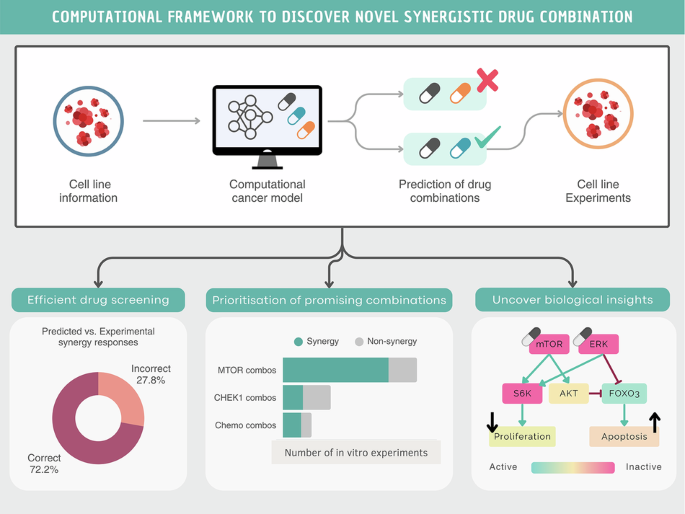
Colorectal cancer (CRC) exhibits high genetic heterogeneity and frequent resistance to single-agent therapies, highlighting the need for rationally designed drug combinations. We apply a mechanistic modelling framework to prioritise synergistic combinations in 16 CRC cell lines. Simulations of 210 double perturbations among 21 targeted inhibitors guided the selection of 17 combinations for experimental validation. Of 704 tested conditions, 68% showed synergy, most involving PI3K/AKT/MTOR-related inhibitors. We report six novel compound combinations that inhibit CRC cell-line growth by targeting MTOR and ERK, or MTOR and BCL2. In silico analysis indicates that feedback suppression via S6K–FOXO3 mediates the MTORi–ERKi synergy, whereas apoptotic reinforcement explains the MTORi–BCL2i effect. These results demonstrate that model-guided prioritisation enables the efficient discovery of synergistic drug pairs, mechanistic insight into their action, and a scalable route to rational combination-therapy design in CRC.
Trending
- Lancashire cancer clinicians take on 140-mile charity bike ride
- β3GnT2-mediated N-glycosylation of EGFR and LDLR drives glioblastoma progression and can be targeted by AST-1306
- Family of Bradford factory worker seek answers after cancer death
- Hastings twin sisters turn life and illness into comedy play
- I had 11 years of chemotherapy for a cancer I didn’t have
- Cancer treatment alters the selection of pre-existing somatic mutations in normal esophagus
- Patient-derived 3D organotypic co-cultures as a long-term ex vivo model for pleomorphic adenoma of the parotid gland
- Teclistamab versus lenalidomide-dexamethasone in high-risk smoldering multiple myeloma: a randomized phase 2 trial


Monday, September 14
Model-guided discovery of MTOR-oriented synergistic drug combinations in colorectal cancer
 By NewsCancer