


circFOCAD is positively associated with LN metastasis in BCa
Given that the maturation of VEGF-C is closely associated with the activation of the VEGFR2/3 signaling pathway, we investigated the relationship between VEGF-C activation and LN metastasis in BCa. We analyzed scRNA-seq data from 14 cases of BCa tissue samples with or without LN metastasis (GSA: HRA011607, HRA011606, HRA011529, HRA011579) (Fig. 1A). Cluster and differential expression analyses revealed that lymphatic endothelial cells (LECs) in LN-metastatic BCa tissues exhibited higher expression levels of VEGFR2/3 pathway-related genes compared to those in LN-non-metastatic BCa tissues (Fig. 1B). Using the single-sample gene set enrichment analysis (ssGSEA) algorithm, we found that the VEGFR2/3 pathway-associated gene signature was significantly elevated in LN-metastatic BCa tissues (Fig. 1C). Analysis of the TCGA BCa database validated the correlation between activation of the VEGFR2/3 pathway and lymphatic metastasis in BCa (Fig. 1D). A higher VEGFR2/3 pathway signature score was associated with poor prognosis in BCa patients (Fig. 1E), suggesting that VEGF-C activation and maturation are closely related to LN metastasis in BCa. To identify key regulatory molecules involved in VEGF-C activation mediating BCa LN metastasis, we performed high-throughput sequencing on LN metastatic or non-metastatic BCa and normal adjacent tissue samples (NATs) (GSE191036). The results revealed that 497 circRNAs were upregulated and 144 downregulated in BCa tissues compared with NATs, while 2500 circRNAs were significantly upregulated and 3455 circRNAs were downregulated in the LN metastatic BCa tissues compared with non-metastatic BCa tissues. Integrated analysis identified 8 circRNAs highly expressed in LN metastatic BCa tissues (Fig. 1F and S1A). We evaluated the clinical value of these circRNAs in a clinical BCa cohort of 295 patients. The results showed that circFOCAD (hsa_circ_0142581) was the most significantly upregulated circRNA in the BCa tissues compared with the NATs and in LN metastatic BCa tissues compared with those without LN metastasis (Fig. 1G, H). Kaplan–Meier survival analysis revealed that high levels of circFOCAD were associated with shorter overall survival (OS) and disease-free survival (DFS) (Fig. 1I, J). We detected an increased level of circFOCAD in BCa cell lines (UM-UC-3, T24 and 5637) compared with the SV-HUC-1 cell line (human uroepithelial cells) (Fig. S1B). Importantly, quantitative real-time PCR (qRT‒PCR) and RNA fluorescence in situ hybridization (FISH) verified that circFOCAD had higher expression levels in BCa tissues than in NATs and in LN metastatic BCa tissues than non-LN metastatic BCa tissues (Fig. 1K). Notably, immunofluorescence (IF) staining of lymphatic vessel endothelial hyaluronan receptor 1 (LYVE-1) confirmed that circFOCAD was positively associated with an increase in the number of lymphatic vessels in both intratumoral and peritumoral regions in BCa tissues (Fig. 1L and S1C), suggesting that circFOCAD is correlated with BCa lymphangiogenesis. Cox univariate and multivariate analyses revealed that circFOCAD expression was an independent predictor of poor prognosis in BCa patients (Tables S1–3).
Fig. 1: circFOCAD is upregulated in BCa and positively associated with LN metastasis of BCa.The alternative text for this image may have been generated using AI.
A Uniform Manifold Approximation and Projection (UMAP) plots showing the number of different cell types in bladder cancer (BCa) tissues. B Volcano plots showing VEGFR2/3 pathway-related genes in lymphatic endothelial cells (LECs) from single-cell sequencing (scRNA-seq). C Enrichment of the VEGFR2/3 pathway signature in each lymphatic endothelial cell in scRNA-seq. D Enrichment of the VEGFR2/3 pathway signature in the cancer genome atlas (TCGA) 355 BCa cohort. E Kaplan‒Meier curves for overall survival in the TCGA 355 BCa cohort. F Heatmap of the circular RNAs (circRNAs) differentially expressed in BCa tissues compared with normal adjacent tissues (NATs). G, H qRT-PCR analysis of circFOCAD expression in 295 BCa tissues and paired NATs, and in LN-positive (n = 55) versus LN-negative (n = 240) BCa tissues. I, J Kaplan‒Meier survival analysis of the overall survival (OS) and disease-free survival (DFS) of BCa patients with low versus high circFOCAD expression. K Representative FISH images and proportion of circFOCAD expression in BCa tissues with or without LN metastasis and NATs. Scale bar: 50 μm. L Representative images and quantification of numbers of LYVE-1-indicated lymphatic vessels and circFOCAD expression in intratumoral regions of BCa tissues. Scale bars: 50 μm. M Assessment of circFOCAD and FOCAD mRNA stability in UM-UC-3 cell. N, O Representative images and quantification of tube formation and Transwell migration by human lymphatic endothelial cells (HLECs) that were co-cultured with control or circFOCAD-knockdown UM-UC-3 and T24 cells. Scale bars: 100 μm. P, Q Representative images and quantification of tube formation and Transwell migration by HLECs were co-cultured with control or circFOCAD-overexpressing UM-UC-3 and T24 cells. The statistical difference was assessed through the nonparametric Mann–Whitney U test in (C, D) and (G, H); and the χ2 test in (K, L); and one-way ANOVA followed by Dunnett’s test in (N, O); the 2-tailed Student t test in (M) and (P, Q). The data are presented as the mean ± SD of three independent experiments. **p < 0.01. H&E hematoxylin and eosin.
We subsequently examined the circular characteristics of circFOCAD in BCa. Sanger sequencing analysis confirmed that circFOCAD originated from exons 1–3 of the FOCAD gene and contains a back-splicing site (Fig. S1D, E). circFOCAD was successfully amplified from complementary DNA (cDNA) but not from genomic DNA (gDNA) in UM-UC-3 and T24 cells (Fig. S1F, G). Additionally, circFOCAD could not be reverse-transcribed using oligo-dT primers, in contrast to random primers (Fig. S1H), indicating that circFOCAD has a circular structure lacking a poly(A) tail. Given that circRNAs are more stable than their linear counterparts, we further investigated the stability of circFOCAD compared to FOCAD mRNA. RNase R digestion assays demonstrated that circFOCAD is resistant to RNase R in UM-UC-3 and T24 cells, unlike the linear FOCAD mRNA (mFOCAD) (Fig. S1I). Actinomycin D assays also revealed a longer half-life for circFOCAD compared to mFOCAD (Fig. 1M and S1J). Collectively, these findings demonstrate that circFOCAD, which possesses a stable covalently closed loop structure, is positively correlated with LNs metastasis and poor prognosis in BCa patients.
circFOCAD promotes lymphangiogenesis and lymphatic metastasis of BCa
Based on the correlation between circFOCAD expression and an increased number of lymphatic vessels, we investigated the role of circFOCAD in exacerbating lymphangiogenesis in vitro. We conducted IF assay and confirmed the identity of the cells as human lymphatic endothelial cells (HLECs), demonstrating their endothelial characteristics (Fig. S2A). We found that the tube formation and migration ability of HLECs were significantly inhibited after coculturing with UM-UC-3 and T24 cells with circFOCAD downregulation (Fig. 1N, O and S2B, C). Conversely, after coculturing with media from circFOCAD-overexpressing UM-UC-3 and T24 cells, the tube formation and migration of HLECs were substantially increased (Fig. 1P, Q and S2D, E). Additionally, circFOCAD knockdown had little effects on the apoptosis of HLECs (Fig. S2F, G). These results indicate that circFOCAD promotes BCa lymphangiogenesis in vitro.
To investigate the effect of circFOCAD on LN metastasis of BCa in vivo, we constructed a mouse model of popliteal LN metastasis by inoculating mCherry-tagged vectors or circFOCAD-overexpressing UM-UC-3 cells into the right footpads of nude mice (Fig. 2A). LN metastasis was subsequently assessed weekly via an in vivo imaging system (IVIS), and the tumor tissues and popliteal LNs were resected for further analysis. The IVIS results revealed that circFOCAD considerably enhanced the metastasis of luciferase-labeled BCa cells to popliteal LNs compared with the control group (Fig. 2B, C). Enucleating the popliteal LNs for further analysis revealed a higher metastatic rate of LNs in the circFOCAD-overexpressing group than in the control group (Fig. 2D–F and S2H). Importantly, in both the intratumoral and peritumoral regions of primary tumor tissues, circFOCAD overexpression significantly increased the number of lymphatic vessels (Fig. 2G, H and S2I, J), suggesting that circFOCAD promotes lymphangiogenesis in BCa tissues.
Fig. 2: circFOCAD promotes lymphangiogenesis and LN metastasis of BCa in vivo.The alternative text for this image may have been generated using AI.
A Schematic illustration of the footpad-popliteal LN metastasis model constructed from a nude mouse. Representative images (B) and quantification (C) of bioluminescence of the popliteal metastatic LNs in nude mice after overexpressing circFOCAD (n = 12). Red arrows, footpad tumor and metastatic popliteal LN. D Representative images showing the popliteal LNs removed from 12 nude mice and the measured volume of the LNs. E Representative immunofluorescence (IF) images of anti-mcherry analysis in the popliteal LNs from mice (n = 12). White and black scale bars: 100 μm. F The popliteal LN metastatic rate in control and circFOCAD-overexpressing groups (n = 12). G, H Representative IF images and proportions of anti-LYVE1-stained the number of lymphatic vessels in footpad primary tumor tissues. Scale bars: 50 μm. I Schematic diagram showing the foundation of BCa orthotopic xenograft model. Representative bioluminescence images (J) and quantification (K) of nude mice treated with vector or circFOCAD-overexpressing UM-UC-3 cells (n = 12). Red arrows, primary tumor and metastatic LNs. L Representative IF images of anti-mcherry analysis in the pelvic LNs from mice (n = 12). White and black scale bars: 500 μm. M The pelvic LN metastatic rate in control and circFOCAD-overexpressing groups (n = 12). N, O Representative IF images and analysis of IF staining showing the number of lymphatic vessels stained with anti-LYVE1 in the mouse tissues with different circFOCAD expression. The statistical difference was assessed through the χ2 test in (F, M); and the 2-tailed Student t test in (C, D, G, H, K, N, O). The data are presented as the mean ± SD of three independent experiments. **p < 0.01. H&E hematoxylin and eosin.
To better simulate the anatomy and physiology of LN metastasis in BCa in vivo, we developed an orthotopic xenograft mouse model to confirm the role of circFOCAD in LN metastasis of BCa. The urinary bladders of the nude mice were injected with circFOCAD-overexpressing and mCherry-labeled UM-UC-3 cells (Fig. 2I). The IVIS results revealed that circFOCAD significantly facilitated the metastasis of BCa cells into the LNs surrounding the bladder (Fig. 2J, K). Given that pelvic LNs are the most common drainage LNs of BCa in mice, we further enucleated these LNs to investigate the LN status. The results confirmed that incubation with circFOCAD-overexpressing BCa cells resulted in a higher rate of LN metastasis than incubation with control cells (Fig. 2L, M). Furthermore, circFOCAD overexpression exacerbated the number of lymphatic vessels in both the intratumoral and peritumoral regions of primary tumor tissues (Fig. 2N, O and S2K), indicating that circFOCAD stimulates lymphangiogenesis in BCa tissues. Collectively, these results demonstrate that circFOCAD promotes lymphangiogenesis and LN metastasis in BCa.
circFOCAD functions as a competitive inhibitor of miR-1205 in the cytoplasm of BCa cells
We next investigated the molecular mechanisms through which circFOCAD facilitates lymphangiogenesis and lymphatic metastasis in BCa. Considering that the intracellular localization of circRNAs influences their function, we analyzed the location of circFOCAD within BCa cells. Subcellular fractionation and fluorescence in situ hybridization (FISH) assays indicated that circFOCAD is present in both the nucleus and cytoplasm, with a predominant presence in the cytoplasm (Figs. 3A and S2L). Since circRNAs primarily function as binding competitor of miRNA in the cytoplasm [17, 18], we used miRWalk and TargetScan to identify five potential miRNAs likely to bind to circFOCAD (Fig. 3B). RNA pull-down assays revealed that only miR-1205 was enriched by circFOCAD in both UM-UC-3 and T24 cells (Fig. 3C, D), indicating that circFOCAD binds to miR-1205. The RNAfold WebServer predicted the miR-1205 binding site on circFOCAD to be between nucleotides 94 nt and 116 nt (Fig. 3E). After site-directed mutagenesis of the anticipated complementary binding sites of miR-1205 on circFOCAD, miR-1205 failed to alter the luciferase activity of circFOCAD (Fig. 3F, G and S2M). Consistently, RNA pull-down assays using a biotin-labeled miR-1205 probe confirmed that miR-1205 captures circFOCAD (Fig. 3H). Additionally, the cytoplasmic/nuclear distribution ratios of circFOCAD and miR-1205 were 56% and 81%, respectively, with the colocalization of miR-1205 and circFOCAD being primarily co-localized in the cytoplasm of UM-UC-3 and T24 cells (Fig. 3I, J). RNA pull-down assays demonstrated that circFOCAD preferentially interacted with miR-1205 in the cytoplasmic fraction compared with the nuclear fraction (Fig. 3K), supporting the specific interaction between circFOCAD and miR-1205 in the cytoplasm of BCa cells.
Fig. 3: circFOCAD acts as a competitive inhibitor for miR-1205 in BCa.The alternative text for this image may have been generated using AI.
A FISH and subcellular fractionation assays were used to detect the cellular localization of circFOCAD. Scale bar: 10 μm. U6 was used as a nuclear control and 18S rRNA as a cytoplasmic control. B Targetscan and Circinteractome was used to predict the potential target miRNAs of circFOCAD. The expression of five predicted target miRNAs of circFOCAD in UM-UC-3 (C) and T24 (D) cells. E RNAfold WebServer was used to predict the secondary structure of circFOCAD. F Schematic illustrating the sequence attachment of circFOCAD with miR-1205. G The luciferase activities of circFOCAD-wt or circFOCAD-mut plasmids were measured after transfection of UM-UC-3 cells with NC mimics or miR-1205 mimics. H qRT-PCR analysis of the circFOCAD captured by miR-1205. I FISH analysis of the co-localization of circFOCAD and miR-1205. Scale bar: 10 μm. J Subcellular fractionation assays were used to detect the cellular localization of circFOCAD and miR-1205. 18S rRNA as a cytoplasmic control. K The expression of miR-1205 binding with circFOCAD in nucleus and cytoplasm. Representative images and quantification of tube formation and Transwell migration by HLECs that were co-cultured with control or miR-1205-silencing UM-UC-3 (L) and T24 (M) cells. Scale bars: 100 μm. Representative images and quantification of tube formation and Transwell migration assays by indicated UM-UC-3 (N) and T24 (O) cells. Scale bar: 10 μm. The statistical difference was assessed with 2-tailed Student t test in (C, D, G, H, K, L, M); and one-way ANOVA followed by Dunnett’s test was used in (N, O). The data are presented as the mean ± SD of three independent experiments. **p < 0.01.
We subsequently examined whether the interaction between circFOCAD and miR-1205 influences lymphangiogenesis in BCa. Our findings indicated that miR-1205 expression was downregulated in UM-UC-3, T24, and 5637 cells compared to SV-HUC-1 cells (Fig. S2N). Notably, correlation analysis showed no significant relationship between circFOCAD and miR-1205 expression (Fig. S2O). HLECs cocultured with conditioned media from UM-UC-3 and T24 cells, where miR-1205 was knocked down using inhibitors, exhibited enhanced tube formation and migration (Fig. 3L, M and S2P, Q). Conversely, miR-1205 overexpression via miR-1205 mimics reduced the ability of BCa cells to promote tube formation and migration of HLECs (Fig. S2R–U), indicating that miR-1205 inhibits lymphangiogenesis in vitro. Importantly, circFOCAD overexpression significantly counteracted the inhibitory effect of miR-1205 on the tube formation and migration of HLECs (Fig. 3N, O). Taken together, these data suggest that circFOCAD enhances BCa lymphangiogenesis by binding to miR-1205.
circFOCAD counteracts the miR-1205-mediated suppression of CCBE1 expression in the cytoplasm
We further explored the downstream molecules modulated by the interaction between circFOCAD and miR-1205. Next-generation sequencing (NGS) revealed that 357 genes were upregulated after circFOCAD overexpression in BCa cells (fold change ≥ 2 and p < 0.01) (Fig. 4A). Bioinformatic analyses using prediction databases identified 201 potential target genes of miR-1205 from miRDB and 46 putative binding genes from TargetScan. Overlapping the potential target genes from NGS and bioinformatics pinpointed CCBE1 as a downstream target upregulated following circFOCAD overexpression and binding to miR-1205 (Fig. 4B). qRT-PCR and western blotting confirmed that CCBE1 mRNA and protein levels were upregulated or downregulated by circFOCAD overexpression or knockdown in UM-UC-3 and T24 cells, respectively (Figs. 4C, D and S3A–D). Sequence analysis identified specific sequences in the 3’ UTR of CCBE1 complementary to miR-1205 (Fig. 4E). Dual-luciferase assays demonstrated that mutating the miR-1205 binding site on CCBE1 blocked miR-1205’s ability to reduce CCBE1 luciferase activity (Fig. 4F and S3E), suggesting that miR-1205 directly binds to the 3’ UTR of CCBE1 to decrease its expression. qRT-PCR revealed that CCBE1 expression was upregulated or downregulated after transfecting miR-1205 inhibitor or mimic, respectively (Fig. 4G and S3F, G). Importantly, miR-1205 overexpression inhibited the circFOCAD-induced increase in CCBE1 expression, and CCBE1 expression was regulated by miR-1205 overexpression or knockdown (Fig. 4H, I and S3H–L), indicating that circFOCAD upregulates CCBE1 mRNA by antagonizing the suppressive effect of miR-1205 on CCBE1. To further determine whether circFOCAD serves as a regulatory factor through competitive binding or as a canonical sponge for miR-1205 inhibition, we estimated the mean copy number per cell of circFOCAD, miR-1205, and CCBE1 mRNA in UM-UC-3 cells using qRT–PCR with standard curves. The results revealed that circFOCAD was expressed at 438 copies per cell on average, with 12762 copies per cell of miR-1205 and 486 copies per cell of CCBE1 on average, respectively (Fig. 4J and S3M–O). Furthermore, we have performed the concentration-dependent luciferase reporter assays. The results revealed that miR-1205-mediated suppression of CCBE1 mRNA expression was significantly attenuated after reaching a concentration ratio of 1/50 (Fig. 4K), consistent with the mean copies ratio in BCa cells, confirming the inhibitory effect of circFOCAD on miR-1205 activity at low concentration ratios. Notably, the isothermal titration calorimetry (ITC) assays demonstrated that the circFOCAD bound to miR-1205 with a KD of 3.31 × 10⁻⁶, which was markedly smaller than the KD of 2.68 × 10⁻³ observed for CCBE1 binding to miR-1205 (Fig. 4L), suggesting that the binding affinity of circFOCAD for miR-1205 is largely higher than that of CCBE1. Collectively, these findings suggest that circFOCAD functions as a competitive inhibitory molecule by interacting with miR-1205 at specific sequences to upregulate CCBE1 expression.
Fig. 4: CCBE1 interacts with ADAM10 to promote CCBE1-mediated cleavage of VEGF-C precursor protein.The alternative text for this image may have been generated using AI.
A Heatmap of differentially expressed transcripts in circFOCAD-overexpressing UM-UC-3 cells. B Schematic illustration for the prediction of miR-1205 downstream target genes. C, D qRT-PCR and Western blotting analysis of calcium-binding epidermal growth factor domain 1 (CCBE1) expression in BCa cells following circFOCAD knockdown. E Schematic representation of the sequence binding of miR-1205 to the 3’ UTR of CCBE1. F The values of luciferase activity were analyzed in UM-UC-3 cells after transfection with either the CCBE1-3’ UTR-wt plasmid or the CCBE1-3’ UTR-mut plasmid along with either the NC mimic or miR-1205 mimics. G qRT-PCR analysis of the CCBE1 expression levels in UM-UC-3 cells after silencing or overexpressing miR-1205. H, I qRT-PCR and Western blotting analysis of the expression of CCBE1 after overexpressing circFOCAD or miR-1205. J qRT-PCR analysis of mean copies per cell of circFOCAD, miR-1205 and CCBE1 mRNA in BCa cells. K The concentration-dependent luciferase reporter assays for the interaction between circFOCAD and miR-1205. L ITC assay detected the stoichiometry and affinity of miR-1205 binding to CCBE1 mRNA and circFOCAD. M Western blotting analysis of VEGF-C maturation in circFOCAD-knockdown BCa cells. N, O Western blotting of VEGF-C expression in indicated groups. P Western blotting of VEGF-C expression in ADAMTS3/ADAMTS14-knockdown BCa cells. Silver staining (Q) and mass spectrometry (R) analysis for the detection of CCBE1-interacting proteins. S Western blot analysis after co-IP assays with anti-CCBE1 or IgG in BCa tissues. T Analysis of ADAM10 expression in the TCGA 432 BCa cohort and qRT-PCR analysis of ADAM10 expression in LN-positive (n = 55) and LN-negative (n = 240) BCa tissues. U IF assays for the colocalization of CCBE1, VEGF-C and a disintegrin and metalloproteinase with thrombospondin motifs 10 (ADAM10) in BCa tissues. Scale bars: 50 μm. V Western blot analysis after co-IP assays of the interaction between His-labeled ADAM10 and FLAG-labeled pro-VEGF-C in indicated BCa cells. W Western blot analysis after co-IP assays of the interaction between HA-labeled CCBE1 and FLAG-labeled pro-VEGF-C in indicated BCa cells. X, Y Western blotting analysis of VEGF-C maturation in indicated BCa cells. The statistical difference was assessed with one-way ANOVA followed by Dunnett tests in (C, H, J); and the 2-tailed Student t test in (F, G, K); Mann–Whitney U test in (T). Error bars indicate the standard deviations. The data are presented as the mean ± SD of three independent experiments. **p < 0.01; *p < 0.05.
circFOCAD-upregulated CCBE1 promotes VEGF-C precursor protein cleavage
Previous studies indicates that CCBE1 is essential for lymphangiogenesis and lymphatic metastasis by facilitating pro-VEGF-C cleavage [19, 20]. Initially, we measured supernatant protein concentration using a BCA kit and conducted Western blot analysis to assess the impact of circFOCAD on pro-VEGF-C cleavage. Results showed equivalent supernatant protein concentrations; downregulating circFOCAD reduced mature VEGF-C expression in BCa, with a molecular weight of about 23 kDa, while upregulating circFOCAD had the opposite effect, suggesting that circFOCAD promotes pro-VEGF-C cleavage (Fig. 4M, N and S4A–D). Western blot analysis confirmed that CCBE1 knockdown reversed the circFOCAD-induced increase in pro-VEGF-C cleavage in UM-UC-3 and T24 cell cultures (Fig. 4N and S4E–I). Moreover, miR-1205 inhibitor increased the mature VEGF-C levels and miR-1205 mimic suppressed circFOCAD-elevated mature VEGF-C levels (Fig. 4O), indicating that circFOCAD enhances pro-VEGF-C cleavage and maturation via miR-1205 and CCBE1. It is known that CCBE1 must bind to metalloproteinases like ADAMTS3 and ADAMTS14 in the extracellular matrix to mediate pro-VEGF-C cleavage [14, 19]. However, in our clinical cohort with 295 patients, ADAMTS3 and ADAMTS14 expression showed no significant difference in BCa tissues between LN metastasis and LN non-metastasis (Fig. S4J, K). Similarly, no significant differences were observed in ADAMTS3 and ADAMTS14 expression in TCGA BCa data (Fig. S4L). To identify the proteinase responsible for VEGF-C maturation, we knocked down ADAMTS3 and ADAMTS14, respectively, and the results revealed ADAMTS3 and ADAMTS14 had little effect on the circFOCAD-induced pro-VEGF-C cleavage (Fig. 4P and S4M, N), suggesting the involvement of other metalloproteinases mediating this process in BCa with LN metastasis. Collectively, these results indicate that circFOCAD enhances CCBE1-dependent pro-VEGF-C cleavage, and that this process occurs independently of ADAMTS3 or ADAMTS14, implying the involvement of additional proteases in VEGF-C maturation within the tumor microenvironment.
CCBE1 functions as a scaffold protein to recruit ADAM10 for pro-VEGF-C cleavage
To further identify the protease mediating CCBE1-dependent pro-VEGF-C cleavage, we performed co-immunoprecipitation (Co-IP) experiments to screen potential CCBE1-interacting proteins in BCa tissues. ADAM10 was identified as a candidate cofactor. Silver staining revealed a differentially expressed band at 55–70 kDa in the biotinylated CCBE1 group, later confirmed to be ADAM10 by mass spectrometry (Fig. 4Q, R). Co-IP results confirmed the interaction between CCBE1 and ADAM10, as well as the binding of CCBE1 to pro-VEGF-C, compared with the IgG and unrelated protein GFP (Fig. 4S and S4O). Analysis of TCGA BCa data and qRT-PCR of a clinical cohort verified that ADAM10 is upregulated in BCa tissues compared to NATs and in LN metastatic BCa tissues compared to non-metastatic ones (Fig. 4T). HE and IF experiments confirmed the co-localizations of CCBE1, VEGF-C and ADAM10 in BCa tissues (Fig. 4U). qRT‒PCR analysis demonstrated that CCBE1 knockdown did not significantly affect ADAM10 mRNA expression in UM-UC-3 and T24 cells (Fig. S4P). Of note, co-transduction of ADAM10 and pro-VEGF-C and Co-IP assays revealed that depletion of CCBE1 significantly impaired the interaction between ADAM10 and pro-VEGF-C (Fig. 4V and S4Q); whereas ADAM10 knockdown scarcely affected the binding between pro-VEGF-C and CCBE1 (Fig. 4W), suggesting that CCBE1 mediates the interplay of ADAM10 and pro-VEGF-C. Moreover, we conducted the endogenous knockout and additional overexpression of CCBE1 and ADAM10 in UM-UC-3 cells. The results revealed that overexpression of CCBE1 or ADAM10 alone had little impact on mature VEGF-C expression; whereas co-overexpression of CCBE1 and ADAM10 significantly increased mature VEGF-C levels (Fig. 4X), suggesting that the synergistic roles of CCBE1 and ADAM10 are required for efficiency of pro-VEGF-C cleavage. Additionally, western blot analysis revealed that CCBE1 overexpression-enhanced pro-VEGF-C cleavage was reversed by ADAM10 knockdown (Fig. 4Y and S4R), suggesting that CCBE1 facilitates pro-VEGF-C cleavage dependent on ADAM10. These results indicate that circFOCAD-regulated CCBE1 enhances pro-VEGF-C cleavage by enabling the interaction of ADAM10 and pro-VEGF-C.
To further investigate the interaction of CCBE1, ADAM10 and pro-VEGF-C, we adopted AlphaFold3 to predict the structure of the ADAM10/CCBE1/pro-VEGF-C protein complex, and revealed that CCBE1 acted as a scaffold protein facilitating the interaction between ADAM10 and pro-VEGF-C, while ADAMTS3 and ADAMTS14 bound directly to mature VEGF-C, indicating their lack of involvement in pro-VEGF-C cleavage (Fig. 5A and S4S). Molecular dynamics simulations determined the most stable conformations of the ADAM10, CCBE1, and pro-VEGF-C complex, identifying the state with the minimum binding free energy before ADAM10 cleaves pro-VEGF-C (Fig. 5B). The results revealed that ADAM10 and CCBE1 bound to the N-terminal propeptide of pro-VEGF-C at the state of minimum binding free energy (Fig. 5C). The binding free energy between ADAM10 and pro-VEGF-C had a positive value (ΔG = +66.1 kcal/mol), while for CCBE1 binding to ADAM10 (ΔG = –92.9 kcal/mol) and pro-VEGF-C (ΔG = –322.7 kcal/mol) with negative values (Fig. 5D), indicating CCBE1 functions as a scaffold protein to enhance the binding of ADAM10 and pro-VEGF-C. Moreover, MM/PBSA analysis revealed that residues R301/R302 and K216-K231 in CCBE1 predominantly contribute to the binding free energy of ADAM10 and pro-VEGF-C, respectively (Fig. 5E, F), further confirming CCBE1’s scaffold role at these sites. Molecular dynamics simulations showed that ADAM10 residues R556-R643 interface with the N-terminal propeptide of pro-VEGF-C (E58-R61), while ADAMTS3 and ADAMTS14 interact with the mature peptide of pro-VEGF-C (Fig. 5C and S4S), implying ADAM10 mediates the cleavage of pro-VEGF-C, rather than ADAMTS3 or ADAMTS14. Furthermore, we generated alanine mutants of CCBE1 at the R301/R302 and K216/K231 sites, respectively. The results demonstrated that the CCBE1 mutants abrogated the binding of CCBE1 to ADAM10 and CCBE1 to pro-VEGF-C, respectively, and the interaction between ADAM10 and pro-VEGF-C (Fig. 5G, H and S4T). Further western blot analyses revealed that the CCBE1 mutants attenuated pro-VEGF-C maturation (Fig. 5I and S4U), confirming the roles of the CCBE1/ADAM10 and CCBE1/pro-VEGF-C interfaces in promoting pro-VEGF-C cleavage. Moreover, we generated an ADAM10 mutant with deletion of the HEVGHNFGSPHD motif, which has been reported to be responsible for the proteolytic activity of metalloproteases [21,22,23]. The results demonstrated a decline of mature VEGF-C and an increase of pro-VEGF-C, indicating the role of ADAM10 in proteolytically processing pro-VEGF-C (Fig. 5J and S4V). Collectively, circFOCAD-regulated CCBE1 acts as a scaffold protein to tether ADAM10 and pro-VEGF-C and facilitate cleavage of the VEGF-C precursor protein in BCa.
Fig. 5: circFOCAD activates ADAM10 transcription by interacting with YBX1.The alternative text for this image may have been generated using AI.
A AlphaFold3 predicted structures of ADAM10_CCBE1_pro-VEGF-C, ADAMTS3_CCBE1_pro-VEGF-C and ADAMTS14_CCBE1_pro-VEGF-C complexes. B Root Mean Square Deviation (RMSD) from molecular dynamics of metalloproteases with CCBE1-pro-VEGF-C. C Representative molecular dynamics simulation plots of ADAM10_CCBE1_pro-VEGF-C complexes. D Molecular mechanics/Poisson–Boltzmann surface area (MM/PBSA) binding free energy (ΔG) values for ADAM10_pro-VEGF-C, CCBE1_pro-VEGF-C, and CCBE1_ADAM10 complexes. E, F Representative plots for residues contributing to binding free energy for CCBE1_ADAM10, CCBE1_pro-VEGF-C, and ADAM10_pro-VEGF-C complexes with MM/PBSA. G Western blot analysis after co-IP assays of the interaction between HA-labeled CCBE1 and FLAG-labeled pro-VEGF-C or His-labeled ADAM10 in indicated BCa cells. H Western blot analysis after co-IP assays of the interaction between His-labeled ADAM10 and FLAG-labeled pro-VEGF-C in indicated BCa cells. I Western blot analysis showing the expression of pro-VEGF-C and Mature VEGF-C after mutation of the binding site of CCBE1. J Western blotting analysis of the expression of pro-VEGF-C and Mature VEGF-C after mutation of the binding site (K590) of ADAM10. K Luciferase activity in UM-UC-3. L, M Silver-stained and mass spectrometry image of RNA pull-down assay using circFOCAD and control probes. N Western blotting analysis of the interplay between circFOCAD and YBX1, compared with negative controls concluding antisence circFOCAD, circSEMA3C and positive controls concluding TSPAN13. O RIP assays showing that YBX1 accumulates circFOCAD in UM-UC-3 cells, compared with circSEMA3C as negative controls. P FISH and IF assays for the colocalization of circFOCAD and YBX1 in BCa cells. Scale bars: 10 μm. Q YBX1-binding motif predicted by RBPmap. R Transcriptional activity of ADAM10 in circFOCAD-overexpressing UM-UC-3 cells transfected with truncated ADAM10 promoter luciferase plasmids. S ChIRP assays identified the chromatin fragments associated with circFOCAD at the ADAM10 promoter in UM-UC-3 cells, compared with LacZ and scrambled probes. T Luciferase reporter assays evaluating the transcriptional activity of the wild-type or circFOCAD-binding region mutated ADAM10 promoter in control and circFOCAD-overexpressing BCa cells. U, V ChIP-qPCR analysis of YBX1 and H3K9ac enrichment at the ADAM10 promoter after circFOCAD overexpression in UM-UC-3 cells. W ChIP-qPCR analysis of H3K9ac enrichment on ADAM10 promoter after overexpressing circFOCAD in UM-UC-3 cells with or without silencing YBX1. X qRT-PCR analysis of the expression levels of ADAM10 in UM-UC-3 cells overexpressing circFOCAD with or without YBX1 knockdown. The statistical difference was assessed with one-way ANOVA followed by Dunnett tests in (U–X); and the 2-tailed Student t test in (K, S, O, T). Error bars indicate the standard deviations. The data are presented as the mean ± SD of three independent experiments. **p < 0.01.
Nuclear circFOCAD directly binds with YBX1 to facilitate ADAM10 expression
Considering that ADAM10 is highly expressed in LN metastatic BCa and capable of promoting pro-VEGF-C cleavage, a process regulated by circFOCAD, we next investigated whether circFOCAD modulates ADAM10 expression. qRT-PCR and western blot assays confirmed that circFOCAD increased ADAM10 expression (Fig. S5A–D). Moreover, overexpressing circFOCAD increased the luciferase activity of ADAM10 in UM-UC-3 and T24 cells (Fig. 5K and S5E), suggesting that nuclear-resident circFOCAD may activate the ADAM10 transcription, while cytoplasmic-resident circFOCAD regulates CCBE1 by competitively binding to miR-1205. We performed RNA pull-down assays followed by silver staining and identified a differential circFOCAD pull-down band with a molecular weight of 35–40 kDa (Fig. 5L). Mass spectrometry identified the band as Y-box binding protein 1 (YBX1), indicating that YBX1 interacts with circFOCAD in the nucleus (Fig. 5M). Western blot analysis validated the specific enrichment of YBX1 by circFOCAD compared with the antisense circRNA, unrelated circSEMA3C and mutant of circFOCAD (Fig. 5N and S5F–H). RNA immunoprecipitation (RIP) confirmed the significant enrichment of circFOCAD by YBX1 compared to the IgG, circSEMA3C and FOCAD mRNA (Fig. 5O and S5I). FISH and IF assays demonstrated that circFOCAD and YBX1 colocalized within the nucleus in BCa cells (Fig. 5P). CatRAPID predicted a YBX1-binding motif in the back-splicing site of circFOCAD (Fig. 5Q and S5J). RIP experiments confirmed that YBX1 significantly enriches circFOCAD compared with FOCAD mRNA and unrelated circRNA, indicating the importance of the back-splicing site for their interaction (Fig. S5K). Moreover, YBX1 mutation and knockdown restrained the expression of ADAM10 and pro-VEGF-C cleavage facilitated by circFOCAD overexpression (Fig. S5L–S), suggesting that nuclear circFOCAD facilitates ADAM10 transcription and expression in a YBX1-dependent manner.
circFOCAD interacts with the ADAM10 promoter and recruits YBX1 to enhance ADAM10 transcription
To elucidate the regulatory mechanism behind circFOCAD-induced ADAM10 transcription, we constructed a series of luciferase plasmids encompassing various lengths from −2000 nt to +200 nt of the ADAM10 promoter. Luciferase assays indicated that the region from −450 nt to −200 nt of the ADAM10 promoter significantly increased luciferase activity in circFOCAD-overexpressing BCa cells compared to control cells (Fig. 5R and S6A), suggesting this region is essential for circFOCAD-mediated ADAM10 transcriptional activation. Recent studies have shown that circRNAs and long non-coding RNAs similarly regulate target gene transcription by interacting with their promoters [24, 25]. Chromatin isolation by RNA purification (ChIRP) confirmed that circFOCAD binds to the −450 nt to −200 nt region of the ADAM10 promoter compared with the scrambled probe and LacZ probe (Fig. 5S and S6B, C). Sequence alignment analysis identified the −429 nt to −420 nt (referred to as P2) fragment of ADAM10 as the most complementary region between circFOCAD and the ADAM10 promoter (Fig. S6B, C). Overexpressing circFOCAD significantly increased ADAM10 promoter luciferase activity, whereas mutating the circFOCAD-binding region on the ADAM10 promoter markedly reduced circFOCAD-mediated transcriptional activation of ADAM10 (Fig. 5T and S6D), indicating that circFOCAD directly binds to the P2 region of the ADAM10 promoter to form a DNA-RNA triplex and activate ADAM10 transcription.
Histone modifications play crucial roles in the epigenetic regulation of gene expression, and YBX1-induced histone modifications contribute to the transcriptional activation of target genes [26,27,28,29]. We investigated whether nuclear circFOCAD promotes ADAM10 transcription by recruiting YBX1 to induce histone modifications on the ADAM10 promoter. Chromatin immunoprecipitation (ChIP) assays revealed that YBX1 enrichment at the ADAM10 promoter was significantly increased by circFOCAD compared with the IgG control (Fig. 5U and S6E). Furthermore, ChIP assays revealed that histone H3K9 acetylation (H3K9ac) rather than trimethylation of histone H3 lysine 4 (H3K4me3) at the ADAM10 promoter region was significantly elevated after circFOCAD overexpression compared with the IgG control (Fig. 5V and S6F–H). Importantly, ChIP analysis and qRT–PCR confirmed that silencing YBX1 substantially diminished circFOCAD overexpression-induced H3K9ac enrichment at the ADAM10 promoter and ADAM10 transcription (Fig. 5W, X and S6I–L). Collectively, our findings demonstrate that circFOCAD binds to the ADAM10 promoter region to recruit YBX1, thereby inducing H3K9ac and activating ADAM10 transcription.
circFOCAD exacerbates lymphatic metastasis in BCa via the CCBE1/ADAM10/VEGF-C axis
To investigate whether circFOCAD promotes lymphangiogenesis and LN metastasis in BCa through CCBE1 and ADAM10-mediated VEGF-C precursor protein cleavage, we constructed an in vitro coculture model and footpad-popliteal LN metastasis models. Results indicated that circFOCAD-induced tube formation and migratory capacity of HLECs were inhibited by αCCBE1 and αADAM10 (Fig. 6A, B). In the footpad-popliteal LN metastasis model, the promotion of circFOCAD on BCa metastasis to popliteal LNs and the increase in LN volume and metastasis ratio were significantly reduced by αCCBE1 or αADAM10 treatment (Fig. 6C–E and S6M). Importantly, IF demonstrated that circFOCAD overexpression markedly increased VEGF-C expression and lymphatic vessel numbers, effects reversed by αCCBE1 and αADAM10 (Fig. 6F–H and S6N, O). Collectively, our findings indicate that circFOCAD promotes lymphatic metastasis in BCa through CCBE1-mediated pro-VEGF-C cleavage, and blocking CCBE1 and ADAM10 can inhibit this metastasis.
Fig. 6: circFOCAD fosters LN metastasis via CCBE1-mediated cleavage of VEGF-C precursor protein.The alternative text for this image may have been generated using AI.
A, B Representative images and quantification of tube formation and Transwell migration by HLECs that were co-cultured with UM-UC-3 and T24 cells with indicated groups. Scale bar: 100 μm. C Quantification of bioluminescence of popliteal metastatic LNs in mice belonging to the indicated groups (n = 12). D Statistical analysis of LNs volume in the indicated groups (n = 12). E The table shows the popliteal LN metastasis rate in the indicated groups (n = 12). F–H Representative fluorescence images and quantification of VEGF-C expression as well as lymphatic Vessel Endothelial Hyaluronan Receptor 1 (LYVE1)-indicated the number of lymphatic vessels in footpad tumor tissues from the indicated mice. Scale bars: 50 μm. The statistical difference was assessed through the χ2 test in (E); and one-way ANOVA followed by Dunnett tests in (A–D, G, H). The data are presented as the mean ± SD of three independent experiments. **p < 0.01. H&E hematoxylin and eosin.
Clinical relevance of circFOCAD in inducing the CCBE1/ADAM10/VEGF-C axis in BCa
We evaluated the clinical correlation between the circFOCAD-mediated miR-1205/YBX1/CCBE1/VEGF-C regulatory axis and LN metastasis in BCa. The results showed that miR-1205 was downregulated in BCa tissues compared to NATs (Fig. 7A). Moreover, miR-1205 was downregulated in BCa tissues with LN metastasis compared to those without LN metastasis (Fig. 7B). Additionally, CCBE1 expression was higher in BCa tissues than in NATs and increased in BCa tissues with LN metastasis compared to those without LN metastasis (Fig. 7C, D). Importantly, correlation analysis revealed that VEGF-C and CCBE1 expression positively correlated with circFOCAD expression (Fig. S6P, Q). FISH and IF revealed that high levels of circFOCAD expression contribute to increased mature VEGF-C and CCBE1 expression in BCa tissues (Fig. 7E–G). Kaplan–Meier analysis indicated that BCa patients with high CCBE1 expression had shorter overall survival (OS) and disease-free survival (DFS) than those with low CCBE1 expression (Fig. 7H, I).
Fig. 7: Clinical relevance of circFOCAD induces miR-1205/YBX1/CCBE1/VEGF-C axis in BCa patients.The alternative text for this image may have been generated using AI.
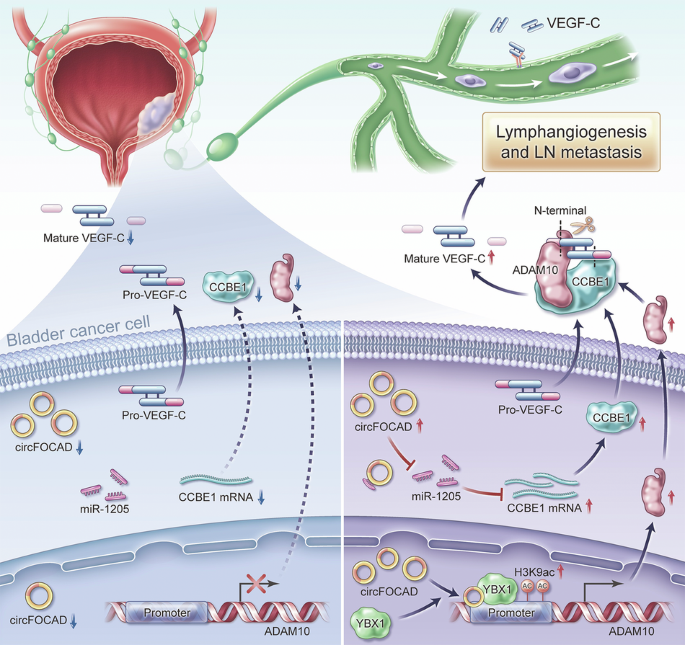
A qRT-PCR analysis showed miR-1205 expression level in a 295-case cohort of BCa tissues and paired NATs. B qRT-PCR for miR-1205 expression in BCa in relation to LN status. C qRT-PCR for the CCBE1 expression in a 295-case cohort of BCa tissues and paired NATs. D qRT-PCR analysis of the CCBE1 expression in LN-positive (n = 55) and LN-negative BCa tissues (n = 240). Representative fluorescence images (E) and correlation analysis of circFOCAD, CCBE1, and VEGF-C (F, G) expression and LYVE1-indicated the number of lymphatic vessels in both intratumoral and peritumoral regions of BCa tissues (n = 295). Scale bars: 50 μm. Kaplan–Meier survival analysis comparing patients with BCa with low versus high CCBE1 levels for OS (H) and DFS (I). The cutoff value was determined based on the median expression of CCBE1. J Schematic illustration for establishing patient derived xenograft (PDX) model. K Statistical analysis of tumor volume in the PDXs. L Representative fluorescence images of CCBE1, ADAM10 and LYVE1 in PDXs tumor tissues. Scale bars: 50 μm. M–P Mature VEGF-C and lymphangiogenic vessel density in PDX tumor tissues. Q Representative MRI images of tumor growth from indicated mice. R Representative images of pelvic LNs from indicated mice (n = 12). Scale bars, 200 μm or 50 μm. S The ratio of LNs metastasis was calculated for all groups (n = 12). T Quantification of metastatic LNs in indicated mice (n = 12). U Schematic illustrating the potential mechanism of circFOCAD on lymphangiogenesis and LN metastasis facilitation in BCa via the miR-1205/YBX1/CCBE1/VEGF-Cs axis. The statistical difference was assessed through the nonparametric Mann–Whitney U test in (A–D); and the χ2 test in (F, G); and the one-way ANOVA analyses followed by Dunnett’s tests in (K, T, M–P). The data are presented as the mean ± SD of three independent experiments. **p < 0.01. H&E hematoxylin and eosin.
Given the critical role of the circFOCAD/CCBE1/ADAM10/VEGF-C axis in promoting LN metastasis in BCa, we established patient-derived xenograft (PDX) models using high circFOCAD-expressing LN-metastatic BCa tissues to assess the therapeutic effect of inhibiting this axis (Fig. 7J). When PDX tumors reached 200 mm³, mice were randomly assigned to four groups and received intratumoral injections of neutralizing antibodies αCCBE1 or αADAM10. Compared to control treatments, αCCBE1 or αADAM10 treatments significantly suppressed tumor growth in PDX models (Fig. 7K). Moreover, inhibition of CCBE1 or ADAM10 significantly reduced mature VEGF-C expression and LYVE1-indicated lymphatic vessel numbers per mm2 of PDX tumor section, while having little effect on ADAM10 expression (Fig. 7L–P and S6R, S). To better evaluate the efficacy of blocking the axis of circFOCAD/CCBE1/ADAM10/VEGF-C in LN metastasis of BCa, we further developed an orthotopic BCa nude mouse model by injecting circFOCAD-overexpressing UM-UC-3 cells. We used Magnetic Resonance Imaging (MRI) to monitor metastatic pelvic LNs and revealed that both αCCBE1 and αADAM10 treatments significantly decreased the number of circFOCAD-elicited BCa-metastatic LNs and the ratio of LN-metastatic mice bearing bladder tumors, as measured by HE and IHC assays (Fig. 7Q–T). Collectively, these results demonstrate that silencing the circFOCAD/CCBE1/ADAM10/VEGF-C axis inhibits BCa lymphangiogenesis (Fig. 7U), suggesting that targeting this axis could be a potential treatment for LN-metastatic BCa.
