


In this phase II study, total neoadjuvant chemotherapy combined with a PD‑1 antibody and IL‑2 for mid–low LARC achieved a pCR rate of 42.4% and demonstrated favorable safety. This represents the first exploration of combining a traditional immunogenic antitumor agent with an ICI in the neoadjuvant treatment of MSS/pMMR type mid–low LARC. Moreover, the treatment regimen incorporated both a “subtraction” (omitting radiotherapy) and an “addition” (combining ICIs with IL‑2) approach to evaluate the efficacy and safety of this novel strategy in LARC.
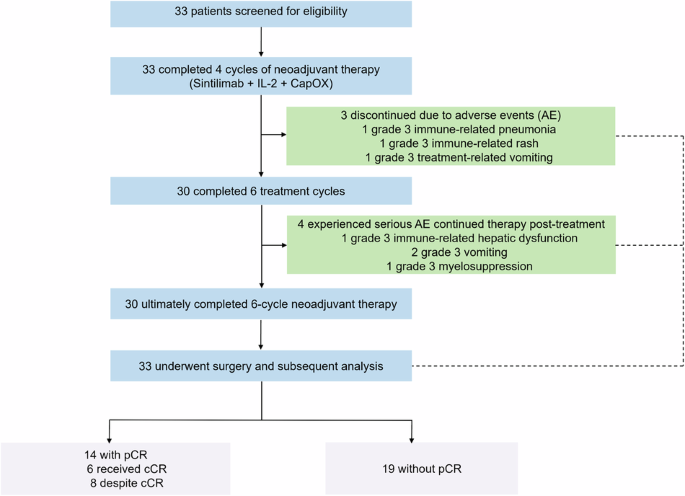
A total of 33 patients were enrolled in this study, and no patients were excluded during the screening phase. Given the single-arm design and strict enrollment criteria, only patients confirmed to have MSS/pMMR mid–low LARC, with definitive histopathological diagnosis were included. During treatment, three patients did not complete the full six cycles of neoadjuvant therapy as protocol-specified; however, they all underwent subsequent surgical resection and achieved postoperative pathological results consistent with partial response. These patients were therefore retained in the final analysis without exclusion.
Currently, in MSS/pMMR mid–low LARC, reports have shown that PD‑1 antibody monotherapy is ineffective. Although combining chemoradiotherapy (either long‑ or short‑course) with synchronous or sequential PD‑1 therapy benefits some patients—with most studies using pCR as the primary endpoint and a few using the neoadjuvant rectal (NAR) score—the pCR rate in existing single‑arm studies ranges from 30% to 40%,18,19,20 and randomized controlled studies have reported rates between approximately 31.9% and 44.8%.21,22,23,24,25 Compared with these studies, the 42.4% pCR rate reported here is higher, suggesting that even without radiotherapy, the combination of a PD‑1 antibody with IL‑2 can yield significant clinical efficacy. However, further large‑sample, randomized controlled studies are necessary.
Furthermore, when comparing neoadjuvant chemotherapy alone, previous studies using the FOLFOX regimen (6 cycles) in LARC achieved a pCR rate of 21.9%. There is a paucity of reports on total neoadjuvant chemotherapy using the CapOX regimen, which may differ significantly from neoadjuvant chemoradiotherapy regarding treatment cycles. In addition, the French PRODIGE 23 multicenter randomized controlled trial demonstrated that, in patients with cT3 or cT4 M0 rectal cancer, administering six cycles of neoadjuvant FOLFIRINOX chemotherapy before preoperative chemoradiotherapy significantly improved treatment outcomes. Compared with preoperative chemoradiotherapy alone, this approach markedly increased disease-free survival and reduced neurotoxicity. In addition, TNT regimens incorporating chemoradiotherapy have improved pCR rates from the historical 15–20% to approximately 27–28%, as reported in landmark trials such as RAPIDO and PRODIGE 23 studies.26,27 Nevertheless, even within the TNT paradigm, the combination of chemotherapy and radiotherapy appears to have reached a plateau in terms of pCR achievement.26 In this study, the combination of the CapOX regimen with a PD‑1 antibody and IL‑2 raised the pCR rate to 42.4%, further confirming the synergistic effect of PD‑1 antibody and IL‑2. Although omitting radiotherapy raised concerns about local recurrence, the PROSPECT study13 provided sufficient confidence that, after omitting radiotherapy, a lower local recurrence rate could be achieved compared with the chemoradiotherapy group.
Regarding the combined use of IL‑2 and ICIs, although no reports have yet addressed this combination in LARC, the potential synergy between IL‑2 and PD‑1 has attracted considerable attention. Recently, a phase I clinical study of IBI363—a bispecific antibody fusion protein with a PD‑1/IL‑2α bias-in MSS/pMMR metastatic rectal cancer achieved an objective response rate of 13.6%,28 indirectly supporting the potential value of combining a PD‑1 antibody with IL‑2. In addition, dosing of IL‑2 has been a concern in the early phase of this study. Previous high‑dose regimens—administered either intravenously or subcutaneously—used a dose of 720,000 IU/kg per administration every 8 h, for up to 15 doses per cycle.29 In this study, a commercially available recombinant IL‑2 injection was used. In previous clinical antitumor treatments, we administered subcutaneous IL-2 concurrently with chemotherapy. Monitoring patients’ immune cell distributions revealed that after IL-2 injection, peripheral blood levels of CD8+ T cells, NK cells, and M1 macrophages showed a certain degree of increase. The evidence level for inferring whether the tumor has transitioned from a “cold” to a “hot” state based on peripheral blood mononuclear cell (PBMC) analysis is limited. Therefore, we also performed multiplex immunofluorescence staining on preoperative endoscopic biopsy tissues from patients to further evaluate the immunomodulatory sensitization effect of PD-1 antibody in combination with IL-2. This finding serves as one of the indirect evidence supporting the IL-2 regimen used in our current study. To ensure an effective blood concentration and avoid excessive toxicity, the dosing followed the antitumor treatment recommendations in the product label rather than the high‑dose regimens used in melanoma or metastatic renal cancer. Although this dose did not reach the high concentrations reported in previous studies, it was relatively higher than low‑dose regimens (72,000 IU/kg per administration).
Regarding postoperative treatment strategies, because non-randomized allocation may introduce confounding, postoperative management in this study was determined based on MDT consensus and patient preference. We acknowledge that the non-randomized nature of postoperative strategy (observation vs. continued treatment) precludes causal inference regarding recurrence outcomes—a key limitation inherent to single-arm trials. Nevertheless, although such postoperative management may introduce confounding effects on long-term outcomes such as overall survival (OS) or disease-free survival (DFS), the primary endpoint of this study—pCR rate—has already been achieved. Moreover, all patients achieved R0 resection according to postoperative pathology, which meets current guideline recommendations. The use of adjuvant radiotherapy in selected cases was intended to further reduce the risk of local recurrence. Importantly, this does not imply failure of radiation-sparing strategies; rather, in the majority of patients, we successfully avoided preoperative radiotherapy, thereby reducing radiation-related toxicities. Furthermore, adjuvant radiotherapy, when used as a salvage intervention, can effectively lower the risk of postoperative local recurrence. In future large-scale randomized controlled trials, we plan to further investigate salvage radiotherapy strategies tailored to postoperative pathological findings. We hope that the treatment paradigm established in this exploratory study—including the use of postoperative adjuvant radiotherapy—will ultimately yield favorable OS and DFS outcomes.
The study also revealed a clear discrepancy between the pCR rate and the cCR rate. In particular, 8 patients still showed significant tumor mass on imaging and endoscopy prior to surgery despite postoperative histopathology confirming no residual tumor cells. This observation offers new perspectives on preoperative cCR assessment criteria. Similar findings have been reported in studies such as NRG‑GI002.21 Because the primary endpoint of this study was pCR, all patients underwent radical resection rather than adopting a watch‑and‑wait strategy—even though one patient underwent the Miles procedure, with explicit informed consent obtained prior to enrollment. The discrepancy between cCR and pCR is not attributable to heterogeneity between preoperative imaging and postoperative pathological diagnosis. Rather, it primarily stems from the fact that many patients who achieved pCR still exhibited residual masses on preoperative imaging or endoscopic evaluation, despite negative tumor findings in endoscopic biopsies. Notably, the study protocol did not define a “near-cCR” endpoint. Consequently, all patients with visible residual masses proceeded to surgical resection, resulting in a lower number of cCR cases and a relatively higher pCR rate. In our ongoing randomized controlled trial (RCT), we have now integrated a response-adapted treatment algorithm: patients achieving cCR will enter a watch-and-wait program with maintenance immunotherapy, This approach aims to maximize functional outcomes while maintaining oncologic safety.
Omitting radiotherapy (“subtraction”) reduced its long‑term adverse effects on the intestine, bladder, and sexual function. Moreover, while surgery is typically scheduled 6–8 weeks after neoadjuvant chemoradiotherapy, the total neoadjuvant chemotherapy combined with PD‑1 + IL‑2 strategy shortened the interval from the last treatment to surgery. This reduction may help prevent tumor progression during the waiting period and lessen the risk of increased fibrosis, as the absence of radiotherapy decreases edema and fibrosis in the surgical area. Moreover, the CR rate of 42.4% under the premise of omitting radiotherapy still approaches the upper limit reported in previous studies, further supporting the advantages of this regimen. Regarding surgical quality, although 3 patients underwent the Miles procedure due to tumors located <2 cm from the anal verge, sphincter preservation was achieved in all other cases. No anastomotic leakage occurred—likely owing to the absence of additional radiation‑induced intestinal injury—even though 3 patients underwent prophylactic terminal ileostomy; postoperative imaging did not reveal any anastomotic leakage. With respect to drug‑related AEs, no treatment‑related deaths occurred among any patients in the PICS trial. Moreover, while severe (grade 3–4) treatment‑related AEs in neoadjuvant chemoradiotherapy combined or sequential with PD‑1 therapy have been reported at rates of 36%–48.2%, this study observed a rate of 21.2%. The overall AE incidence was 93.9%, which may be attributable to the 6 consecutive cycles of the CapOX regimen combined with IL‑2.
Limitations of the study include: (1) it is a small‑sample, open‑label, single‑arm phase II study with a relatively short follow‑up period; thus, although a high pCR rate was achieved, whether this translates into long‑term survival benefits requires longer follow‑up and more comprehensive evaluation; (2) radiotherapy is critical in preventing local recurrence in rectal cancer—especially in patients with high‑risk features—and although the PROSPECT study has provided evidence that total neoadjuvant chemotherapy can improve DFS, it remains to be determined whether the CapOX regimen used here can achieve outcomes comparable to the FOLFOX regimen; and (3) as a non‑randomized, open‑label trial, the study cannot be considered confirmatory, and further research is needed before these results can be generalized to a broader population of low rectal cancer patients; (4) Patient-reported outcomes (PROs) or quality of life (QOL) data were not incorporated in this study. However, based on the observed AE profile, low-grade vomiting (CTCAE Grade 1/2) occurred in patients (median duration: 1 day), predominantly within 24 h after chemotherapy. All episodes were managed with ondansetron and did not lead to treatment interruption. The symptom burden was clinically manageable. Although Grade 1/2 vomiting is commonly associated with oxaliplatin-based regimens, the addition of sintilimab and IL-2 in this regimen did not appear to significantly increase symptomatic burden. In future multicenter randomized controlled trials, PRO and QOL data will be prospectively collected and reported in greater detail; (5) this study was also limited by the high surgical expertise at the study center and the investigational IL-2 dosing regimen. However, the pCR endpoint is pathology-defined and therefore less susceptible to variability in surgical technique. The subcutaneous IL-2 regimen was intentionally designed to be safe and easily administrable to facilitate future multicenter implementation. Prior to broad clinical adoption, validation of this regimen in more diverse populations and healthcare settings will be necessary.
In summary, this study provides preliminary and encouraging results for patients with MSS/pMMR type LARC through the combination of total neoadjuvant chemotherapy with a PD‑1 antibody and IL‑2. The observed pCR rate of 42.4% represents a hypothesis-generating signal suggesting potential superiority over conventional therapy, which requires confirmation in future randomized controlled trials to establish clinical benefit. Besides, we also exhibited a controllable safety profile with no grade 4 or 5 AEs or treatment‑related deaths. Moreover, the innovative omission of radiotherapy reduced long‑term adverse effects on the intestine, bladder, and sexual function, and the shorter interval from the last treatment to surgery may contribute to a lower incidence of postoperative complications.
