


TopBP1cKO mice exhibited rapid tumor growth due to impaired anti-tumor immunity
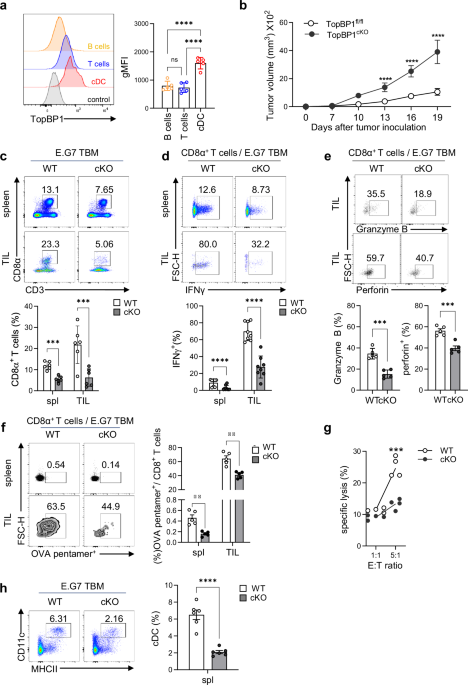
Although TopBP1 is essential for V(D)J recombination and development of T and B cells19, its expression level was significantly higher in cDCs than in T and B cells (Fig. 1a). TopBP1 expression was further confirmed at the mRNA level during the in vitro generation of Flt3L-mediated BM-derived DCs (FL-BMDCs) (Supplementary Fig. 1a). We generated DC-specific TopBP1-depleted (TopBP1cKO; CD11c-cre × TopBP1fl/fl) mice (Supplementary Fig. 1b) and examined tumor growth. TopBP1cKO tumor-bearing mice (TBM) exhibited notably faster tumor progression (Fig. 1b) and splenomegaly (Supplementary Fig. 1c) compared with littermate control (TopBP1fl/fl WT) TBM. The population (Fig. 1c) and number (Supplementary Fig. 1d) of CD8α+ T cells were significantly reduced in the spleen and TILs of TopBP1cKO TBM compared with WT TBM. Effector CD8+ T cells, secreting IFNγ (Fig. 1d), perforin and granzyme B (Fig. 1e), were also markedly decreased in the TILs of TopBP1cKO TBM. In addition, the population of OVA-specific CD8+ T cells, critical for anti-tumor immunity against OVA-expressing E.G7 tumors, was significantly lower in both the spleen and TILs of TopBP1cKO mice (Fig. 1f). CTL responses in TILs were also impaired in TopBP1cKO TBM (Fig. 1g). Furthermore, the frequency and number of CD4+ T cells (Supplementary Fig. 1e) and IFNγ+CD4+ T cells in the spleen, inguinal LN and TILs (Supplementary Fig. 1f) were significantly reduced in TopBP1cKO TBM. By contrast, NK cell populations remained unaffected in the spleen and inguinal LN but were instead increased in the TILs of TopBP1cKO TBM (Supplementary Fig. 1g). In further analysis of the reduction of effector T cells in TopBP1cKO mice, we found no differences in T cell development in the thymus between WT and TopBP1cKO mice (Supplementary Fig. 2a), and the total number of thymic CD3⁺ T cells was also comparable between the two groups (Supplementary Fig. 2b). In addition, the frequency of apoptotic CD8α⁺ and CD4⁺ T cells in the spleen showed no differences between the two groups (Supplementary Fig. 2c). These results suggest that the reduced numbers of effector T cells observed in TopBP1cKO TBMs are not due to defects in T cell development or increased apoptosis but are probably a secondary effect of altered cDC population. Supporting this, the cDC population in the spleen was significantly reduced in TopBP1cKO TBM compared with WT TBM (Fig. 1h). Overall, these findings suggest that the rapid tumor growth in TopBP1cKO mice results from impaired anti-tumor immunity due to defects in TopBP1-mediated cDC development.
Fig. 1: Rapid tumor growth in TopBP1cKO mice due to impaired anti-tumor immunity.The alternative text for this image may have been generated using AI.
a Expression levels of TopBP1 in B cells, T cells and cDCs. b E.G7 tumor growth in WT and TopBP1cKO mice. n = 8 per group. c CD8+T cells in the spleens and TILs of E.G7-TBM. n = 6 per group. d IFNγ+ effector CD8+ T cells in TILs of E.G7-TBM. n = 8 per group. e Granzyme B- and perforin-expressing CD8+ T cells in TILs of WT and TopBP1cKO E.G7-TBM. n = 5 per group. f OVA-specific CD8α⁺ T cells in the spleens and TILs of WT and TopBP1cKO E.G7-TBM. n = 5 per group. g CTL activity in the TILs of WT and TopBP1cKO E.G7-TBM. n = 4 per group. h The frequency of total cDCs in the spleens of WT and TopBP1cKO E.G7-TBM. n = 6 per group. An unpaired one-way ANOVA with Tukey’s multiple comparisons test was used for a two-way ANOVA with Turkey’s multiple comparisons test was used for b–d and f–g), and an unpaired t-test with Welch’s correction was used were used for statistical analysis in e and h. **P < 0.01, ***P < 0.001, ****P < 0.0001; the error bars indicate mean ± s.e.m.
Reduced cDC levels in lymphoid and nonlymphoid organs of TopBP1cKO mice
We examined the DC population at a steady state based on the gating strategy illustrated in Supplementary Fig. 3a. Intriguingly, the population of cDCs was significantly reduced in TopBP1cKO mice compared with WT littermates in lymphoid organs (spleen and mesenteric LN) and nonlymphoid (lung, liver and kidney) organs (Fig. 2a). Compared with WT controls, the t-distributed stochastic neighbor embedding (t-SNE) plots of TopBP1cKO splenocytes showed a clear decrease in cells expressing CD11c and MHCII (Fig. 2b). Consistent with the results in TopBP1cKO mice, cDC (CD11c+MHCII+) populations were significantly reduced in in vitro-generated TopBP1cKO FL-BMDCs compared with that in WT FL-BMDCs (Fig. 2c). In further subset analysis, the numbers of both XCR1+CD11b− cDC1s and XCR1−CD11b+ cDC2s were also significantly reduced in TopBP1cKO mice (Fig. 2d). However, the population and number of pDCs remained unchanged in both lymphoid and nonlymphoid organs in both TopBP1cKO and WT mice (Fig. 2e). These results suggest that TopBP1 plays a crucial role in cDC development but is little involved in pDC development.
Fig. 2: Conditional depletion of TopBP1 leads to cDC deficiency in mice.The alternative text for this image may have been generated using AI.
a Total cDCs in lymphoid organs (spleen and LN) and nonlymphoid organs (lung, liver and kidney) of WT and TopBP1cKO mice at a steady state. n = 6 per group. b t-SNE plot of cytometry analysis of live immune cells in the spleens and lungs of WT and TopBP1cKO mice at a steady state. (gated on FVD−Lin−BST2−CD45+) c cDC populations on day 5 of Flt3L (50 ng/ml)-BMDC generation in WT and TopBP1cKO mice. n = 3 per group. d cDC subsets in the spleens and lungs of WT and TopBP1cKO mice. n = 5 per group. e pDCs in lymphoid organs and nonlymphoid organs of WT and TopBP1cKO mice at a steady state. n = 6 per group. Unpaired multiple t-tests for a, d and e and unpaired t-test with Welch’s correction for c were used for statistics. **P < 0.01, ***P < 0.001, ****P < 0.0001; ns not significant, the error bars indicate mean ± s.e.m.
TopBP1 is intrinsically required for the differentiation of pre-DCs into cDCs
We considered three possible reasons for the reduction of cDCs in TopBP1cKO mice: (1) impairment of cDC differentiation, (2) impairment of pre-DC/cDC proliferation and/or (3) cDC apoptosis increased in TopBP1cKO mice due to accumulation of DNA damages. Normally, pre-DCs (Lin−BST2−CD117−/intMHCII−CD11c+CD115−CD135+) express TopBP1 at levels comparable to those observed in cDCs (Fig. 3a). In TopBP1cKO mice, pre-DCs accumulated significantly in the BM and other organs compared with WT mice (Fig. 3b). It is well known that pre-DCs comprise pre-cDC1s (SiglecH−Ly6C−) and pre-cDC2s (SiglecH−Ly6C+) and then differentiate into cDC1 and cDC2 subsets, respectively56. Analysis of pre-DC subsets revealed no significant differences in the population of pre-cDC1 and pre-cDC2 between WT and TopBP1cKO mice (Supplementary Fig. 3b). These results imply that TopBP1 is probably involved in the differentiation of pre-DCs into cDCs, regardless of final fate. Proliferation capacity was assessed based on the expression of the proliferation marker Ki-67 and BrdU incorporation. Although the proportion of Ki-67⁺ cells in BM pre-DCs was comparable between WT and TopBP1cKO mice (Supplementary Fig. 4a), the proportions of Ki-67⁺ cells in splenic cDC1s, cDC2s and pDCs were increased in TopBP1cKO mice compared with WT (Supplementary Fig. 4b). To validate this result more precisely, we analyzed BrdU incorporation, which revealed a significant increase in BrdU⁺ cells in both BM and splenic pre-DCs and cDCs of TopBP1cKO mice compared with WT controls (Supplementary Fig. 4c). In addition, there was no significant difference in pre-DC apoptosis rates in the BM and spleen (Supplementary Fig. 5a) or in cDC subsets in the spleen and lungs (Supplementary Fig. 5b) between WT and TopBP1cKO mice. DNA damage analysis by staining with γH2AX, a DNA damage marker, showed no significant difference in the extent of DNA damage accumulation between WT and TopBP1cKO mice in BM-derived pre-DCs (Supplementary Fig. 6a), whereas in pre-DC subsets, there was a trend toward even further reduction in DNA damage accumulation in the TopBP1cKO mice (Supplementary Fig. 6b). In addition, no clear difference in DNA damage accumulation was observed between WT and TopBP1cKO mice in the cDC subsets (Supplementary Fig. 6c). Overall, our findings suggest that the significant reduction in the cDC population observed in TopBP1cKO mice is primarily due to an impaired differentiation process from pre-DCs to cDCs rather than reduced cDC proliferation capacity, increased DNA damage accumulation or increased cDC apoptosis during cDC development in TopBP1cKO mice.
Fig. 3: TopBP1 is an intrinsic factor required for pre-DC differentiation into cDCs.The alternative text for this image may have been generated using AI.
a Expression levels of TopBP1 in pre-DCs and cDCs were compared with that of T cells as a positive control in the spleens of WT mice. n = 3 per group. b Populations of pre-DCs in the spleens, BM and lungs of WT and TopBP1cKO mice at a steady state. n = 5 per group. c, Total BM cells of WT (CD45.1+) and TopBP1cKO (CD45.2+) mice were mixed at a 1:1 ratio and injected intravenous (i.v.) into recipient WT (CD45.1+2+) mice. After 7 days, cDCs and pre-DCs differentiated from donor BM cells were assessed. n = 4 per group. d Pre-DCs sorted from the BM of WT (CD45.1+2+) and TopBP1cKO (CD45.2+) mice were mixed at a 1:1 ratio and injected i.v. into recipient WT (CD45.1+) mice. After 5 days, cDCs differentiated from donor pre-DCs were assessed in the spleen and lung. n = 3 per group, with ten mice used per replicate. e Pre-DCs sorted from the BM of WT (CD45.1+2+) and TopBP1cKO (CD45.2+) mice were cultured with CD45.1+ feeder cells (50 ng/ml Flt3L-BMDC, d5). After 4 days, cDCs differentiated from donor pre-DCs were assessed. n = 4 per group, with five mice used per replicate. f Pre-DCs sorted from the BM of WT (CD45.1+2+) and TopBP1cKO (CD45.2+) mice were mixed at a 1:1 ratio and injected i.v. into recipient WT (CD45.1+) mice. After 2 days, MHCII expression levels in donor cells were assessed in the spleen of recipient mice. n = 3 per group, with six mice used per replicate. Unpaired one-way ANOVA with Tukey’s multiple comparisons test for a two-way ANOVA with Tukey’s multiple comparisons test for b–d unpaired t-test with Welch’s correction for e and two-way ANOVA with Bonferroni for multiple comparisons for f were used to measure significance. *P < 0.05, **P < 0.01, ***P < 0.001, ****P < 0.0001, ns not significant, the error bars indicate mean ± s.e.m.
Next, to determine whether TopBP1 is an intrinsic or extrinsic factor in cDC development, WT (CD45.1+) and TopBP1cKO (CD45.2+) BM cells were mixed at a 1:1 ratio and adoptively transferred into WT(CD45.1+CD45.2+) recipient mice. The cDC population derived from TopBP1cKO BM cells was significantly reduced compared with that derived from WT BM cells, whereas the pre-DC population derived from TopBP1cKO BM cells was increased (Fig. 3c). Furthermore, in the adoptive transfer of pre-DC mixtures obtained from the BM of WT (CD45.1+2+) and TopBP1cKO (CD45.2+) mice into WT (CD45.1+) recipient mice, the population of cDCs derived from TopBP1cKO pre-DCs was substantially lower than that derived from WT pre-DCs (Fig. 3d). When the pre-DCs sorted from the BM of WT and TopBP1cKO mice were cultured in the presence of feeder cells (FL-BMDCs on day 5), the cDC population derived from TopBP1cKO pre-DCs was also markedly reduced compared with cDCs derived from WT pre-DCs (Fig. 3e). These data suggest that TopBP1 is an intrinsic factor in the differentiation of pre-DCs into cDCs. Another interesting observation is that 2 days after adoptive transfer of pre-DCs, the MHCII+ population among cDCs was markedly reduced in TopBP1cKO pre-DC-derived cells compared with WT pre-DC-derived cells (Fig. 3f). This implies that TopBP1 is involved in the transition from MHCII− to MHCII+ during cDC differentiation. This observation is further delineated in the Discussion.
Flt3L-based tumor immunotherapy was not effective in TopBP1cKO TBM due to impairment of cDC1 development
Flt3L is a growth factor widely used in tumor immunotherapy to increase immune cells25. It was recently reported that Flt3L amplifies small amounts of EPs (CD11c+CD117+) in the BM and then promotes further differentiation of amplified EPs into cDC1s26, inducing anti-tumor immunity. Consistent with a previous report, the EP population dramatically increased in the BM of Flt3L-expressing B16F10 melanoma TBM compared with B16F10 TBM or GM-CSF-expressing B16F10 TBM (Supplementary Fig. 7a). When pre-DCs and EPs obtained from the BM of control and Flt3L-injected mice, respectively, were mix-cultured with feeder cells, cDC1s were more efficiently differentiated from Flt3L-derived EPs than from pre-DCs (Supplementary Fig. 7b).
To determine whether the reduced anti-tumor immunity in TopBP1cKO TBM could be restored by Flt3L immunotherapy, Flt3L was administered intraperitoneally (i.p.) daily to E.G7-TBM. In WT TBM, Flt3L immunotherapy effectively inhibited tumor growth, but this suppression was absent in TopBP1cKO TBM, mirroring the observations in cDC1-deficient Batf3KO TBM (Fig. 4a). Flt3L administration resulted in a significant increase in the population and number of cDCs in WT TBM; however, this marked enhancement was not observed in TopBP1cKO and Batf3KO TBM (Fig. 4b). As expected, the majority population among the expanded cDCs in the spleen of Flt3L-injected WT TBM was cDC1s, whereas in TopBP1cKO TBM, the cDC1 population remained unchanged, with only a marginal increase in cell numbers even after Flt3L administration (Fig. 4c). Moreover, antigen-specific CTL responses were not effectively induced in TopBP1cKO TBM compared with WT TBM (Supplementary Fig. 7c). However, there was no significant difference in the populations of total EPs in the BM and spleen between WT and TopBP1cKO TBM receiving Flt3L immunotherapy (Fig. 4d). Further analysis of total EPs based on MHCII expression revealed a significant reduction in the MHCII+ population and a notable accumulation of the MHCII− population in TopBP1cKO TBM compared with WT TBM (Fig. 4e). This observation is also delineated in the Discussion. MHCII− EPs were sorted from the spleens of Flt3L-injected WT (CD45.1+) or TopBP1cKO (CD45.2+) mice and cultured in the presence of feeder cells (CD45.1+2+) to induce differentiation, as illustrated in Fig. 4f. MHCII− EPs from TopBP1cKO failed to properly differentiate into cDC1s compared with those from WT MHCII− EPs (Fig. 4f). These results indicate that the inefficient tumor suppression by Flt3L immunotherapy in TopBP1cKO TBM is probably due to an impairment in the differentiation process from EPs into cDC1s. By contrast, ratio of the splenic cDC2 populations between WT and TopBP1cKO mice showed no clear difference at a steady state. However, in Flt3L-treated E.G7-TBMs, WT mice exhibited a marked increase in the cDC1 population, resulting in a relatively reduced proportion of cDC2s. In TopBP1cKO mice, cDC1 differentiation was severely impaired, leading to a relatively increased proportion of cDC2s (Supplementary Fig. 7d, left). These results suggest that the cDC2 population in TBMs is not substantially affected by Flt3L-treatment, regardless of TopBP1 status. However, the absolute cell number of splenic cDC2 was substantially reduced in TopBP1cKO mice compared with WT mice in both PBS- and FL-treated groups (Supplementary Fig. 7d, right), suggesting that TopBP1 is also essential for cDC2 development.
Fig. 4: Flt3L-based tumor immunotherapy was not effective in TopBP1cKO TBM due to impairment of cDC1 development.The alternative text for this image may have been generated using AI.
a Tumor growth was monitored in WT, TopBP1cKO and Batf3KO E.G7-TBM treated with Flt3L as a tumor immunotherapy. Recombinant Flt3L (3 µg) was administered i.p. daily from day 9 to day 18 after tumor injection. n = 8 per group. b Analysis of cDCs on day 16 in the spleens of WT, TopBP1cKO and Batf3KO E.G7-TBM treated with Flt3L. n = 5 per group. c, Analysis of cDC1 subset on day 16 in the spleens of WT and TopBP1cKO E.G7-TBM treated with Flt3L. n = 5 per group. d Total EPs (CD117+CD11c+) were assessed in the BM and spleens of WT, TopBP1cKO and Batf3KO E.G7-TBM treated with Flt3L. n = 10 per group. e MHCII+ population in the splenic EPs of Flt3L-treated WT and TopBP1cKO E.G7-TBM. n = 9 per group. f MHCII- EPs were sorted from WT (CD45.1+) and TopBP1cKO (CD45.2+) BM cells cultured for 2 days with Flt3L (50 ng/ml) and then further cultured with FL-BMDCs (day 4) as feeder cells (CD45.1+2+). Four days later, the population of cDC1s differentiated from MHCII− EPs were assessed. n = 4 per group. Unpaired two-way ANOVA with Tukey for multiple comparisons for a–e and an unpaired t-test with Welch’s correction for f were used to measure significance. **P < 0.01, ***P < 0.001, ****P < 0.0001, ns not significant, the error bars indicate mean ± s.e.m.
TopBP1 plays a crucial role in the differentiation process from XCR1−CD24+ EPs to XCR1+CD24+cDC1s in Flt3L-mediated cDC1 development
The population of cDCs within EPs was significantly reduced in TopBP1cKO Flt3L-TBM compared with WT Flt3L-TBM (Supplementary Fig. 7e). Since EPs are defined based solely on the expression of CD11c and CD117 (c-kit), they constitute a heterogeneous population encompassing both DC progenitors and fully differentiated cDCs26. To determine at which stage the differentiation from EPs to cDCs is impaired in TopBP1cKO mice, we analyzed splenic EPs from Flt3L-injected mice using XCR1 and CD24, which are established surface markers for cDC1s57. Within the splenic EPs of WT Flt3L-TBM, the cDC gate was further examined for cDC1 markers, revealing three distinct populations: XCR1−CD24−, XCR1−CD24+ and XCR1+CD24+ (cDC1). Given the lower expression levels of MHCII and CD11c in the XCR1⁻CD24⁺ population, we hypothesized that this subset serves as a precursor to XCR1⁺CD24⁺ cDC1s (Fig. 5a). Although the total EP populations were comparable between WT and TopBP1cKO TBM injected with Flt3L (Fig. 4d), a notable finding was the significant increase in the XCR1⁻CD24⁺ population, accompanied by a marked decrease in the XCR1⁺CD24⁺cDC1 population in the splenic EPs of TopBP1cKO TBM compared with those of WT TBM (Fig. 5b). This accumulation of XCR1−CD24+ cDC1 precursors was similarly observed in tumor-free TopBP1cKO mice injected with Flt3L (Fig. 5c). Similarly, in FL-BMDCs generated in vitro, the XCR1-CD24+ population accumulated, whereas the fully differentiated XCR1+CD24+ cDC1 population was significantly reduced in TopBP1cKO FL-BMDCs compared with WT FL-BMDCs (Fig. 5d). Batf3KO mice, in which differentiation into cDC1s is blocked, were used as a control. Differentiation into XCR1⁻CD24⁺EP cells in TopBP1cKO mice was comparable to that observed in Batf3KO mice (Fig. 5d). To determine whether XCR1⁺CD24⁺ cDC1s differentiate from XCR1⁻CD24⁺ EPs, XCR1⁻CD24⁺ EPs were sorted from the spleens of Flt3L-injected mice and cultured with feeder cells. The generation of XCR1+CD24+ cDC1s was markedly reduced in cultures derived from TopBP1cKO EPs compared with those from WT EPs (Fig. 5e). Consistent with these results, when XCR1−CD24+ EPs sorted from the FL-BMDCs were cultured with feeder cells (CD45.1+), the development of XCR1+CD24+ cDC1s was also dramatically reduced in TopBP1cKO EPs—similar to what was observed in Batf3KO mice—compared with WT EPs (Fig. 5f). Overall, these results indicate that TopBP1 plays a crucial role in the differentiation of XCR1−CD24+EPs into XCR1+CD24+ cDC1s. Meanwhile, XCR1−CD24− cells, probably corresponding to cDC2s, represented a minor population among the EPs (Fig. 5a), and MHCII+ population within these cells was also significantly reduced in TopBP1cKO EPs compared with WT EPs (Supplementary Fig. 8a). Even when further cultured with feeder cells, these XCR1−CD24− WT EPs did not express XCR1 within the DC gate (Supplementary Fig. 8b).
Fig. 5: TopBP1 is essential for differentiation of XCR1-CD24+ EPs to XCR1+CD24+ cDC1s.The alternative text for this image may have been generated using AI.
a The cDC gate in the splenic EPs of Flt3L-treated WT TBM was further examined for the expression of cDC1 markers, CD24 and XCR1, and the three distinct populations were re-plotted based on MHCII and CD11c expression levels. b Splenic EPs from the Flt3L-treated WT and TopBP1cKO TBM were analyzed based on the expression of XCR1 and CD24. n = 5 per group. c Splenic EPs from WT and TopBP1cKO mice treated with Flt3L-Ig on day 0 and day 3 were analyzed on day 9 based on the expression of XCR1 and CD24. n = 5 per group. d Total EPs of WT, TopBP1cKO and Batf3KO mice were further examined based on the expression levels of XCR1 and CD24, which are cDC1 markers, during the FL-BMDC cultures on day 3 and 5. n = 3 per group. e XCR1−CD24+ EPs were sorted on day 9 from total splenic EPs of WT (CD45.1+2+) and TopBP1cKO (CD45.2+) mice treated with Flt3L-Ig on day 0 and day 3, and equal numbers of these EPs were cultured with CD45.1+ feeder cells (FL-BMDCs on day 5). Four days later, the population of cDC1s differentiated from XCR1−CD24+ EPs was assessed. n = 4 per group. f XCR1−CD24+ EPs were sorted from FL-BMDC cultures on day 5 of WT (CD45.1+2+), TopBP1cKO (CD45.2+) and Batf3KO (CD45.2+) mice, respectively. Equal numbers of sorted cells were cultured with CD45.1+ feeder cells (FL-BMDCs on day 5). After 5 days, the population of XCR1−CD24+EPs and XCR1+CD24+ cDC1s differentiated from the cultures were assessed. n = 4 per group. Unpaired t-test with Welch’s correction for b, c and e unpaired two-way ANOVA with Tukey for post-test for d and unpaired one-way ANOVA with Tukey for post-test for f were used to measure significance. *P < 0.05, **P < 0.01, ***P < 0.001, ****P < 0.0001; ns not significant; the error bars indicate mean ± s.e.m.
Reduced expression of DC-related TF target genes in the pre-DCs and EPs of TopBP1cKO mice
As TopBP1cKO mice showed only cDC deficiency without affecting the differentiation of pDCs, we investigated the expression of zbtb46, a key TF for the development of cDCs58, in the pre-DC and cDCs of TopBP1cKO mice. However, the zbtb46 expression was not affected by TopBP1 depletion in pre-DCs/cDCs or in EPs in the BM and spleens of WT and TopBP1cKO mice (Supplementary Fig. 9a). We further examined the expression of well-established TFs involved in cDC differentiation using qRT–PCR in pre-DCs isolated from the BM of WT and TopBP1cKO mice. Most TFs did not show any significant reduction in expression in the pre-DCs of TopBP1cKO mice; however, some TFs, including Batf3, IRF4 and Notch2, exhibited increased expression in TopBP1cKO pre-DCs compared with WT pre-DCs (Supplementary Fig. 9b). Moreover, XCR1−CD24+ splenic EPs showed no differences in the expression of DC-related TFs between Flt3L-injected WT and TopBP1cKO mice (Supplementary Fig. 9c). These results suggest that TopBP1 may contribute to cDC development through mechanisms other than direct regulation of DC-related TF expression during cDC differentiation. For further analysis, we performed bulk RNA -seq transcriptomic analysis on CD24+ splenic EPs from WT and TopBP1cKO mice. Consistently, there was no significant difference in the expression of DC-related major TFs in the CD24+ EPs between Flt3L-injected WT and TopBP1cKO mice (Fig. 6a). By contrast, genes whose expression was reduced by more than 50% in TopBP1cKO EPs compared with WT EPs were predominantly associated with protein binding in molecular functions and transcription regulation by RNA polymerase II in biological processes (Fig. 6b). It is well established that TopBP1 functions as a scaffold protein, indirectly binding to DNA through protein–protein interactions59,60. Based on this, we evaluated the expression of TF target genes curated from the TRRUST database and Ma’ayan Laboratory resources and found that the target genes regulated by PU.1 (Spi1), IRF8 and IRF4 were substantially downregulated (fold change <0.5, false discovery rate (FDR) <0.05) in TopBP1cKO EPs. (Fig. 6c). Intriguingly, more than half of the IRF8 and IRF4 target genes downregulated in TopBP1cKO EPs overlapped with the PU.1 target genes (Fig. 6c). Heat map analysis (fold change <0.1, FDR <0.05) revealed that the expression levels of PU.1/IRF8/IRF4 target genes were significantly reduced in TopBP1cKO EPs compared with WT EPs, and most of the IRF4 and IRF8 target genes downregulated in TopBP1cKO EPs overlapped with those of PU.1 (Fig. 6d). Taken together, our results suggest that TopBP1 plays a crucial role in cDC development by regulating the target gene expression of DC-related TFs, such as PU.1, IRF4 and IRF8, rather than by directly controlling the expression of the TFs themselves.
Fig. 6: Depletion of TopBP1 in cDCs leads to reduced expression of target genes regulated by PU.1, IRF8 and IRF4.The alternative text for this image may have been generated using AI.
a The relative expression levels of key TFs involved in cDC differentiation were assessed basis on bulk RNA-seq transcriptomics of CD24+ splenic EPs collected on day 9 from WT and TopBP1cKO mice injected i.p. with Flt3L-Ig on day 0 and day 3. An unpaired t-test was used to measure significance. ns, not significant; the error bars indicate mean ± s.e.m. b The −log10 P values of pathways enriched in the DAVID-based gene ontology analysis of downregulated genes (fold change < 0.5, P value <0.05) from the transcriptomics of CD24+ splenic EPs in TopBP1cKO mice compared with those of WT mice. c The Venn diagram shows the numbers of PU.1, IRF8 and IRF4 target genes downregulated (fold change <0.5, FDR <0.05) in CD24+ splenic EPs of TopBP1cKO mice compared with those of WT mice with the bulk RNA-seq transcriptomic data described in a. The number of genes in each category is indicated. d A heat map showing the relative expression of genes identified as targets of PU.1, IRF8 and IRF4, which are reduced to 0.1-fold or less (FDR <0.05) in TopBP1cKO EPs compared with WT EPs based on transcriptomics.
TopBP1 directly interacts with PU.1–IRF8 heterodimeric complex to facilitate transcription of their target genes during cDC development
As TopBP1 does not regulate the expression of DC-specific TFs during DC differentiation, we hypothesized that it may instead interact with these TFs. TopBP1 interact with Miz-146, which has been reported to associate with IRF8 and PU.1 to induce Nramp1 expression in a hematopoietic cell line47. Given these previous findings, we investigated whether TopBP1 interacts with PU.1 and IRF8 via Miz-1 during DC development. To investigate whether TopBP1 interacts with PU.1, IRF8 and/or IRF4 to induce target gene expression, leading to cDC development, we performed ChIP-seq analysis on CD24+ splenic EPs of FL-injected WT mice. In CD24⁺ EP cells, 42 target genes were identified through anti-TopBP1 antibody ChIP-seq analysis, a number smaller than expected, probably due to limited sample availability. Among these 42 genes, we analyzed PU.1, IRF8 and IRF4-regulated target genes using the Harmonizome database provided by the Ma’ayan Laboratory. Through the analysis, we identified a total of 17 genes, including 9 PU.1-specific target genes, 4 PU.1/IRF8-shared target genes, 2 PU.1/IRF4–shared target genes and 2 IRF4-specific target genes (Fig. 7a). H3K4me is widely recognized as an activating histone modification, and all 17 of these genes were detected in anti-H3K4me antibody ChIP-seq datasets (Fig. 7a). Subsequent qRT–PCR analysis confirmed a significant reduction in the expression of PU.1-specific target genes (Ch25h, Bambi, Tdrd3 and Mllt3) and PU.1/IRF4-shared target gene (Nek1) in the XCR1−CD24+ splenic EPs of TopBP1cKO mice compared with WT mice (Fig. 7b). Biological functions of these target genes remain to be elucidated in relation to cDC1 development. Intriguingly, although the protein levels of IRF8 in both pre-DCs and splenic EPs (cDC1 and XCR1−CD24+ EPs) were even higher in TopBP1cKO mice than in WT mice (Supplementary Fig. 9d), cDC1s were still deficient in TopBP1cKO mice (Figs. 2d and 4c), suggesting that TopBP1 is essential for IRF8-mediated cDC1 differentiation. Next, we performed co-immunoprecipitation (Co-IP) assays and found that TopBP1 directly interacts with both PU.1 and IRF8 but shows weak interaction with IRF4 and no detectable interaction with Miz-1 in WT CD24+ splenic EPs from Flt3L-injected mice and in in vitro-generated FL-BMDCs (Fig. 7c). These interactions were further assessed in steady-state splenic CD11c⁺ cells and revealed normal interactions not only with PU.1 and IRF8 but also with IRF4 under steady-state conditions (Supplementary Fig. 10). Confocal microscopy further revealed strong overlapping fluorescence signals of TopBP1 with PU.1 and IRF8, whereas only weak overlap was observed with IRF4, in WT FL-injected splenic CD11c⁺ cells (Fig. 7d). In a correlation analysis with the Coloc 2 plugin in the Fiji program, TopBP1 showed a strong correlation with PU.1 (r = 0.84 ± 0.05) and IRF8 (r = 0.76 ± 0.09), whereas its colocalization with IRF4 was significantly lower (r = 0.11 ± 0.07) in FL-injected WT splenic CD11c⁺ cells (Fig. 7e). Taken together, these results suggest that TopBP1 does not interact with Miz-1 but instead strongly interacts with PU.1 and IRF8 and weakly interacts with IRF4 in the splenic DCs of FL-injected mice, probably reflecting the Flt3L-injected condition, which favors cDC1 differentiation and reduces IRF4⁺ cDC2 abundance. To further assess whether these interactions observed in mice are conserved in humans, we transfected HEK293 cells with human-derived TopBP1, PU.1, IRF8, IRF4 and Miz-1 expression vectors. The Co-IP assay revealed that human TopBP1 also interacts with human PU.1 and IRF8 (Fig. 7f) as well as IRF4 (Supplementary Fig. 11a) but not with Miz-1 (Supplementary Fig. 11b), suggesting a potential role for these interactions in human cDC development. PU.1 and IRF8 are known to form a heterodimeric complex that co-binds to specific target genes, thereby regulating inflammatory responses, antimicrobial immunity, anti-tumor immunity and cell differentiation61. In our mRNA-seq analysis, approximately 80% of IRF8 target genes were found to overlap with PU.1 target genes (Fig. 6c, d), promoting us to investigate whether TopBP1 is directly involved in the formation of the PU.1–IRF8 heterodimeric complex. However, ectopic expression experiments demonstrated that PU.1 and IRF8 can form a complex even in the absence of TopBP1 (Fig. 7g), suggesting that TopBP1 is not essential for the formation of the PU.1–IRF8 heterodimeric complex but is probably required for their function in regulating the transcription of target genes. On the other hand, IRF8 has been reported to suppress neutrophil (NP) differentiation, thereby acting as a key regulator of the developmental balance between DCs and NPs62. Given that cDC differentiation is severely impaired in TopBP1cKO mice, we examined whether NP differentiation is concomitantly enhanced under TopBP1-depleted conditions. We first examined the expression of TopBP1 and CD11c in splenic NPs. TopBP1 was highly expressed in splenic NPs (Supplementary Fig. 12a), and approximately 35% of NPs displayed intermediate levels of CD11c expression (Supplementary Fig. 12b). We also assessed splenic NP populations in TopBP1cKO mice and observed a substantial increase in NPs compared with WT mice (Supplementary Fig. 12c). These findings suggest that the expansion of the splenic NP population in CD11c-specific TopBP1cKO mice may result from impaired IRF8-mediated suppression of NP differentiation due to TopBP1 depletion. Further study remains to elucidate the role of TopBP1 in IRF8-mediated NP suppression, as it lies beyond the scope of the present study.
Fig. 7: TopBP1 drives cDC development via interaction with both PU.1 and IRF8.The alternative text for this image may have been generated using AI.
a ChIP-seq analysis on CD24+ splenic EPs, collected on day 9 from WT mice injected with Flt3L-Ig on days 0 and 3, using anti-TopBP1 and H3K4me antibodies. Normalized ChIP-seq binding tracks are shown for the genes identified, with differential TopBP1 binding regions marked by red arrows. b mRNA expression levels of the target genes, identified by ChIP-seq analysis in a were examined by qRT–PCR in XCR1−CD24+ splenic EPs of WT and TopBP1cKO mice. c Co-IP analysis of PU.1 and IRF8 using an anti-TopBP1 antibody on CD24+ splenic EPs from WT mice injected with Flt3L-Ig (left) and on FL-BMDCs (right), followed by immunoblot (IB) analysis with appropriate antibodies. d Confocal imaging of total CD11c+ cells enriched from the splenocytes of WT mice injected with Flt3L-Ig, following staining with fluorescence-labeled antibodies against TopBP1, PU.1, IRF8 and IRF4. Hoechst serves as a DNA stain. e Colocalization of TopBP1 with PU.1, IRF8 or IRF4 was quantified using the Coloc 2 plugin in Fiji program. Pearson’s correlation coefficients (below threshold) were calculated from 20 individual cells (regions of interest, ROIs) per group. Statistical analysis was performed using one-way ANOVA followed by Tukey’s multiple comparison test (**P < 0.01, ****P < 0.0001). The error bars represent mean ± s.d. f Co-IP analysis of PU.1 and IRF8 with TopBP1 using an anti-TopBP1 antibody in HEK293 cells co-transfected with plasmids expressing human PU.1, IRF8 and TopBP1. g Co-IP analysis of PU.1 and IRF8 in HEK293 cells co-transfected with plasmids expressing mouse PU.1, IRF8 and either with or without TopBP1, using anti-PU.1 antibodies.
Collectively, our findings demonstrate that interactions between TopBP1 and the PU.1–IRF8 heterodimeric complex are critical for cDC development, particularly for the differentiation of cDC1s during Flt3L-based immunotherapy.
