


The discovery and elucidation of the ubiquitin-proteasome system (UPS [1, 2]) spanned a long period. It started with the discovery of the enzymatic cascade of conjugation of ubiquitin (Ub) to target substrates and their subsequent degradation by the proteasome. It then moved to the development of drugs that target the system and has expanded recently by the development of targeted protein degradation (TPD [3, 4]). All along, the UPS was found to be tightly linked to cancer pathogenesis and therapeutics. Taking a global approach as described in two research articles in this issue, González-Robles et al. describe the clinical proteogenomic landscape of the UPS in cancer [5, 6]. Thirty-five years ago, it was shown that oncoproteins are degraded by the UPS [7]. This was followed by the understanding that “degrons”, amino acid residues/sequences present in certain proto-oncoproteins and other short-lived proteins, mediate their recognition by E3 ubiquitin ligases and are frequently mutated in cancer [8, 9]. Subsequently, Scheffner et al. identified E6-AP as the first cancer-related E3. E6-AP catalyzes the ubiquitylation and subsequent proteasomal degradation of p53 in HPV infected cells [10]. Remarkably, this degradation is mediated by the virus-encoded E6 protein that serves as a “natural” proteolysis-targeting chimera, a PROTAC-like compound, that physically connect TP53 to E6-AP. Similarly, MDM2 was identified as the E3 ligase that regulates the steady state of TP53. However, in multiple cancers, when MDM2 is in excess, it becomes an oncoprotein by mediating the uncontrolled degradation of p53 [11, 12].
Over the years, extensive experimental studies established that cancer development involves the degradation of tumor suppressors or the stabilization of oncoproteins. The latter is mediated either by silencing their degradation machinery or by active ubiquitin-dependent stabilization [13]. In addition, Ub- and Ub-like (UbLs)-related enzymes were shown to regulate multiple non-proteolytic functions linked to the ‘canonical’ hallmarks of cancer including oncogenic signaling, genomic instability, epigenetic regulation of gene expression, and nuclear organization [14]. However, a comprehensive clinical landscape of the Ub/UbL pathways in cancer has been largely missing. The emergence of patient-derived clinical proteogenomic resources has enabled researchers to comprehensively profile the pathways in cancer, thereby opening new venues for the discovery of related targets for cancer diagnosis, therapeutics and TPD.
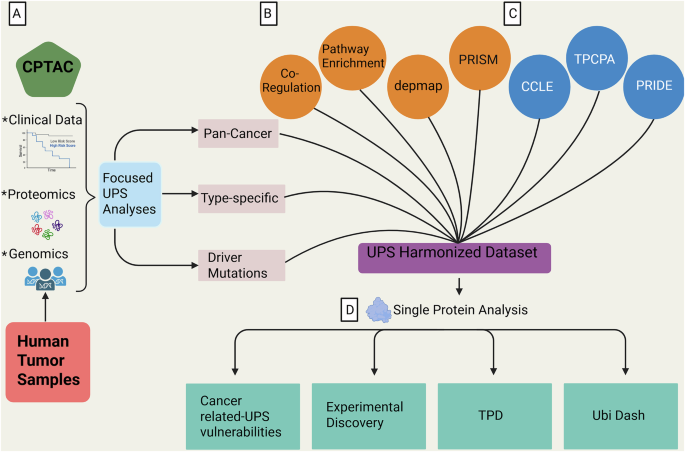
Toward this end, González-Robles et al. used data derived from the Clinical Proteomic Tumor Analysis Consortium (CPTAC), an NCI-coordinated collaborative effort for the understanding of the molecular basis of cancer via large-scale clinical proteome and genome analyses (proteogenomics), that also include clinical records [Fig. 1 [5]], https://dctd.cancer.gov/research/networks/cptac. First, CPTAC cohorts were analyzed for paired comparison of mRNA and protein abundance using adjacent non-tumor tissue as reference in up to eleven tumor entities and twenty tissues. For glioblastoma (GBM) non-tumorigenic adjacent samples could not be obtained for an obvious reason. These comparisons identified 1025 (562 unique) UPS genes, and 503 (295 unique) E3 ligases that were significantly dysregulated. Remarkably, while some UPS genes showed concordance between mRNA and protein abundance, a large number of transcription factors, signaling molecules and UPS genes did not show a correlation between protein abundance and mRNA levels, that in some cases even displayed an opposite relationship. Thus suggesting that these proteins are regulated post-translationally across multiple cancers. Overall, these analyses identified dysregulation of multiple UPS genes across diverse cancers (“pan-cancer”) as well as cancer type-specific ones (“lineage-specific”). Mathematical algorithms and statistical tests strongly suggest that this dysregulation is selective and not random. The clinical relevance of these findings was evaluated by correlating the proteogenomic data with patients’ survival records. It unveiled 153 E3s, whose protein levels were significantly associated with overall patient survival. Some such as FBXL18 and FBXL3, predicted pan-cancer survival that are associated with either poorer or better survival, respectively. Many E3s exhibited prognostic value in a tumor-specific manner that is unique to a cancer type. In some cases, reciprocal impact on survival was observed for the same E3 ligase depending on the tumor entity (e.g., TRIM28).
Fig. 1: Schematic diagram of the UPS proteogenomic project.The alternative text for this image may have been generated using AI.
A Initial proteogenomic analysis of the UPS in cancer using CPTAC data of patient-derived tumor samples combined with clinical data across multiple cancers. CPTAC analyses established both global and type-specific tumors’ views and unveiled the impact of cancer-driving mutations on re-shaping the UPS. B Advanced analysis of CPTAC data using co-regulation and proteomic pathway enrichment analyses, genetic editing-based dependency (DepMap) and drug sensitivity (PRISM) [5]. C Generation of harmonized comprehensive UPS analysis with the combination of the above data along with normal and tumor protein atlas (TPCPA), patient- derived immortalized cells lines (CCLE), and analysis of post-mortem tissues (PRIDE). D The harmonized UPS compendium will be valuable for identifying UPS vulnerabilities, expand experimental research of the USP biology in caner, discover additional E3 ligases for TPD and oncogenic UPS enzymes for diagnostic and potential therapeutics. The harmonized data is available to the community via the Ubi/Dash website [6]. Created in https://BioRender.com.
Previously, the power of cancer-driving genes to reshape the UPS was elegantly demonstrated in the case of c-Myc in the context of Burkitt’s lymphoma [15]. More than two decades later and taking a global approach, screening UPS protein quantitative trait loci (pQTLs) revealed widespread mutation-associated with proteomic restructuring and affecting all levels of UPS in the patients’ samples. The ability of cancer-driving mutations to reshape the UPS was studied in detail in tumors harboring p53 point mutations. Along with low expression of TP53 target genes such as FBXO22, the authors observed an increase in E3s that are required for coping with genomic instability (e.g., CDT2 and CDC20). In addition, in multiple tumor entities, well-established tumor suppressor E3s, such as VHL and FBXW7, were recurrently mutated. This analysis also highlighted the potential importance of less-studied E3s in cancer. For example, RNF213 is an atypical RING E3 that was recently identified in a comprehensive E3-omic compendium to be localized to centrosomes and is one of the most mutated and amplified Ub-ligase [16]. It is also mutated in Moyamoya, a rare disease of progressive cerebral angiopathy [17].
The authors extended their study by comparing the CPTAC data to using four additional resources; (i) UPS co-regulation and (ii) proteome-wide pathway enrichment, (iii) lineage-specific genetic editing-based co-dependency (DepMap, https://depmap.org/portal/), and (iv) drug-sensitivity analyses [PRISM; see also Fig. 1 [6]]. An example of one striking observation was the upregulation of the HECT-type E3 UBR5 in seven cancer entities that correlated with poor prognosis. Pathway analysis of “high UBR5” tumors revealed that the gene signature of these cancers was enriched for DNA damage response (DDR) and AKT-driven pathways, suggesting that UBR5 enables cancer cells to cope with genomic instability that is likely accelerated in TP53-mutated tumors. Indeed, DepMap analysis demonstrated co-dependency on DNA damage-, chromatin- and ubiquitin-related regulators for UBR5. In accordance, drug sensitivity analysis (PRISM, https://www.theprismlab.org) showed that these tumors were highly sensitive to compounds targeting DDR, such as ATR and ChK1 inhibitors. Thus, UBR5 is an example of the impact of TP53 mutation-driven tumors on proteostasis networks in multiple cancers.
Using a similar approach, TRIM28 was shown to mold the proteome but in a context/lineage-specific manner and independent of tumor-driving mutation(s). “High TRIM28” tumors exhibit high expression of c-Myc- and E2F-dependent genes. In addition, context-specific pathway analysis points to upregulation of mitochondrial gene signatures and downregulation of EMT programs, selectively in head and neck carcinoma (HNSCCHigh TRIM28) but not in brain tumor glioblastoma multiforme (GBMHigh TRIM28). In each tumor, TRIM28 had distinct co-dependencies such as with KRAB-zinc finger transcription factors, RNA regulatory proteins and increased sensitivity to specific compounds unique to HNSCC. The prognosis of “High TRIM28” tumors is also context dependent: it is poor in HNSCC but favorable in GBM.
One area of expanding research is the field of targeted protein degradation (TPD), either by “Molecular glues” or Proteolysis Targeting Chimeras (PROTACs) with several compounds in clinical use and many more in clinical trials [3, 4, 18]. In TPD, the proteasomal degradation of a protein of interest (POI) is forced by a small molecule that brings it to molecular proximity with an E3 “recruiter” that is present and active in the relevant cell, resulting in the ubiquitylation and subsequent degradation of the POI. To date, the number of E3 “recruiters” is small. Expanding the variety and increasing tumor specificity of potential E3-recruiters with cancer and tissue specificity, is a current challenge. In addition, oncogenic E3s can be excellent targets for diagnosis and inhibition of cancer. As a first step for identifying of such E3s, the second paper compiled muti datasets for UPS profiling [6]. To construct a harmonized dataset, additional resources were used: (i) PRIDE – the post-mortem data base of normal tissues; (ii) TPCPA – a compendium of tumors and metastases of normal and healthy tissues; and (iii) CCLE – an immortalized cancer patient-derived cell line resource. This exploration identified multiple potential relevant E3s enriched in cancerous but not in similar normal tissues. One example FBXL18 that was enriched in brain and head and neck tumors. The anti-apoptotic E3 XIAP was enriched in heamatological tumors, soft tissues, skin, and lung cancers, as well as in different metastases, but not in adjacent or normal tissues. Likewise, KHLH7 was enriched specifically in female reproductive tumors. It also identified E3s associated with context-specific poor-prognosis cancers such as the ligase LTN1 in lung-adenocarcinoma (LUAD). This E3-focused analysis is complementary to a recent study portraying the landscape of the E3-ome integrating AlphaFold-based structure comparisons, intracellular localization and linkage to human diseases [16]. Finally, to enable community exploration of the UPS, González-Robles et al. developed UbiDash, which is open to the public and enables proteogenomic visualization in cancer [(http://ruggleslab.shinyapps.io/UbiDash/) [6]].
Collectively, these papers portray the proteogenomic landscape of the UPS and UbL pathways in cancer. They will serve as a resource for experimental basic and translational interrogation of these pathways that may lead to discovery of fundamental aspects of ubiquitin biology in cancer and their subsequent translational applications. While the resource focuses mainly on proteostasis, modification by Ub and UbL pathways regulate multiple non-degradative processes and modification of non-protein substrates. Thus, having the proteogenomic roadmap will be of great value for understanding these processes in cancer as well.
