


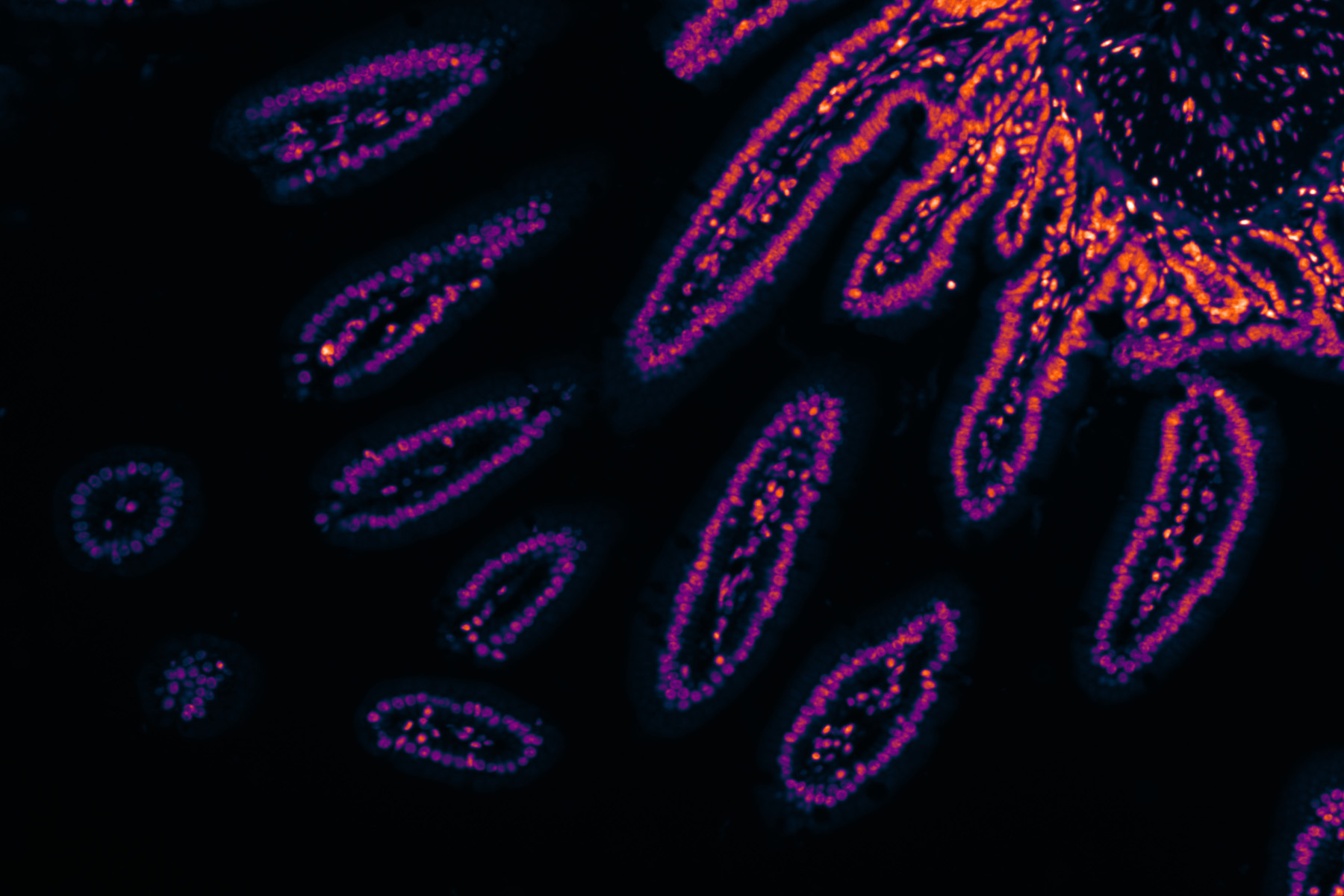
Most images of our DNA show it as a long, twisted ladder. But inside our cells, it looks more like tightly wound balls of yarn. Thousands of proteins coil our DNA into bundles so it can squeeze into the tiny space in the centre of our cells.
And these bundles do more than just organise our DNA. They also work like genetic gatekeepers. Chemical marks can tell them to unravel or wind up DNA to turn specific genes, or instructions, on or off. This helps our body create many kinds of cells, with different forms and functions, from identical strands of DNA.
These marks are known as epigenetic modifications. Though we inherit some from our parents, most are acquired throughout our lifetime from many different factors. Often, they can help cells remember what they’ve been through and adapt their behaviour.
For PROSPECT’s researchers, who are specifically investigating bowel cancer in under-50s, these marks are particularly interesting.
That’s because, although cancer is caused by changes, or mutations, to a cell’s DNA, these alone don’t always lead to cancer. By understanding if a cell’s chemical marks and memories are also playing a role, the team hopes to get closer to finding out why more younger adults are now developing bowel cancer.
“We want to understand how exposures and experiences throughout a lifetime influence the risk of cancer,” explains Dr Surya Nagaraja, a key researcher on the study from Harvard University in the US.
“There’s growing evidence that things like inflammation can be connected to cancer even when they don’t change DNA, so we wanted to understand if they act through epigenetic mechanisms.”
Uncovering the ‘marks’ of inflammation
To create a mouse model for their study, the researchers used a chemical to mirror the effects of chronic colitis. Afterwards, they looked for changes in the mice’s bowel cells.
Through the microscope, the bowel cells looked normal; but their DNA told another story. It had picked up a distinct set of chemical marks, some of which had gathered around genes targeted by a protein called Activator Protein 1 (AP-1).
AP-1 is a special type of protein known as a transcription factor. Its job is to control when cells read and use genes involved in healing and regeneration.
With each round of inflammation, the cells added more marks to their DNA, making it easier for AP-1 to access these genes. That way, the next time inflammation returned, the cells could turn them on more readily to heal faster.
What really surprised researchers was how long these marks lasted. Most bowel cells are replaced frequently, so these memories should have disappeared soon after the inflammation ended. But after 100 days, the researchers were still finding cells with these marks.
When they investigated further, they found that inflammation had even affected the DNA of cells in the deepest layer of the bowel: colonic stem cells. These long-lived cells continuously create new cells to help maintain the lining of the bowel. They were copying their epigenetic marks into each new cell they produced, keeping the memory of inflammation alive.
