


EHMT2 expression is associated with 5-FU resistance and poor prognosis in colorectal cancer
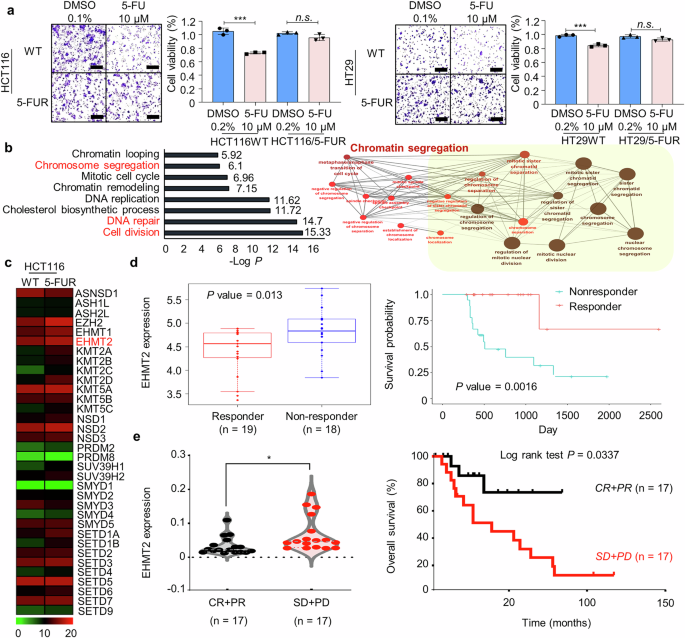
5-Fluorouracil (5-FU) is a representative chemotherapeutic agent that is used to treat colorectal cancer (CRC), but after repeated administration, cancer cells acquire resistance, decreasing its effectiveness. To investigate the mechanisms underlying 5-FU resistance (5-FUR) in CRC, we established two 5-FUR cell lines, namely, the HCT116/5-FUR and HT29/5-FUR cell lines. Using crystal violet (CV) staining and a cell counting kit-8 (CCK) assay, compared with wild-type (WT) cells, only minimal growth inhibition was observed in 5-FUR cells following 5-FU treatment (Fig. 1a and Supplementary Fig. 1a). In addition, IC50 assays confirmed increased resistance to 5-FU, as shown by higher IC50 values in 5-FUR cells than in WT cells (Supplementary Fig. 1b). Furthermore, 5-FU treatment increased caspase 3/7 activity and cleaved PARP levels in WT cells but not in 5-FU-resistant cells (Supplementary Fig. 1c–e). Collectively, these results confirm the successful establishment of 5-FUR cell lines. To elucidate the precise mechanism underlying the development of 5-FU resistance in CRC cells, RNA sequencing (RNA-seq) was performed on 5-FU-resistant cells. After 5-FUR cells were compared with WT cells, Gene Ontology (GO) term analysis was conducted on the basis of the RNA-seq results (Fig. 1b). Interestingly, GO terms such as “chromatin segregation”, “chromatin remodeling”, and “chromatin looping” were more significantly enriched in 5-FUR cells than in WT cells. Chromatin segregation refers to the precise distribution of chromatin (DNA and associated proteins) into daughter cells during cell division19. Disruptions in this process can lead to genomic instability, aneuploidy, and cancer progression. Various chromatin-related genes are involved in chromatin segregation or chromatin remodeling. Among these genes, histone methyltransferases (HMTs) play critical roles in maintaining chromatin structure and function through histone methylation, which regulates gene expression, chromatin condensation, and segregation during mitosis. Thus, we proposed that chromatin modifications mediated by HMTs may contribute to the development of 5-FU resistance through changes in chromatin segregation dynamics. To identify HMTs that are potentially involved in the development of 5-FU resistance, we compared the RNA-seq profiles of WT and 5-FUR HCT116 cells. This analysis revealed that EHMT2 expression was significantly upregulated in 5-FUR cells (Fig. 1c and Supplementary Fig. 2a). EHMT2 has been identified as a key regulator of CRC growth in previous studies20,21. This finding was validated at both the gene and protein levels, confirming that EHMT2 expression was increased in 5-FUR cells (Supplementary Fig. 2b, c). Using data from The Cancer Genome Atlas (TCGA) database, we found that increased EHMT2 expression was correlated with reduced survival in CRC patients (Supplementary Fig. 2d). Moreover, compared with that in normal tissues, EHMT2 expression was significantly elevated in CRC tumor tissues, emphasizing its role in tumor progression (Supplementary Fig. 2e). We subsequently investigated the clinical relevance of EHMT2, which was found to be upregulated in CRC tumor tissues. To address this, we analyzed colorectal cancer patient data from the TCGA database, focusing on 37 patients who received 5-FU-based chemotherapy. Analysis of EHMT2 expression revealed that its expression was significantly greater in the 5-FU nonresponder group than in the responder group (p = 0.013) (Fig. 1d). These findings are consistent with our experimental results, in which EHMT2 expression was elevated in 5-FU-resistant cell lines compared to that in 5-FU-sensitive WT cells. Furthermore, prognostic analysis revealed that patients in the 5-FU nonresponder group had a poorer outcome than those in the responder group. These results suggest that increased EHMT2 expression in the nonresponder group is associated with enhanced 5-FU drug resistance, ultimately contributing to the growth of colorectal cancer. To further validate these results, we analyzed EHMT2 expression and prognosis using clinical tissue samples from 5-FU-treated patients obtained from the Human Biobank of Keimyung University School of Medicine. Consistent with the finding in the TCGA dataset, compared with that in the responder group, EHMT2 expression in the nonresponder group (SD and PD; stable disease and progressive disease) was significantly elevated (Fig. 1e). Thus, both TCGA and cohort analyses revealed that EHMT2 expression levels are associated with 5-FU resistance, suggesting that EHMT2 may serve as an important factor driving 5-FU resistance.
Fig. 1The alternative text for this image may have been generated using AI.
EHMT2 is upregulated in 5-fluorouracil-resistant colorectal cancer and correlated with poor patient survival. a Cell viability of both wild-type (WT) and 5-fluorouracil-resistant (5-FUR) CRC cell lines after 5-FU treatment, as assessed by crystal violet (CV) staining and a CCK-8 assay. The data are presented as the means ± SD of three independent experiments. All P values were calculated using Student’s t test (*P < 0.05, **P < 0.01, ***P < 0.001). b Gene Ontology (GO) plots of genes whose expression was upregulated in 5-FUR cells according to the RNA-seq results. Bar graphs (left) show -log P values, and ClueGO graphs (right) highlight mechanisms that are highly correlated across all the pathways. c Heatmap of histone methyltransferase (HMT) expression based on RNA-sequencing (RNA-seq) analysis. The lowest value, which is based on -log P, is classified as 0 (green box), and the highest value is classified as 20 (red box). d Boxplots (left) showing that among CRC patients who received 5-FU treatment, those with progressive disease (PD) have significantly higher EHMT2 expression than complete responders (CR) (P = 0.013). Kaplan‒Meier survival curves (right) demonstrate that the PD group has markedly shorter overall survival than the CR group (P = 0.0016). The data are from The Cancer Genome Atlas Program (TCGA) CRC cohort. e EHMT2 mRNA expression in CRC clinical tissue samples stratified by clinical response to 5‑FU: CR + PR (n = 7) vs. SD + PD (n = 17) (left). Kaplan‒Meier survival curves according to response (CR + PR, n = 17 vs. SD + PD, n = 17); log‑rank P = 0.0337 (right). CR complete response, PR partial response, SD stable disease, PD progressive disease
Next, to determine whether the downregulation of EHMT2 expression in 5-FUR cells contributes to the suppression of their growth, we performed growth assays using siRNA targeting EHMT2 (siEHMT2). We confirmed the knockdown of EHMT2 by siEHMT2 using qRT‒PCR analysis (Supplementary Fig. 3a). CV staining and CCK assays revealed that siEHMT2-mediated EHMT2 knockdown significantly suppressed the growth of both parental WT and 5-FUR CRC cell lines (Supplementary Fig. 3b). Moreover, cotreatment with 5-FU and siEHMT2 followed by CV staining and CCK assays revealed that siEHMT2 inhibited the growth of 5-FUR cells that were resistant to 5-FU alone (Fig. 2a and Supplementary Fig. 3c). Thus, the downregulation of EHMT2 expression not only suppressed resistance but also inhibited cell proliferation, indicating that EHMT2 may serve as a potential therapeutic target for overcoming 5-FU resistance. To further confirm the association between 5-FU resistance and EHMT2, we constructed an EHMT2 overexpression vector. After the HCT116WT and HT29WT cell lines were transfected with the HA-EHMT2 vector, we confirmed the overexpression of HA-EHMT2 (Fig. 2b left) and subsequently performed growth assays following 5-FU treatment. The results demonstrated that compared with control cells, cells overexpressing EHMT2 exhibited increased resistance to 5-FU, as evidenced by elevated IC50 values (Fig. 2b, right and c). Collectively, these findings indicate that EHMT2 plays an important role in the acquisition of 5-FU resistance in WT cells and suggest that EHMT2 may serve as a critical resistance-specific therapeutic target for overcoming 5-FU resistance.
Fig. 2The alternative text for this image may have been generated using AI.
EHMT2 regulates 5-FU resistance and cell proliferation in CRC cells. a Knockdown of EHMT2 suppressed proliferation in both WT and 5-FU cell lines, and cotreatment with 10 µM 5-FU further inhibited the growth of 5-FU cells. Scale bar, 100 µm. b qRT‒PCR analyses confirming EHMT2 overexpression (HA-EHMT2) in HCT116WT and HT29WT cells (left). The data are presented as the means ± SD of three independent experiments. All P values were calculated using Student’s t-test (***P < 0.001). Crystal violet staining revealed that compared with control cells (Mock), EHMT2-overexpressing cells (HA-EHMT2) displayed enhanced resistance to 5-FU across increasing drug concentrations (2.5–40 µM) (right). Scale bar, 100 µm. c Dose‒response curves showing the relative cell viability of HCT116WT and HT29WT cells transfected with Mock or HA-EHMT2 after 24, 48, and 72 h of 5-FU treatment. Compared with the controls, the overexpression of EHMT2 increased the IC50. d RNA-seq analysis following EHMT2 knockdown in WT and 5-FUR HCT116 cells. A total of 1717 commonly upregulated genes were identified (Venn diagram). Gene Ontology (GO) analysis revealed enrichment of apoptosis and cell cycle regulation pathways
EHMT2 downregulation overcomes 5-FU resistance by promoting apoptosis and cell cycle arrest in 5-FU-resistant CRC cells
To examine the function of EHMT2 in 5-FUR cells, RNA-seq analysis was conducted after the HCT116WT and HCT116/5-FUR cell lines were treated with siRNA EHMT2 (siEHMT2). Compared with the control siRNA (siCont), siEHMT2 upregulated 3003 genes in WT cells and 2348 genes in 5-FUR cells, with 1717 genes commonly upregulated in both cell types. GO analysis of 1717 genes revealed that EHMT2 inhibition was associated with biological processes such as “regulation of the cell cycle” and “apoptosis signaling pathway” (Fig. 2d). The regulation of the cell cycle is closely associated with drug resistance22. Additionally, modulation of the cell cycle can influence cellular responses to anticancer agents, thereby contributing to the development of drug resistance23. Thus, we hypothesized that EHMT2 downregulation in 5-FUR cells may be associated with increased apoptosis and changes in cell cycle regulation, ultimately leading to the suppression of 5-FU resistance and the induction of cell death.
To determine whether EHMT2 knockdown induces apoptosis in 5-FUR cell lines, we treated the cells with siEHMT2 and performed flow cytometry analysis using Annexin V staining. Similar to WT cells, we observed an increase in the proportion of apoptotic 5-FUR CRC cells after EHMT2 knockdown (Fig. 3a and Supplementary Fig. 4a). In addition, caspase 3/7 activity assays revealed a consistent increase in caspase 3/7 activity in 5-FUR cells following EHMT2 downregulation (Fig. 3b and Supplementary Fig. 4b). These findings indicated that the suppression of EHMT2 expression in 5-FUR cells led to increased apoptosis, thereby contributing to the inhibition of cell growth. Furthermore, GO term analysis revealed a connection between EHMT2 knockdown and cell cycle regulation in 5-FUR cells. Thus, we analyzed the cell cycle distribution after EHMT2 knockdown via flow cytometry analysis. The results revealed a significant increase in G1 phase arrest in 5-FUR cells following EHMT2 knockdown, suggesting that EHMT2 may contribute to cell cycle progression in 5-FUR cells (Fig. 3c and Supplementary Fig. 4c). Next, Western blotting revealed that EHMT2 knockdown increased the level of cleaved PARP in 5-FUR cells, indicating that apoptosis was activated (Fig. 3d). Furthermore, the expression of p21, which is a cell cycle regulator, also increased following EHMT2 knockdown, and EHMT2 inhibition promoted both apoptosis and cell cycle arrest in the G1 phase. Taken together, these results suggest that the upregulation of EHMT2 expression in 5-FUR cells may contribute to drug resistance through the suppression of p21 expression, leading to increased genomic instability and uncontrolled proliferation. Thus, by reactivating apoptotic pathways and regulating the cell cycle, EHMT2 downregulation is a key target for overcoming 5-FU resistance.
Fig. 3The alternative text for this image may have been generated using AI.
Apoptotic cell death occurred via cell cycle arrest following EHMT2 downregulation in WT and 5-FU-resistant CRC cell lines. a, b Apoptotic cell population (upper) and Caspase-3/7-positive cell population (lower) following treatment with EHMT2 siRNA for 72 h in the WT and 5-FUR CRC cell lines, as analyzed by flow cytometry. The data are presented as the means ± SD of three independent experiments. All P values were calculated using one-way ANOVA (*P < 0.05, ***P < 0.001). c Flow cytometry analysis via propidium iodide (PI) staining was performed after WT and 5-FUR CRC cells were treated with siEHMT2. The data are presented as the means ± SD of three independent experiments. All P values were calculated via one-way ANOVA (*P < 0.05, **P < 0.01, ***P < 0.001). d Western blotting analysis of WT and 5-FUR CRC cells treated with EHMT2 siRNA for 72 h. Analysis was performed with the indicated anti-EHMT2, anti-PARP, and anti-p21 antibodies, and anti-actin (ACTB) served as a loading control
EHMT2 directly represses PPM1B to promote 5-FU resistance in CRC cells
To identify direct targets of EHMT2 in 5-FUR cells, we analyzed gene expression after EHMT2 knockdown in WT and 5-FUR CRC cells. Among the 148 commonly upregulated genes, we identified 16 candidate genes related to drug resistance and cell death that were negatively correlated with EHMT2 expression (Fig. 4a and Supplementary Fig. 5a). Among these candidates, we ultimately selected protein phosphatase 1B (PPM1B) for further study. PPM1B is a protein phosphatase, and its expression is dysregulated in cancer cells. PPM1B can modulate the p21-CDK2 axis to induce cell cycle arrest and apoptosis in cancer cells24. Additionally, in glioma, PPM1B overexpression inhibits tumor growth and promotes sensitivity to temozolomide25. After both the WT and 5-FUR cell lines were treated with siEHMT2, RNA-seq analysis revealed increased PPM1B expression. This upregulation was further confirmed by qRT‒PCR, which revealed that PPM1B expression was significantly elevated in 5-FUR cells following EHMT2 knockdown (Supplementary Fig. 5b). Furthermore, RNA-seq and qRT‒PCR revealed that compared with that in WT cells, the expression of PPM1B was decreased in 5-FUR cells, in which EHMT2 expression was elevated (Supplementary Fig. 5c, d). In addition, immunocytochemical analysis confirmed that PPM1B expression was upregulated in 5-FUR cells following EHMT2 knockdown, suggesting that there is a regulatory relationship between EHMT2 and PPM1B (Supplementary Fig. 6a, b). In the TCGA portal, PPM1B expression was decreased in CRC tumor tissues compared with normal tissues and inversely correlated with EHMT2 expression. Low PPM1B levels were associated with poor CRC prognosis (Fig. 4b). Immunohistochemical analysis further confirmed that the expression of PPM1B was higher in normal tissues than in CRC tissues (Supplementary Fig. 6c). Correlation analysis of the TCGA data revealed a negative correlation between EHMT2 expression and PPM1B expression (Fig. 4c). These findings suggested that increased EHMT2 expression in 5-FUR cells suppressed PPM1B expression, potentially contributing to the acquisition of drug resistance.
Fig. 4The alternative text for this image may have been generated using AI.
EHMT2 suppresses PPM1B expression to promote proliferation and 5-FU resistance in CRC cells. a Genes negatively correlated with EHMT2 expression (left), and those showing altered PPM1B expression following EHMT2 knockdown as confirmed by RNA-seq (right). b PPM1B expression in normal and colon adenocarcinoma samples (left) and its association with increased survival (right) on the basis of TCGA data. The P value for the expression comparison (left) was calculated by the Mann‒Whitney U test (***P < 0.001). The difference in survival (right) was assessed using the log-rank (Mantel‒Cox) test. c Spearman’s rank correlation coefficient of EHMT2 and PPM1B gene expression in CRC patients from the TCGA database. d Crystal violet staining assays showing the proliferation of 5-FU cells transfected with siCont or two independent siRNAs targeting EHMT2#1 and #2, with or without 5-FU treatment (10 µM). Compared with single treatments, knockdown of EHMT2 significantly suppressed cell proliferation, and the combination of siEHMT2 and 5-FU further reduced cell growth. Scale bar, 100 µm
Next, to further determine whether suppression of PPM1B expression contributes to 5-FUR cell growth, we cotreated cells with siEHMT2 and siPPM1B. Western blot analysis verified that siEHMT2 and siPPM1B effectively suppressed the expression of EHMT2 and PPM1B, respectively, and demonstrated that knockdown of EHMT2 resulted in increased PPM1B expression (Supplementary Fig. 6d). The results of the growth assay revealed that the siEHMT2-induced inhibition of 5-FUR cell growth was reversed by siPPM1B (Supplementary Fig. 6e). In addition, siPPM1B reduced the sensitivity of 5-FUR cells to 5-FU even under conditions of 5-FU treatment (Fig. 4d). To further validate these results, we examined whether PPM1B knockdown could promote 5-FU resistance in WT cells. As shown in Fig. 5a, b and Supplementary Fig. 6f, compared with siCont, siPPM1B-mediated knockdown resulted in increased resistance to 5-FU in both cell lines. Collectively, these results support a model in which upregulated EHMT2 expression suppresses PPM1B expression, thereby contributing to the acquisition of 5-FU resistance.
Fig. 5The alternative text for this image may have been generated using AI.
EHMT2 suppresses PPM1B expression via H3K9me2-mediated transcriptional repression. a Crystal violet staining of HCT116WT and HT29WT cells transfected with siCont or siPPM1B and treated with the indicated concentrations of 5-FU. The knockdown of PPM1B enhanced 5-FU resistance, as shown by increased cell growth. Scale bar, 100 µm. b Quantification of relative PPM1B expression after siRNA transfection using qRT‒PCR. The data are presented as the means ± SD of three independent experiments. P values were calculated using Student’s t-test (***P < 0.001). c Chromatin immunoprecipitation (ChIP) sequencing analysis showing enrichment of EHMT2 at the PPM1B promoter region in HCT116/5-FUR cells. siEHMT2 treatment markedly reduced H3K9me2 occupancy at the PPM1B locus. d Design of ChIP‒PCR primers for the PPM1B promoter region downstream of the transcription start site (TSS). Created with BioRender.com. e ChIP‒PCR with an anti-H3K9me2 antibody showing that EHMT2 binds to the PPM1B promoter in HCT116/5-FUR (left) and HT29/5-FUR (right) cells. The data are presented as the means ± SD of three experiments. P values were calculated by one-way ANOVA (***P < 0.001). f ChIP‒PCR analysis with an anti-EHMT2 antibody showing that EHMT2 directly binds to the PPM1B promoter in both WT and 5-FUR HCT116 cells, with stronger enrichment observed in resistant cells. The data are presented as the means ± SD of three experiments. P values were calculated using Student’s t-test (**P < 0.01, *** P < 0.001)
Next, to determine whether PPM1B is a direct target of EHMT2, chromatin immunoprecipitation sequencing (ChIP-seq) and ChIP assays were performed with an anti-H3K9me2 antibody. After EHMT2 was knocked down in 5-FUR cells, the ChIP-seq and ChIP results revealed a significant decrease in H3K9me2 at the PPM1B promoter region. These findings suggest that PPM1B is a direct target of EHMT2 (Fig. 5c–e). Moreover, ChIP assays using an anti-EHMT2 antibody in both WT and 5-FUR HCT116 cell lines demonstrated increased EHMT2 binding at the PPM1B promoter region in 5-FUR cell lines (Fig. 5f). Together, these results suggest that the direct suppression of PPM1B expression by EHMT2 contributes to the acquisition of 5-FU resistance in CRC cells. These findings indicate that regulation of the EHMT2-PPM1B axis is a crucial repressive mechanism underlying the inhibition of 5-FUR cell growth.
PPM1B mediates the EHMT2-dependent regulation of G1 arrest and apoptosis in 5-FU-resistant CRC cells
To investigate whether PPM1B, which is a direct target of EHMT2, regulates cell cycle progression and apoptosis in 5-FUR cell lines, we performed a flow cytometry analysis. The results revealed that the increase in apoptosis induced by EHMT2 knockdown was significantly inhibited by PPM1B coknockdown (Supplementary Fig. 7a). Similarly, caspase-3/7 activity was measured by flow cytometry analysis, and the results revealed that the increase in caspase-3/7 activity following EHMT2 knockdown was attenuated by PPM1B coknockdown (Supplementary Fig. 7b). Furthermore, cell cycle analysis demonstrated that while EHMT2 knockdown induced G1 phase arrest, this effect was reversed by coknockdown of PPM1B (Supplementary Fig. 7c). Together, these results indicate that PPM1B, which is a direct target of EHMT2, plays a critical role in regulating both cell cycle arrest and apoptosis in 5-FUR cells. In addition, Western blotting analysis further demonstrated that the increase in cleaved PARP levels induced by EHMT2 knockdown in 5-FUR cells was attenuated by PPM1B knockdown (Supplementary Fig. 7d), suggesting that PPM1B plays a role in regulating apoptosis. Zhu et al. reported that PPM1B knockdown led to a reduction in CDK2 phosphorylation, resulting in cell cycle arrest and growth inhibition 24.
Consistently, our Western blotting results revealed that EHMT2 knockdown reduced CDK2 phosphorylation, whereas PPM1B knockdown restored CDK2 phosphorylation. These findings suggest that EHMT2 overexpression contributes to 5-FU resistance through the suppression of PPM1B, thereby maintaining CDK2 phosphorylation and promoting cell proliferation.
BIX01294 suppresses EHMT2 activity and restores PPM1B expression in 5-FU-resistant CRC cells
BIX01294 (BIX) is a selective small-molecule inhibitor of EHMT2, and treatment with this inhibitor decreases its enzymatic activity21. To verify the effects of BIX on 5-FUR CRC cells, we performed CV and CCK analyses following treatment with 5 µM BIX. The results showed that BIX significantly suppressed the proliferation of 5-FUR cells (Fig. 6a). Next, to determine whether the inhibition of EHMT2 enzymatic activity by BIX affects PPM1B expression, we treated 5-FUR cells with BIX and analyzed changes in PPM1B expression levels. Both qRT‒PCR and Western blotting revealed that PPM1B expression was upregulated following BIX treatment (Fig. 6b, c). In addition, immunocytochemical analysis revealed increased PPM1B signal intensity in 5-FUR cell lines following treatment with BIX (Fig. 6d). To further investigate the epigenetic regulation of PPM1B expression, we performed a ChIP assay in which the PPM1B promoter region was targeted in cells that were treated with BIX. Similar to EHMT2 knockdown, BIX treatment reduced the level of H3K9me2 in the PPM1B promoter (Fig. 6e). These findings confirmed that inhibition of EHMT2 enzymatic activity directly reversed the transcriptional repression of PPM1B expression, indicating a direct regulatory relationship between EHMT2 and PPM1B in 5-FUR cell lines.
Fig. 6The alternative text for this image may have been generated using AI.
The EHMT2 inhibitor BIX01294 induced cell cycle arrest by regulating PPM1B through EHMT2 in 5-FUR CRC cell lines. a Growth of 5-FUR CRC cells after treatment with BIX01294 (BIX) for 72 h. Cells were stained with CV (left) or analyzed via a CCK-8 assay (right). Cell growth was measured with a microplate reader (450 nm). Scale bar, 100 μm. The data are presented as the means ± SD of three experiments. P values were calculated using Student’s t-test (***p < 0.001). b qRT‒PCR analysis of PPM1B expression after BIX treatment. The data are presented as the means ± SD of three experiments. P values were calculated using Student’s t-test (**P < 0.01). c Western blotting analysis with anti-PPM1B and anti-ACTB antibodies after BIX treatment. d Nuclear and cytoplasmic localization of PPM1B after BIX treatment in 5-FUR CRC cells. Scale bar, 75 μm. e ChIP‒PCR with an anti-H3K9me2 antibody showing that EHMT2 binds to the PPM1B promoter in HCT116/5-FUR (left) and HT29/5-FUR (right) cells. The data are presented as the means ± SD of three experiments. P values were calculated using Student’s t-test (*P < 0.05, **P < 0.01)
Next, we examined whether BIX treatment regulated cell cycle progression and apoptosis in 5-FUR cell lines. Flow cytometry analysis revealed that BIX treatment increased the number of apoptotic cells and significantly increased caspase-3/7 activity (Supplementary Fig. 8a, b). Consistent with the cellular effects of EHMT2 knockdown, BIX treatment resulted in a marked increase in G1 phase cell cycle arrest (Supplementary Fig. 8c). Moreover, Western blotting revealed that similar to EHMT2 knockdown, BIX treatment increased cleaved PARP levels, enhanced CDK2 dephosphorylation, and elevated p21 expression (Supplementary Fig. 8d). Together, these results collectively suggest that EHMT2 is a potential therapeutic target for overcoming 5-FU resistance in CRC.
BIX01294 synergizes with 5-FU to suppress tumor and organoid growth by targeting the EHMT2-PPM1B axis in 5-FU-resistant CRC cells
To assess the therapeutic effect of EHMT2 inhibition in chemoresistant CRC cell lines, we first confirmed the response of WT tumors to 5-FU. In HCT116WT xenografts, 20 mg/kg 5-FU treatment significantly suppressed tumor growth. Immunohistochemical analysis further revealed that 5-FU exposure led to decreased Ki-67 expression, confirming the in vivo efficacy of 5-FU against WT HCT116 cells (Supplementary Fig. 9). We next established xenograft models using HCT116/5-FUR cells to evaluate the efficacy of EHMT2 inhibition. The mice were treated with 20 mg/kg 5-FU alone, 10 mg/kg BIX alone, or a combination of 5-FU and BIX. Consistent with chemoresistance, 5-FU monotherapy did not significantly affect tumor growth, whereas BIX monotherapy markedly reduced tumor volume. Importantly, compared with either treatment alone, the combination of 5-FU and BIX clearly exerted synergistic antitumor effects, leading to greater tumor suppression (Fig. 7a). Immunohistochemical analysis revealed increased expression of PPM1B and p21, along with reduced Ki-67 expression, in BIX- or combination-treated tumors (Fig. 7b). Toxicity assessments, including body weight monitoring, organ weight measurement, blood chemistry analysis (AST, ALT, CK, BUN, CREA, ALP, and total bilirubin levels), and histopathological examination of major organs, revealed no significant differences among the groups (Supplementary Fig. 10). Both biochemical and histological analyses, as well as organ weight comparisons, revealed no evidence of systemic or organ-specific toxicity, indicating that the treatments did not induce detectable adverse effects. To further validate the effect of EHMT2 inhibition, we extended the analysis to HT29/5-FUR xenografts. In HCT116/5-FUR xenografts, compared with control treatment, BIX monotherapy significantly suppressed tumor growth, and similar tumor suppressive effects were observed in HT29/5-FUR xenografts (Supplementary Fig. 11a, b). Consistently, IHC staining revealed upregulation of PPM1B and p21 expression and reduced Ki-67 expression in both models following BIX treatment, supporting the conserved role of EHMT2 inhibition in restoring growth inhibition control in resistant CRC models (Supplementary Fig. 11c). Furthermore, in an orthotopic HCT116/5-FUR model, compared with DMSO treatment, BIX01294 treatment (10 mg/kg, intraperitoneally, for 21 days) markedly reduced cecal tumor growth, but the body weight did not significantly change (Fig. 7c, d). Collectively, these findings provide direct in vivo evidence that EHMT2 inhibition restores 5-FU sensitivity. Furthermore, data from combination treatment and orthotopic models demonstrate that inhibition of EHMT2 expression by BIX01294 not only overcomes 5-FU resistance but also exerts potent antitumor activity in physiologically relevant chemoresistant CRC models, underscoring its strong translational potential.
Fig. 7The alternative text for this image may have been generated using AI.
Combined treatment with BIX01294 and 5-FU suppresses tumor growth in xenograft and colorectal cancer organoid models. a Effects of DMSO 10%, 5-FU (20 mg/kg), BIX (10 mg/kg), or their combination (5-FU + BIX) on HCT116/5-FU xenograft tumors in nude mice. Representative images of tumors on day 21 (left) and tumor growth curves (right). Data represent the mean ± SD (n = 5 per group). P values were calculated by two-way ANOVA (n.s., not significant; **P < 0.01, ***P < 0.001). b Representative histological and immunohistochemical staining of H&E, Ki-67, p21, and PPM1B in HCT116/5-FU-resistant xenograft tumors treated with DMSO, 5-FU, BIX, or the combination of 5-FU and BIX. All images were acquired at the same magnification. Scale bar, 200 μm. c Representative cecum images (left) and cecum weight (right) of HCT116/5-FUR orthotopic models in NOG mice treated with DMSO (10%) or BIX01294 (10 mg/kg) for 21 days. BIX treatment significantly reduced cecum growth compared with DMSO controls. P values were calculated using two-way ANOVA (**P < 0.01). d Body weight measurements of NOG mice during the treatment period, showing no significant changes between groups
Patient-derived tumor organoids (PDOs) are 3D cultures that are derived from a patient’s tumor tissue, and these PDOs closely mimic the original tumor’s genetic and histological features. PDOs are widely used for personalized drug testing and cancer research because of their high degree of clinical relevance26. To further confirm the regulatory effect of 5-FU treatment on the EHMT2–PPM1B axis, we established 5-FU-resistant patient-derived colon cancer organoids (5-FUR PDOs). Resistance was induced by exposing WT colon cancer PDOs to low concentrations of 5-FU for two weeks (Supplementary Fig. 12a). The results showed that all four PDO types had reduced organoid sizes after 5-FU treatment. Notably, compared with the DMSO-treated PDOs, PDO#3 and #4 resulted in a significant reduction in organoid size. On the basis of their greater sensitivity to 5-FU, PDO#3 and PDO#4 were selected to generate 5-FUR organoids (5-FUR PDOs) by treating them with 5-FU continuously for 12 weeks. Previous studies have shown that lipocalin-2 (LCN2) is upregulated in 5-FUR cells27. Similarly, we found that both EHMT2 and LCN2 were more highly expressed in 5-FUR colon cancer PDOs than in WT PDOs (Supplementary Fig. 12b, c), and these results suggested that the 5-FUR PDO models were successfully established. On the basis of these findings, we next evaluated drug responses in 5-FUR PDOs (PDO#3 and #4). In these resistant organoids, 5-FU alone did not reduce organoid size, confirming resistance. In contrast, BIX treatment led to a noticeable decrease in organoid size after 24 h, and cotreatment with 5-FU and BIX resulted in a more rapid reduction within 24 h (Fig. 8a, b and Supplementary Fig. 12d). In line with these phenotypic findings, molecular analyses demonstrated that EHMT2 expression was elevated in 5-FU-resistant PDOs after 5-FU treatment compared with DMSO-treated controls. In addition, PPM1B expression was suppressed by 5-FU, restored by BIX, and maximally increased with the combination treatment in WT and 5-FU-resistant PDOs (Fig. 8c and Supplementary Fig. 12e).
Fig. 8The alternative text for this image may have been generated using AI.
Combined treatment with BIX01294 and 5-FU suppresses organoid growth by regulating PPM1B through EHMT2 in 5-FU-resistant patient-derived colon cancer organoids. a, b Representative bright-field images of PDO#3/5-FUR (left) and PDO#4-FUR (right) treated with DMSO (0.2%), 5-FU (10 μM), BIX (5 μM), or the combination (5-FU + BIX) for 24, 48, and 72 h. Scale bar, 500 μm. c qRT‒PCR analysis of EHMT2 and PPM1B mRNA expression levels in PDO#3/5-FUR (upper) and PDO#4/5-FUR (lower) after 72 h of the indicated treatments. Data are presented as the mean ± SD of three independent experiments. P values were calculated using Student’s t test (n.s., not significant; *P < 0.05, **P < 0.01, ***p < 0.001). The results show that BIX treatment, either alone or in combination with 5-FU, modulates EHMT2-PPM1B axis gene expression
Together, these results indicate that the EHMT2-PPM1B regulatory axis is critically involved in 5-FU resistance. EHMT2 inhibition not only suppressed organoid and tumor growth but also increased PPM1B expression, thereby restoring chemosensitivity through the induction of G1 arrest and apoptosis. Furthermore, inhibition of EHMT2 by BIX effectively attenuated 5-FU resistance (Supplementary Fig. 13). Therefore, the combination of BIX and 5-FU may represent a more effective therapeutic strategy for overcoming chemoresistance in CRC.
