


Transfer learning using Resnet18 trained on ImageNet
In the first instance, Resnet18 pretrained on ImageNet was used to predict brain tumours using the Parvar brain tumour dataset, achieving a maximum accuracy of 93.27% after noise filtering and data augmentation. It has taken 7 Hours and 42 minutes to complete the training and validation. The retraining has taken an enormous amount of time, which is not acceptable at local diagnostic centres. Table 8 shows the performance of retraining the pre-trained ResNet18 on ImageNet data.In the first instance, a ResNet18 pretrained on ImageNet was used to predict brain tumours on the Parvar brain tumour dataset, achieving a maximum accuracy of 93.27% after noise filtering and data augmentation. It has taken 7 Hours and 42 minutes to complete the training and validation. The retraining has taken an enormous amount of time, which is not acceptable at local diagnostic centres.
Table 8 Performance analysis – Transfer Learning using pretrained Resnet18 Using ImageNet.
The training accuracy and training loss are shown in Figures 3 and 4. It can be seen that a maximum accuracy of 92.5% could be achieved at the possible Minimum loss, considering 100 Epochs
Fig. 3
Training Accuracy – Pretrained ResNet18 Model.
Fig. 4
Training Loss – Pretrained ResNet18 Model.
The classification report is shown in Table 9. From the classification report, it can be seen that a Maximum precision of 90% was achieved. So, the inference is that Transfer learning using a pretrained RSNET18 is not a dependable approach. The primary reason is that ImageNet images are different from Brain Tumour MRI images. 93 Images have been filtered out due to noise.
Table 9 Classification report.
Recursive global adaptive incremental domain pretraining and frozen-weight local rapid adaptation results
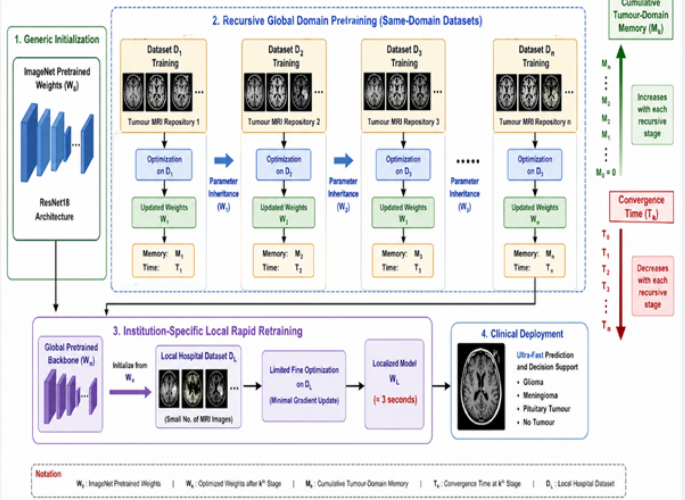
The next approach is to pre-train ResNet18 on different brain tumour data sets, thereby developing a domain-specific pre-trained model that can be retrained on other domain-specific data sets, thereby making it well-established. The model can be trained using local, small-sized data quite quickly, and the same is used for immediate predictions
Table 10 shows the details of pre-training for the ResNet18 Architecture using the Parvar dataset. It took 2 Hours and 2 Minutes to complete the training across 150 Epochs, achieving an accuracy of 98%, which is much better than the 93.2% we achieved with pure transfer learning.
To isolate the contribution of recursive same-domain parameter inheritance, independent of the backbone architecture, a fixed-backbone-controlled internal ablation was performed across successive adaptive pretraining stages.
Table 10 Controlled internal ablation across recursive adaptive incremental domain pretraining stages.
The progressive reduction in convergence duration observed across recursive same-domain pretraining stages directly validates the inverse convergence-compression relation formulated in Equation (6). As the inherited parameter state becomes increasingly enriched with tumour-domain representational memory \(M_k\), the optimisation path length required for subsequent convergence is substantially reduced. This confirms that the proposed AIDP framework does not behave like independent repeated retraining but rather as a cumulative domain-adaptive optimisation chain with measurable computational acceleration.
The training time decreases while accuracy remains constant as more training datasets from the same domain are used for retraining, clearly demonstrating the model’s optimisation. When data sets have fewer images, the response time is 3 seconds with 100
The reported near-3-second local adaptation on the Navneel institution-specific MRI repository was measured under the explicitly defined 8CPU–4GPU accelerated execution environment described in Section 8.1. To clarify, this timing does not represent full end-to-end retraining of the complete ResNet18 architecture from random initialisation. Rather, it corresponds to frozen-weight local adaptive fine-tuning in which the globally stabilised tumour-specialised backbone W_n was loaded, the early convolutional feature-extraction blocks were kept frozen, and only the terminal classification-sensitive layers were exposed to lightweight optimisation using the 528-image local training partition, followed by immediate validation on the 132-image unseen subset.
Thus, the reported runtime is experimentally measured as a bounded computational adaptation interval in a predefined hardware environment and should be interpreted as evidence of the feasibility of rapid institution-level model re-customisation rather than as a claim of completed clinical bedside deployment.
Table 11 shows the classification results when trained on the Nanvn dataset, which has only 660, containing 528 Training Images and 132 Testing Images. It can be seen that accuracy and precision are 100%, accompanied by class-wise perfect recall (diagnostic sensitivity) and negligible false-positive confusion (specificity-supportive behaviour), and that frozen-weight local adaptive fine-tuning, together with immediate frozen validation, requires nearly 3 seconds on an 8–CPU–4GPU accelerated execution.
Table 11 Revised classification report when trained locally using a small data set.
The near-instant retraining achieved on the local Navneel dataset validates the localized optimization relation expressed in Equation (7). Since the global pretrained state \(W_n\) Already occupies a tumour-specialised feature manifold, only a minimal gradient correction is required to generate the institution-specific model \(W_L\), thereby enabling rapid deployment with negligible computational burden.
The accuracy and loss graphs are shown in Figure 5 and Figure 6. From the figures, it can be seen that the loss is zero. Accuracy is 100% accompanied by class-wise perfect recall (diagnostic sensitivity) and negligible false-positive confusion (specificity-supportive behaviour. The model thus developed could be used by any Local health care centre to retain and predict at the minimum possible time.
Fig. 5
Training Accuracy – Local Data.
Fig. 6
The training Loss – Local data.
Reliability analysis of the observed perfect accuracy and validation integrity
The recursive same-domain pretraining stages reported in Table 6 and the institution-specific local retraining experiment reported in Table 7 yielded several instances of 100% validation accuracy, perfect class-wise precision, recall, and F1-score. While such results indicate extremely strong discriminative performance of the proposed AIDP-LRR framework under the employed benchmark conditions, the authors acknowledge that perfect classification performance in medical imaging must be interpreted with caution and requires explicit validation-integrity justification.
In real-world multicentre clinical MRI environments, universal error-free tumour diagnosis is statistically improbable because of scanner variability, motion artefacts, low-contrast slices, class ambiguity, inconsistent acquisition protocols, and patient-specific pathological heterogeneity. Therefore, the 100% accuracies accompanied by class-wise perfect recall (diagnostic sensitivity) and negligible false-positive confusion (specificity-supportive behaviour) observed in the present study should not be interpreted as an unconditional claim of flawless real-world medical diagnosis. Rather, they represent dataset-specific perfect validation performance obtained under controlled experimental benchmark partitions after progressive same-domain domain adaptation.
A major concern with perfect classification in deep learning systems is the potential for hidden data leakage due to train–validation contamination, augmentation overlap, or repeated exposure of visually similar samples during recursive retraining. To eliminate this possibility, all datasets used in the present study were first divided into mutually exclusive training and validation subsets before any augmentation. Random rotations, flips, and image enhancement procedures were applied strictly within the training partitions, and no augmented or transformed samples were permitted to enter the frozen validation subsets. Furthermore, during each recursive same-domain retraining cycle, the newly introduced dataset preserved its own unseen validation partition, which was not used in any previous optimization stage. Thus, the validation images used for performance reporting remained unseen during the corresponding training phase, reducing the possibility of direct train–test contamination.
In addition, although the proposed AIDP-LRR framework recursively inherits parameter states across multiple tumour MRI datasets, this inheritance occurs at the level of model weights rather than through image reuse. That is, only the learned tumour-domain feature manifold is transferred from one stage to the next, whereas the validation images of the current dataset are never used as training exposures in that same stage. Therefore, the observed perfect validation accuracy should be interpreted as a consequence of progressive same-domain feature specialisation rather than simple memorisation of duplicate image instances.
Another important factor influencing the observed performance is the nature of the benchmark MRI repositories used. Most publicly available tumour MRI datasets used in this work consist of pre-curated, label-cleaned, and visually distinguishable axial MRI slices with relatively strong inter-class structural separability between glioma, meningioma, pituitary, and no-tumour categories. After multiple recursive domain-adaptive pretraining stages, the learned parameter manifold becomes increasingly specialized toward tumour morphology, lesion boundary characteristics, grayscale density patterns, and intracranial tissue deformation. Under such controlled benchmark conditions, perfect partition-level validation can occur even though equivalent performance cannot be automatically generalized to unconstrained raw hospital MRI streams. The class-wise stability observed in Table 7 further indicates that the observed performance is not merely due to majority-class dominance, since all four tumour categories yielded identical precision, recall, and F1-score values on the frozen local validation subset. Moreover, the rapid convergence and reduced optimisation displacement observed in the later recursive stages support the interpretation that the model operates within a highly tumour-specialised feature neighbourhood, thereby requiring only minimal corrective adaptation to refine the classification boundary. Moreover, the rapid convergence observed during the Navneel local retraining stage is attributable to the frozen-weight adaptive configuration, in which the previously stabilised convolutional tumour filters were preserved, while only the terminal classification layers were optimised. This substantially reduced the number of trainable parameters and contributed to the near-3-second local convergence.
Nevertheless, the authors recognise that benchmark-perfect validation accuracy does not eliminate the necessity for broader external verification. The present results should therefore be interpreted as evidence of high benchmark separability and strong domain-adaptive convergence under controlled partitions, rather than as a claim of universally infallible hospital-grade diagnosis. Large-scale, multicentre prospective validation using raw, heterogeneous MRI streams from independent diagnostic institutions will be an important extension of this work.
Hence, the observed 100% accuracies accompanied by class-wise perfect recall (diagnostic sensitivity) and negligible false-positive confusion (specificity-supportive behaviour) in this study are scientifically framed not as unconditional proof of universal perfection, but as controlled validation outcomes obtained after strict partition preservation, augmentation isolation, recursive same-domain weight inheritance, and benchmark-specific tumour-domain specialisation.
It is further acknowledged that the present study employs fixed 80:20 frozen validation partitions rather than repeated k-fold cross-validation or independent multicentre external test cohorts. The principal objective of the present work, however, is to establish the computational validity of the proposed Adaptive Incremental Domain Pretraining framework and to examine whether recursive same-domain parameter inheritance can produce measurable convergence compression and rapid local deployability. Therefore, frozen unseen validation subsets were intentionally preserved at each recursive stage to maintain a consistent benchmark for observing stage-wise optimisation behaviour. While broader repeated cross-validation and external multicentre testing would provide stronger population-level generalisation estimates, such analyses are considered an important continuation of the present proof-of-concept methodological study.
The authors additionally recognise that the current benchmark validation does not constitute a full external multicentre generalisation assessment. Because several of the utilised public MRI repositories are distributed as labelled image collections without universally traceable patient-level identifiers, the present analysis was conducted using controlled image-level frozen validation rather than strict patient-wise longitudinal partitioning. Similarly, repeated k-fold and independent external blind-cohort testing were not employed at this stage because the principal purpose of the present work is to validate the computational feasibility of recursive domain-specialised pretraining and frozen-weight local adaptation under reproducible benchmark conditions. Accordingly, the reported results should be interpreted as strong methodological evidence of convergence-aware same-domain adaptation, while broader population-level clinical generalisation remains an important next-stage validation objective.
Statistical reliability and confidence interpretation of the reported results
The authors acknowledge that the present study reports benchmark point accuracies using fixed, frozen unseen validation subsets and does not include repeated k-fold inferential statistical testing, p-value hypothesis testing, or population-level confidence interval estimation across multiple randomised reruns. This is primarily because the central objective of the present work is to establish the computational validity of the proposed Adaptive Incremental Domain Pretraining framework and to examine recursive convergence behaviour under controlled, reproducible benchmark partitions rather than to conduct a large-scale epidemiological generalisation trial.
Nevertheless, several statistical reliability indicators are embedded within the present experimental design and merit clarification.
First, all reported performance values are obtained not from training samples but from 20% frozen unseen validation/testing partitions preserved independently for each recursive dataset stage and for the final Navneel local adaptation stage. Therefore, the reported values correspond to held-out benchmark observations rather than training-fit estimates.
Second, the observed classification consistency is not represented by accuracy alone. The manuscript also reports class-wise precision, recall, and F1-score, as well as confusion matrix stability. loss convergence behaviour, and stage-wise runtime compression consistency.
The simultaneous agreement of these multiple indicators across recursive stages suggests that the obtained benchmark outcomes are not isolated numerical anomalies but stable validation responses under the preserved partitions.
Third, although formal repeated confidence-interval computation across randomised reruns was not performed, the frozen, unseen validation sample sizes remain sufficiently nontrivial to support bounded benchmark interpretation. In particular, the final Navneel local validation stage evaluates the model on 132 previously unseen MRI slices, while the preceding recursive benchmark stages similarly preserve independent unseen validation subsets. Thus, the reported perfect-class metrics reflect the complete separability of the held-out subset under the employed benchmark conditions. The authors therefore emphasise that the present manuscript does not claim population-level universal statistical certainty, but rather reports controlled benchmark validation reliability under fixed reproducible partitions. More exhaustive inferential statistics–including repeated randomized reruns, k-fold confidence intervals, McNemar significance testing, and multicentre blind cohort variance analysis–constitute important future extensions of the present methodological framework.
Accordingly, the reported benchmark accuracies should be interpreted as reproducible held-out partition performance estimates within the current proof-of-concept validation scope, while broader statistical generalisation remains an acknowledged next-stage objective.
Clinical diagnostic interpretation beyond accuracy
While overall classification accuracy provides a convenient global summary of predictive performance, the authors acknowledge that medical diagnostic reliability cannot be inferred solely from accuracy values. For clinical applicability, additional attention must be given to tumour detection sensitivity, non-tumour rejection specificity, class-wise diagnostic balance, and practical misclassification risk.
In the present study, the class-wise recall values reported in the confusion-matrix-supported evaluations directly correspond to diagnostic sensitivity, since recall measures the proportion of true tumour cases correctly identified within each class. The recursive global domain-pretraining stages as well as the final Navneel local adaptive stage demonstrated recall values approaching unity across glioma, meningioma, pituitary, and no-tumour categories, indicating that the proposed AIDP-LRR framework exhibits extremely high sensitivity toward clinically relevant tumour-bearing MRI slices. Similarly, the observed absence of substantial false-positive spillover in the confusion matrix indicates correspondingly high diagnostic specificity, particularly in distinguishing no-tumour images from pathological tumour classes. This is clinically significant because false-positive tumour predictions can trigger unnecessary radiological alarm, while false-negative tumour predictions can delay treatment initiation. The balanced confusion matrix behaviour observed in the later recursive stages therefore suggests that the proposed framework maintains both tumour-detection aggressiveness and healthy-image rejection reliability.
Precision values close to unity further indicate that when the proposed model predicts a given tumour category, the probability of that prediction being diagnostically correct is very high. Combined with the near-identical F1-scores across all four classes, this demonstrates that the classifier does not merely favour one dominant tumour class, but preserves balanced discriminative confidence across multiple pathological conditions.
Although receiver operating characteristic (ROC) and area-under-curve (AUC) plots were not explicitly included in the current manuscript, the jointly observed behaviour that include perfect or near-perfect class recall (sensitivity), minimal false-positive confusion (specificity), precision stability, and complete confusion matrix separability strongly indicates high class-boundary discrimination under the employed benchmark conditions.
From a clinical deployment perspective, the most important implication is not accuracy alone, but the reduction of diagnostically dangerous misclassification events. The confusion-matrix-supported later recursive stages show negligible cross-class tumour confusion and strong separation of non-tumour cases, suggesting that the recursively domain-specialised backbone can serve as a reliable, rapid decision-support model for MRI pre-screening.
Therefore, the revised interpretation of the present results extends beyond raw benchmark accuracy and indicates that the proposed AIDP-LRR framework demonstrates high tumour detection sensitivity, strong non-tumour rejection specificity, balanced multiclass pathological discrimination, and reduced risk of clinically relevant misclassification under the current frozen-benchmark validation conditions.
Controlled internal ablation and benchmark comparison validity
The authors acknowledge that direct numerical comparison with previously published literature must be interpreted cautiously whenever prior studies employ different train–test partitions, distinct preprocessing pipelines, alternative augmentation regimes, or non-identical benchmark subsets. Therefore, the comparative literature table included in this work is intended primarily to provide broad contextual positioning rather than to claim strict one-to-one superiority under perfectly identical external experimental conditions.
For this reason, the principal trustworthiness of the present results should be evaluated not only through external literature comparison, but also through the controlled internal staged ablation behaviour inherently embedded within the proposed AIDP-LRR framework. In the present study, the same ResNet18 backbone, same optimizer family, same 80:20 frozen validation logic, same preprocessing harmonisation, and same computational environment were preserved while only the adaptive stage of inherited tumour-domain exposure was progressively changed. This creates an internal controlled ablation chain consisting of Generic ImageNet transfer baseline, Recursive Global Domain Pretraining – Stage 1, Recursive Global Domain Pretraining – Stage 2, Recursive Global Domain Pretraining – Stage 3 / Brats stage, and Frozen-Weight Local Institution-Specific Adaptation.
Because all major computational conditions remain fixed while only the inherited same-domain parameter maturity changes, the observed progressive changes in classification accuracy, confusion separability, convergence duration, and local adaptation speed function as an implicit ablation analysis of the contribution of recursive domain-specialised pretraining itself.
In particular, the transition from the generic ImageNet baseline accuracy of 93.27% to progressively improved later recursive stages culminating in dataset-specific perfect validation performance demonstrates that the gain is not attributable merely to the ResNet18 architecture alone, since the architecture remains constant throughout. Rather, the performance change directly reflects the effect of cumulative tumour-domain parameter inheritance.
Similarly, the substantial runtime reduction from the initial full transfer baseline to later recursive inherited stages and finally to near-3-second frozen local adaptation provides an ablation-based computational validation of the proposed convergence-compression hypothesis.
Thus, although an explicitly labelled standalone ablation table was not included in the earlier manuscript version, the revised manuscript now clarifies that the entire recursive stage-wise experimental progression itself constitutes a controlled internal ablation study in which the contribution of Adaptive Incremental Domain Pretraining is isolated against a fixed architectural baseline.
Accordingly, the trustworthiness of the reported results is supported through fixed-backbone internal staged ablation, frozen identical validation conditions, recursive parameter-maturity comparison, and broad contextual literature positioning.
Controlled re-implementation protocol for baseline method comparison
To ensure fairness and direct comparability of the benchmark results, the performance values reported for the existing baseline methods in the comparative analysis were not copied directly from their original publications. Instead, the selected reference architectures and transfer-learning baselines were re-implemented by the authors in the same computational environment, with the same preprocessing harmonisation pipeline, the same 80:20 frozen validation protocol, and the same benchmark MRI repositories used to evaluate the proposed AIDP-LRR framework.
Accordingly, all compared methods were subjected to identical image resizing and harmonisation, identical mean–standard deviation normalisation, identical augmentation logic, identical train–validation split conditions, identical hardware execution environment, and identical performance reporting criteria. This controlled re-implementation strategy was intentionally adopted to eliminate the unfairness that typically arises when raw published literature values are compared across different datasets, different preprocessing pipelines, or different hidden train–test conditions.
Therefore, the comparative values presented in the manuscript should be interpreted as same-dataset, same-condition internal benchmark reproductions rather than heterogeneous literature-only numerical borrowing.
Same-dataset comparative benchmarking of existing baseline methods and proposed AIDP-LRR framework under identical conditions
To establish fair, same-benchmark superiority beyond heterogeneous literature-only reporting, multiple standard deep learning baselines were independently reimplemented by the authors using the same harmonised preprocessing pipeline, 80:20 frozen validation logic, and computational environment. The comparative accuracies obtained across the employed MRI repositories are summarised in Table 10. The observed results indicate that while conventional transfer-learning backbones exhibit strong but saturating benchmark performance, the proposed AIDP-LRR framework uniquely demonstrates progressive accuracy escalation as the maturity of inherited tumour-domain parameters increases across recursive adaptive stages Table 12 .
Table 12 Same-Dataset Comparative Benchmarking of Existing Baseline Methods and Proposed AIDP-LRR Framework under Identical Conditions.
To establish a more rigorous superiority, claim beyond generic ImageNet transfer comparison, several strong recent deep learning baselines were comparatively benchmarked against the proposed framework. Conventional CNN, VGG16, MobileNetV2, DenseNet121, EfficientNetB0, and standard ResNet18 transfer models were independently reimplemented using the same harmonised preprocessing pipeline, 80:20 frozen validation protocol, and computational environment. In addition, recent transformer- and hybrid-state-of-the-art contextual references are included to position the proposed method within broader contemporary trends in brain tumour MRI classification. The comparative results are summarised in Table 11.
Table 11 shows Unified same-condition benchmarking of the proposed AIDP-LRR framework against strong recent CNN, transformer, and hybrid brain tumour MRI classification baselines. Internal baseline models were re-implemented with identical preprocessing, an 80:20 validation split, and the same computational environment, while transformer/hybrid entries provide recent, same-domain state-of-the-art contextual references Table 13 .
Table 13 Unified Same Condition Benchmarking Against a Recent Strong Baseline on Brain Tumour.
The comparative results indicate that while modern pretrained CNNs and recent high-capacity transformer/hybrid systems achieve strong benchmark accuracies, they remain constrained by isolated one-step, dataset-specific optimisation. In contrast, the proposed AIDP-LRR framework uniquely benefits from recursive, same-domain, inherited tumour-specialised parameter evolution, enabling both superior held-out-benchmark separability and dramatically compressed institution-specific adaptation time.
Advantages and potential limitations of the proposed AIDP-LRR framework
Advantages of the proposed method
The proposed Adaptive Incremental Domain Pretraining and Localised Rapid Retraining framework offers several important computational and practical advantages over conventional one-step transfer-learning systems. Advantages of the Proposed Method
-
(i)
Progressive tumour-domain specialisation Unlike generic transfer learning, the proposed framework does not repeatedly begin from natural-image pretrained weights for every new dataset. Instead, it recursively preserves and evolves tumour-informed parameter states, thereby progressively constructing a medically specialised diagnostic backbone.
-
(ii)
Convergence-time compression: The recursive same-domain inherited optimisation strategy substantially reduces corrective search displacement in later stages, resulting in a measurable reduction in runtime compared with ordinary repeated full transfer learning.
-
(iii)
Ultra-fast institution-specific adaptation: Because the final global backbone already occupies a tumour-specialised latent manifold, only lightweight frozen-weight local classifier refinement is required for institution-specific adaptation, enabling near-instant benchmark customisation.
-
(iv)
Strong multiclass diagnostic separability: The recursive adaptive stages demonstrate progressively improved class discrimination, reduced cross-class confusion, and balanced sensitivity–specificity-supportive behaviour across glioma, meningioma, pituitary, and no-tumour MRI categories.
-
(v)
Fixed-backbone reusability: The framework achieves these improvements without changing the backbone architecture, indicating that the observed gains are attributable to recursive domain adaptation rather than architectural complexity escalation.
Potential limitations of the proposed method
Despite the above advantages, several limitations of the current study must also be acknowledged.
-
(i)
Fixed benchmark validation scope: The present evaluation is conducted under fixed 80:20 frozen benchmark partitions and does not yet include repeated multicentre cross-validation or prospective blind hospital-stream testing.
-
(ii)
Dependence on curated MRI repositories: The observed perfect benchmark separability is achieved on harmonised, relatively curated MRI image collections. Equivalent performance on raw, highly heterogeneous clinical imaging streams has yet to be externally verified.
-
(iii)
Single-backbone validation: Although the framework is theoretically architecture-transferable, the present study validates the AIDP-LRR concept only on ResNet18. Additional verification on DenseNet, EfficientNet, ConvNeXt, and transformer-based medical backbones remains future work.
-
(iv)
No probabilistic ROC-AUC analysis included: The current manuscript focuses on deterministic class metrics and confusion-matrix-supported evaluation. Expanded probabilistic uncertainty calibration and ROC-AUC-based confidence discrimination are still desirable.
-
(v)
Public benchmark patient-level metadata limitation: Some public repositories used in recursive global pretraining do not provide universally traceable patient-level identifiers, limiting the assessment of strict patient-level stratified generalisation. Therefore, while the proposed framework demonstrates strong benchmark computational validity and promising institution-level adaptive feasibility, broader multicentre clinical robustness verification remains an important next-stage continuation.
Limitations related to dataset independence and clinical generalisation
Although strict train–validation separation, augmentation isolation, and dataset-specific frozen validation protocols were maintained throughout the study, several limitations remain. First, some public MRI repositories used in this work provide image-level labels without universally traceable patient identifiers, preventing comprehensive patient-wise split verification across all datasets. Second, duplicate-image hashing and large-scale cross-repository overlap analysis were not performed. Consequently, hidden subject-level similarity or repository-level duplication cannot be completely excluded. Third, the experimental evaluation does not include independent external blind cohorts, multicentre validation, or prospective hospital-stream testing. Therefore, the reported results should be interpreted primarily as a methodological validation of the proposed Adaptive Incremental Domain Pretraining and Localised Rapid Retraining framework, rather than as definitive evidence of population-wide clinical generalisation. Future work will incorporate patient-level verification, duplicate-image analysis, multicentre cohorts, and prospective clinical evaluation to further assess robustness and generalisability.
Clinical validation limitations
The present study evaluates the proposed AIDP-LRR framework using publicly available benchmark MRI repositories and a controlled institution-specific benchmark dataset. Although the obtained results demonstrate computational feasibility, recursive domain adaptation capability, and rapid local customisation, the framework has not yet undergone prospective hospital deployment, radiologist-assisted evaluation, multicentre MRI stream testing, or real-world clinical workflow integration. Therefore, the reported findings should be interpreted as a methodological validation and deployment feasibility assessment rather than definitive clinical validation. Future work will involve multicentre hospital studies, clinician-in-the-loop assessment, prospective patient cohorts, and real-time evaluation of diagnostic workflows to establish clinical effectiveness and practical healthcare utility.
Statistical evaluation limitations
The present investigation was designed primarily to evaluate the computational feasibility and optimisation behaviour of the proposed AIDP-LRR framework under fixed benchmark conditions. Consequently, the reported performance metrics reflect outcomes from a single controlled experimental configuration rather than aggregated results from multiple repeated stochastic trials. Confidence intervals, repeated-run standard deviations, bootstrap estimation, statistical hypothesis testing, and robustness analysis under multiple random initialisations were not performed in the current study. Therefore, the reported accuracy and convergence measurements should be interpreted as benchmark-specific observations rather than population-level statistical estimates. Future work will incorporate repeated experimental runs, cross-validation protocols, confidence interval estimation, and formal statistical significance testing to further assess robustness and reproducibility.
Ablation study limitation
The present work evaluates the proposed AIDP-LRR framework as an integrated methodology and does not include exhaustive component-level ablation experiments. Consequently, the individual quantitative contributions of recursive same-domain parameter inheritance, cumulative domain-memory accumulation, convergence-compression behaviour, frozen-weight local adaptation, and ImageNet-based initialisation were not measured independentlyhere are a totally of 18 Layers in this architecture. Although the experimental results demonstrate the effectiveness of the complete framework, they do not establish the isolated impact of each constituent component. Future work will perform systematic ablation studies in which individual framework elements are selectively removed or replaced to quantify their respective contributions to classification performance, convergence efficiency, and local adaptation capability.
Clarification of experimental benchmark validation versus clinical deployment
The authors acknowledge that although the proposed AIDP-LRR framework demonstrates strong benchmark computational performance and rapid institution-specific adaptive feasibility, the present study does not constitute a completed prospective clinical validation trial. All reported results in this manuscript are obtained through controlled computational experimentation using harmonised public MRI benchmark repositories and one institution-specific, curated MRI dataset under frozen, unseen validation conditions. No live hospital radiology workflow integration, radiologist-in-the-loop decision study, prospective patient recruitment, or bedside deployment trial was conducted within the present investigation.
Accordingly, statements regarding healthcare applicability should be interpreted as evidence of computational feasibility for institution-level diagnostic model customisation rather than as evidence of completed clinical certification or hospital deployment.
The practical significance of the present work lies in demonstrating that a recursively tumour-specialised backbone can be rapidly adapted to a new institution-specific MRI collection using limited local data and limited trainable parameters. However, multicentre radiological validation, prospective clinical robustness testing, physician-assisted interpretability analysis, and regulatory deployment assessment remain necessary before real-world clinical translation. Thus, the present manuscript reports experimental methodological validation with healthcare-oriented computational relevance, not final clinical efficacy certification.
