
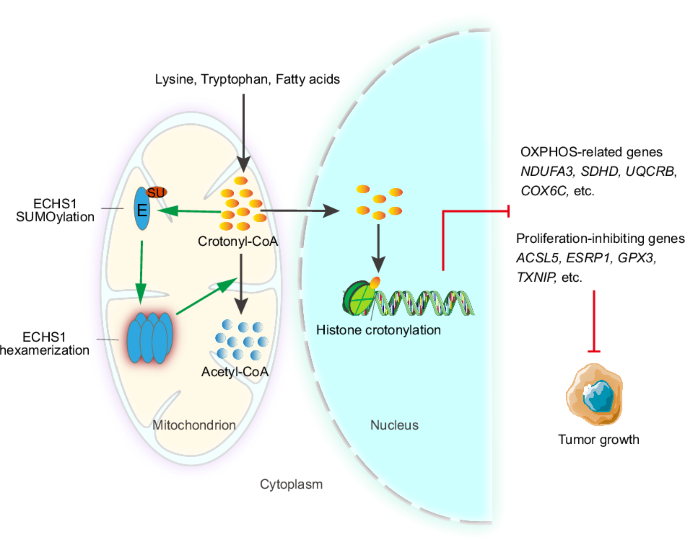
Cellular metabolism dynamically adapts to nutrient fluctuations, yet the regulatory mechanisms underlying this plasticity remain incompletely understood. In particular, the adaptive activation mechanism of enoyl-CoA hydratase short-chain 1 (ECHS1), a key mitochondrial enzyme for fatty acid and amino acid catabolism, is poorly characterized. Herein, we identify SUMO1 modification at lysine 128 of ECHS1 as an essential activation switch that drives mitochondrial catabolism and restricts growth of lung cancer cells. Nutrients generating crotonyl-CoA (fatty acids, lysine, tryptophan) stimulate this modification, accelerating crotonyl-CoA oxidation to acetyl-CoA. This metabolic adaptation decreases crotonyl-CoA pools, thereby reducing histone crotonylation (e.g., H2BK20cr and H3K27cr). Conversely, SUMOylation deficiency impairs formation of the catalytic ECHS1 homohexamer, increasing crotonyl-CoA accumulation and histone crotonylation. This epigenetically suppresses oxidative phosphorylation and associated ROS generation while activating PI3K-Akt signaling, promoting lung cancer growth in vitro and in vivo. In lung adenocarcinoma patients, H2BK20cr and H3K27cr levels are elevated in tumor tissues and predict poor survival, highlighting their clinical prognostic significance. Collectively, these findings establish ECHS1 SUMOylation as a nutrient-sensitive activation mechanism for adaptive catabolism and reveal mitochondrial SUMOylation as a critical regulator of nuclear epigenetic reprogramming, defining a metabolite-driven paradigm in cancer epigenetics.
Trending
- Interleukin-1 receptor-associated kinase 1 controls chemoresistance and immuno-killing in non-small cell lung cancer
- Indigenous Leader Raoni Receives Palliative Care in Brazil After Cancer Diagnosis
- Brazilian Indigenous Leader Chief Raoni Diagnosed With Cancer
- FDA Approves Lutetium Lu 177 Dotatate Injection for GEP-NETs
- Acrolein- thioredoxin 1- p38 signaling drives neutrophil-mediated immunosuppression and glioblastoma progression
- SOHO 2026 Sessions Reveal Key Updates Across Leukemia Populations
- Bayer’s Monsanto Unit Urges Missouri Judge to Approve $7.25 Billion Roundup Settlement
- Targeting CD38 with bispecific antibody XmAb 18968 in patients with relapsed/refractory acute myeloid leukemia and T-cell acute lymphoblastic leukemia


Tuesday, September 15
