


In this study, we provide a comprehensive clinicopathological, molecular, and tumor microenvironment (TME)-oriented characterization of SMARCA-deficient esophageal adenocarcinoma (EAC) in a large, well-defined Western cohort. Several aspects distinguish the present work from previous reports and underscore its relevance for both tumor biology and clinical stratification of EAC.
First, a major strength of this study is the exceptionally large cohort of 722 Caucasian EAC patients deeply annotated with clinicopathological, molecular, and stromal parameters. To our knowledge, this represents the largest analysis to date addressing the prevalence, composition, and biological implications of SMARCA2/4 loss in EAC. Previous studies on SMARCA-deficient esophageal tumors have largely been limited to small case series, case reports, or mixed cohorts enriched for undifferentiated or rhabdoid carcinomas37,38. By contrast, our cohort reflects the full histomorphological spectrum of conventional EAC encountered in Western clinical practice and therefore allows robust conclusions regarding the clinical relevance of this subtype. Within this cohort, SMARCA deficiency was identified in approximately 11% of EACs, confirming that loss of SWI/SNF ATPase activity is not a rare event in this disease9,38. Importantly, when restricting the analysis to unequivocally SMARCA-deficient tumors (excluding heterogeneous expression), this subgroup still accounted for nearly 8% of cases, highlighting its biological and potential clinical importance.
Consistent with previous reports on SMARCA2/4-deficient esophageal malignancies, this protein loss was more prevalent among older individuals in our cohort39,40.
Second, our data significantly expands current knowledge regarding the molecular landscape of SMARCA-deficient EAC. Among all analyzed oncogenic alterations, MET amplification emerged as the most robustly enriched molecular co-alteration in SMARCA-deficient tumors. This association was particularly pronounced in the neoadjuvant-treated subgroup, where nearly one quarter of SMARCA-deficient EACs harbored MET amplification41,42.
The significant enrichment of MET amplification within the SMARCA-deficient subset suggests a non-random molecular association. While the exact mechanistic link in EAC remains to be fully elucidated, similar patterns of extreme aggressiveness and specific molecular co-occurrences have been described in SMARCA4-deficient lung carcinomas43. In these models, the loss of SWI/SNF subunits is associated with a profound remodeling of the tumor microenvironment and a dependency on alternative oncogenic pathways. Our data indicate that MET amplification might represent one such compensatory mechanism in EAC. Interestingly, this association was not observed for other drivers like HER2 or EGFR, suggesting that the synergy between SMARCA deficiency and MET signaling may be a specific hallmark of this aggressive subtype, rather than a sign of generalized genomic instability.
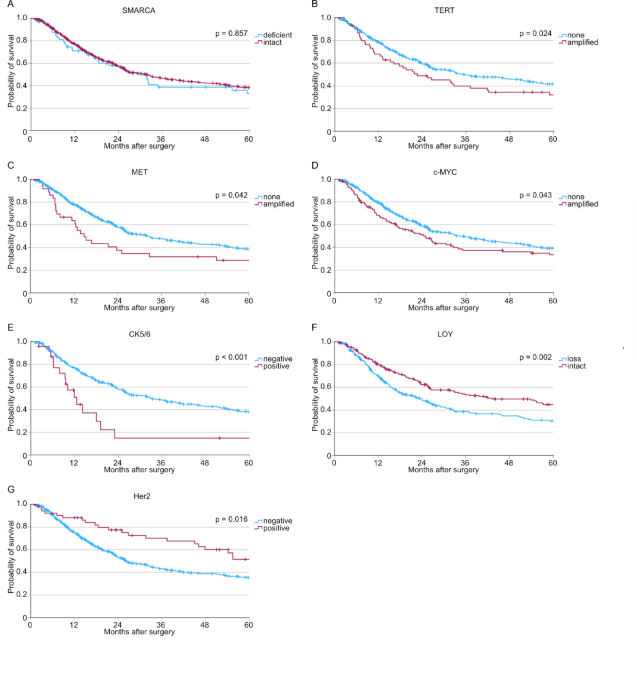
MET activation may therefore represent a compensatory oncogenic pathway that supports tumor growth and therapy resistance in the context of impaired chromatin remodeling. From a clinical perspective, this observation is highly relevant, as MET-amplified EACs have been associated with aggressive behavior and poor outcome, and MET represents a potentially druggable target44. In addition to MET, loss of the Y chromosome (LOY) emerged as a critical adverse factor within SMARCA-deficient tumors. While LOY has previously been described as a frequent event in Barrett-associated adenocarcinoma and linked to poor prognosis, our data demonstrate that its negative prognostic impact persists within the biologically high-risk context of SMARCA deficiency15,45. The relationship between our findings and prior investigations on this cohort deserves clarification. While the previous study established LOY as a frequent event in EAC15 and the proteomic vulnerabilities of MET-amplified cases16, our data demonstrate for the first time that these features, MET amplification and LOY, are non-randomly enriched within the SMARCA-deficient subset. By shifting the focus from individual markers to a comprehensive ‘SMARCA-deficient’ phenotype, we provide a more integrated molecular model that explains the extreme aggressiveness previously observed in these patients. The combination of SMARCA loss, MET amplification, and LOY identifies a subset of EACs with particularly unfavorable clinical behavior, suggesting cooperative effects between chromatin remodeling defects, chromosomal instability, and oncogenic signaling.
Third, the present study provides important insights into the prognostic relevance of SMARCA deficiency itself. SMARCA-deficiency showed no impact on patients’ overall survival. This finding suggests that SMARCA deficiency acts less as an isolated prognostic driver and more as a biological framework that modulates the impact of additional molecular and microenvironmental factors, such as MET amplification, LOY, and TME composition. This concept aligns well with emerging data from other tumor entities, where SWI/SNF alterations define aggressive molecular subtypes but require cooperative events to fully determine clinical outcome46,47.
Fourth, a particularly novel aspect of this work is the systematic characterization of the inflammatory TME and CAF subtypes in SMARCA-deficient EAC. Overall, CAF composition did not differ substantially between SMARCA-deficient and SMARCA-intact tumors, indicating that SMARCA loss does not globally reprogram stromal abundance. However, within the SMARCA-deficient subgroup, distinct stromal and immune cell populations showed strong prognostic associations. High densities of PDGFRβ-positive CAFs, plasma cells (MUM1+), and mast cells were consistently linked to improved survival, suggesting that specific stromal–immune interactions may partially counterbalance the aggressive biology conferred by SMARCA loss. Conversely, LOY remained a dominant adverse factor across stromal and histological subgroups, underscoring its strong and context-independent prognostic impact. Stratification by histological growth pattern further revealed that SMARCA-deficient tumors are biologically heterogeneous, despite sharing a common chromatin remodeling defect. In tubular SMARCA-deficient EACs, FOXP3 + regulatory T cells and PDGFRβ + CAFs were associated with a favorable outcome, whereas PIK3CA amplification identified a poor-prognosis subset. In non-tubular tumors, mast cell infiltration emerged as the only favorable prognostic marker, again highlighting the context-dependent role of the immune microenvironment. These findings suggest that SMARCA deficiency sensitizes tumor behavior to microenvironmental cues, rather than uniformly dictating immune exclusion or stromal activation.
Taken together, our results position SMARCA-deficient EAC as a distinct molecular and biological subtype characterized by (I) frequent co-occurrence with MET amplification, (II) LOY with particularly adverse prognostic implications, and (III) a complex, prognostically relevant interplay with specific immune and stromal components. Importantly, the identification of MET amplification within this subgroup provides a rational basis for exploring targeted therapeutic strategies, particularly in patients who fail standard multimodal treatment48.
All the markers have been selected as they represent the most clinically relevant oncogenic drivers in EAC with potential for targeted therapy. Furthermore, we integrated the analysis of the microenvironmental landscape (CAFs) and large-scale genomic alterations, such as Y-chromosome loss (LOY), to investigate whether SMARCA2/4 deficiency identifies a biologically distinct ‘cluster’ within the heterogeneous landscape of EAC. While mismatch repair (MMR) status and PD-L1 expression are established predictive biomarkers for immunotherapy in gastroesophageal cancers, they were not the primary focus of the present study. Our investigation specifically aimed to characterize the epigenetic dysregulation linked to the SWI/SNF complex and its interaction with tyrosine kinase receptor signaling and the stromal microenvironment. Future prospective studies integrating SMARCA status with MMR/PD-L1 profiles are warranted to better define the immunotherapeutic landscape of this subtype.
Some limitations of this study should be acknowledged. First, this is a retrospective, single-center analysis, which may introduce selection bias despite the large, well-characterized cohort and uniform treatment strategies. Second, SMARCA2 and SMARCA4 status were assessed by immunohistochemistry, which reliably reflects functional loss but does not distinguish between underlying genetic, epigenetic, or post-transcriptional mechanisms; parallel sequencing data were not available for all cases. Third, although tissue microarrays enabled high-throughput and standardized analyses, they may incompletely capture intratumoral heterogeneity of both tumor cells and the tumor microenvironment, despite the use of multi-spot sampling for SMARCA-deficient cases. Fourth, the molecular analyses were limited to selected, clinically relevant gene amplifications and did not include genome-wide or transcriptomic profiling, precluding deeper mechanistic insights.
Another limitation of our study is the assessment of morphology primarily through a tubular/non-tubular classification on TMA cores. This approach may underestimate the presence of focal dedifferentiated or rhabdoid features, which have been described in SMARCA-deficient tumors of other organs. While our large-scale screening using tissue microarrays identifies a molecular subset, further studies on whole-slide images are warranted to provide a more granular histological description of the intratumoral heterogeneity associated with SMARCA2/4 loss.
Due to the exploratory nature of this study on a rare molecular subtype, corrections for multiple statistical testing were not applied to avoid a disproportionate increase in false-negative results. Consequently, marginal p-values should be interpreted with caution and warrant validation in larger, independent cohorts.
In conclusion, this study represents the largest and most comprehensive analysis of SMARCA-deficient EAC to date. By integrating clinicopathological parameters, oncogenic co-alterations, CAF subtypes, and immune infiltration, we demonstrate that SMARCA deficiency is associated with a biologically aggressive EAC subtype whose clinical course is strongly shaped by additional molecular events and the tumor microenvironment. After further characterization and external validation of this subtype, these findings could refine current molecular stratification concepts in EAC and may inform future biomarker-driven therapeutic approaches.
