


Patients and tissue samples
The analysis included 80 patients with a total of 602 RF-OES incisions made on tumor specimens. The mean age of the cohort was 58 years (± 15), with only one male patient.
68 patients underwent oncological breast surgery, whereas 12 patients underwent risk-reducing or breast reduction procedures.
The most common pathological tumor stage was pT2, accounting for 50% of patients and 51,2% of incisions. Lower stages (pTis and pT1) were less frequent, while higher stages (pT3 and pT4) were rare. Most tumors were graded as G2 (61,7% of patients and 62,1% of incisions), indicating moderate differentiation. G3 tumors, which are poorly differentiated, accounted for 35,7% of patients and 36,1% of incisions. HR (hormone receptor)-positive tumors made up 91,2% of the malignant tissue. Her2/neu status was predominantly classified as low (64.7% of patients and 68.7% of incisions), with fewer cases being Her2/neu negative or positive. Regarding histological subtype, invasive carcinoma of no special type (NST), either alone or in combination with ductal carcinoma in situ (DCIS), constituted the majority of cases (47%). Additional subtypes included lobular carcinoma in situ (LCIS), in both classic and pleomorphic forms, which collectively accounted for 23% of patients.
Surgical interventions included breast-conserving surgery in 35% of cases, primary mastectomy in 28%, and oncologic nipple- or skin-sparing mastectomy (NSM/SSM) in 21%. In addition, risk reducing procedures and reduction mammoplasties were included for OES data acquisition in benign tissue.
The majority of patients (78%) did not receive preoperative therapy. Neoadjuvant chemotherapy was administered in 15% of cases, while 7% of patients underwent primary endocrine therapy.
An overview of patient and tissue characteristics can be seen in Tables 1 and 2.
Table 1 Tumor and patient characteristics.Table 2 Characteristics of examined malignant tissue.
To evaluate the performance of OES on untreated tissue, dynamic incisions were performed on samples from 62 patients who had not received any prior therapy.
In the NST group, a total of 182 incisions of tissue were analyzed, including 81 incisions made on abnormal tissue. In the abnormal tissue group, 71/81 (87,7%) incisions contained active NST tumor, 9/81 (11,1%) incisions exhibited combined NST and DCIS, and 7/81 (8,6%) contained only DCIS. Additionally, 4/81 (4,9%) incisions included tumor necrosis, with 2/81 (2,5%) incisions containing only necrosis. Tumor stroma was present in 71/81 (87,7%) incisions in abnormal tissue. In the normal tissue group, incisions predominantly contained fat tissue, which was absent in only 2/101 (2,0%). Connective tissue was present in 86/101 (85,1%) incisions, and glandular tissue in 27/101 (26,7%). One patient in the NST cohort had abundant intraductal papilloma tissue (Fig. 3a).
In the ILC group, 164 incisions were analyzed, with 71 containing abnormal tissue (Fig. 3b; Table 2). Active ILC tumor was present in 70/71 (98,6%) of these incisions. ILC combined with LCIS was observed in 2/71 (2,8%) incisions, and LCIS alone in another 2/71 (2,8%). Tumor stroma was found in 70/71 (98,6%) incisions in abnormal tissue. A total of 93 incisions containing normal tissue were analyzed, with adipose tissue found in 89/93 (95,7%) incisions, connective tissue in 71/93 (76,3%), and glandular tissue in 13/93 (14,0%). Based on the evaluation of tissue type distribution across incisions made in both groups, NST and ILC were similar.
Fig. 3The alternative text for this image may have been generated using AI.
Tissue type distribution across incisions labelled according to histopathologic analysis. For the (a) 26 NST-Group and (b) 23 ILC-Group patients without prior treatment included in the study, all tissue types present in individual incisions have been sorted by tissue composition. All incisions presenting active tumors (NST or ILC depending on group), DCIS, LCIS, tumor stroma or tumor necrosis are rated as abnormal, whereas incisions including only adipose tissue, connective tissue and glands are summarized as normal tissue. Other tissue detected in incisions of the NST group consists of papilloma tissue derived from one patient.
Selected features for machine learning
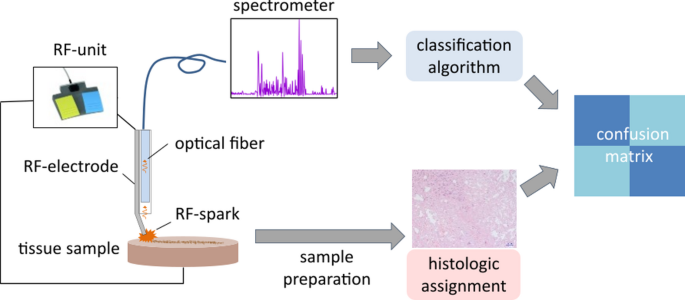
The feasibility study for OES breast tissue analysis employed a high-resolution Echelle spectrometer and identified a total of 19 discriminative spectroscopic features across the entire spectral range23. In contrast, the present study utilized a more cost-effective, lower-resolution optical emission spectrometer (OceanOptics Maya2000 Pro) with a narrower optical window (200–424 nm), selected for its suitability in future clinical applications. Therefore, some of the previously identified features are no more available for analysis. The three features shown in Fig. 4 were selected for tissue classification.
Fig. 4The alternative text for this image may have been generated using AI.
Overview of the three selected features for tissue classification. The spectral peaks at (a) 213.5 nm (phosphor/zink), (b) 232.0 nm (carbon) and (c) 279.5 nm (magnesium) were used for tissue classification. The figure shows the mean spectra of normal and abnormal tissue derived from the 26 patients with NST tumors. Spectra were normalized for the overlay due to different spectral intensities in normal and abnormal tissue.
Histological differences of NST and ILC tumors
Figure 5 presents HE-stained tissue sections, offering an overview of the entire RF-incisions and specific tissue types. The RF-incision surface, depicted in Fig. 5a, is marked with green tissue ink, highlighting the vacuolized and coagulated tissue surrounding the incision. This coagulation results from the heat generated during monopolar RF resection. Pathologists classified the adjacent normal and abnormal tissue content surrounding the incision.
For comparative purposes, the typical histological features of normal (Fig. 5b) and abnormal (Fig. 5c-f) breast tissue (NST, DCIS, ILC and LCIS, respectively) are illustrated. NST (Fig. 5c) is characterized by pleomorphic tumor cells arranged in nest-like structures accompanied by necrotic areas and reactive tumor stroma. In contrast, ILC (Fig. 5e, compare scale bar) exhibits filamentous growth of small, irregularly shaped tumor cells into a fibrous stroma. DCIS cells (Fig. 5d) fill the mammary ducts but show no invasion into adjacent tissue. LCIS (Fig. 5f) forms in the terminal ductal lobular unit (TDLU), filling acini, which are glandular tissues involved in milk production. By definition, LCIS is diagnosed when more than 50% of the acinar tissue is filled and expanded by tumor cells25.
Fig. 5The alternative text for this image may have been generated using AI.
Typical histology of (a) RF-incision in NST tumor tissue, (b) normal breast tissue, (c) NST tumor, (d) DCIS, (e) ILC tumor, (f) LCIS. Abbreviations: Adipose tissue (A), coagulated tissue (COAG), connective tissue (C), duct with DCIS (D), gland (G), LCIS (L), necrosis (N), RF-incision with green ink (RF), tumor stroma (S), tumor (T).
Classification accuracy based on tumor type
The confusion matrices show the true positive, true negative, false positive and false negative classification of spectra in NST and ILC patient subgroups (Fig. 6).
In the entire patient cohort (Fig. 6a), the SVC achieved a true negative rate of 91,9% and a true positive rate of 84,7%. The false positive and false negative rates were 8,1% and 15,3%, respectively. These results indicate high specificity and good sensitivity in distinguishing all normal from abnormal tissue.
For the NST cohort (Fig. 6b), 473/497 (95,2%) spectra were correctly classified as normal tissue, while 365/401 (91,0%) spectra were accurately classified as abnormal tissue. Additionally, 36/401 (9,0%) spectra were classified as false negatives, and 24/497 (4,8%) were classified as false positives. Notably, all 21 spectra obtained from the male NST patient were correctly classified with 100% accuracy.
For the ILC cohort (Fig. 6c), 346/410 (84,4%) spectra were correctly classified as normal tissue, and 273/347 (78,7%) were correctly classified as abnormal tissue. The false negative rate for ILC was 74/347 (21,3%), and the false positive rate was 64/410 (15,6%).
Fig. 6The alternative text for this image may have been generated using AI.
Confusion matrices showing true positive (TPR), true negative (TNR), false positive (FPR) and false negative (FNR) classification of spectra in (a) all patients, (b) NST (n = 26) and (c) ILC (n = 23) patients. The number (n) of spectra allocated to the individual groups is shown in brackets. Correct prediction is depicted by a color range.
