


PD-L1 and PD-L2 display heterogeneous expression across PMBCL models associated with genomic and epigenetic differences
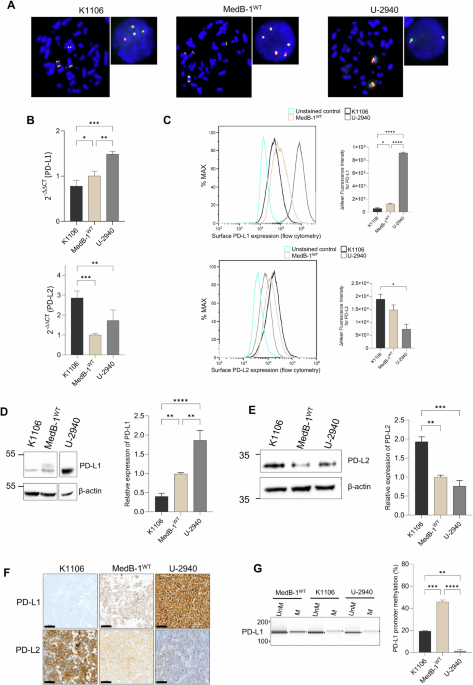
We first characterized the genomic, transcriptional, and protein landscape of PD-L1 (CD274) and PD-L2 (PDCD1LG2) across three representative PMBCL cell lines (K1106, MedB-1WT, U-2940). Fluorescence in situ hybridization (FISH) revealed variable copy number gains at the 9p24.1 locus, with strong amplification in MedB-1WT, moderate gain in K1106, and a diploid configuration in U-2940 (Fig. 1A). Consistently, RT-qPCR analyses demonstrated heterogeneous mRNA expression for both ligands across models, indicating that copy number alterations only partially account for transcriptional output (Fig. 1B; Table S7). Flow cytometry confirmed variable surface expression patterns, with clear differences in PD-L1 and PD-L2 distribution among cell lines (Fig. 1C; Fig. S7). At the protein level, Western blotting confirmed transcript-level findings: PD-L1 protein was highly expressed in U-2940, whereas PD-L2 expression predominated in K1106 (Fig. 1D–E; Table S7). Immunohistochemistry validated these differences, showing variable membrane staining intensities across models (Fig. 1F). To investigate potential epigenetic regulation, methylation-specific PCR (MSP) of the CD274 promoter was performed. MedB-1WT exhibited predominantly methylated alleles, K1106 showed a mixed methylation pattern, and U-2940 displayed largely unmethylated profiles suggesting that promoter methylation contributes to PD-L1 transcriptional control (Fig. 1G; Fig. S10).
Fig. 1: Heterogeneous PD-L1 and PD-L2 expression across PMBCL models reflects multi-level regulatory variability.
A Fluorescence in situ hybridization (FISH) analysis of the 9p24.1 locus in K1106, MedB-1WT, and U-2940 cells showing variable copy number gains of PD-L1 (green) and PD-L2 (orange). Representative images are shown. B Quantitative RT–qPCR analysis of PD-L1 and PD-L2 mRNA expression normalized to GAPDH and RPLP0. Data shown are from one representative experiment of three independent experiments performed in technical triplicate. C Flow cytometry analysis of surface PD-L1 and PD-L2 expression across PMBCL cell lines, with corresponding quantification of median fluorescence intensity (MFI). D, E Western blot analysis of PD-L1 (D) and PD-L2 (E) protein expression, with β-actin as loading control. Densitometric quantification was performed from two to three independent experiments (ChemiDoc XRS + , ImageLab, Bio-Rad). F Immunohistochemical staining of PD-L1 and PD-L2 in paraffin-embedded CAM-derived tumors (n = 3 per cell line). Representative fields are shown. Scale bar, 100 µm. G Methylation-specific PCR analysis of the PD-L1 promoter following bisulfite conversion, showing variable CpG methylation patterns across cell lines, consistent with differential transcriptional regulation. Data are representative of three independent experiments. Statistical analyses were performed using one-way ANOVA with Tukey’s post-hoc test (*p < 0.05; **p < 0.01; ***p < 0.001; ****p < 0.0001; ns, not significant). FISH fluorescence in situ hybridization, FC flow cytometry, RT–qPCR reverse transcription quantitative PCR, MFI median fluorescence intensity.
In line with these molecular differences, R-CHOP dose–response assays revealed distinct response profiles among the three models, with K1106 being the most sensitive and MedB-1WT the most resistant (Fig. S11), further indicating that PD-L1/PD-L2 expression heterogeneity is associated with broader phenotypic divergence across PMBCL cell lines. Collectively, these data show that PD-L1 and PD-L2 expression in PMBCL varies across models and is associated with combined effects of copy-number variation, promoter methylation, and post-transcriptional regulation, resulting in distinct baseline expression hierarchies (Table S8).
Generation of isogenic PD-L1 and PD-L2 PMBCL models by CRISPR–Cas9 and plasmid-based overexpression
To examine ligand-specific functions, we generated isogenic MedB-1 cell lines through CRISPR–Cas9 knockout and stable plasmid-mediated overexpression of CD274 and PDCD1LG2 (Fig. 2A). Guide RNAs targeting exon 3 of CD274 and exons 3–4 of PDCD1LG2 induced frameshift deletions confirmed by Sanger sequencing (Tables S3-S4; Fig. S1–S2). No off-target events were detected (Table S2; Figs. S3–S4). Flow cytometry analysis validated efficient disruption of PD-L1 or PD-L2 surface expression in knockout clones (Fig. 2B–C; Fig. S7). RT–qPCR and Western blot analyses confirmed efficient knockout or overexpression (Fig. 2D–E; Table S9), while immunohistochemistry demonstrated marked reduction or absence of membranous staining in knockout clones and enhanced expression in overexpression models (Fig. 2G; Table S10). Proliferation rates were comparable across principal clones, excluding major growth biases (Fig. S12). Detailed experimental procedures, sgRNA sequences, and validation workflows are provided in the Supplementary Materials and Methods.
Fig. 2: Generation and validation of PD-L1- and PD-L2-engineered isogenic MedB-1 models.
For immunohistochemistry, representative tumors derived from PD-L1KO clone 1 and PD-L2KO clone 1 were analyzed, whereas flow cytometry and R-CHOP response assays were performed across multiple independently edited clones to assess reproducibility of surface modulation and treatment sensitivity. A Schematic overview of CRISPR-Cas9-mediated disruption (knockout, KO) and plasmid-based overexpression (OE) strategies targeting CD274 (PD-L1) and PDCD1LG2 (PD-L2) in MedB-1WT cells. Clonal selection and multi-level validation (Sanger sequencing, RT–qPCR, Western blot, and immunohistochemistry) were performed. Figure created with BioRender.com. B, C Flow cytometry analysis of surface PD-L1 (B) and PD-L2 (C) expression in parental MedB-1WT cells and independently edited clones. Representative histograms and corresponding quantification of median fluorescence intensity (MFI) are shown, confirming efficient surface modulation. Data are representative of two independent experiments performed on multiple clones per condition. D Quantitative RT–PCR analysis of CD274 and PDCD1LG2 expression across KO, double KO (DKO), and overexpression (OE) clones relative to MedB-1WT cells. Data shown are from one representative experiment of three independent experiments performed in technical triplicate. E, F Western blot analysis of PD-L1 (E) and PD-L2 (F) protein expression in edited clones, with β-actin as loading control. Densitometric quantification from two to three independent experiments is shown, confirming efficient modulation at the protein level (ChemiDoc XRS + , ImageLab, Bio-Rad). G Immunohistochemical staining of PD-L1 and PD-L2 in CAM-derived tumors generated from representative clones (n = 3 tumors per condition), illustrating loss or overexpression of membranous staining consistent with genetic perturbations. Representative fields are shown. Scale bar, 100 µm. H Representative R-CHOP dose–response curves for MedB-1WT cells and edited clones. Data are derived from three independent biological experiments. I, J Distribution of IC50 values across individual clones (I) and grouped conditions (J). Each point represents an independent biological experiment (n = 3 per clone). K Summary table of IC50 values (mean ± SD) for all tested clones. Statistical analyses were performed using one-way ANOVA with Tukey’s post-hoc test (*p < 0.05; **p < 0.01; ***p < 0.001; ****p < 0.0001; ns, not significant). KO knockout, DKO double knockout, OE overexpression, MFI median fluorescence intensity, RT–qPCR reverse transcription quantitative PCR, IHC immunohistochemistry.
We next evaluated the impact of PD-L1 and PD-L2 modulation on therapeutic response using R-CHOP across multiple independent clones (Fig. 2H–K). Although overall response amplitudes remained within a comparable range, ligand-specific differences in IC50 values were consistently observed. PD-L1 knockout clones displayed increased IC50 values relative to MedB-1WT, whereas PD-L2 knockout clones showed reduced IC50 values, indicating enhanced sensitivity to R-CHOP. Importantly, despite some degree of inter-clonal variability, these directional effects were reproducible across independently derived clones, supporting the robustness of the observed phenotype. Notably, these responses were not strictly reciprocal, suggesting non-redundant contributions of PD-L1 and PD-L2 to treatment sensitivity. Complementary analyses performed under CHOP and O-CHOP conditions revealed partially concordant but context-dependent effects (Fig. S13), indicating that PD-L1 and PD-L2 modulation influences treatment response in a regimen-specific manner.
Structural and binding support for cross-species PD-1 targeting in the avian CAM model
To evaluate the relevance of the avian CAM model for immune checkpoint studies, we first performed comparative structural modeling of human and avian PD-1 ectodomains. Structural superimposition revealed strong conservation, with a root mean square deviation (RMSD) of 1.37 Å and only minor loop variations (Fig. 3A, B). Comparative modeling of anti–PD-1 antibody interfaces further suggested differential cross-species compatibility: pembrolizumab and nivolumab displayed only partial interface conservation, whereas tislelizumab retained a more stable and conserved interaction surface with avian PD-1 (Fig. 3C; Fig. S14). Residue-level analysis indicated that the tislelizumab-binding interface is predominantly composed of conserved hydrophobic and structurally compatible residues (Table S11).
Fig. 3: Structural and binding support for cross-species PD-1 targeting in the avian CAM model.
A, B Structural alignment of human and avian PD-1 ectodomains generated with AlphaFold and visualized in PyMOL, showing strong conservation of the immunoglobulin-like β-sheet scaffold (RMSD = 1.37 Å) with limited conformational differences restricted to loop regions. C Structural modeling of PD-1 interactions with therapeutic antibodies. Comparative analyses indicate partial interface conservation for pembrolizumab, whereas tislelizumab displays a more conserved and stable binding interface with avian PD-1. Representative interface mapping is shown; predicted contact residues are detailed in Table S11 and additional models are provided in Fig. S9. D, b Flow cytometry analysis of tislelizumab binding to avian PBMCs. Representative histograms (D) and quantitative analysis of AF488 signal intensity and percentage of positive cells (E) demonstrate dose-dependent binding of tislelizumab (2, 10, and 30 µg) compared to human IgG control. Data are representative of two independent experiments. F RT–qPCR profiling of immune effector genes (GZMA, IFNG, IL2, IL6, IL10, IL12, TNFA) in avian PBMC co-cultures under basal (vehicle) conditions. PD-L1 knockout induces a broad Th1-associated transcriptional response, whereas PD-L1 or PD-L2 overexpression is associated with global cytokine repression. Data shown are from one representative experiment of two independent experiments performed in technical triplicate. G Time-resolved expression of T-cell activation markers (CD3D, CD3E, CD8A, CD8B) at 24 h and 48 h, showing sustained activation in PD-L1-deficient conditions and attenuated responses in PD-L1OE and PD-L2OE contexts. Data shown are from one representative experiment of two independent experiments performed in technical triplicate. H, I Cytokine expression profiles in PBMC co-cultures treated with vehicle (H) or tislelizumab (I). PD-1 blockade selectively enhances inflammatory signaling, with a pronounced response in PD-L1OE conditions, whereas PD-L2OE remains associated with a comparatively attenuated cytokine induction profile. Data shown are from one representative experiment of two independent experiments performed in technical triplicate. Statistical analysis was performed using one-way ANOVA with Tukey’s post-hoc test (*p < 0.05; **p < 0.01; ***p < 0.001; ****p < 0.0001). RMSD root-mean-square deviation, RT–qPCR reverse transcription quantitative PCR, PBMC peripheral blood mononuclear cell, OE overexpression.
To complement these in silico observations with an experimental binding readout, we quantified tislelizumab binding to avian PBMCs by flow cytometry. Within the viable CD45⁺CD3⁺ compartment, tislelizumab produced a dose-dependent increase in AF488 signal relative to human IgG isotype control, with progressive rightward shifts in fluorescence intensity and increasing proportions of AF488-positive cells across 2, 10, and 30 µg conditions (Fig. 3D–E; Fig. S8, S15). These findings support detectable binding of tislelizumab to avian immune cells and provide experimental support for its use in downstream CAM-based immune-interaction assays.
Together, these structural and flow-cytometric data support the use of tislelizumab as the most suitable anti–PD-1 reagent for downstream experiments in our avian system. However, given the cross-species context, these results were interpreted as evidence of binding compatibility rather than as a full demonstration of human-equivalent PD-1 signaling blockade.
PD-L1 and PD-L2 differentially regulate basal and PD-1–dependent immune transcription in avian PBMC co-cultures
To evaluate how PD-L1 and PD-L2 expression shape immune polarization, transcriptional profiles of key cytokines were analyzed in avian PBMCs co-cultured with untreated isogenic MedB-1 clones under basal (vehicle) conditions (Fig. 3F, G). PD-L2KO cells induced a moderate but consistent increase in Granzyme A (GZMA) expression ( ~ 4-fold) together with moderate IL2 induction ( ~ 1.5-fold). In contrast, PD-L1KO clones triggered a broader pro-inflammatory response characterized by increased IL6 ( ~ 4.8-fold) and IL10 ( ~ 1.8-fold). Dual ligand knockout (PD-L1/2DKO) further enhanced IL12 ( ~ 8-fold) and TNFA ( ~ 2.4-fold) expression, consistent with a balanced Th1/inflammatory activation program. Conversely, PD-L1OE suppressed most immune transcripts, with the notable exception of IL12 ( ~ 5.4-fold), whereas PD-L2OE enforced broad cytokine repression (Fig. 3F).
Analysis of T-cell lineage markers revealed ligand-specific effects on spontaneous immune activation. At 24 h, PD-L1KO and PD-L2KO clones induced strong CD3D ( ~ 40-fold) and CD3E ( ~ 8-fold) expression, whereas PD-L1OE nearly abolished T-cell marker induction. At 48 h, PD-L1KO sustained CD3E expression and markedly amplified CD8A ( ~ 31-fold), indicative of progressive cytotoxic maturation. Overall, ligand depletion promoted spontaneous T-cell activation and differentiation, whereas PD-L1 or PD-L2 overexpression imposed delayed or incomplete polarization (Fig. 3G).
To assess PD-1–dependent immune reactivation, co-cultures were treated with the PD-1–blocking antibody tislelizumab (Fig. 3H, I). Under PD-1 blockade, IL6 was selectively upregulated in PD-L2KO and PD-L1OE co-cultures, whereas IL10 and IFNG levels remained largely unchanged, indicating a delayed, IL6-dominant inflammatory response. Notably, PD-L1OE conditions exhibited minimal basal activation but showed pronounced cytokine induction upon PD-1 inhibition, consistent with a checkpoint-dependent immune restraint that is unmasked by blockade (Fig. 3I; Fig. S16).
In parallel, functional co-culture assays demonstrated that PD-L1/PD-L2 expression also dictates contact-dependent cytotoxic interactions with avian PBMCs (Fig. S17). PD-L1KO, PD-L2KO, and PD-L1/2DKO exhibited pronounced viability loss upon direct PBMC contact, partially rescued by PD-1 blockade, whereas PD-L1OE and PD-L2OE cells remained largely resistant and showed no cytotoxicity under Transwell conditions.
Together, these findings indicate that PD-L1 and PD-L2 are associated with distinct but complementary effects on immune activation in this model, with PD-L1 exerting the strongest influence on Th1-associated immune restraint and PD-L2 modulating immune tone.
Distinct therapeutic response patterns under PD-1 blockade and chemo-immunotherapy
To investigate the contribution of PD-L1 and PD-L2 to therapeutic responsiveness, isogenic MedB-1 clones (WT, single knockout, double knockout, and overexpression models) were evaluated in the CAM xenograft model under R-CHOP, PD-1 blockade (pembrolizumab or tislelizumab), or their combinations (Fig. 4A; Fig. S6). Tumor weight analyses revealed clear ligand-dependent differences in treatment outcomes. Comparable experiments were conducted using K1106 and U-2940 xenografts (Fig. S18), and nivolumab was further evaluated in MedB-1WT, PD-L1KO, PD-L2KO, and PD-L1/2DKO tumors (Fig. S19).
Fig. 4: PD-L1 and PD-L2 are associated with distinct therapeutic response patterns under PD-1 blockade in ovo.
A CAM xenograft assays performed with MedB-1WT and PD-L1/PD-L2-engineered clones (PD-L1KO cl1, PD-L2KO cl1, PD-L1/2DKO, PD-L1OE cl1 and PD-L2OE cl1) treated with vehicle, R-CHOP, pembrolizumab, tislelizumab, or combined R-CHOP + PD-1 blockade. Tumor weight quantification at embryonic day 18 (EDD18) revealing ligand-dependent heterogeneity in therapeutic responses. Data are presented as box-and-whisker plots (median with interquartile range). Each point represents an individual xenograft (n = 5-14 per condition). Statistical analysis was performed using one-way ANOVA with Tukey’s multiple comparisons (*p < 0.05; **p < 0.01; ***p < 0.001; ****p < 0.0001; ns, not significant). See Fig. S19 for nivolumab-treated xenograft MedB-1WT, PD-L1KO cl1, PD-L2KO cl1 and PD-L1/2DKO cl1. B Plasma cytokine profiling of CAM-bearing embryos under the indicated treatment conditions. PD-L1OE tumors are associated with enhanced Th1-related cytokine induction (including IFNG and IL2), particularly under PD-1 blockade, whereas PD-L2OE tumors display a comparatively attenuated cytokine response profile. Data shown are from one representative experiment of two independent experiments performed in technical duplicate. The experimental design and treatment timeline are detailed in Fig. S6. Additional validation in K1106 and U-2940 xenografts is provided in Fig. S18. CAM chorioallantoic membrane, WT wild type, KO knockout, DKO double knockout, OE overexpression, EDD embryonic development day.
PD-L2 perturbation was associated with altered R-CHOP response patterns. PD-L2 loss consistently enhanced in vitro sensitivity, whereas in ovo effects appeared more context-dependent. In contrast, PD-L1KO and dual PD-L1/2 knockout xenografts displayed attenuated responses across all treatment arms (Fig. 4A; Fig. S20). Cytokine profiling supported these phenotypic trends: PD-L1OE tumors showed elevated IFNG, IL2, and IL10 levels, while combined R-CHOP plus PD-1 inhibition selectively amplified IL6 and IL10 secretion in PD-L1OE contexts (Fig. 4B). Histopathological analyses further supported these differential treatment outcomes: Ki-67 and cleaved caspase-3 staining in CAM xenografts revealed treatment-dependent shifts in proliferative and apoptotic indices, with PD-L2KO and PD-L2OE tumors displaying enhanced R-CHOP–associated apoptosis, whereas PD-L1OE tumors maintained high proliferative activity but showed increased cleaved caspase-3 staining under PD-1 blockade (Figs. S21 and S22).
Collectively, these findings indicate that PD-L1 and PD-L2 expression states are associated with distinct therapeutic response patterns in PMBCL, with PD-L1 more closely linked to checkpoint responsiveness and PD-L2 more closely linked to R-CHOP sensitivity.
PD-L2 is associated with remodeling of B-cell transcriptional programs in PMBCL
To investigate the role of PD-L2 in lineage-associated transcriptional regulation, we quantified the expression of key B-cell–associated genes (BCL6, FOXP1, SPIB, EBF1, CD79B, MS4A1/CD20, IRF4, PRDM1, and PAX5) across isogenic MedB-1 models (WT, PD-L1KO, PD-L2KO) using RT–qPCR analyses performed on multiple independent clones (Fig. 5A–C; Table S6). PD-L2 knockout induced a coordinated remodeling of B-cell transcriptional programs. Expression of germinal center–associated regulators, including BCL6, SPIB, and EBF1, was consistently reduced across independent PD-L2KO clones, together with decreased MS4A1 (CD20) expression. In contrast, CD79B levels remained relatively stable, indicating preservation of selected B-cell receptor components. Notably, PAX5 expression increased markedly, accompanied by a modest increase in FOXP1 expression, whereas IRF4 and PRDM1 levels were reduced.
Fig. 5: PD-L2 is associated with remodeling of B-cell transcriptional programs in primary mediastinal large B-cell lymphoma.
A–C RT–qPCR analysis of PD-L1 and PD-L2 expression (A) and lineage-associated genes (B, C; BCL6, FOXP1, SPIB, EBF1, CD79B, MS4A1/CD20, PAX5, IRF4, PRDM1) in MedB-1WT, PD-L1KO, and PD-L2KO clones. PD-L2 knockout is associated with reduced expression of germinal center–related regulators (BCL6, SPIB, EBF1) and CD20, together with increased PAX5 expression and decreased IRF4 and PRDM1 levels. Data shown are from one representative experiment of three independent experiments performed in technical triplicate. D–F Validation in an independent PMBCL model (K1106) following transient PD-L2 silencing using DsiRNA. RT–qPCR analyses confirm consistent modulation of lineage-associated genes, including reduced SPIB, EBF1, IRF4, PRDM1, and increased PAX5 expression. Data shown are from one representative experiment of two independent experiments performed in technical triplicate. G–I RT–qPCR profiling of lineage-associated genes in MedB-1 clones with PD-L1 or PD-L2 overexpression. PD-L1 overexpression induces modest increases in SPIB, EBF1, CD79B, and PRDM1 expression. In contrast, PD-L2 overexpression is associated with broader transcriptional remodeling, including increased BCL6, CD79B, FOXP1, and PRDM1 expression, moderate increases in SPIB and IRF4, and reduced PAX5 expression. Data shown are from one representative experiment of three independent experiments performed in technical triplicate. Expression values were normalized to GAPDH and RPLP0. J Immunohistochemical analysis of lineage markers (BCL6, CD19, CD20, CD22, CD23, MUM1/IRF4, PAX5) in CAM xenograft tumors derived from MedB-1WT and engineered clones (PD-L1KO cl1, PD-L2KO cl1, PD-L1/2DKO, PD-L1OE cl1, PD-L2OE cl1) (n = 3 tumors per condition). PD-L2-deficient tumors show reduced expression of germinal center–associated markers, whereas PD-L2 overexpression is associated with preservation or enhancement of these features. Representative images are shown. Scale bars, 50 µm. Statistical analyses were performed using one-way ANOVA followed by Tukey’s multiple comparisons test (*p < 0.05; **p < 0.01; ***p < 0.001; ****p < 0.0001). RT–qPCR reverse transcription quantitative PCR, CAM chorioallantoic membrane, KO knockout, OE overexpression.
These findings indicate that PD-L2 loss does not recapitulate a canonical plasmablastic differentiation program, but instead alters the coordination of germinal center–associated transcriptional features while preserving, and in some respects reinforcing, aspects of lineage commitment. This results in a reconfigured B-cell transcriptional state characterized by dissociation between germinal center–associated programs and lineage commitment features. These changes were reproducible across multiple independent clones, supporting a PD-L2-associated effect rather than a clonal selection artifact. PD-L1KO clones showed partially overlapping but less pronounced alterations, indicating that PD-L1 and PD-L2 are associated with distinct contributions to lineage-associated transcriptional regulation.
To validate these findings in an independent PMBCL model, PDCD1LG2 was transiently silenced in K1106 cells using three independent DsiRNAs (Fig. S9). A 1 nM condition was selected for downstream analyses as it efficiently reduced PD-L2 expression while preserving PD-L1 levels (Fig. 5D). PD-L2 silencing in K1106 reproduced key aspects of the transcriptional remodeling observed in MedB-1WT, including consistent alterations in SPIB, EBF1, IRF4, PRDM1, and PAX5 expression (Fig. 5D–F).
We next assessed the impact of PD-L1 and PD-L2 overexpression in MedB-1 clones (Fig. 5G–I). PD-L1 overexpression induced modest increases in SPIB, EBF1, CD79B, and PRDM1 expression. In contrast, PD-L2 overexpression resulted in a broader remodeling of transcriptional programs, characterized by strong upregulation of BCL6, CD79B, FOXP1, and PRDM1, together with moderate increases in SPIB and IRF4 and a reduction in PAX5 expression. These findings indicate that PD-L2 overexpression does not simply mirror the effects of PD-L2 loss, but rather promotes a distinct transcriptional configuration combining germinal center–associated regulators, B-cell receptor components, and differentiation-related markers.
Histopathological analyses of MedB-1WT derived models supported these findings at the protein level, with PD-L2-deficient cells showing reduced expression of germinal center–associated markers, whereas PD-L2 overexpression was associated with preservation of these features (Fig. 5J).
Collectively, these data support the view that PD-L2 contributes to the coordination of germinal center–associated transcriptional programs in PMBCL and is associated with the maintenance of a balance between lineage commitment and differentiation-related transcriptional features, rather than simply sustaining B-cell identity in a binary manner. Consistent with these observations, additional RT–qPCR analyses indicated that PD-L1 modulation preferentially affected immune- and interferon-associated transcripts, whereas PD-L1 and PD-L2 perturbation differentially influenced apoptosis-related transcriptional programs (Figs. S23 and S24).
In the primary PMBCL cohort GSE87371, PD-L2–dominant samples exhibited higher expression of genes associated with B-cell identity and signaling, including BCL11A, CD19, MS4A1, and PAX5, consistent with preservation of lineage-associated transcriptional programs. In contrast, PD-L1–dominant samples were enriched for immune activation and interferon-responsive genes, including CD70 and MHC class II components (HLA-DRA, HLA-DPA1, HLA-DPB1), reflecting engagement of inflammatory and antigen-presentation pathways.
These transcriptional patterns were consistently observed in an independent PMBCL dataset (GSE181063), supporting the robustness of the segregation between PD-L1- and PD-L2-associated expression profiles. Notably, this dichotomy parallels the phenotypic and transcriptional differences observed in our experimental models, suggesting that PD-L1 and PD-L2 are associated with distinct biological states in PMBCL.
Collectively, these data support a functional divergence in which PD-L2 is associated with maintenance of B-cell transcriptional features, whereas PD-L1 aligns with immune activation and interferon-driven networks. Given that these analyses are based on bulk transcriptomic data, the observed associations may reflect contributions from both tumor-intrinsic programs and microenvironmental composition; accordingly, these findings should be interpreted as correlative rather than definitive mechanistic evidence (Fig. 6).
Fig. 6: Transcriptomic validation of PD-L1– and PD-L2–associated transcriptional programs in primary mediastinal large B-cell lymphoma.
Heatmap representation of gene expression across two independent PMBCL patient cohorts (GSE87371 and GSE181063), stratified according to PD-L1–dominant and PD-L2–dominant expression profiles. Samples were grouped based on relative CD274 (PD-L1) and PDCD1LG2 (PD-L2) expression levels, and gene expression values were scaled (row-wise Z-score). Gene modules are organized according to functional categories, including B-cell identity and signaling (CD19, CD22, MS4A1, PAX5), germinal center–associated regulators (BCL6, EBF1, MEF2B), plasma cell–associated genes (IRF4, PRDM1, XBP1), and immune activation/IFN response genes (CD74, HLA-DRA, HLA-DPA1, HLA-DPB1, CXCL10, CIITA). PD-L2–dominant samples are associated with higher expression of B-cell identity and germinal center–related genes, consistent with preservation of lineage-associated transcriptional programs. In contrast, PD-L1–dominant samples show relative enrichment of immune activation and antigen-presentation signatures, including MHC class II and interferon-responsive genes. These patterns are reproducible across independent datasets, supporting the association of PD-L1 and PD-L2 with distinct transcriptional states in PMBCL. PMBCL primary mediastinal large B-cell lymphoma, IFN interferon.
Integrated model of PD-L1- and PD-L2-associated states in PMBCL
Comprehensive genomic, epigenetic, functional, and transcriptomic analyses support a model in which PD-L1 and PD-L2 define distinct but interconnected states in PMBCL. PD-L1 is more closely linked to PD-1 blockade responsiveness, Th1-associated immune restraint, and the magnitude of immune reactivation under checkpoint inhibition. PD-L2, in contrast, is more closely associated with lineage-associated transcriptional balance and R-CHOP sensitivity. Combined PD-L1/PD-L2 disruption enhances Th1-polarized immune activation while altering B-cell transcriptional programs, supporting a coordinated role of both ligands in shaping immune and lineage-associated states in PMBCL. Conversely, PD-L1 overexpression reinforced an immune-suppressive phenotype responsive to PD-1 blockade, whereas PD-L2 overexpression preserved lineage-associated transcriptional features while constraining effector engagement (Fig. 7).
Fig. 7: Conceptual model of PD-L1– and PD-L2–associated regulatory axes in primary mediastinal large B-cell lymphoma (Graphical Abstract).
Schematic representation integrating the distinct but complementary roles associated with PD-L1 and PD-L2 in PMBCL. The PD-L1 axis is primarily associated with modulation of immune responses, including restraint of Th1-associated cytokine production (e.g., IFNG, IL2) and responsiveness to PD-1 blockade. In parallel, the PD-L2 axis is associated with maintenance of B-cell transcriptional programs, including regulators such as BCL6, PAX5, and FOXP1, as well as treatment-response patterns. Together, these observations support a model in which PD-L1 and PD-L2 are associated with distinct but interconnected tumor states, linking immune regulation to lineage-associated transcriptional features. Combined perturbation of both ligands is associated with enhanced immune activation and remodeling of B-cell transcriptional programs. Functional validation of these ligand-associated states was performed using an immune-interactive in ovo chorioallantoic membrane (CAM) xenograft model, enabling cross-species interrogation of PD-1–directed therapies (pembrolizumab, nivolumab, tislelizumab). This framework supports the exploration of PD-L1/PD-L2 co-assessment as a biologically informed strategy for therapeutic stratification in PMBCL. Figure created with BioRender.com. PMBCL primary mediastinal large B-cell lymphoma.
