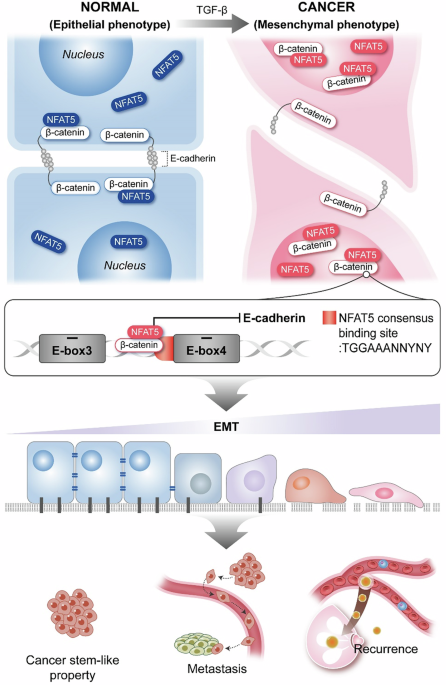
Metastasis and stem cell-like traits are major contributors to breast cancer lethality, yet the transcriptional mechanisms driving these processes remain poorly understood. Nuclear factor of activated T-cells 5 (NFAT5), is originally characterized as an osmoregulatory transcription factor implicated in cellular adaptation to hypertonic stress, has recently been implicated in cancer progression and invasion. However, the precise mechanisms by which NFAT5 contributes to breast cancer progression remain unclear. In this study, we investigated the role of NFAT5 in epithelial–mesenchymal transition (EMT) and stemness-associated phenotype in breast cancer cells. NFAT5 overexpression in MCF7 cells promoted EMT and mammosphere formation, whereas NFAT5 knockdown ameliorated transforming growth factor-β (TGF-β)-induced EMT, migration, and invasion. Disruption of the nuclear localization signal (NLS) in NFAT5 also inhibited TGF-β-induced EMT and reduced β-catenin nuclear accumulation. Mechanistically, TGF-β promoted NFAT5 nuclear localization and facilitated the formation of an intranuclear NFAT5/β-catenin complex. This complex enhanced NFAT5 occupancy at the E-cadherin promoter and was associated with reduced E-cadherin transcription. β-catenin depletion attenuated NFAT5 enrichment at the E-cadherin promoter and reduced nuclear NFAT5 accumulation, suggesting that β-catenin contributes to NFAT5 nuclear localization and promoter engagement during TGF-β-induced EMT. NFAT5 knockdown also reduced xenograft tumor growth and altered stemness-associated marker expression in vivo. In human breast cancer tissues, NFAT5 expression was significantly elevated and predominantly localized in the nucleus compared with adjacent normal tissues. Gene set enrichment analysis (GSEA) further showed enrichment of EMT-, stemness-, and Wnt/β-catenin-related gene signatures in NFAT5-high breast tumors. Together, these findings identify NFAT5 as a contributor to TGF-β-induced EMT and stemness-associated breast cancer progression through its interaction with β-catenin, highlighting NFAT5-associated transcriptional regulation as a potential therapeutic target in aggressive breast cancer.
Trending
- AI’s Evolving Role in Radiation Oncology
- Alcohol-related cancer deaths in US have more than doubled over three decades | Alcohol
- AI-Driven Auto-Contouring and Planning Enable Precise Radiation Oncology
- Why Do Radiotherapy Access Gaps Persist Even in Wealthy Countries?
- Mass General Brigham Medicare Advantage plan drops Dana-Farber
- NFAT5 regulates TGF-β-induced epithelial-mesenchymal transition in breast cancer cells through interaction with β-catenin
- Etentamig Improves ORR/PFS in Relapsed/Refractory Multiple Myeloma
- How Do Final CAPItello-291 OS Data Shape Capivasertib Use in Breast Cancer?


Friday, September 4
NFAT5 regulates TGF-β-induced epithelial-mesenchymal transition in breast cancer cells through interaction with β-catenin
 By NewsCancer