


Clinical sample acquisition
The studies involving human participants were reviewed and approved by Clinical Research Ethics Committee of the First Affiliated Hospital of Xiamen University (approval No. 2024-108). All the patients presented with informed consent preoperatively and received no treatment prior to biopsy. All biopsy tissues were obtained via nasopharyngeal endoscopy. NPC tissues were collected from patients diagnosed with NPC, while normal control tissues were obtained from individuals suspected of having NPC but ultimately confirmed to be negative. Altogether, we collected the primary tumors of 87 NPC patients, as well as 56 non-cancerous nasopharyngeal samples of normal subjects from the First Affiliated Hospital of Xiamen University (Data S1). Another clinical cohort included tissue microarrays from 89 NPC patients from SHANGHAI OUTDO BIOTECH CO., LTD. (Data S6). All cases were classified according to the 8th edition of the American Joint Committee on Cancer (AJCC) pTNM system. Clinical information regarding smoking, alcohol consumption, and histopathological factors was obtained from medical records. Overall survival (OS) was defined as the interval from diagnosis to death or from diagnosis to the last observation for surviving patients. Progression-free survival (PFS) was defined as the interval from diagnosis to the confirmation of recurrence, metastasis, or death.
Cell lines, organoids, and reagents
HK1 (EBV-) and C666-1 (EBV+) cells were cultured in RPMI-1640 medium supplemented with 10% fetal bovine serum (FBS) and 1% Penicillin /Streptomycin (P/S), while 5–8 F (EBV-) and HNE2 (EBV-) cells were cultured in DMEM supplemented with 10% FBS and 1% P/S. All cells were maintained under the humidified 5% CO2 atmosphere at 37 °C. One strain of NPC organoids was purchased from Xiamen Mogengel. The cryopreserved organoid vials stored in liquid nitrogen were retrieved and rapidly thawed in a 37 °C water bath for 1–2 min. After thawing, 5 volumes of organoid-specific medium (MB-0818L07, Xiamen Mogengel) were added, followed by gentle pipetting to mix thoroughly. The mixture was centrifuged at 1000 rpm for 5 min, and the supernatant was discarded. The organoid pellet was resuspended in complete medium containing Matrigel, which was then dropped into a culture dish to form microdroplets. The microdroplets were incubated in a 37 °C, 5% CO₂ incubator for 20 min to allow Matrigel solidification. After solidification, sufficient organoid medium was added, and the medium was refreshed every 2–3 days. The organoids were continuously cultured for 3–5 days until their morphology stabilized. Droxinostat (S1422), KU-0063794 (S1226), and Panobinostat (S1030) were purchased from Selleck Chemicals. Treprostinil (HY-100441), Evodiamine (HY-N0114), Griseofulvin (HY-17583), and GW-843682 (HY-11003) were purchased from MedChemExpress. Emetine (M2666) was purchased from Abmole.
Plasmids
Lentiviral expression vector of MYC was purchased from PPL (Public Protein/Plasmid Library). ShRNA targeting MYC were cloned into pPLK vector (targeting sequence: 5’-CAGTTGAAACACAAACTTGAA-3’ and 5’-CAATGACACCCTGTACTTCTT-3’). The plasmids pDRGFP and pCBASceI were purchased from Addgene.
Animals
Female BALB/c nude mice (age 4–6 weeks) were purchased from Charles River Laboratories Company (Beijing, China). All animal experiments were conducted following a protocol approved by the Institutional Animal Care and Use Committee of the Xiamen University Laboratory Animal Center. Mice were maintained in animal room with 12 h-light/12 h-dark cycles at Animal Facility in Xiamen University. For tumor implantation, C666-1 cells (5 × 10^6 cells per mouse) were suspended in RPMI-1640 medium without FBS and subcutaneously inoculated into the right hind limb of each mouse. Mice were then blindly randomized into experimental groups (n = 6 per group). Two sets of treatment regimens were implemented in the experiment. One set of treatments included intraperitoneal administration of either vehicle control (DMSO) or therapeutic agents (Panobinostat, 10 mg/kg; KU-0063794, 3 mg/kg; Droxinostat, 15 mg/kg) three times per week for four consecutive weeks, continuing until the predefined experimental endpoint. The other set of treatments consisted of Panobinostat monotherapy (5 mg/kg, intraperitoneal injection every three days for three weeks), localized radiotherapy (8 Gy single-dose irradiation), or their combination (Radiotherapy was administered 24 h prior to the first Panobinostat dose). The length and width of the tumors (in millimeters) were measured 3 times every week with calipers. Tumor volume was calculated using the formula (A*B2)/2, where A and B were the long and short dimensions, respectively. Mice were blindly randomized into different groups for treatment studies.
LC-MS/MS analysis
Protein extraction and digestion
The NPC and normal nasopharyngeal tissue samples were processed according to the Filter Aided Sample Preparation (FASP) method as described previously.15 Briefly, the tryptic peptides were desalted using StageTips and then lyophilized. Subsequently, they were labeled with TMTpro 16plex (Pierce) as per the manufacturer’s instructions. All samples were taken in equal amounts to mix for the “internal reference” used in TMT labeling. For each set of TMT labeling experiment, 100 µg of peptides from mixed samples per EP tube were used as internal reference. 1.6 mg labeled peptides were off-line fractionated by bRP using a Waters XBridge BEH C18 5 μm 4.6 × 250 mm column on an Ultimate 3000 high-pressure liquid chromatography (HPLC) system (Dionex) operating at 1 mL/min. Peptides were separated by a linear gradient from 5 to 40% B (5 mM ammonium formate, 90% ACN) in 66 min followed by a linear increase to 70% B in 6 min. A total of 72 peptide fractions were collected and sequentially numbered. These 72 fractions were first concatenated into 24 fractions (i.e., fractions 1, 25, 49 were combined; fractions 2, 26, 50 were combined, and so forth). For global proteome analysis, 5% of each of these 24 pooled fractions was aliquoted and reserved. The remaining 95% portion of the 24 fractions was renumbered, then further concatenated into 8 fractions (i.e., fractions 1, 9, 17 were combined; fractions 2, 10, 18 were combined, etc.). These 8 fractions were subjected to phosphopeptide enrichment using the Fe-NTA kit (Thermo Scientific, A32992) in strict accordance with the manufacturer’s instructions. Finally, all prepared peptide samples (both for proteome and phosphoproteome profiling) were lyophilized prior to LC-MS/MS analysis.
TMTpro 16-plex labeling
The 87 NPC tumor and 56 normal nasopharyngeal tissue samples were labeled in 10 groups of TMTpro 16plex experiments for LC-MS/MS analysis. For each TMTpro 16plex experiment, the mixed peptides were labeled with channel 131 C as the internal reference, and all NPC tumor and normal nasopharyngeal tissue samples were labeled with the other 15 channels (Tumor nasopharyngeal tissues labeled with 127 N, 128 N, 129 N, 130 N, 131 N, 132 N,133 N, and 134 N; non-tumor nasopharyngeal tissues labeled with 126, 127 C, 128 C, 129 C, 130 C, 132 C, and 133 C).
Proteomic and phosphoproteomic LC-MS/MS analysis
MS experiments were performed on Orbitrap Fusion Lumos (Thermo Fisher Scientific). The peptides were dissolved in 0.1% formic acid (FA) and separated on an analytical column (75 μm × 25 cm) packed with 2 μm C18 beads (Thermo Fisher Scientific) using a linear gradient ranging from 9 to 40% B (80% ACN and 0.1% FA) in 100 min and followed by a linear increase to 50% B in 20 min at a flow rate of 300 nL/min. The MS was operated in data-dependent acquisition (DDA) mode. The spray voltage was set at 2.2 kV and the temperature of ion transfer capillary was 300 °C. The MS spectra (350–1500 m/z) were collected with 60,000 resolution, AGC of 4 × 10⁵ and 50 ms maximal injection time. Selected ions were sequentially fragmented by HCD with 38% normalized collision energy in a 3 s cycle, specified isolated windows 0.7 m/z, 50,000 resolution. AGC of 1 × 10⁵ and 105 ms maximal injection time were used. Dynamic exclusion was set to 30 s.
MS data analysis
The data were collected using Xcalibur software (Thermo Fisher Scientific, version 3.0). Raw data was processed using Proteome Discoverer (PD, version 2.4), and MS/MS spectra were searched against the Uniprot human proteome database. Search parameters were as follows: 20 ppm tolerance of precursor mass error, 0.02 Da tolerance of fragment mass error, variable modification for oxidation (Met) ( + 15.9949 Da), TMTpro (Lys) (304.207 Da), phosphorylation (Ser, Thr, Tyr) ( + 79.966 Da) and acetylation (protein N-terminus) ( + 42.0106 Da), carbamidomethylation (Cys) ( + 57.0215 Da), TMTpro (N-terminal) (304.207 Da) as fixed modification. The peptide and protein identifications were filtered by PD to control the false discovery rate (FDR) < 1%. At least one unique peptide was required for protein identification.
Proteomic data analysis
Data normalization
The protein expression ratio is the ratio of sample abundance to “internal reference” mixed sample abundance. To reduce sample-specific bias in protein level quantification, expression ratios are log2-transformed and normalized using mean centering across all proteins. In normalized samples, proteins should have a log2-transformed expression ratio centered at zero.
Data filtering
The proteomic data was filtered to five datasets at different levels as the following criteria. Dataset 1 (Prot1): all proteins quantified in at least one of 10 TMT groups. Dataset 2 (Prot2): proteins quantified with high confidence in at least one of 10 TMT groups. Dataset 3 (Prot3): proteins quantified with high confidence in at least half samples. Dataset 4 (Prot4): proteins quantified in all samples. Dataset 5 (Prot5): proteins quantified with high confidence in all samples.
Batch effect analysis
The unsupervised PCA and hierarchical clustering were performed on protein expression ratios in Prot5 to assess batch effect due to TMT multiplexes in R v.4.4.1 based on group (Tumor/non-tumor) and run-id (Batch 1–10). For PCA, used R package base for confidence intervals. For hierarchical clustering, used complete linkage with Euclidean distance by R package pheatmap v.1.0.12.
Differential expression analysis between tumor and non-tumor
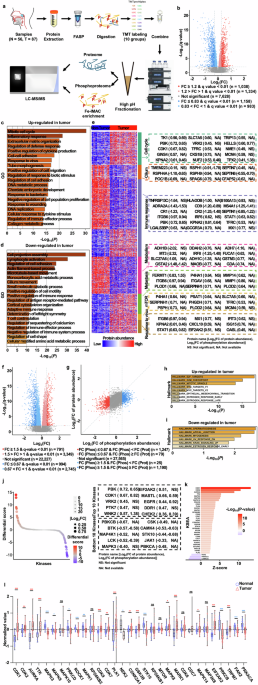
Differential expression analysis between tumor and non-tumor samples was performed on proteins in Prot1. The statistical significance was calculated by two-sided wilcoxon rank-sum test. Proteins with BH adjusted P value < 0.01 and FC (Fold change, ratio of average protein expression ratio between tumor and non-tumor samples) > 1.2 or < 0.83 were considered to be significantly upregulated or downregulated in tumor samples.
Differential expression analysis between EBV-positive and EBV-negative NPC
Differential expression analysis was performed on proteins in Prot1 between EBV-positive and EBV-negative NPC. The EBV infection status was shown in Data S1. The statistical significance was calculated by two-sided wilcoxon rank-sum test. Proteins with P value < 0.05 and FC (Fold change, ratio of protein expression between tumor and non-tumor samples) > 1.2 or < 0.83 were considered to be significantly upregulated or downregulated in tumor samples, respectively.
Correlation between protein expression ratios and clinical outcome
We evaluated the association between differential expression protein expression ratios and patient risk by Cox PH model. A univariate Cox PH model was used to estimate the hazard ratio (HR), confidence interval, and Cox P value of each protein. HR > 1 means that the expression of the protein is positively correlated with patient risk, while HR < 1 means a negative correlation. The correlation is considered significant if log-rank P value < 0.05. Correlation with OS and DFS are estimated separately.
Phosphoproteomic data analysis
Quantification and normalization of phosphosites
Each phosphopeptide’s abundance is determined by the sum of the three final eluted fractions. Phosphosite abundance is determined by the median abundance of all phosphopeptides matching that site. The expression abundance of the phosphosites was subjected to quantile normalization implemented in the R package limma v.3.42.2. Missing values were imputed with the minimum value in the phosphoproteomic data.
Phosphoproteomic data filtering
The phosphoproteomic data was filtered to three datasets at different levels using the following criteria. Dataset 1 (Phos1): Phospho-sites quantifiable in at least one of the 10 groups. Dataset 2: Phospho-sites quantifiable in at least half sample. Dataset 3: Phospho-sites quantifiable in all samples.
Differential phosphoproteomic analysis between tumor and non-tumor samples
Differential phosphoproteomic analysis between tumor and non-tumor samples was performed on phosphosites in Phos1. The statistical significance was calculated by two-sided wilcoxon rank-sum test. Phosphosites with BH adjusted P value < 0.01 and FC (Fold change, ratio of average phosphosite abundance between tumor and non-tumor samples) > 1.5 or < 0.67 were considered to be significantly upregulated or downregulated proteins in tumor samples.
Proteomic subtyping analysis
Consensus clustering for proteomic data
The consensus clustering method was used to implement the consensus clustering method to identify subtypes of NPC by R package ConsensusClusterPlus. The top 5,000 genes with the largest changes based on MAD (median absolute deviation) was selected for clustering analysis. The main settings are as follows: maximum cluster number (maxK) = 6, number of repeats (reps) = 1000, proportion of items to sample (pItem) = 0.8, proportion of features to sample (pFeature) = 0.8, cluster algorithm (clusterAlg) = “hc” (hierarchical clustering), distance = “pearson” and seed = 314. The average silhouette width which determine the optimal number of clustering was calculated using the R package cluster v.2.1.0.
Prognostic assessment of molecular subtypes
Kaplan–Meier curves was used to evaluate the OS and PFS difference between the two molecular subtypes, S1 and S2. The P value was calculated by log-rank tests.
The differential expression analysis between the two molecular subtypes
Differential expression analysis between the two molecular subtypes was performed on proteins in Prot1. The statistical significance was calculated by two-sided wilcoxon rank-sum test. Proteins with BH adjusted P value < 0.01 and FC (Fold change, ratio of average protein expression ratio between S2 and S1 subtype) > 1.2 or < 0.83 were considered to be significantly upregulated or downregulated in molecular subtypes samples.
Estimation of STromal and Immune cells in MAlignant Tumor tissues using Expression data (ESTIMATE) analysis for molecular subtypes
Immune cell and stromal cell score for all samples were calculated by the R package estimate.
Immunoinfiltration analysis for two molecular subtypes
Single-sample gene set enrichment analysis (ssGSEA) was performed using R package GSVA (version 1.46.0)81 to calculate the ssGSEA scores for immune cell gene set. The gene sets used in the ssGSEA analysis were retrieved from the following published study.82
Functional enrichment analysis
The differentially expressed proteins and phosphoproteins were used to infer enriched KEGG pathways, Hallmark gene sets, and GO biological functions by R package clusterProfiler. The differentially expressed proteins and phosphoproteins included: (1) upregulated or downregulated proteins in tumor vs. non-tumor samples; (2) upregulated or downregulated phosphoproteins in tumor vs. non-tumor samples; (3) upregulated or downregulated proteins in molecular subtypes vs. non-tumor samples; (4) upregulated or downregulated phosphoproteins in molecular subtypes vs. non-tumor samples.
Tumor diagnostic model
Signature identification
The differential proteins in tumor vs. normal-tumor samples were used as the initial feature set for feature identification. Feature selected was implemented on the initial feature set by the R package mlr and the maximum number of features was limited to no more than 3. Support vector machine (SVM) was chosen as the classifier because it has good generalization ability. Parameters were set as follows: feature selection method = “sfs” (sequential forward search), resampling algorithm = “Subsample”, number of resampling = 50, and performance measures = “auc”. We set the maximum number of features (“max.features”) to 1, 2 or 3, and repeated the feature selection process 100 times. Feature combinations that are frequently identified during feature selection are considered as robust signatures.
Signature evaluation
The classification performance of each signature was evaluated using five-fold cross-validation. For each cross-validation fold, the dataset was randomly partitioned into five equally sized subsets. Four of these subsets were used to train a Support Vector Machine (SVM) model for each signature, while the remaining subset served as the test set. This process was iterated five times, ensuring that each subset served as the test set exactly once. The performance of the SVM model for each signature was then measured by its Area Under the Receiver Operating Characteristic Curve (AUC) and accuracy on the held-out test set. To ensure an unbiased and robust evaluation, this entire five-fold cross-validation procedure was repeated 100 times, and the results were averaged.
Subtype prediction
For the 89 NPC patient samples included in the tissue microarray, the H-Scores of ACTBL2 and UNC13D were first subjected to log₂ transformation and further normalized via Z-score transformation. Subsequently, the normalized H-Scores of ACTBL2 and UNC13D for each patient were input into the subtype diagnostic model to predict the probability of their classification into the S1 or S2 subtype.
CMAP-based drug prediction
We used CAMP to predict potential drugs for NPC and two Subtypes. We first calculated the significance ranking by −10 * log(FC) * (P value), setting the top 150 most significantly changed proteins as signatures. The signatures were then compared to each reference gene-expression profile. When upregulated proteins tended to appear near the top of the list and down-regulated proteins near the bottom, it was named “positive connectivity”. Conversely, it was named “negative connectivity”, yielding a “connectivity score” ranging from +1 to −1. The connectivity score of each perturbagen was calculated using the signatures. We sorted perturbagens according to their connectivity scores in increasing order. And the top drugs with the highest negative connectivity scores were predicted as potential drugs.
Plasmids transfection, lenti-viral vectors packaging and infection
Plasmids transfection was carried out by employing Lipofectamine 2000 (Life Technology) or Transfect EZ 3000 Plus (Zhong Ke Xin Chuang Biotech) in accordance with the manufacturer’s protocol. Briefly, HEK293T cells were seeded in the culture plates coated with poly-D-lysine (0.1% (w/v), Sigma, P7280) and transfected with the lenti-viral vector along with the packaging vectors, pMDL, VSVG, and REV, at a ratio of 10:5:3:2 using Transfect EZ 3000 Plus. After 48 h, the virus was collected, filtered, and added to HK1 and C666-1 cells in the presence of 10 mg/mL polybrene (Sigma, H9268), followed by centrifugation for 30 min at 1500 × g at 37 °C. The medium was replaced 24 h later.
RNA Isolation and real-time quantitative PCR (RT-qPCR)
Total RNA was isolated using Trizol (Invitrogen) following the manufacturer’s protocol. First-strand cDNA synthesis from total RNA was carried out using GoScript™ Reverse Transcription Mix (Promega, random primers), followed by quantitative PCR (qPCR) using AriaMx Real-Time PCR machine (Agilent Technologies). qPCR was performed using AriaMx Real-Time PCR machine (Agilent Technologies). All RT-qPCRs were repeated at least three times, and the relative abundance of each transcript was normalized to the expression level of GAPDH. Sequence information for all the primers used were presented in Supplementary Data 9.
RNA Sequencing (RNA-seq)
To prepare RNA for sequencing, total RNA was isolated using RNeasy Mini Kit (Qiagen) following the manufacturer’s protocol. DNase I in column digestion was included to ensure the RNA quality. RNA library preparation was performed by using NEBNext® UltraTM Directional RNA Library Prep Kit for Illumina(E7420L). Paired-end sequencing was performed with Illumina HiSeq platform at Amogene Biotech Co., Ltd.
BCL files were demultiplexed and converted to fastq files by using bcl2fastq (version 2.20), and then fastp (version 0.19.10) was used to trim adapter and filter out low quality reads. Sequencing reads were aligned to hg19 reference genome by using Tophat83(http://ccb.jhu.edu/software/tophat/index.shtml). Cuffdiff was used to quantify the expression of RefSeq annotated genes with the option -M (reads aligned to repetitive regions were masked) and -u (multiple aligned reads are corrected using ‘rescue method’).83 Coding genes with FPKM (fragments per kilobase per million mapped reads) larger than 0.5 in any of the experimental conditions were included in our analysis. FPKM of a gene was calculated as mapped reads on exons divided by exonic length and the total number of mapped reads.
Western blotting
Proteins were extracted from cells using RIPA Lysis Buffer (E-BC-R327, Elabscience). The protein lysates were quantified by BCA assay (23250, Thermo Fisher). Samples were then loaded onto SDS-PAGE gels and electrophoresed at a constant voltage. Subsequently, proteins were transferred to a PVDF using wet transfer system. The membrane was blocked with 5% skim milk in TBST (50 mM Tris-HCl (pH 7.4), 150 mM NaCl, 0.1% Tween-20) for 1 to 2 h at room temperature. Next, primary antibodies specific to the target proteins were added and incubated overnight at 4 °C. After washing with TBST for 5 times, the membrane was incubated with the appropriate secondary antibody conjugated to horseradish peroxidase (HRP) for 1 h at room temperature. Finally, the protein bands were visualized using an enhanced chemiluminescence (ECL) detection system, and the images were captured using a gel imaging system. Rabbit anti-ATR polyclonal antibody (A21253, Abclonal), rabbit anti-CHEK1 antibody (A4194, Abclonal), rabbit anti-RAD51 antibody (A6268, Abclonal), rabbit anti-BRCA1 antibody (22362-1-AP, Proteintech), rabbit anti-cMYC antibody (67447-1-IG, Proteintech) and rabbit anti-ACTBL2 antibody (DF4799, Affinity Biosciences) were diluted at 1:1000. Mouse anti-α-Tubulin monoclonal antibody (A6830, Abclonal) and mouse anti-UNC13D monoclonal antibody (67193-1-Ig, Proteintech) was diluted at 1:5000.
Cell proliferation assay
The cells were digested and cultured in a medium containing 10% serum to form a single cell suspension. The cells were counted and inoculated into 96-well plates with 1,000 cells per well (100 μL/well). The cells were cultured for 12 h to adhere to the cell well, and then the culture medium with different drug concentration was changed. After incubation for different duration, 10 μL CCK8 (GK10001, GlpBio) was added into each well for 1 h. The absorbance value of each well was measured at the wavelength of 450 nm using Infinite F50 Plus microplate reader (TECAN). The cell viability at different drug concentrations was calculated and then mapped with GraphPad prism 9 software.
Colony formation assay
In the 6-well plates, 500–1000 cells per well were inoculated. After 24 h, the cells adhered to the well. Different concentrations of drugs were added to the cell culture medium, and the culture medium was replaced with drug every two days for 2 weeks. After washing with cold PBS, cells were fixed with cold 4% paraformaldehyde for 20 min and stained with crystal violet for 15 min. Each experiment was done in triplicate.
ATP detection in organoids
Organoids with uniform morphology and good viability were selected and transferred to a 96-well plate (approximately 50 organoids per well). After culturing for 3–5 days until the organoid morphology stabilized, different drugs were added for treatment, followed by incubation at 37 °C with 5% CO₂ for 72 h. After incubation, the 96-well plate was placed under an inverted microscope, and 3–5 random fields of view were selected for each group to observe and record the size, integrity, and structural changes of organoids. Imaging was performed with a Leica DMi8 microscope. After photography, the medium in the wells was aspirated and discarded, and 100 μL of ATP detection reagent diluted according to the kit instructions (Beyotime, C0056L) was added to each well, followed by shaking incubation at room temperature in the dark for 10 min. Subsequently, the supernatant in each well was transferred to a microplate reader (SpectraMax i3x) to detect the fluorescence intensity with the fluorescence value indirectly reflecting ATP content and cell viability. Finally, the relative viability of each drug group was calculated with the control group viability set as 100%, and statistical analysis was performed using Prism 9 software.
Cell cycle by flow cytometry
The cells treated with 100 nM panobinostat or DMSO for 72 h were collected and rinsed with cold PBS. Subsequently, the cells were incubated with RedNucleus I (C6078S, UElandy) in binding buffer for 20 min in the dark. The samples were analyzed on a flow cytometer, and the proportions of cells in G0/G1, S, and G2/M phases were calculated using Flowjo 10.8.1. The experiment was independently repeated three times, and data were presented as mean ± SEM. Differences between groups were analyzed by one-way ANOVA, with P < 0.05 considered statistically significant.
Tissue microarray (TMA) and immunohistochemistry (IHC)
A TMA containing 89 NPC tissue samples was obtained from SHANGHAI OUTDO BIOTECH CO.,LTD., with the clinical data of these 89 patients provided in Supplementary Data S6; the markers used in this study included ACTBL2 and UNC13D, and the primary antibodies were rabbit anti-human ACTBL2 polyclonal antibody (Cat. No. DF4799, Affinity Biosciences) diluted at 1:200 and mouse anti-human UNC13D monoclonal antibody (Cat. No. 67193-1-Ig, Proteintech) diluted at 1:500, after which tissue sections were scanned using the TissueFAXS SpectraS Automatic Quantitative Pathological Imaging System (Tissue Gnostics); the specific scoring criteria were as follows—the staining status of each tissue spot was observed under low magnification and classified into three grades based on staining intensity: weak positive (1 + , pale yellow), moderate positive (2 + , brownish yellow), and strong positive (3 + , brown); 100 cells were randomly selected in one field of view of each tissue spot to calculate the percentage of positive cells (denoted as X₁%), the same procedure was repeated in another two fields of view to determine the positive cell percentages (denoted as X₂% and X₃%), the average of the three percentages was taken as the final positive rate of the tissue spot, then the H-Score was calculated based on staining intensity and positive rate using the formula: H-Score = (Percentage₀₊ × 0) + (Percentage₁₊ × 1) + (Percentage₂₊ × 2) + (Percentage₃₊ × 3), and the resulting H-Score ranged from 0 to 300, representing the continuous expression level of the target protein.
Immunofluorescence (IF) analysis
The cells were seeded on coverslips in 24-well plates. After the cells adhered to the well, the culture medium was then replaced with fresh medium containing different concentrations of drugs for 24 h. Then the cells were washed twice with PBS and fixed with 4% paraformaldehyde (Solarbio) at room temperature (RT) for 20 min. Cells were then washed again with PBS and incubated with 0.1% (v/v) Triton X-100 (Sigma) in PBS for 10 min at RT. After washing twice with PBS, cells were blocked in 2% BSA (Sigma) in PBS for 1 h at RT and incubated with primary antibodies (anti-γH2AX, Abcam, ab9110; 1:200 dilution) overnight at 4 °C. After washing five time with PBS, the cells were incubated with secondary antibodies (GeneTex, GTX213111-05) for 1 h and then DAPI (Biosharp) for 5 min at RT, followed by extensive washes with PBS. Next, cells were mounted on a slide with fluoromount-G (SouthernBiotech). Imaging was performed with a Leica DMi8 microscope.
Ten cases of NPC tissues and ten cases of non-cancerous nasopharyngeal tissues and tissue microarrays were processed as follows: tissue microarrays were placed in an oven at 63 °C for 1 h to bake paraffin. Deparaffinization was performed using the LEICA ST50 automatic staining machine. For antigen retrieval, 10 × retrieval solution (AR6001KT, Akoya) was diluted to 1 × working solution; the solution was boiled in a microwave at high power for 3 min, then slides were immersed, and microwave power was adjusted to low power for further retrieval for 15–20 min (ensuring tissues remained submerged throughout). Slides were cooled naturally to room temperature. After retrieval, slides were washed with TBST, placed in a humidified chamber, and incubated with blocking buffer (ARD1001EA, Akoya Biosciences) for 10 min. Primary antibodies (anti-IGF2BP3 mouse monoclonal, MA5-32838, Thermo Fisher Scientific, 1:500; anti-FERMT1 rabbit monoclonal, 22215-1-AP, Proteintech, 1:100; anti-CD33 rabbit monoclonal, ab269456, Abcam, 1:100; anti-CD11B rabbit monoclonal, ab133357, Abcam, 1:100; anti-CD4 rabbit monoclonal, PA285, Abcarta, 1:100; anti-CD8 rabbit monoclonal, PA577, Abcarta, 1:100; Abcarta, 1:100; anti-Foxp3 mouse monoclonal, PA448, Abcarta, 1:100) were added to the humidified chamber and incubated at room temperature for 1 h, followed by TBST washes. Secondary antibodies were then applied and incubated at room temperature for 10 min, with subsequent TBST washes. Opal dye dilution (1:100) was added and incubated at room temperature for 10 min, followed by TBST washes. To remove primary/secondary antibodies, microwave retrieval was performed, and slides were washed with TBST. For multiplex staining, blocking to antibody removal were repeated until all targets were labeled. Finally, DAPI (BDHM-0009, Beida Heming Technology) working solution was applied in a humidified chamber for 10 min at room temperature; slides were washed with TBST, then mounted with VECTASHIELD® HardSet Antifade Mounting Medium (H-1400, Vector Labs). Images were scanned using the TissueFAXS SpectraS automatic quantitative pathological imaging system (Tissue Gnostics). Quantification was performed with Qupath software (version 0.4.3), and statistical analysis was conducted using unpaired Student’s t-test.
Apoptosis detection by flow cytometry
The cells treated with different concentrations of drugs or control for 72 h were collected and rinsed with cold PBS. Subsequently, the cells were incubated with Annexin V-FITC and PI (556547, BD) in binding buffer for 20 min in the dark. The samples were then analyzed on a flow cytometer. Cells showing Annexin V-positive staining but PI-negative were classified as early apoptotic cells, and those positive for both Annexin V and PI were late apoptotic or necrotic.
HR (homologous recombination) detection by flow cytometry
Cells were first transfected with the DR-GFP plasmid for 72 h before transfecting with I-Sce plasmid for 24 h. Cells were treated with or without Panobinostat or MYCi975 for 48 h before washing with ice-cold PBS and then subjected to flow cytometry analysis to quantify the proportion of GFP-positive cells.
Data visualization
Data visualization was performed in R (version 4.2.2), using the ggplot2 (version 3.4.1), ggpubr (version 0.6.0), ggraph (version 2.1.0), pheatmap (version 1.0.12), and UpSetR (version 1.4.0) packages.
