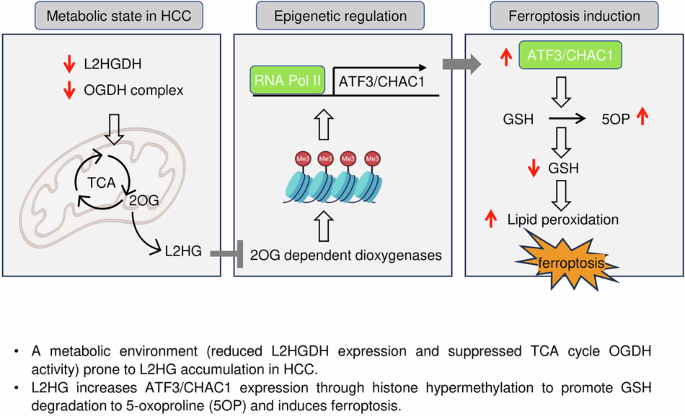
Ferroptosis is an iron-dependent form of regulated cell death driven by lipid peroxidation and glutathione (GSH) depletion and represents a therapeutic vulnerability in hepatocellular carcinoma (HCC). While canonical ferroptosis regulation centers on cystine uptake and GPX4-mediated GSH utilization, the endogenous metabolic pathways governing ferroptosis sensitivity in liver tumors remain incompletely understood. Here, using a metabolic-scale CRISPR activation screen integrated with transcriptomic and metabolomic analyses, we identify L-2-hydroxyglutarate dehydrogenase (L2HGDH) as a potent antagonist of ferroptosis in HCC. We demonstrate that L2HGDH is frequently suppressed in liver tumors, leading to pathological accumulation of its substrate L-2-hydroxyglutarate (L2HG). Elevated L2HG sensitizes HCC cells to ferroptosis both in vitro and in vivo. Mechanistically, L2HG acts as a metabolic-epigenetic regulator that inhibits 2-oxoglutarate-dependent dioxygenases, induces histone hypermethylation, and remodels chromatin accessibility to activate an ATF3-dependent transcriptional program. This program induces the glutathione-degrading enzyme CHAC1, thereby accelerating GSH degradation to 5-oxoproline and disrupting redox homeostasis. Notably, L2HG-induced ferroptosis occurs independently of impaired cystine uptake, transsulfuration pathway activity, or increased GPX4-mediated GSH utilization, revealing a non-canonical ferroptosis mechanism driven by enhanced GSH catabolism. Consistent with these findings, genetic targeting of L2HGDH suppresses tumor growth, elevates L2HG levels, enhances GSH degradation, and promotes ferroptosis in HCC xenograft models. Collectively, our study identifies the L2HGDH-L2HG axis as a previously unrecognized metabolic checkpoint controlling ferroptosis sensitivity in liver cancer and uncovers glutathione degradation as a therapeutically exploitable vulnerability for ferroptosis-based treatment strategies in HCC.
Trending
- I had 11 years of chemotherapy for a cancer I didn’t have
- Cancer treatment alters the selection of pre-existing somatic mutations in normal esophagus
- Patient-derived 3D organotypic co-cultures as a long-term ex vivo model for pleomorphic adenoma of the parotid gland
- Teclistamab versus lenalidomide-dexamethasone in high-risk smoldering multiple myeloma: a randomized phase 2 trial
- MMSDH facilitates ACSL4 propionylation to counteract ferroptosis upon hypoxia and impairs PDAC chemotherapy efficacy
- Development and preclinical evaluation of a decoy DLL4-encoding oncolytic HSV-1 for high-grade glioma
- ATR inhibition induces NF-κB-dependent immunogenicity in Merkel cell carcinoma independent of cGAS-STING
- Debating CAR T-Cell Therapy Vs Bispecifics at First Relapse in Myeloma


Monday, September 14
L-2-Hydroxyglutarate sensitizes ferroptosis through ATF3/CHAC1-mediated glutathione degradation in hepatocellular carcinoma
 By NewsCancer