


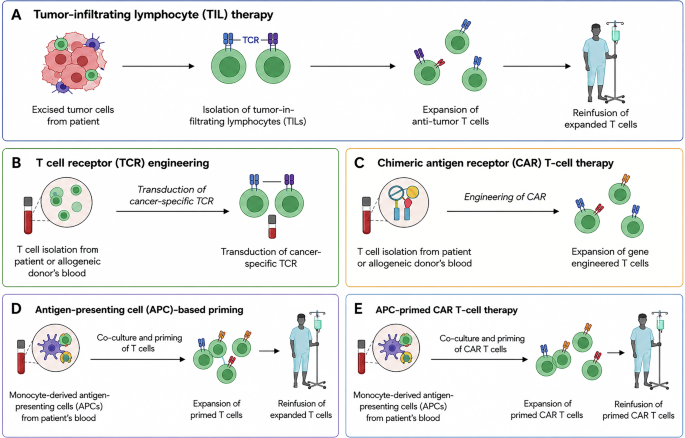
While multiple T cell–based immunotherapies exist, this review focuses specifically on CAR-T cell engineering, with emphasis on how costimulatory domains regulate persistence in triple-negative breast cancer (TNBC). Other adoptive T-cell approaches, including tumor-infiltrating lymphocyte (TIL) therapy and T cell receptor (TCR) engineering, have shown therapeutic potential; however, this review centers on CAR-T cells due to their capacity to recognize tumor antigens independently of major histocompatibility complex (MHC) presentation and their adaptability through genetic engineering [15, 30, 31] (Fig. 1).
Fig. 1: Schematic representation of the main strategies for adoptive T-cell therapy to treat tumors.
A Tumor-infi ltrating lymphocyte (TIL) therapy. Tumor tissue is obtained from the patient, and TILs are isolated from the excised tumor, expanded ex vivo, and subsequently reinfused into the patient. B T-cell receptor (TCR) engineering. T cells isolated from the patient or an allogeneic donor are genetically modifi ed ex vivo to express tumor-specifi c TCRs and expanded for therapeutic use. C Chimeric antigen receptor (CAR) T-cell therapy. T cell sisolated from the patient or an allogeneic donor are genetically engineered to express CARs that recognize tumor-associated antigens, followed by ex vivo expansion and reinfusion. D Antigen-presenting cell (APC)-based priming. Monocyte-derived APCs are generated from the patient’s blood and co-cultured with T cells to promote tumor-antigen-specifi c activation and expansion before reinfusion. (E) APC-primed CAR T-cell therapy. Monocyte-derived APCs are co-cultured with CAR T cells to enhance their activation and expansion prior to reinfusion into the patient. Collectively, these approaches rely on ex vivo activation and/or genetic modifi cation, expansion, and subsequent reintroduction of therapeutic T cells. They diff er principally in the mechanisms by which tumor antigens are recognized and, for TCR- and APC-dependent approaches, in their reliance on major histocompatibility complex (MHC)-mediated antigen presentation. The figure was created with BioRender.com [7, 8, 30, 78].
CAR-T cell therapy has evolved through several generations of design, with second-generation CARs introducing costimulatory domains such as CD28 or 4-1BB, which significantly enhance T-cell activation, proliferation, and survival compared to first-generation constructs that rely solely on CD3ζ signaling [18, 19, 23]. Subsequent CAR designs have incorporated multiple or alternative costimulatory domains to further refine T-cell function and persistence [5, 7] (Fig. 2).
Fig. 2: Schematic showing the evolution of CAR-T cells over multiple generations and an overview of the co-stimulator domain.
A The first generation of CARs has an antigen-binding extracellular domain (generally a single-chain variable fragment (scFv)) to bind a specific antigen, a hinge region, and a transmembrane region from the scFv domain to link to the intracellular portion of the CAR containing a CD3ζ signaling domain to activate T cells in the absence of costimulation. B The second generation of CARs has one costimulation domain (for example, either CD28 or 4-1BB) added to the CD3ζ signaling domain to increase T cell activation and proliferation and enhance T cell persistence. C The third generation of CARs has two costimulatory domains (typically CD28 and 4-1BB) to increase T cell signaling and enhance T cell function. D The fourth generation of CARs, called a TRUCK, can be designed to induce the production of cytokines or additional co-stimulatory ligands through methods that utilize NFAT transcription, allowing CAR-T cells to alter the tumor microenvironment. E Enhanced fourth-generation CAR constructs have further modified T cell signaling through the addition of regulatory elements, resulting in increased production of cytokines from T cells and increased local immune activation. F The fifth generation of CARs will contain intracellular signaling domains that are derived from cytokine receptors (such as IL-2Rβ), allowing the CAR-T cells to activate JAK-STAT signaling pathways and achieve sustained proliferation, survival, and long-term persistence. This diagram summarizes how the addition of co-stimulator and cytokine signaling domains throughout the evolution of CAR-T cells will affect T cell signaling, metabolic programming, and long-term persistence. The illustration was created utilizing previously published work that describes CAR T cell design and function, and was created using BioRender.com [18, 19, 24].
In the context of TNBC, the selection of costimulatory domains is a key determinant of CAR-T cell persistence, as these domains regulate intracellular signaling pathways that influence metabolic fitness, differentiation state, and resistance to exhaustion within the tumor microenvironment [8, 11, 23, 32].
Integrated signaling pathways governing CAR-T cell persistence
In TNBC, costimulatory domains modulate CAR-T cell persistence primarily through differential activation of signaling pathways that control metabolism, survival, and differentiation under immunosuppressive conditions. Costimulatory domains function independently of their structural classification to activate intracellular signaling cascades that ultimately determine CAR-T cell fate, particularly within the hostile tumor microenvironment characteristic of solid tumors such as TNBC (Fig. 3) [19, 24].
Fig. 3: Costimulatory domain–dependent signaling pathways regulating CAR-T cell persistence.
A CD28-mediated signaling activates the PI3K–AKT–mTOR pathway, promoting glycolysis, rapid effector differentiation, and early cytotoxicity but contributing to exhaustion under reduced persistence. B 4-1BB–mediated signaling activates TRAF-dependent pathways, including NF-κB and p38 MAPK, supporting mitochondrial biogenesis, oxidative phosphorylation, long-term persistence, and memory T-cell formation. C Comparative metabolic programming: CD28 favors glycolytic metabolism, whereas 4-1BB promotes oxidative metabolism and long-term persistence. D Functional consequences in TNBC: differential signaling affects CAR-T cell persistence, exhaustion, and resistance to immunosuppressive conditions in the tumor microenvironment. This schematic summarizes key intracellular signaling pathways activated by major costimulatory domains and their impact on CAR-T cell persistence, metabolism, and functional differentiation. The framework is derived from studies investigating CD28- and 4-1BB-mediated signaling, tonic signaling, and mechanisms regulating CAR-T cell exhaustion and survival [9, 19, 20, 22, 35]. CD28 signaling is associated with PI3K–AKT–mTOR activation and glycolytic metabolism, whereas 4-1BB signaling promotes mitochondrial biogenesis and oxidative phosphorylation through NF-κB–dependent pathways. These signaling differences are critical determinants of CAR-T cell persistence, particularly in the metabolically restrictive tumor microenvironment of TNBC. The figure was developed using BioRender.com.
CD28-based CAR-T cells predominantly activate the PI3K–AKT–mTOR signaling axis, which promotes rapid effector differentiation, glycolytic metabolism, and immediate cytotoxic function [19, 20, 23]. While this signaling profile enhances early tumor clearance, sustained mTOR activation has been associated with terminal differentiation and increased susceptibility to exhaustion, particularly under nutrient-deprived and hypoxic conditions typical of the TNBC tumor microenvironment [20, 21]. In contrast, 4-1BB–based CAR-T cells preferentially engage TRAF-mediated signaling pathways, including non-canonical NF-κB and p38 MAPK, which support mitochondrial biogenesis, oxidative phosphorylation, and the development of central memory-like T-cell phenotypes [19, 22]. Long-term persistence and continued antitumor activity are associated with these biopsy-transcriptional programs, which were mostly described in non-TNBC solid tumor or hematologic models, in solid tumours, including TNBC [9, 22].
Emerging costimulatory domains, such as HVEM and TNFRSF9, introduce additional layers of signaling complexity by modulating the balance between activating and inhibitory pathways within the tumor microenvironment (Fig. 4). HVEM functions as a bidirectional signaling receptor, capable of promoting NF-κB activation through interaction with LIGHT, while also mediating inhibitory signaling via BTLA or CD160, thereby influencing T-cell activation in a context-dependent manner [33, 34]. Similarly, TNFRSF9 (4-1BBL) signaling enhances CAR-T cell survival and persistence through activation of anti-apoptotic pathways, including upregulation of Bcl-xL, and supports mitochondrial fitness [22]. These domains may contribute to improved CAR-T cell durability by promoting resistance to apoptosis and maintaining functional capacity during prolonged antigen exposure. However, their precise effects in TNBC remain incompletely defined.
Fig. 4: Additional mechanisms regulating CAR-T cell persistence, safety, and therapeutic efficacy in TNBC.
A Tonic signaling of the CAR design is a result of receptor clustering due to the high degree of affinity of the scFv and will happen before there is any interaction with a ligand, and as a result of being activated by a ligand, the CAR activates the PI3K-AKT-mTOR pathway, resulting in T-cell exhaustion. B If there are high levels of costimulation, then there will be a high level of cytokine release, thus putting the patient at increased risk of developing CRS and ICANS. C Although HVEM’s signaling pathway is capable of a bidirectional regulatory effect, an interaction with LIGHT leads to the induction of NF-kB (in both T cells and LIGHT-responsive cells), and these signals will lead to increased survival of T cells through activation of the NF-kB pathway (i.e., Bcl-xL). Conversely, if the T cells express either BTLA or CD160, then those receptors will provide T-cell inhibition signals that are dependent on the strength of activation and the time since activation. D T-cells are activated through the engagement of 4-1BBL (TNFRSF9) and the resulting engagement of the NF-kB pathway will provide for prolonged CAR T-cell persistence. E Factors in the TNBC tumoral microenvironment that influence CAR T-cell functionality include a hypoxic environment, immunosuppressive cytokines (TGF-beta and/or IL-10), regulatory immune cells, and immune checkpoint signaling, leading to T-cell metabolic dysfunction and exhaustion. F Strategies aimed at optimizing CAR-T persistence include, but are not limited to, balancing activation and persistence via dual co-stimulation, checkpoint blockade, and metabolic reprogramming/epigenetic modifications. These diagrams illustrate results or mechanisms arising from scientific investigations of CAR-T-cell signaling (i.e., tonic activation of CAR-T cells), CAR-T cellular interaction with the tumor microenvironment, and next-generation engineering and were created using BioRender.com [19, 20, 22, 35, 67].
Collectively, these findings suggest that different costimulatory domains regulate CAR-T cell persistence by shaping distinct signaling networks that control metabolic programming, differentiation state, and resistance to exhaustion. In the context of TNBC, where the tumor microenvironment imposes significant metabolic and immunosuppressive constraints, the selection and optimization of costimulatory domains represent critical determinants of therapeutic efficacy.
A significant proportion of these mechanistic insights are derived from hematologic malignancies or non-TNBC solid tumor models. While these findings provide a valuable framework, their direct applicability to TNBC remains to be fully validated and should be interpreted with caution.
The majority of mechanistic models detailing the costimulatory signaling pathway (e.g., the PI3K–AKT–mTOR pathway or that of NF-κB) have been developed by studying hematologic malignancies or using model systems based on non-TNBC solid tumors [19, 20]. Additionally, although these studies have provided essential information regarding CAR-T cell biology, they do not always translate well to TNBC, due to unique characteristics associated with TNBC cells and their related immune suppression, which may ultimately impact the signaling dynamics for CAR-T cells and persistence [1, 11]. Thus, in instances where minimal or no TNBC-specific data are available, conclusions should be viewed as hypothesis-generating rather than conclusive.
In particular, improved CAR-T cell persistence does not uniformly accompany increased costimulatory signaling. Tonic signaling is constituted independently of ligand activation may occur as a result of features of the CAR design, such as scFvs having high affinities, spontaneous clustering of the receptors, and strong costimulatory domains [19, 20]. Tonic signaling via CD28-containing CAR constructs is associated with enhanced activation of the PI3K-AKT-mTOR signaling cascade, resulting in early T-cell exhaustion and impaired longevity [19, 35]. In contrast, tonic signaling via 4-1BB-containing CAR constructs is associated with improved mitochondrial function, memory development, and a reduced likelihood of dysfunction due to persistent exposure to antigen [19, 22]. In TNBC, where CAR-T cells are continuously exposed to antigen stimulation and an immunosuppressive environment, excessive tonic signaling could increase metabolic stress and impair CAR-T cell function.
Excessive co-stimulation can lead to serious safety concerns and negatively affect the persistence of CAR-T cells (see Fig. 4). The degree of stimulation from a strong co-stimulatory domain has also been shown to be associated with higher levels of cytokine production; increased activation may place a patient at greater risk of developing CRS or other inflammatory toxicities [16, 31]. In addition, persistent activation can contribute to activation-induced cell death and immune system dysregulation due to prolonged signaling, thereby limiting the durability of CAR-T cells as a therapy [7, 20]. Specific design parameters of CAR-T cells, such as co-stimulatory domain choice, scFv affinity, hinge/transmembrane design, and expression level, can greatly influence both the tonic signaling and the safety profile of CAR-T cell therapy [24, 35]. Therefore, the results of this study suggest that optimizing persistence of CAR-T cells in TNBC requires adequate calibration of co-stimulation magnitude to achieve a suitable compromise among efficacy, long-term function, and patient safety.
Regarding TNBC, it has been determined that excessive co-stimulation signaling could lead to an accelerated rate of CAR T cell exhaustion and risk of toxicity and that it would be more important to design signals to be balanced rather than maximally activated.
CD28 domain
Within TNBC-relevant models, CD28 costimulation is associated with rapid effector differentiation and strong initial cytotoxicity but limited long-term persistence due to increased susceptibility to exhaustion in the immunosuppressive tumor microenvironment [9, 19, 20]. CD28 provides a critical costimulatory signal through interaction with CD80/CD86 ligands, leading to enhanced T-cell activation, proliferation, cytokine production, and survival [36]. In CAR-T cells, incorporation of the CD28 intracellular domain activates downstream signaling pathways, particularly PI3K–AKT–mTOR, which promote glycolytic metabolism and effector T-cell differentiation [20, 23]. These signaling characteristics enable rapid tumor cell killing but are also associated with terminal differentiation and reduced persistence under chronic antigen exposure [20, 21]. This means that in triple-negative breast cancer, the CD28 costimulation pathway increases effector functions in the early stages through the traditional glycolytic pathway that is primarily controlled by the PI3K-AKT-mTOR pathway, but it also limits the persistence of CAR-T cells due to an increased rate of differentiation and an increased risk of experiencing exhaustion once located within the tumor microenvironment.
Studies in TNBC and other solid tumor models are investigating the efficacy of CD28-based CAR-T cells targeting tumor-associated antigens (TAAs), including HER2, MUC1, and EGFR, with the aim of improving tumor specificity and therapeutic outcomes [13, 37]. CD28-based CAR-T cells promote antitumor activity through increased production of cytokines such as IL-2 and IFN-γ, which support T-cell expansion and effector function [23]. However, the TNBC tumor microenvironment, characterized by the presence of regulatory T cells (Tregs), myeloid-derived suppressor cells (MDSCs), and inhibitory cytokines such as IL-10 and TGF-β, imposes significant constraints on CAR-T cell activity and persistence [11, 13]. While CD28 signaling enhances early activation and pro-inflammatory responses, these same features may accelerate exhaustion in the context of sustained antigen stimulation within solid tumors [20, 21].
In preclinical trials involving solid tumors without triple-negative breast cancer (TNBC), CD28-based CAR-T cells showed superior early tumor clearance compared with 4-1BB CARs. This was especially evident in models of tumors designed to express both CD19 and EGFR [20, 22]. However, these responses are often not durable, as CD28-driven CAR-T cells tend to decline more rapidly over time [22, 38]. In TNBC-specific models, combination strategies have been explored to overcome these limitations. For example, CAR-T cells targeting carcinoembryonic antigen (CEA) with CD28ζ signaling have shown enhanced cytotoxicity in vitro, and when combined with image-guided radiation therapy (IGRT), demonstrated improved tumor control and CAR-T cell infiltration in orthotopic TNBC mouse models [39]. These findings suggest that augmenting CD28-based CAR-T cells with complementary therapeutic approaches may improve their persistence and efficacy.
Additional strategies to enhance CD28-based CAR-T cell performance include combining CAR-T therapy with immune checkpoint inhibitors, engineering CAR-T cells to secrete pro-inflammatory cytokines, and modifying chemokine receptor expression to improve tumor infiltration [8, 11]. Advances in gene-editing technologies, such as CRISPR/Cas9, have also enabled targeted modification of inhibitory pathways and immune checkpoint regulators to improve CAR-T cell persistence [40]. Furthermore, optimizing CAR design parameters—including receptor affinity and costimulatory domain combinations—has been shown to influence functional outcomes and resistance to immunosuppression [41].
Despite these advances, a substantial portion of the mechanistic understanding of CD28 signaling is derived from hematologic malignancies or non-TNBC solid tumor models. Therefore, the extent to which these findings translate to TNBC remains under active investigation. In the context of TNBC, these findings suggest that CD28-driven signaling enhances early tumor control but may compromise persistence unless combined with strategies that mitigate exhaustion [20, 35].
Studies on CD28-mediated signaling to understand why CAR-T cells persist have mostly examined blood cancers; however, there are also studies showing both similarities and differences between TNBC and blood cancers. An example of this is that CD28 signaling promotes rapid differentiation into terminal effector cells across multiple systems, but at the same time does not promote CD28-mediated CAR-T cell persistence like it does in TNBC due to increased metabolic challenge and immunosuppressive signaling in the TNBC tumor microenvironment [1, 11, 19, 20]. Therefore, care should be taken when using CD28-based CAR-T cell strategies in TNBC due to the lack of concordance with other non-TNBC settings.
4-1BB (CD137) costimulatory domain
In TNBC-associated models, 4-1BB costimulation promotes mitochondrial biogenesis and oxidative metabolism, supporting the development of memory-like CAR-T cells with enhanced persistence [9, 19, 20]. Unlike CD28-driven signaling, which favors rapid effector differentiation, 4-1BB activates TRAF-dependent pathways, including non-canonical NF-κB and p38 MAPK, leading to improved mitochondrial fitness, resistance to apoptosis, and sustained T-cell survival [19, 22]. These signaling characteristics are particularly advantageous in the nutrient-deprived and immunosuppressive tumor microenvironment of TNBC, where long-term persistence is essential for therapeutic efficacy [9, 21]. With regard to TNBC, this indicates that 4-1BB costimulation increases CAR-T cell persistence because 4-1BB costimulation supports mitochondrial health, oxidative metabolism, and resistance to apoptosis for long-term anti-tumor effects during a metabolism-exhausted state [22].
According to research on non-TNBC solid cancerous tissue models carried out in clinical research studies, CAR-T cells utilizing 4-1BB as a signal have been found to survive longer and persist longer than those utilizing CD28, but typically have slower growth (proliferation) and killing (cytotoxic) abilities initially [19, 23]. In TNBC xenograft models, 4-1BB signaling has been associated with increased CAR-T cell infiltration and sustained tumor control, highlighting its relevance for solid tumor applications [42]. However, excessive or prolonged stimulation of the 4-1BB pathway may contribute to T-cell dysfunction, indicating that an optimal balance of signaling intensity is required to maximize persistence while avoiding exhaustion [42]. In the context of triple-negative breast cancer (TNBC), HVEM-mediated costimulation may regulate CAR-T cell persistence by acting as a bidirectional signaling hub that modulates the balance between activating and inhibitory pathways. More specifically, HVEM engagement with ligands such as LIGHT supports T cell activation, survival, and function through NF-κB-dependent signaling pathways, whereas engagement of inhibitory receptors (e.g., BTLA and CD160) on T cells prevents their activation and cytokine production (Fig. 4). Therefore, the dual signaling properties of HVEM can modulate T cell responses depending on the context in which they are stimulated, ultimately determining CAR-T cell fitness, persistence, and anti-tumor efficacy, which are determined by the relative strength of co-stimulatory and co-inhibitory signaling in the tumor microenvironment [43,44,45].
Recent studies have explored the integration of 4-1BB with additional costimulatory or therapeutic strategies to enhance CAR-T cell function in TNBC. For example, CAR-T cells targeting Trop-2 that incorporate multiple costimulatory domains, including 4-1BB, CD28, and CD27, have demonstrated enhanced cytotoxicity, proliferation, and cytokine production in breast cancer cell lines and three-dimensional tumor models [13]. Similarly, targeting folate receptor alpha (FRα) with 4-1BB–containing CAR-T cells has shown significant antitumor activity and improved persistence in preclinical models of breast cancer [46]. Combination approaches, such as pairing 4-1BB agonists with immune checkpoint inhibitors (e.g., PD-L1 blockade), have also demonstrated synergistic antitumor effects in TNBC models, suggesting a strategy to overcome immune suppression and enhance CAR-T cell efficacy [42].
Additional engineering strategies aim to further optimize 4-1BB signaling in CAR-T cells. Incorporation of alternative costimulatory domains, such as OX40, alongside 4-1BB has been shown to enhance cytokine production, improve T-cell function, and potentially reduce treatment-related toxicities such as cytokine release syndrome (CRS) [47]. These combinatorial designs highlight the importance of fine-tuning costimulatory signaling to balance activation, persistence, and safety in CAR-T cell therapy for solid tumors.
Despite these advances, much of the current understanding of 4-1BB signaling is derived from hematologic malignancies or non-TNBC solid tumor models, and further validation in TNBC-specific systems is required. In the context of TNBC, 4-1BB signaling is therefore more closely associated with sustained CAR-T cell persistence, although it may require optimization to achieve robust early cytotoxic responses.
Most of the data supporting the persistence-enhancing properties of 4-1BB signaling come from research on hematologic malignancies or a small number of solid tumor types [35, 48]. Studies have demonstrated that 4-1BB costimulation leads to greater mitochondrial fitness, increased aerobic metabolism, and a higher proportion of T-cells with memory T-cell phenotypes. However, it is uncertain whether these benefits will be experienced in triple-negative breast cancer (TNBC). Several studies with a TNBC focus have suggested that 4-1BB signaling can increase CAR-T cell persistence under the oxygen-poor, nutrient-deficient conditions of the TNBC tumor microenvironment, but additional studies using clinically relevant TNBC models are needed to provide definitive evidence of these effects.
Dual costimulatory domains in cancer immunotherapy
A recent study has defined a method to enhance the effectiveness of CAR-T cells for treating breast cancer by using both CD28 and 4-1BB as costimulatory domains to create “dual costimulatory CAR-T cells.” Using both TCR activation models, the researchers demonstrated that these dual-costimulatory CAR-T cells exploit two complementary mechanisms to promote rapid T-cell proliferation and long-term persistence. Data from preclinical non-TNBC solid tumor models targeting mesothelin showed that dual costimulatory CAR-T cells were significantly more effective than conventional (non-combined) therapies in eradicating tumors and extending patient survival, and were associated with higher levels of cytokine secretion and lower levels of fatigue [47, 49]. These results suggest that dual costimulatory CAR-T cells may mitigate some of the shortcomings associated with single-costimulatory therapies (e.g., fatigue and reduced long-term persistence).
Information about co-stimulatory domains used in CAR T therapy (especially for TNBC patients) is included in Table 1. This information includes important signaling pathways, metabolic and developmental outcomes, and experimental validation systems for the co-stimulatory domains. Below are just two examples: the co-stimulatory domains (CD28 and 4-1BB) have distinct roles in regulating intracellular signaling through the PKB-AKT-mTOR and NF-κB pathways, respectively, thereby affecting T-cell metabolism (exhaustion), persistence (epigenetic regulation), and susceptibility to exhaustion (cytolytic activity) [19, 20, 24]. In solid tumors such as TNBC, these effects are further influenced by tumor microenvironmental factors, including hypoxia and immunosuppressive signaling [8, 13]. Therefore, a comprehensive comparison requires integration of construct-specific details (e.g., scFv target, CAR architecture), functional readouts (e.g., cytokine production, persistence), and model systems (e.g., in vitro, 3D cultures, xenografts). The revised table reflects these parameters, providing a more precise framework for evaluating CAR-T cell persistence in TNBC (Table 1).
Table 1 Mechanistic and Translational Comparison of Costimulatory Domains in CAR-T Cells (TNBC Focus).
This indicates that using two different types of co-stimulatory signals together will improve the duration CAR T-cells last by combining CD28, which triggers an immediate response from T-cells, with 4-1BB, which helps T-cells build energy stores and develop memory, allowing for both fast tumor clearance and longer-lasting results.
The structure of the CAR, along with the model used to examine it, has a major influence on how well a dual costimulation CAR functions as intended. The way that different scFv selections, spacer lengths, types of transmembrane domains, and the arrangement of costimulatory motifs affect CAR’s ability to provide effective signals, metabolic programming, and sustained activity [18, 24]. Findings from preclinical studies of solid tumors, demonstrating that dual-costimulatory signaling enhances the production of cytokines and proliferation in breast cancer, demonstrate that these enhancements are not consistently seen and are dependent on a number of factors, including the specific antigen density present, the microenvironment of the tumor, and how long the cells were exposed to an antigen [8, 18]. As such, it is important to optimize the CAR − 19 architecture based on the context of use, rather than assuming the same level of efficacy across all tumor types (e.g., TNBC).
Both the CD28 and 4-1BB costimulatory domains have had their own individual effects on CAR-T cell activity studied extensively. Each domain has both advantages and disadvantages. Cappell et al. studied CARs constructed using CD28 rather than 4-1BB. In that study, the authors reported that CD28-based CAR-T cells had a faster activation time, a quicker proliferation rate, and acute toxicity to the tumor cells compared with 4-1BB. However, these cells have an increased rate of in vivo exhaustion; therefore, they do not have as good an effect long term. 4-1BB CAR-T cells demonstrate slower T-cell proliferation; however, they do have more sustained proliferative potential over time, an improved memory profile, and higher post-treatment survival rates than CD28 CAR-T cells. The longer duration of T-cell proliferation allows for more prolonged anti-cancer activity against solid tumor types, particularly breast cancer [19]. As such, when deciding between the use of CD28 or 4-1BB as a costimulatory domain for CAR-T therapy, it is necessary to consider the type of tumor and the expected duration of response to treatment [50, 51].
Translational implications for clinical trial design in TNBC
Different biological effects in patients with the same costimulatory domain are critical for the clinical use of CAR-T therapies in TNBC. That means designing trials for CAR-Ts is no longer just about which antigen(s) are used but also about how the costimulatory domain(s) used affects how quickly and effectively CAR-T cells expand, how long CAR-T cells persist, and the toxicity associated with those expanded and persisting CAR-T cells. CD28-based CAR-T cells appear to be particularly effective at achieving rapid tumor control in patients with bulky or rapidly growing tumors, while 4-1BB-based CAR-T therapies are likely to be most effective in providing a response for patients requiring maintenance approaches to target MRD. Evaluating CARs that utilize both costimulatory domains presents a unique opportunity to combine the advantages of both CD28 and 4-1BB costimulatory domains. Evaluating how dual-costimulatory CARs perform will require that endpoints are evaluated more thoroughly than just objective response rates, but also CAR-T persistence, metabolic fitness, and dynamics of exhaustion marker expression, as well as through longitudinal immune-monitoring studies associated with developing these types of trials [19, 47, 52].
By stratifying patients according to their tumor antigen density, their immune infiltration status, and the metabolic properties of their TNBC microenvironment, patient outcomes will be maximized. The addition of correlative studies such as single-cell transcriptomics and chromatin accessibility profiles in early phase clinical trials will be required to identify predictors of long-term response. The use of such integrated trial designs will meet the emerging regulatory requirements for gene therapy thus enabling the rapid and rational deployment of costimulative domain-optimized CAR-T cells for TNBC [10, 15, 16, 18, 21, 31].
The use of fourth-generation CAR-T cells that combine CD3ζ signaling and 4-1BB costimulation has shown promising results in breast cancer treatment, mainly targeting specific antigens like Trop2 and folate receptor alpha (FRα). The potent cytotoxicity and durable anti-cancer activity of fourth-generation CAR-T cells that targeted Trop2 is demonstrated in the context of breast cancer both in vitro (cell lines) and in vivo (PDX). In addition, adding 4-1BB costimulation enhanced the persistence and activity of Trop2-directed CAR-T cells, resulting in reduced tumor size and a lower likelihood of tumor recurrence [53]. FRα-targeting CAR-T cells showed remarkable antitumor efficacy and prolonged survival in breast cancer models [46]. These findings suggest that combining 4-1BB with the CD3ζ signaling domain improves the clinical potential of CAR-T therapies, providing a novel and potent approach to targeting breast cancer [53, 54].
Combining two Costimulatory representations in CAR-T cell Therapy has a high potential to increase the Antitumor activity of CAR-T cells in patients with cancer by enhancing both T cell Persistence and activity, which are both aspects of high activity. CD28 represents a more immediate response of the newly developed CAR-T cells; 4-1BB represents improved long-term control of tumors in most of the solid tumor types. The efficacy and long-term survival rate of the newly developed CAR-T cells in the treatment of patients with breast cancer who were either metastatic or drug-resistant has increased when both costimulatory domains, CD28 and 4-1-BB, were combined. Future research will be focused on optimizing the balance between these two costimulatory domains in order to achieve rapid and sustained responses to therapy in patients with advanced breast cancer and other solid tumors [55, 56].
