


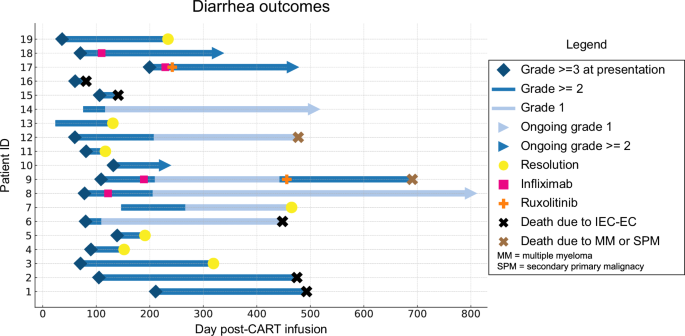
This multicenter case series identifies immune effector cell–associated enterocolitis (IEC-EC) as a late-onset, high-morbidity complication of BCMA-directed CAR T-cell therapy in relapsed/refractory multiple myeloma. The syndrome is characterized by protracted, often steroid-refractory diarrhea, frequent hospitalizations, and substantial treatment-related toxicity. Despite immunosuppressive therapies—including corticosteroids, infliximab, ruxolitinib, and photopheresis—and nutritional support, responses were limited, with symptoms often persisting for weeks to months. Most patients required total parenteral nutrition, underscoring the severity of gastrointestinal dysfunction and suggesting potential benefit from bowel rest. Mortality attributable to IEC-EC was high, with five patients (26%) dying from either infection or intestinal perforation. These outcomes occurred independently of myeloma progression, underscoring that immune-related toxicity and complications of immunosuppressive treatment, rather than underlying malignancy, were the primary causes of death.
The pathophysiology of IEC-EC remains incompletely defined but likely involves dysregulated T-cell activity, with clinical and histopathologic features overlapping graft-versus-host disease (GVHD) and common variable immunodeficiency (CVID) [1, 2]. Frequent upper GI involvement, corticosteroid resistance, and mucosal T-cell infiltration suggest an immunopathologic profile distinct from checkpoint inhibitor colitis. In a healthy gut, plasma cells in the lamina propria secrete IgA, which plays a crucial protective role in neutralizing pathogens and preventing their translocation across the epithelial barrier. These IgA-secreting plasma cells also produce anti-inflammatory cytokines, such as IL-10, which help regulate immune responses. Disruption of gut plasma cells, particularly long-lived IgA-producing cells, could lead to an excessive or inappropriate immune response, impairing gut homeostasis and leading to tissue damage, akin to the mechanisms seen in CVID, autoimmune diseases, or GVHD [3]. Isolated detection of CAR + T cells in gastrointestinal biopsies did not correspond to overt lymphoproliferative disease in our cohort, in contrast to recent reports of post–CAR T-cell lymphomas. This highlights the challenge of interpreting T-cell–rich infiltrates following CAR T therapy and the risk of overdiagnosis. Accurate distinction between reactive and neoplastic processes requires a multimodal approach, including TCR clonality testing in conjunction with expert hematopathologic review, as not all clonal T-cells represent neoplasia. Incorporation of T-cell lymphoma specialists is important, particularly in the setting of persistent or atypical inflammation [4,5,6,7].
Our findings align with those of Fortuna et al., including three overlapping cases [8]. Both cohorts reported high mortality related to IEC-EC (36% vs. 26%), limited steroid responsiveness, and prolonged symptom duration. Notably, 21% of our patients improved with supportive care alone, suggesting heterogeneous disease trajectories and the need for risk-adapted management—early escalation for severe cases versus conservative approaches in selected patients. While steroid-sparing agents such as ruxolitinib or vedolizumab are increasingly used in refractory cases, our findings do not suggest a clear benefit, highlighting the importance of careful consideration when adding immunosuppressive therapies that may increase infection-related morbidity.
Due to the retrospective nature of our study and the limited number of patients who developed enterocolitis, we were unable to perform a statistically meaningful comparison of patient characteristics for those who developed colitis and those who did not. However, overall demographics and disease characteristics, including age, number of lines of therapy, depth of response, and CRS rates, were similar to those reported in the pivotal CAR T-cell trials such as KarMMa-1 [9] and CARTITUDE-1 [10], with the exception of ICANS, which was numerically higher in the current study (Supplementary Table 2). Additionally, we observed a higher incidence of delayed neurotoxicities within the colitis cohort than previously reported with ciltacabtagene autoleucel [11]. While all patients with delayed neurotoxicity developed severe IEC-EC (grade ≥3), this trend did not reach statistical significance, likely due to the small sample size. In addition, no significant association was found between absolute lymphocyte count and IEC-EC severity.
As BCMA CAR T-cell therapy moves earlier in treatment paradigms, timely recognition, mechanistic understanding, and tailored interventions will be critical. Endoscopic evaluation, including TCR clonality studies, should be pursued when biopsies reveal T-cell infiltrates. Further research is urgently needed to elucidate the mechanisms driving IEC-EC, identify predisposing factors and biomarkers for early detection, and optimize tailored treatment strategies to enhance the efficacy and safety profile of these therapies. Furthermore, future studies incorporating high-resolution immune profiling, TCR sequencing, and spatial transcriptomics may help distinguish reactive from neoplastic infiltrates and clarify the pathogenic potential of long-lived CAR T cells in non-hematopoietic tissues.
