


Single-cell RNA-seq acquisition and processing
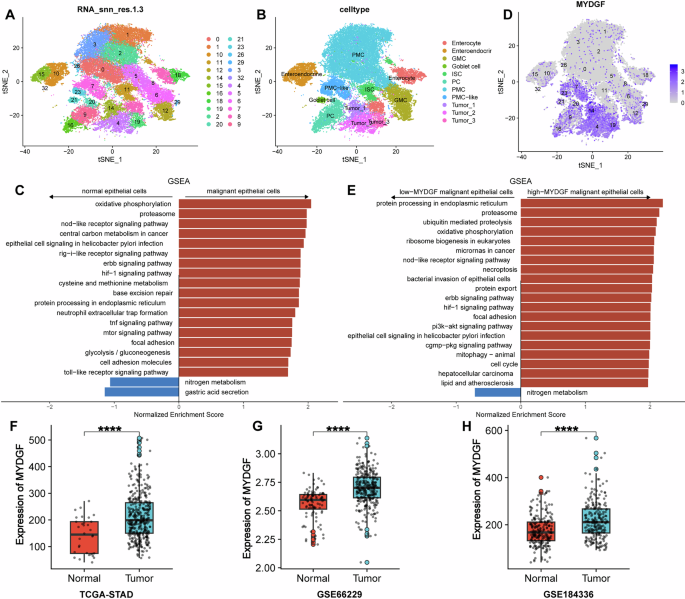
To comprehensively analyze the gastric cancer continuum, we integrated two key single-cell RNA-seq datasets from GEO: GSE183904 (gastric cancer) [20] and GSE134520 (precancerous lesions) [21]. Quality control was performed separately on each dataset using Seurat to filter cells (retaining those expressing 300–6000 genes and excluding those with mitochondrial RNA ratios >20%) and genes (expressed in ≥3 cells). Doublets were removed with DoubletFinder [22]. Datasets were then integrated by cell type, and batch effects were corrected using harmony [23]. Marker genes for each subcluster were identified via FindAllMarkers (min.pct = 0.25, logfc.threshold = 0.25). Cell types were annotated into nine major classes (Supplementary Table 1) and eight epithelial subtypes (Supplementary Table 2) based on established markers.
Cell culture, hypoxia treatment and transfection
Human GC cell lines AGS and HGC27 (Shanghai Institute of Cell Research, Chinese Academy of Sciences) were maintained in RPMI-1640 (Solarbio) supplemented with 10% FBS (Zeta Life) at 37 °C/5% CO₂. For the hypoxia experiments, the cells were incubated with 1% O₂ for 24 h. All lentiviruses, plasmids, and siRNAs used in this study were purchased from General Biology Co., Ltd. Transfection procedures for lentiviral vectors and plasmids were strictly performed in accordance with the manufacturer’s protocols. All shRNA and siRNA sequences are listed in Supplementary Table 3. All cell lines were recently authenticated by short tandem repeat (STR) profiling and tested negative for mycoplasma contamination using the MycoAlert Mycoplasma Detection Kit prior to experiments.
Western blot analysis
Protein lysates were extracted from gastric cancer cells using ice-cold RIPA buffer (NCM Biotech) supplemented with 1× protease/phosphatase inhibitor cocktail (TargetMol Chemicals, Inc.). Protein concentrations were quantified via a BCA assay (Jiangsu Cowin Biotech). Proteins were separated by SDS‒PAGE and electroblotted onto PVDF membranes (Yeasen Biotechnology). The membranes were then blocked in Rapid Blocking Buffer (NCM Biotech) for half an hour and then incubated with primary antibody at 4 °C overnight. After being washed 3 times with TBST (10 min each time), the membranes were incubated with secondary antibodies diluted in blocking buffer for 1 h at room temperature. The samples were then washed again with TBST three times, after which enhanced chemiluminescence (ECL) was performed using an ECL kit (Yeasen Biotechnology). β-actin served as the loading control.
All primary antibodies used for Western blotting were as follows: anti-MYDGF (1:1000, R&D Systems, catalog#MAB1104), anti-β-actin (1:10,000, Proteintech, catalog#66009-1-Ig), anti-LCN2 (1:1000, Abcam, catalog#ab125075), anti-ubiquitin (1:10,000, Santa Cruz, catalog#sc-8017), anti-P62 (1:5000, Proteintech, catalog# 66184-1-Ig), anti-LC3 (1:4000, Proteintech, catalog#81004-1-RR), anti-UBQLN1 (1:1000, CST, catalog#14526), anti-UBQLN2 (1:1000, CST, catalog#85509), anti-Myc (1:1000, Abcam, catalog#ab314108), anti-XBP1s (1:1000, Abcam, catalog# ab220783), anti-Flag (1:3000, Abcam, catalog#ab205606), anti-HA (1:1000, Abcam, catalog#ab314237) and anti-HIF1α (1:1000, Abcam, catalog# ab179483).
EdU assay and cell counting kit-8 (CCK8) assay
Gastric cancer cells were seeded in 96-well plates at optimized densities (EdU: 2×10⁴/well; CCK-8: 3×10³/well). Cells were pulsed with 50 μM EdU reagent (UElandy) diluted in prewarmed serum-free medium for 2 h, followed by fixation with 4% paraformaldehyde (30 min), glycine quenching (5 min), and permeabilization with 0.5% Triton X-100 (30 min). Nonspecific sites were blocked with 3% BSA (1 h). Click-iT reaction cocktail containing Alexa Fluor 488-azide was applied for 30 min in the dark, and the nuclei were counterstained with Hoechst 33342 for 15 min prior to fluorescence imaging.
At designated intervals (6, 24, 48, and 96 h), 10% CCK-8 reagent (APExBIO) was directly added to the existing medium without replacement. After a 2-h incubation at 37 °C, the absorbance was measured at 450 nm. Cell viability was normalized to the 6-h baseline OD values.
Lipid ROS detection
BODIPY 581/591 C11 sensor was prepared as a 10 mM stock solution in DMSO and stored at −20 °C in the dark. Cells seeded in 6-well plates (4×10⁵ cells/well), washed with PBS after adherence, and then incubated with 5 μM probe solution in serum-free medium at 37 °C for 60 min in the dark. Following incubation, the cells were detached using trypsin, resuspended in PBS, and immediately analyzed by flow cytometry. Lipid peroxidation levels were quantified by measuring oxidized-state signals via the FITC channel and comparing the MFI between groups using FlowJo software.
MDA assay
After trypsinization and counting, 1×10⁷ cells were pelleted and washed with PBS. The cell pellet was resuspended in 100 µl of Antioxidant PBS, followed by the addition of 100 µl of lysis buffer and vortexing for 30 s. After a 5-min incubation at room temperature, 300 µl of freshly prepared working solution was added. The mixture was vortexed, incubated at 95 °C for 15 min with intermittent shaking, and then cooled on ice. After centrifugation at 10,000×g for 10 min, the absorbance of the supernatant was measured at 532 nm. The MDA concentration was determined using a standard curve and normalized to the total protein content quantified by a BCA assay.
Transmission electron microscopy analysis
Following drug treatments, the cells were immersion-fixed in 2.5% glutaraldehyde (buffered in 0.1 M sodium cacodylate, pH 7.2) for 24 h at 4 °C. The samples were then postfixed with 1% osmium tetroxide in the same buffer for 2 h at room temperature. After fixation, the samples underwent stepwise dehydration in graded ethanol solutions (50%, 70%, 95%, and 100%), followed by infiltration and embedding in Spurr’s epoxy resin. Ultrathin sections (70–90 nm) were counterstained with uranyl acetate and lead citrate and then examined under a transmission electron microscope (TEM) to analyze ultrastructural alterations.
Quantitative real-time PCR (qRT‒PCR)
Total RNA was isolated from cellular samples using TRIzol (Thermo Fisher). The expression of glyceraldehyde-3-phosphate dehydrogenase (GAPDH), a constitutively expressed housekeeping gene, served as the endogenous control for data normalization. The 2^-ΔΔCt method was employed to calculate the relative expression levels of the target genes. Statistical analyses were performed in GraphPad Prism 8.0.2, with intergroup differences assessed by two-tailed Student’s t test (statistical significance threshold: p < 0.05).
Fe2+ detection
Cells were seeded in 96-well plates (10,000 cells/well, triplicates) and incubated overnight at 37 °C with 5% CO₂. After adhering, the cells were exposed to normoxic or hypoxic conditions for 24 h. The supernatant was then discarded, and the cells were washed three times with prewarmed HBSS. The cells were then incubated with 1 μmol/L FerroOrange working solution for 30 min in the dark. Fluorescence imaging was performed immediately after incubation without further washing, using filters optimized for FerroOrange detection.
Immunoprecipitation (IP)
The cells were lysed using precooled IP lysis buffer supplemented with 1× protease/phosphatase inhibitor cocktail for 30 min, followed by centrifugation at 12,000 rpm for 10 min to collect the cell-containing supernatant. Protein A/G magnetic beads were incubated with the primary antibody at 4 °C for 2 h. After magnetic separation, the supernatant was discarded, and the beads were collected. The beads were then incubated with the cell lysate supernatant overnight at 4 °C under gentle agitation. The immunoprecipitated complex was pelleted, resuspended in 2× SDS sample buffer, and denatured by boiling at 95–100 °C for 10 min. The samples were analyzed by Western blotting.
Immunofluorescence staining assay
Following passaging, the cells were resuspended and seeded onto sterile coverslips in 12-well plates at 1000–5000 cells/well. After 24 h of culture (37 °C, 5% CO₂), the cells were washed with cold PBS (3×3 min), fixed with 4% paraformaldehyde (500 μL, 15 min), and washed again with PBS. Permeabilization was performed using 0.5% Triton X-100 (500 μL, 10 min), followed by washing with PBS. Nonspecific sites were blocked with 2% BSA (500 μL, 37 °C, 30 min). Primary antibody (diluted in 1% BSA per the manufacturer’s protocol) was applied overnight at 4 °C, with PBS as a control. After the cells were washed with PBS, they were incubated with species-matched fluorescent secondary antibodies (2 h, dark). Coverslips were then washed, mounted with DAPI-containing anti-fade medium (50 μL), and imaged by confocal microscopy.
Chromatin immunoprecipitation (ChIP‒qPCR)
Chromatin immunoprecipitation (ChIP) was performed on gastric cancer cell lysates. After crosslinking with 1% formaldehyde (quenched with 0.125 M glycine), the chromatin was sonicated to generate 200–1000 bp fragments. The lysates were immunoprecipitated overnight at 4 °C with anti-XBP1s antibody or control IgG, after which the input DNA was used for normalization. Antibody complexes were captured with Protein A magnetic beads, washed with salt buffers, and eluted. The crosslinks were reversed (65 °C, ≥6 h in 0.2 M NaCl), followed by RNase A and proteinase K digestion. Purified DNA was analyzed by qPCR with target-specific primers. XBP1s binding enrichment was quantified by the ΔΔCt method relative to that of the Input and the IgG control. The primer sequences for the four potential binding sites in the MYDGF promoter are provided in Supplementary Table 4.
Luciferase reporter assay
HEK293T cells were seeded in 6-well plates and cultured for 24 h. Cells were cotransfected with XBP1s overexpression plasmid, pRL-TK control plasmid, and wild-type/mutant MYDGF promoter reporter plasmids. After 48 h, the cells were lysed, and the supernatant was collected by centrifugation. A 20 μL aliquot of the supernatant was mixed with 100 μL of luciferase assay reagent in a black 96-well plate and incubated for 2 min in the dark before luminescence measurement. Renilla luciferase activity was detected using a freshly prepared Substrate II/Buffer II (1:50) mixture with a 1000 ms integration time.
Subcutaneous tumor xenograft experiment
BALB/c-Nu nude mice (male, 6-8 weeks old) were randomly divided into four groups (NC, OE-MYDGF, sh-LCN2, and OE-MYDGF+sh-LCN2; n = 6/group) and injected subcutaneously with HGC27 stable cells. One week later, half of the mice in each group received intraperitoneal imidazole ketone erastin (IKE) (40 mg/kg/day for 2 weeks), a modified erastin derivative specifically engineered for improved pharmacokinetics and in vivo stability, making it ideal for animal studies [24]. Tumor volumes were measured weekly, and the tumors were harvested and weighed on Day 21.
The sample size for animal experiments (n = 6 per group) was determined based on previous studies in similar models and power analysis using G*Power software to ensure adequate power (80%) to detect a pre-specified effect size (Cohen’s d = 1.5) at a significance level of α = 0.05. Animals were randomly allocated to experimental groups using a random number generator to ensure unbiased allocation. The randomization sequence was generated by an independent researcher not involved in the experiment.
Statistical analysis
In this study, statistical analysis and graph generation were performed using GraphPad Prism version 8.0.2. For normally distributed data, the t test was applied; otherwise, the Wilcoxon rank-sum test was used. Comparisons between two groups were conducted using one-way ANOVA. All independent experiments were repeated three times to ensure statistical significance at P < 0.05. The following symbols were used to denote statistical significance: ns, not significant; P < 0.05; *, P < 0.01; **, P < 0.001; ***, P < 0.0001.
