


Cell culture
Human prostate cancer cells (PC3) from American Type Culture Collections (ATCC CRL-1435, Manassas, VA, USA) were cultured and maintained in RPMI1640 medium from Multicell (cat# 350–000) containing 1% Penicillin-Streptomycin (Gibco 15140) and 10% fetal bovine serum (Hyclone, characterized, GE Life Sciences). Cells were then incubated at 37°C and 5% CO2 conditions to reach confluence. Afterward, the cells were washed with phosphate-buffered saline (PBS) and trypsinized using 0.05% Trypsin-EDTA at room temperature. Subsequently, the detached cells were collected and centrifuged at 1000 rpm for 7 minutes at 4°C. Pellets were isolated and re-suspended by adding 100 µL of Mg + /Ca+ Dulbecco’s Phosphate Buffered Saline (DPBS) per 5 ×10⁶ cells. Tumour viability was assessed using trypan blue for quantification. Cells were diluted immediately preceding intracranial injection at a ratio of 50:50 Matrigel for a final concentration of 1.0 ×10⁶ cells/20 µL.
Animal model
Animal work completed in this study was approved by the Sunnybrook Research Institute Animal Care Committee. New Zealand White rabbits (Charles River, Canada) were intracranially injected with a cell suspension of approximately 1.0 ×10⁶ cells to induce tumours. After cell injection, the tumours were left to grow for approximately 2 weeks, or until visible tumours were seen in MRI scans before their respective treatments. The rabbits were injected intramuscularly with cyclosporin A (10–25 mg/kg daily) for three days including the day of cell injection, to induce immunosuppression (for details see [22]). Before cell injection and treatment administration, rabbits were anesthetized with 3% isoflurane and 2 L/min of O2 through continuous inhalation. The body temperature of animals during treatment was kept normal using heating pads. Vitals were monitored throughout the entirety of the treatment.
Group size was determined by the number of conditions tested and number of animals requested per condition for us to see a real difference in the treatment.
All our current and previous studies (published) use a minimum of 3-4 rabbits per group/condition for data analysis.
To ensure the statistical power (1 – β) > 0.8, minimum experimental group sizes were calculated (n = 3-4) from the minimum effect size in animal models at the selected therapy parameters (this is based on our previous study).
Animals were randomly assigned to each treatment group by an expert senior technician. Ear notching was used to identify animals. To avoid selection bias, the technician was unaware of which animals were assigned to which groups (blinded).
Animals that reached humane endpoint during the experimental period was euthanized. Humane endpoints followed in this study included animal’s weight loss greater than 20%, lack of feeding, bleeding, or ulcerations of the tumour area, lack of ambulation, and self-mutilation.
Tumour cell injection/implantation
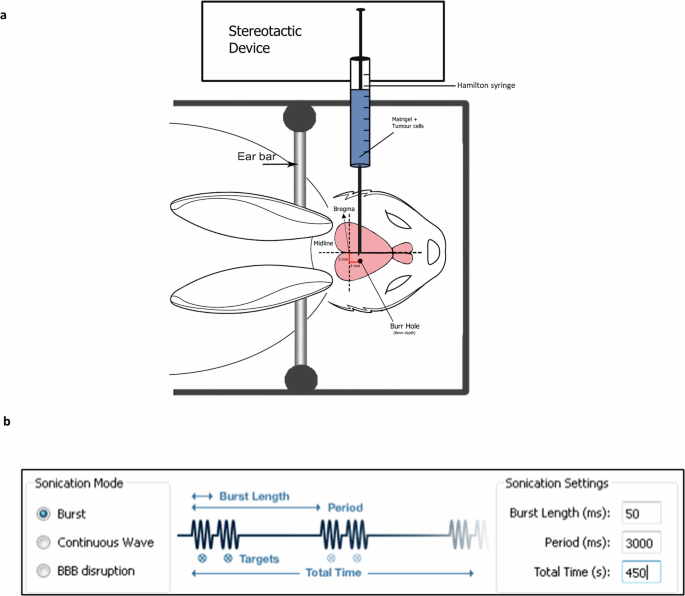
For the preparation of intracranial injection, rabbits were first anesthetized using 5% isoflurane in oxygen for induction and 3% for maintenance (all anesthetics were obtained from manufacturer (Fresenius Kabi, DIN 02237518)). Furthermore, 2% of oxygen was given in a continuous inhalant form. Rabbit heart rate and blood oxygen levels were monitored with a pulse oximeter. Rabbits were under complete anesthetic while being intubated with a 2.5 mm endotracheal tube (Teleflex). Afterward, eye lubrication Systane Ointment (Alcon, DIN 02444062) was applied, and the animal was gently secure to a stereotactic apparatus. Once a rabbit was in the apparatus, the skull was exposed by shaving the top of the head with an electric razor. Marcaine (stock concentration 2.5 mg/ml) was added (few drops to site of surgery (before surgery)) atop the exposed section, and a 2 cm sagittal cut was made along the midline of the head to expose the skull. Coordinates for injection were mapped using the bregma as the reference point (AP = 3.0 mm; ML = 4.0 mm, DV = 8 mm). Once the point was marked, a small burr hole was drilled at the potential injection site to expose the brain. For injection, a 26 Gauge Hamilton syringe (Hamilton Co., Reno Nevada) was used to inoculate 20 µL of 106 PC3 cells (1:1 mixture of cells and Matrigel at a rate of approximately 1 µL/min into the site of interest). After injection, the needle was kept in place for 5 min and then was withdrawn slowly over another 1 mm/min. The skull was cleaned and dried using a sterile dry cotton swab (Medline). The hole in the skull was then covered with bone wax, and cut skin was sutured back together with 5–0 silk sutures. For postoperative pain relief and to prevent bacterial infections in animals, buprenorphine (0.3 mg/ml concentration, given 0.1 mg/kg, as necessary, Vetergesic, Ceva) and Baytril (Enrofloxacin, 50 mg/ml bottle, DIN 02169428, Bayer Inc. Dose: 5 mg/kg) were administered respectively three days via subcutaneous injection at doses, respectively. Animal incisions were assessed post-operatively to ensure that sutures remain intact until they are fully healed. Tumour growth was monitored every week by a 3 T Bruker MRI (Achieva, Philips Healthcare, Best, Netherlands)) using gadolinium contrast (Gadovist 1.0, DIN 02241089, Bayer Inc. (3 ml gadolinium chased by 4 ml saline)).
Animals cohort and treatment regimen
Animals were divided into two cohorts: a 24 hour cohort (in which treatment was administered only once following tumour response assessed at 24 hours) and a multifraction 1- week cohort (in which treatment was administered thrice during a one week period, specifically on Monday, Wednesday, and Friday, with tumour response assessed at 72 hours following the last treatment day). All treatment parameters were kept the same for 24 hours and a 1-week study. A total of 3-6 animals were used in each of the treatment conditions for 24 hours and 1 week (control, FUS + MB, XRT, and FUS + MB + XRT). A treatment plan for 24 hours and a one-week study is presented in Fig. 2.
Ultrasound-mediated microbubble treatment
Rabbits treated with FUS + MB were under complete anesthetic before hair above the tumour region was removed using a 50:50 ratio of Nair lotion (Nair, TM Trademark of/ MC Marque de commerce de Church & Dwight Co Inc). Definity® MB (perfluoropropane gas/liposome shell, Lantheus Medical Imaging, Inc., North Billerica, MA, USA) were used in this study. A Vialmix ® device (Lantheus Medical Imaging, Inc., North Billerica, MA, USA) was used to activate MB by shaking at 3000 rpm for 45 seconds. MB once prepared was placed in the tubing attached to the catheter. Animals (~ 2 Kg) received MB (2 mL Definity MB plus 4 mL saline (total 6 mL), corresponding to a total dose of approximately 9 × 10^9 MB/kg, or 0.75 mL/kg. A power injector was used for injecting the MB. This was delivered at 1ml/min during ultrasound treatment, that usually lasted for 6-7 minutes. Ultrasound exposure included 16 cycles of a tone burst over 50 milliseconds. The peak acoustic pressure was set to approximately 0.1MPa. For the FUS + MB only and combined treated groups, the FUS + MB treatment was administered on both Monday and Friday of the treatment week. Ultrasound treatment was delivered using a FUS LP-100 system with transducer frequency working at 1.1 MHz (Focused Ultrasound Instruments, Toronto, Canada) in a 3 T MRI system. The transducer was submerged in degassed deionized water and attached to a FUS system. During the treatments, rabbits were anesthetized with isoflurane and intubated. They were positioned supine on top of an MRI-compatible FUS system, with a catheter/stopcock attached to tubing and a syringe for an automatic power injector, for delivery of contrast agent and/or MB. A catheter was inserted into the ear vein with a four-way stopcock secured by tape. The pulse oximeter was secured to the toe to monitor oxygen and heart rate. MRI guided the ultrasound-mediated microbubble treatment. T1-weighted MR imaging was used to identify targets in the brain along with gadolium-based contrast. A custom miniature brain coil (a single-loop linearly polarised transmit/receive custom design for rabbits) was used in place for treatments.
Radiation therapy
Rabbits were anesthetized during radiation procedures. For irradiation rabbits were immobilized using tape to an animal holder which was then placed in an x-ray irradiator (Faxitron Cabinet X-ray, Faxitron X-ray, LLC, IL) with a lead sheet covering the entire body except for the brain area where the tumour were located as confirmed by MRI (a skin marking was made in the brain tumour area). Lead sheets contained a small circular opening (2.5 cm diameter) that allowed exposure to the tumour-bearing region during treatment. Animals were treated on Monday, Wednesday, and Friday of the treatment week. Irradiator settings were as follows: 160 kV, 6.3 mA for 3 minutes for a dosage of 6 Gy per treatment day for a total dose of 6 Gy for the single treatment cohort and for the multiple treatment cohort a total of 18 Gy in three fractions.
Histology
At the end of the studies (24 hours and 1 week), animals were euthanized under anesthesia with intravenous sodium pentobarbitol (Euthanyl) via the ear vein immediately at endpoints and the brain was removed and fixed in 10% (v/v) neutral buffered formalin (10% formalin in sodium phosphate buffer (0.075 M)) (Fisher Scientific (Fisher Chemicals), SF93-4 (4 L)). Three days thereafter, each specimen was cut into approximately three sections (labeled as A, B, and C) and placed into cassettes. The cassettes were put into buffered formalin (10% (v/v) at room temperature for another four days before further processing. Afterwards, cassettes were embedded in paraffin and sectioned for staining. All sections were stained with hematoxylin and eosin (H&E) to determine the tumour area/location and size. Once the tumour area/location was determined, corresponding factor VIII staining, a vascular disruption marker, Ki-67 staining, a cell proliferation marker, and ASMase, a cell stress marker was carried out using immunohistochemistry. For factor VIII quantification, from each stained section, 11 random regions of interest (ROIs) were selected at 20X magnification, and the stained blood vessels within the confirmed tumour area were counted and averaged. The proliferative fraction was quantified from digitized Ki-67 image files using an in-house MATLAB program (MathWorks, Natick, MA, USA). Quantification of ASMase staining was performed using QuPath (v0.5.1), an open-source bioimage analysis software [23]. ASMase staining was carried out using Invitrogen ASM monoclonal Antibody (OTI3H7) (Product # MA5-26615) (Thermo Fisher Scientific). For this, ROIs were manually annotated using either default or marker-specific optimized parameters. All the staining was performed at Pathology Research Program, University Health Network, Toronto, ON, Canada). Images of whole mount tumour stains were acquired at 20X magnification, resulting in a resolution of 0.5 µm/pixel using the TissueScope LE scanner (Huron Digital Pathology, St. Jacobs, ON, Canada).
Statistics
A one-way ANOVA followed by Sidak selected comparison statistical test was performed using GraphPad Prism (GraphPad Software Inc, La Jolla, USA). Each treatment condition was compared with the untreated control group. Each group was also tested against the others for statistical significance. A significant P-value was indicated by *P ≤ 0.05.
