


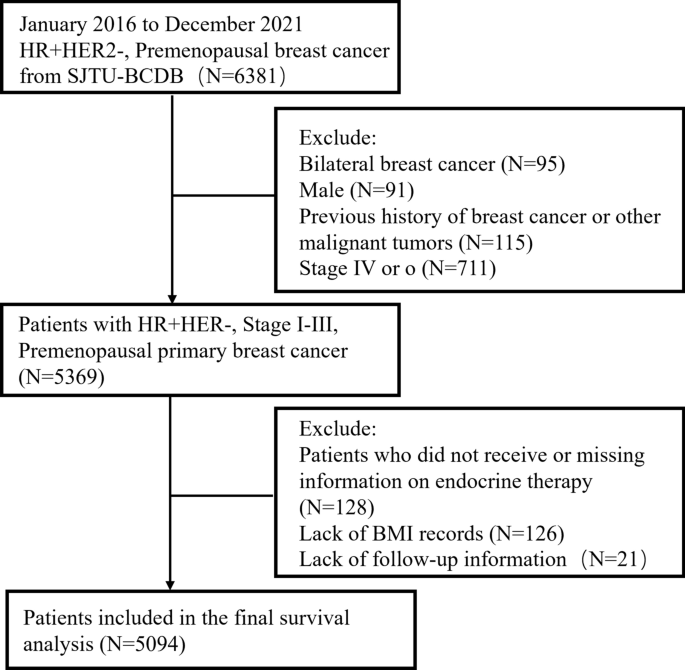
HR+HER2- is the most common molecular subtype of breast cancer. To the best of our knowledge, no studies have specifically explored the relationship between BMI and prognosis in premenopausal women with HR+HER2- breast cancer. Using multi-center data, we found that obesity increases the risk of breast cancer recurrence in premenopausal patients with HR+HER2- subtype. Interestingly, obesity appears to have a greater impact on recurrence risk in patients treated with SERMs alone, but not in those receiving OFS as part of adjuvant endocrine therapy. Moreover, the risk of recurrence progressively increases with BMI above the normal range.
A growing body of research has identified high BMI as a risk factor for postmenopausal breast cancer8,10,11. However, few studies have focused on the relationship between BMI and prognosis in premenopausal breast cancer. Ozaki et al. analyzed 3,380 cases of premenopausal women with HR+breast cancer and found that high BMI was associated with worse BCSS in patients receiving adjuvant TAM9. Another single-center retrospective analysis from Taiwan showed that BMI was an independent prognostic factor for OS and DFS in breast cancer patients under the age of 5012. Previous studies have also shown that BMI is not an independent prognostic factor for HER2-positive or triple-negative breast cancer, suggesting that the effects of obesity on breast cancer prognosis may be subtype-dependent. To avoid confounding factors from other subtypes, our study exclusively included premenopausal patients with HR+HER2- breast cancer. Based on an analysis of 5,094 cases from multiple centers, we demonstrated that obesity is an independent risk factor for DFS, even after adjusting for clinicopathological and treatment factors. The mechanisms by which high BMI leads to poor prognosis in premenopausal HR+HER2- breast cancer remain unclear, but several factors may contribute. First, high BMI is often associated with hormonal changes, particularly increased estrogen levels, which may promote the growth and proliferation of HR+breast cancer cells. Premenopausal patients with HR+HER2- breast cancer typically receive TAM treatment. Sahar et al. demonstrated that circulating exosomes derived from obese women are more likely to induce tumorigenesis and tamoxifen resistance in MCF7 cells compared to those from women of normal weight13. Second, obesity can upregulate pro-inflammatory cytokines, adipokines, and angiogenic factors, all of which are closely linked to the proliferation and invasive behavior of breast cancer14. Additionally, high BMI increases circulating levels of insulin and insulin-like growth factor-1, promoting tumor cell proliferation and invasion15. In vivo experiments have shown that an obese microenvironment elevates local leptin levels, activating the PI3K, ERK1/2, and STAT3 pathways through leptin receptors, ultimately accelerating tumor progression16. Another study by Linares et al. showed that leptin not only increases breast cancer cell proliferation in vitro but also reduces tamoxifen efficacy17. Recently, a preplanned analysis from the PALLAS trial demonstrated a significant impact of BMI on side effects, dose reductions, early treatment discontinuation, and relative dose intensity, suggesting that BMI may affect prognosis by influencing drug efficacy and tolerability18.
Our study also suggested that BMI did not affect the prognosis of premenopausal women with HR+HER2- breast cancer who received OFS as part of their endocrine therapy. An exploratory analysis from the ABCSG12 trial showed that overweight premenopausal patients treated with OFS and aromatase inhibitors (AI) had a significantly higher risk of disease recurrence compared to normal-weight patients. However, BMI did not influence the prognosis of patients who received OFS and TAM7. Ozaki et al. reported similar findings, showing that premenopausal patients with HR+breast cancer and BMI ≥ 25 who were treated with TAM had significantly worse BCSS compared to those with BMI < 25. These results suggest that the addition of OFS may mitigate the negative impact of BMI on the prognosis of premenopausal breast cancer treated with TAM. Unfortunately, our study could not further analyze the effect of BMI on prognosis in patients receiving OFS in combination with TAM. Longer follow-up is needed to determine whether adding OFS to TAM offers a prognostic benefit for premenopausal breast cancer patients with high BMI. Moreover, chemotherapy-induced amenorrhea or menopause may be associated with better prognostic outcomes, potentially diluting the impact of OFS on prognosis19. Unfortunately, we do not have these data in our cohort for further analysis. Overall, although our findings suggest that OFS may attenuate the adverse prognostic impact of obesity in premenopausal patients, this observation should be interpreted with caution. Given the non-randomized nature of treatment allocation and the potential for residual confounding despite PSM and multivariable adjustment, this result should be considered hypothesis-generating rather than indicative of a causal relationship.
