


Daniel J, Spiegelman GB, Weeks G. Characterization of a third ras gene, rasB, that is expressed throughout the growth and development of Dictyostelium discoideum. Oncogene. 1993;8:1041–7.
Google Scholar
Daniel J, Bush J, Cardelli J, Spiegelman GB, Weeks G. Isolation of two novel ras genes in Dictyostelium discoideum; evidence for a complex, developmentally regulated ras gene subfamily. Oncogene. 1994;9:501–8.
Google Scholar
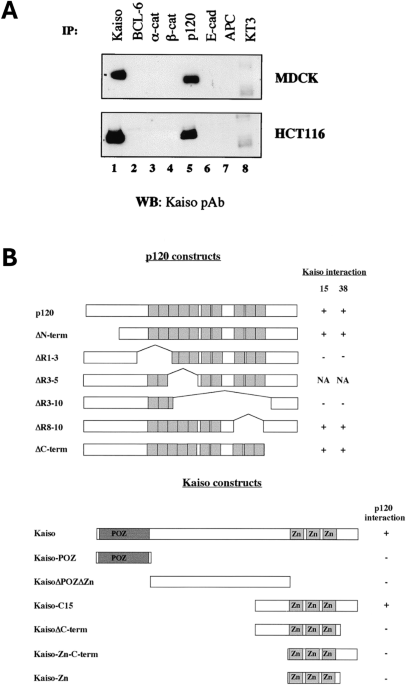
Daniel JM, Reynolds AB. The Catenin p120ctn Interacts with Kaiso, a Novel BTB/POZ Domain Zinc Finger Transcription Factor. Mol Cell Biol. 1999;19:3614–23.
Google Scholar
McCrea PD, Gu D. The catenin family at a glance. J Cell Sci. 2010;123:637–42.
Google Scholar
Daniel JM, Spring CM, Crawford HC, Reynolds AB, Baig A. The p120ctn-binding partner Kaiso is a bi-modal DNA-binding protein that recognizes both a sequence-specific consensus and methylated CpG dinucleotides. Nucleic Acids Res. 2002;30:2911–9.
Google Scholar
Kelly KF, Spring CM, Otchere AA, Daniel JM. NLS-dependent nuclear localization of p120ctn is necessary to relieve Kaiso-mediated transcriptional repression. J Cell Sci. 2004;117:2675–86.
Google Scholar
Spring CM, Kelly KF, O’Kelly I, Graham M, Crawford HC, Daniel JM. The catenin p120ctn inhibits Kaiso-mediated transcriptional repression of the β-catenin/TCF target gene matrilysin. Exp Cell Res. 2005;305:253–65.
Google Scholar
Park J-I, Kim SW, Lyons JP, Ji H, Nguyen TT, Cho K, et al. Kaiso/p120-Catenin and TCF/β-Catenin Complexes Coordinately Regulate Canonical Wnt Gene Targets. Devel Cell. 2005;8:843–54.
Google Scholar
Chaudhary R, Pierre CC, Nanan K, Wojtal D, Morone S, Pinelli C, et al. The POZ-ZF Transcription Factor Kaiso (ZBTB33) Induces Inflammation and Progenitor Cell Differentiation in the Murine Intestine. PLoS ONE. 2013;8:e74160.
Google Scholar
Pierre CC, Longo J, Mavor M, Milosavljevic SB, Chaudhary R, Gilbreath E, et al. Kaiso overexpression promotes intestinal inflammation and potentiates intestinal tumorigenesis in ApcMin/+ mice. Biochimica et Biophysica Acta (BBA) – Mol Basis Dis. 2015;1852:1846–55.
Google Scholar
Robinson SC, Chaudhary R, Jiménez-Saiz R, Rayner LGA, Bayer L, Jordana M, et al. Kaiso-induced intestinal inflammation is preceded by diminished E-cadherin expression and intestinal integrity. PLoS ONE. 2019;14:e0217220.
Google Scholar
Lessey LR, Adan H, Robinson SC, Chaudhary R, Sivakumar S, Ali Fairbairn S, et al. Kaiso overexpression promotes an interferon immune response in murine intestines. BMC Genomics. 2026 https://doi.org/10.1186/s12864-026-13047-5.
Donaldson NS, Pierre CC, Anstey MI, Robinson SC, Weerawardane SM, Daniel JM. Kaiso Represses the Cell Cycle Gene cyclin D1 via Sequence-Specific and Methyl-CpG-Dependent Mechanisms. PLoS ONE. 2012;7:e50398.
Google Scholar
Pierre CC, Longo J, Bassey-Archibong BI, Hallett RM, Milosavljevic S, Beatty L, et al. Methylation-dependent regulation of hypoxia inducible factor-1 alpha gene expression by the transcription factor Kaiso. Biochimica et Biophysica Acta (BBA) – Gene Regulatory Mechanisms. 2015;1849:1432–41.
Google Scholar
Robinson SC, Klobucar K, Pierre CC, Ansari A, Zhenilo S, Prokhortchouk E, et al. Kaiso differentially regulates components of the Notch signaling pathway in intestinal cells. Cell Commun Signal. 2017;15:24.
Bassey-Archibong BI, Kwiecien JM, Milosavljevic SB, Hallett RM, Rayner LGA, Erb MJ, et al. Kaiso depletion attenuates transforming growth factor-β signaling and metastatic activity of triple-negative breast cancer cells. Oncogenesis. 2016;5:e208.
Google Scholar
Vermeulen JF, Van De Ven RAH, Ercan C, Van Der Groep P, Van Der Wall E, Bult P, et al. Nuclear Kaiso Expression Is Associated with High Grade and Triple-Negative Invasive Breast Cancer. PLoS ONE. 2012;7:e37864.
Google Scholar
Hercules SM, Alnajar M, Chen C, Mladjenovic SM, Shipeolu BA, Perkovic O, et al. Triple-negative breast cancer prevalence in Africa: a systematic review and meta-analysis. BMJ Open. 2022;12:e055735.
Google Scholar
Hercules SM, Hercules JC, Ansari A, Date SAJ, Skeete DHA, Connell SPS, et al. High triple-negative breast cancer prevalence and aggressive prognostic factors in Barbadian women with breast cancer. Cancer. 2020;126:2217–24.
Google Scholar
Hercules SM, Liu X, Bassey-Archibong BBI, Skeete DHA, Connell SS, Daramola A, et al. Analysis of the genomic landscapes of Barbadian and Nigerian women with triple negative breast cancer. Cancer Causes Control. 2022;33:831–41.
Google Scholar
Bassey-Archibong BI, Hercules SM, Rayner LGA, Skeete DHA, Connell SPS, Brain I, et al. Kaiso is highly expressed in TNBC tissues of women of African ancestry compared to Caucasian women. Cancer Causes Control. 2017;28:1295–304.
Google Scholar
Bassey-Archibong BI, Rayner LGA, Hercules SM, Aarts CW, Dvorkin-Gheva A, Bramson JL, et al. Kaiso depletion attenuates the growth and survival of triple negative breast cancer cells. Cell Death Dis. 2017;8:e2689.
Ali Fairbairn S, Kim K, Cowan RW, Lessey LR, Fanaian M, Adan H, et al. Kaiso modulates androgen receptor expression in triple-negative breast cancer. Breast Cancer Res. 2026;28:116.
