


Risk categorization for MCL
Several biological and clinical risk factors which are associated with poor response to chemoimmunotherapy and auto-HCT and reduced efficacy of Bruton tyrosine kinase inhibitors (BTKi) have been identified in MCL. These can be used to define risk categories in order to enable risk-adapted allocation and sequencing of the various cellular therapies [6,7,8].
At baseline, mutations of the TP53 gene indicate relative refractoriness to chemoimmunotherapy, resulting in a significantly increased mortality risk with CIT/auto-HCT-based treatment strategies [9, 10]. In addition, TP53 deletions, p53 overexpression on immunohistochemistry ( > 50%), a high KI-67 proliferation index ( > 30%) and a high MCL International Prognostic Index including Ki-67 (MIPI-c) can be used to define high-risk MCL, although their adverse impact on outcomes is weaker [9, 11,12,13,14]. Because it is superseded by KI-67, blastoid or pleomorphic histology is only considered as high-risk defining if KI-67 information is not available [12, 14]. Biological high-risk features also affect the outcome of BTKi-based induction and salvage therapies, albeit to a lesser extent [15,16,17].
In patients who experienced first-line treatment failure, the interval between treatment initiation and failure event represents an additional important risk factor, as progression or relapse of treated MCL within 24 months (POD24) is associated with substantially reduced survival independent of the aforementioned biological risk factors [18,19,20]. Recent data also suggest that failure of MRD clearance at 10-6 level using the clonoSEQ assay [21] after consolidation with auto-HCT during induction therapy may be associated with an impaired prognosis [22].
By contrast, patients with non-nodal MCL and those with asymptomatic classical nodal MCL and low proliferation index are considered to have low-risk MCL [23, 24]. These patients typically follow different management algorithms, currently do not need any cellular therapy in the first line and will not be further addressed in this paper.
All patients not falling into these two categories will be defined as having standard-risk MCL.
Panel 1. MCL risk categorization
-
High-risk
-
At the start of 1L treatment (or evolving during disease course):
-
TP53 mutation (strong effect, median OS <3y with CIT +/– autoHCT)
-
TP53 deletion, p53 expression >50% (immunohistochemistry), Ki-67 >30%, MIPI-c high, blastoid/pleomorphic variant (in the absence of Ki-67 information) (moderate effect, median OS about 4-5y).
-
-
At the end of induction after autoHCT, the provisional criterion:
-
At first relapse/progression:
-
-
Standard-risk: all other patients.
-
Low-risk: indolent MCL (non-nodal without adverse genetic features or nodal without symptoms, high tumour burden, high Ki-67, or blastoid morphology).
CAR T-cell therapy
CART indications: first-line treatment
Despite reduced efficacy of standard CIT/auto-HCT-based treatment approaches in patients with high-risk MCL, modern BTKi-containing first-line regimens can provide durable disease control in the majority of patients with high-risk features [25, 26]. Therefore, CARTs as part of first-line therapy in high-risk MCL have to be considered as experimental and should be performed only within prospective clinical trials, such as CARMAN (NCT064822684) or BMT CTN 2502 study (personal communication M. Hamadani) [2, 3, 27]. There is no role for CART in the first-line therapy of standard-risk MCL.
CART indications: relapsed and refractory disease
Brexucabtagene autoleucel (Brexucel) and, recently, Lisocabtagene maraleucel (Lisocel) are currently the only commercially available CART therapies for MCL in Europe, both approved for patients who have received 2 lines of systemic treatment, including a BTKi. Nevertheless, in the absence of effective standard therapies for patients who experience disease progression following BTKi-containing frontline treatment, CAR T-cell therapy may be considered in the second-line setting for this high-risk group when enrolment in a CAR T–based clinical trial is not feasible. Despite favourable trial data [28], patients who are BTKi-naïve at second line have currently no indication for CART in Europe outside of a clinical trial, irrespective of their risk category.
Beyond the second line, CD19 CARTs are the treatment of choice for all CART-naïve patients. While there is no evidence supporting repeat CD19 CART therapy in patients with MCL, the use of CARTs employing alternative targets and co-stimulatory elements is an option, to date only within clinical trials [29]. A prior alloHCT is not a contraindication for CART therapy [30].
Panel 2. Recommendations for CART indications
-
First-line
-
High-risk MCL: only in trials.
-
Standard-risk MCL: no role.
-
Second-line
-
BTKi-naïve: no role outside of clinical trials.
-
BTKi-exposed: clinical option, especially in those patients who progressed while still on BTKi, or within a clinical trial.
-
Beyond second-line
-
CART-naïve: standard of care.
-
CART-exposed: no role for repeat CD19 CART. Consider an alternative CART in clinical trials.
Eligibility for CART treatment
Similar to LBCL, there is no strict upper age limit for CART treatment in MCL [31, 32]. Instead, it appears to be reasonable to follow published algorithms for CD19 CARTs, suggesting that the key patient-related factors of age, performance status and comorbidity collectively define individual CART eligibility [3, 33]. A careful assessment of performance status as a composite indicator of age, comorbidity and tumour biology-related impairment is warranted [34, 35]. Whether formal geriatric assessment in older patients may help in defining CART eligibility remains to be shown [36, 37].
Tumour-related baseline prognostic factors for CART treatment
The evidence that CAR T-cell therapy can overcome the adverse impact of high-risk MCL-defining features is still conflicting. Where investigated, response rates do not appear to be significantly affected by TP53 alterations, KI-67 index, or blastoid morphology [38, 39]. However, responses seem to be less durable in the presence of high-risk features in some, but not all, series reported. More consistent evidence supports the notion that patients with short remission duration following first-line (POD24) or subsequent therapies have an inferior outcome after brexucel [39,40,41]. Prognostic parameters identified in individual retrospective studies are described in Table 1. Among these are indicators of tumour activity (LDH, bulky disease, extra-nodal involvement) and inflammation (CRP, ferritin), which are well- established risk factors of CART outcomes in LBCL [42], but need to be further validated for MCL.
Table 1 Real-world series on brexu-cel for MCL: Adverse factors for progression-free survival.
Limited evidence is available for CART therapy in MCL patients with CNS involvement. While response rates appear to be as encouraging as in patients without CNS disease, short response duration is a concern, especially in patients with active CNS disease at lymphodepletion [43].
Panel 3. Recommendations for CART eligibility and baseline outcome predictors
-
There are no strictly defined age limits or single comorbidities that preclude CART eligibility in MCL.
-
Performance status, comorbidity and age collectively define individual CART eligibility.
-
Tumour-related outcome predictors
-
MCL high-risk criteria may adversely affect response duration after CART therapy.
-
LBCL-typical unfavourable biological parameters, such as high tumour volume, tumour proliferative activity and inflammation markers, still need to be validated in MCL.
-
Prognostic scores
-
CAR-HEMATOTOX is the only prognostic score validated for MCL CART treatments to date.
Prognostic scores
Similar to CART use in LBCL and multiple myeloma, the CAR-HEMATOTOX score (which takes into account pre-lymphodepletion cytopenias, ferritin and CRP levels) predicts the risks of prolonged cytopenias, severe infections, NRM and overall mortality, also after brexucel treatment of MCL [44]. Other prognostic scores effective in LBCL and/or multiple myeloma CART settings, such as the EASIX [45], still need to be validated in MCL.
Holding and bridging
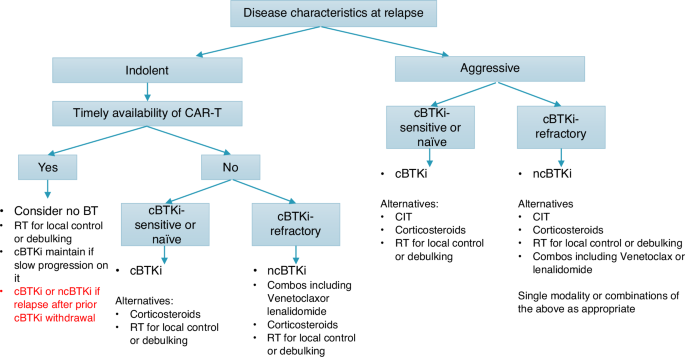
Holding therapies are defined as those administered between indication for CART and leukapheresis and bridging therapies as those given between leukapheresis and CART infusion. Except for the French and German real-world studies [41, 46] the beneficial effects of holding/bridging therapy on survival outcomes have not been demonstrated in other major MCL CART studies published to date [38,39,40, 47]. The depth of disease control/response with bridging to achieve the optimum outcome with CART in MCL is currently unclear. Nevertheless, there may be medical needs requiring immediate intervention in the form of holding/bridging therapies, such as symptom control, keeping the patient stable until CART infusion, and mitigating pro-inflammatory effects of active lymphoma. There is no need to achieve an objective response as a prerequisite for proceeding to CART administration, even in case of CNS involvement, as long as there is no aggressively proliferating disease with large tumour volume and/or heavy leukemic expansion. Thus, the treatment goal of holding and bridging is avoiding massive disease progression and providing symptom relief during CART manufacturing rather than achieving a state of minimal tumour load prior to lymphodepletion [33]. In addition, the expected duration of CART production time influences the decision to consider holding/bridging therapies.
There is no standard approach to holding/bridging in MCL; the choice is based on the aggressiveness of the disease, treatment history (including sensitivity to prior agents), age, comorbidities, performance status, expected product turnaround time, and the need for systemic versus local control. In-label holding/bridging options in covalent BTKi-refractory patients include pirtobrutinib and MCL-effective chemoimmunotherapy, with the exception that bendamustine-containing regimens should not be used for holding because of their severe lymphodepleting effects [39, 48,49,50]. In addition, it is still not settled whether CD19-targeting agents (which are currently not approved in MCL) could affect the outcome of subsequent CD19-directed CART therapy [33, 51]. Radiotherapy should be considered for single symptomatic or bulky sites. A suggested algorithm for holding/bridging is shown in Fig. 1. Other, still off-label bridging options comprise combinations of venetoclax with covalent BTKi and CD20 antibodies, and bispecific antibodies [52,53,54].
Fig. 1: Algorithm for bridging therapy in MCL.
(BT bridging therapy, cBTKi covalent Bruton’s tyrosine kinase inhibitor, CIT chemoimmunotherapy, ncBTKi non-covalent Bruton’s tyrosine kinase inhibitor, RT radiotherapy, PS performance status).
If the patient is on BTKi and still sensitive (ongoing response or only slow progression), BTKi should be maintained through leukapheresis until lymphodepletion to avoid tumour flare and take advantage of presumptive T-cell fitness-enhancing effects [55] and improvement of the myeloid suppressive environment. This hypothesis has been tested with ibrutinib in the TARMAC study, with promising results even in covalent BTKi-resistant patients [56].
Panel 4. Recommendations for holding and bridging strategies
-
Treatment goal of holding/bridging is symptom control and keeping the patient stable rather than achieving minimal tumour load prior to CART.
-
Avoid delaying CART if already available unless there is massive disease progression.
-
Selection of holding/bridging strategy
-
The decision to use holding/bridging therapies is based on disease biology, tumour kinetics and the presence of symptoms.
-
There is no standard approach for holding/bridging in MCL; the choice is based on the aggressiveness of the disease, prior treatments, age, comorbidities, available options, expected turnaround and the need for systemic vs local disease control.
-
If the patient is on BTKi, BTKi should be maintained through leukapheresis.
-
Bendamustine should be avoided for holding therapies.
Product selection
Brexucel and, since December 2025, lisocel are both approved by the EMA for the treatment of adult patients with relapsed or refractory MCL after at least two lines of systemic therapy, including a BTKi. According to the registration trials, lisocel is associated with less neurotoxicity than brexucel, which could make this product more suitable, particularly for older and comorbid patients. However, if this translates into a better safety profile in terms of ICAHT, infection risk, and NRM still needs to be shown. Although both CARTs achieved high CR rates in their respective approval trials (brexucel 68%, lisocel 75%) [38, 49], responses were not stable (median duration of response with brexucel 28 months, lisocel 16 months) without a clear-cut plateau, implying that evidence of the curative potential of CART therapy in MCL is still lacking. European real-world data on brexucel are in line with the results of the brexucel approval trial ZUMA-2 [3]. Currently, there is no conclusive data showing the efficacy advantages of one of these two products over the other, with the caveat that the body of evidence available for lisocel in this indication is still very limited. Moreover, the published turnaround times (from leukapheresis to product delivery) are shorter for brexucel than for lisocel. These issues need to be weighed against the more favourable toxicity profile of lisocel on a patient-by-patient basis.
CART administration
As there is no specific procedure for product administration in patients with MCL, we refer to the EBMT general CART best practice recommendation [57]. and the authorized product information of the two labelled CARTs (Tecartus, INN-brexucabtagene autoleucel) (Breyanzi, INN-lisocabtagene maraleucel).
Post-infusion management
Although NRM appears to be higher after CART treatment in MCL compared to other indications, with infections as the leading cause of death [58], an MCL-specific pattern of infections or complications that suggests modifications of post-CART supportive care could not be identified yet. Therefore, the generally recommended measures apply also to MCL [57]. Preliminary data suggest a beneficial role of immunoglobulin replacement after brexucel for MCL [41], but current evidence is still insufficient to support prophylactic immunoglobulin administration policies.
Assessment of measurable residual disease by molecular detection methods following CART therapy in MCL may have prognostic implications [22, 49] but lacks prospective validation in this setting, without data supporting a benefit of pre-emptive interventions. The same accounts for post-CART PET-CT surveillance [59, 60]. PET-CT may be useful, however, to select an appropriate site for biopsy in those patients who fail to achieve morphologic CR beyond 3 months after CART infusion.
There is currently no role for post-CART consolidation or maintenance, e.g. with CD20 antibodies or BTKi, outside of clinical trials.
Panel 5. Recommendations for post-CART management
-
Routine supportive care policies should follow general post-CART management guidelines.
-
Response surveillance
-
There is currently no established role for post-CART MRD monitoring and/or PET-CT surveillance as part of the clinical routine.
-
Patients who do not achieve a CR as the best response to CART must be considered as treatment failures and are candidates for biopsy, ideally guided by PET imaging.
-
Maintenance
-
There is currently no role for post-CART consolidation or maintenance, e.g. with CD20 antibodies or BTKi, outside of clinical trials.
Autologous hematopoietic cell transplantation
Auto-HCT indications: first-line treatment
Since its introduction to routine clinical care more than 20 years ago, high-dose ara-C-based chemoimmunotherapy with auto-HCT consolidation has been considered as the backbone of first-line therapy in younger patients ( ≤ 65 years) [2, 61,62,63]. This paradigm is now challenged by the advent of BTKi in MCL upfront treatment. The TRIANGLE trial compared standard frontline therapy (ara-c-based chemoimmunotherapy followed by auto-HCT consolidation and rituximab maintenance) without (A) or with ibrutinib (A + I) with a third arm with ibrutinib but without auto-HCT (I) and could not show an additional benefit of auto-HCT consolidation in terms of failure-free survival when ibrutinib is given as part of induction and fixed duration maintenance therapy [64]. However, the follow-up of TRIANGLE is still too short to exclude the inferiority of I vs A + I after rituximab maintenance has ended. Indeed, an unplanned post-hoc analysis of the TRIANGLE trial showed a non-significant PFS benefit at the 4-year landmark (90%; 95% CI 85–96% vs 85%; 95% CI 78–91%) in favour of A + I over I for those patients who had received rituximab maintenance [65]. In addition, subgroup analyses from the TRIANGLE trial showed a non-significant trend toward failure-free survival benefit for A + I in patients with high-risk MCL [64]. However, ibrutinib maintenance following auto-HCT provided substantially more non-fatal toxicity than ibrutinib maintenance without auto-HCT.
On the other hand, in patients with favourable IGHV families, A + I did not provide additional benefit compared to A in TRIANGLE [66]. Finally, the added value of auto-HCT in patients who achieve CR with MRD clearance at the 10-6 level after induction with or without BTKi is questioned by the randomized ECOG 4151 trial, where achievement of MRD-negativity after induction (regardless of induction regimen) identified a group that appears to derive little benefit from auto-HCT, provided that rituximab maintenance for 3 years is given subsequently [22].
Taken together, the results of both the TRIANGLE and the ECOG 4151 trials, as well as some real-world data [67], provide evidence that consolidative auto-HCT as part of first-line therapy can be safely omitted at least in standard risk MCL if BTKi are part of induction and/or MRD clearance at the 10-6 level is achieved. As the long-term implications of this strategy are still not settled, the pros and cons of auto-HCT in this setting have to be discussed in depth with the patient before decision-making.
Auto-HCT indications: relapsed and refractory disease
With respect to relapsed and refractory MCL, only a few transplant-eligible patients will currently arrive HCT-naïve in the salvage setting. This situation may change with 1 L auto-HCT being increasingly replaced by BTKi. However, the majority of early relapses on BTKi-based 1 L regimens will be characterized by high-risk features and the feasibility and efficacy of autologous transplantation in BTKi-refractory patients are largely unclear.
Panel 6. Recommendations for indications of consolidative auto-HCT in MCL
-
TP53 mutations present: only in trials.
-
Other high-risk and standard-risk: auto-HCT consolidation is recommended. Consider omission if MRD is undetectable at the 10–6 level (clonoSEQ) after induction.
-
First-line, with BTKi
-
High-risk: auto-HCT consolidation should be considered, especially if MRD-positive.
-
Standard-risk: omission of auto-HCT should be considered, especially if MRD-negative (10–6) after induction. Discuss with the patient that the possible late benefits of auto-HCT have to be weighed against its toxicity.
-
Second-line and beyond
-
There is no evidence supporting a role for auto-HCT in the salvage setting in the current MCL treatment landscape.
Eligibility for auto-HCT
Although age (cut-off 65 or 70 years) has been used as a factor defining auto-HCT-ineligibility in some CART trials [68, 69] there is no strict upper age limit for auto-HCT in MCL or in general. Jantunen et al. compared patients autografted for MCL who were aged between 65 and 73 years with younger patients and found similar outcomes [70]. However, all high-level randomized trial-based evidence on auto-HCT consolidation in MCL has been obtained in patients <66 years [25, 63, 71]. Patients older than 65 years are heavily underrepresented in real-world analyses on auto-HCT in MCL (or any other auto-HCT indication) and data on auto-HCT beyond the 75-year landmark are very limited. Therefore, it can be stated that auto-HCT can be safely performed in patients with MCL aged 65 years or older, but the proportion of eligible patients reduces with increasing age and the benefit of auto-HCT in this age group is only poorly documented. Patient suitability should be assessed by a clinician experienced in auto-HCT, and age, along with performance status, comorbidities and alternative treatment options should be considered.
Patients with disease unresponsive to standard induction chemoimmunotherapy have been generally excluded from the pivotal trials establishing the role of consolidative auto-HCT in MCL. Nevertheless, extrapolation from other lymphoma entities, biological plausibility and preliminary retrospective data [70, 72] support the established consensus that auto-HCT should not be performed in patients with refractory MCL [3, 27, 73].
Panel 7. Recommendations for auto-HCT eligibility in MCL
-
Patient-related: age
-
There is no high-level evidence supporting the use of consolidative auto-HCT as part of first-line MCL therapy in patients older than 65 years.
-
Nonetheless, auto-HCT can be safely performed in eligible MCL patients older than 65 years, but the benefit of auto-HCT in this age group is questionable.
-
Patient-related: general
-
Patient suitability should be assessed by a clinician experienced in auto-HCT.
-
Assessment should consider age, performance status, comorbidities and alternative treatment options.
-
Disease status
-
Auto-HCT is not recommended in patients not achieve at least a PR on induction therapy.
How to perform auto-HCT
BEAM (carmustine, etoposide, ara-C, melphalan) is considered the standard high-dose regimen for auto-HCT in MCL. Myeloablative doses of total body irradiation (TBI) or busulfan in combination with cyclophosphamide (BuCy) can be an alternative to BEAM in case of carmustine or melphalan shortage [72, 74]. No other high-dose regimen has been adequately tested or can be recommended outside of clinical trials in this setting. There is no role for in-vitro or in-vivo purging of the graft in auto-HCT in patients with MCL in the rituximab era [1].
Post-auto-HCT management
The LYMA trial established rituximab maintenance (375 mg/m2 every 2 months for 3 years) as standard after 1st-line consolidative auto-HCT in MCL, providing significantly superior progression-free survival (hazard ratio (HR) 0.36; 95% CI 0.23–0.56) and numerically superior overall survival (HR 0.63; 95% CI 0.37–1.08) compared to no maintenance [75]. Preliminary data from TRIANGLE suggest that the benefit of rituximab maintenance persists even when ibrutinib is part of frontline therapy 11684.
Although MRD monitoring by allele-specific quantitative PCR (qPCR) can help to identify patients at increased risk of relapse during the post-transplant course {7404}, the benefit of MRD-guided pre-emptive interventions, such as rituximab treatment, is uncertain [76].
Posttransplant surveillance, supportive care and infection prophylaxis should follow general guidelines [77].
Panel 8. Recommendations for post-auto-HCT care
-
Maintenance
-
Rituximab maintenance (for 3 years) is recommended after first-line consolidative auto-HCT for MCL, irrespective of concurrent BTKi maintenance.
-
MRD monitoring
-
Irrespective of the technology used, there is currently no established role for post-auto-HCT MRD monitoring as part of the clinical routine in MCL.
Allogeneic hematopoietic cell transplantation
Allo-HCT indications: first-line treatment
Given its morbidity and mortality risks on the one hand and the excellent outlook with modern first-line therapies on the other hand, upfront allo-HCT has no role in current MCL treatment algorithms [2, 3, 27].
Allo-HCT indications: relapsed and refractory disease
The evidence for allo-HCT in BTKi-pretreated patients is limited [78, 79]. In the only larger analysis to date, the EBMT reported 12-month estimates for OS, PFS, NRM and relapse incidence (REL) of 66%, 56%, 19% and 26%, respectively, in 272 patients who underwent allo-HCT for MCL after BTKi exposure [80]. This appears to be comparable, however, to the 12-month OS, PFS, NRM and REL rates of 62%, 51%, 24% and 25%, respectively, observed in a previous EBMT study including 324 patients from the pre-BTKi era [81]. Thus, in settings where CARTs are not available, allo-HCT could be considered for second-line consolidation in salvage-sensitive patients who progressed on BTKi-based first-line therapy or do not achieve CR on second-line BTKi at the 6-month landmark [2, 3, 27]. The role of a consolidative allo-HCT in patients achieving a CR to second-line BTKI is uncertain but may be considered in high-risk patients where no CART is available and preferably within the context of a clinical study.
The ZUMA-2 trial population had a significantly better OS when matched 1:1 to a cohort of BTKi-exposed allo-HCT recipients from the EBMT registry (3-year rate 57% vs 45%, median follow-up 36 months) [80]. This was largely due to significantly lower NRM in the ZUMA-2 cohort (3.6% vs 21.2% at 12 months), supporting the notion that CART should be preferred over allo-HCT in BTKi-refractory patients even if they are allo-HCT eligible.
This moves allo-HCT to the next line after CART [2, 3, 7] (Figure 2). Unfortunately, published evidence on the feasibility and efficacy of allo-HCT in this setting in MCL is extremely sparse. An American real-world analysis investigated the outcome of 135 patients with MCL who relapsed or were refractory to CD19-directed CART therapy. With a median OS of less than 6 months, the outcome was poor in this population, in particular for those patients who had failed CART within the first 3 months. However, of the 8 patients who managed to proceed to consolidative allo-HCT after successful salvage therapies, 6 were alive and disease-free at a median follow-up of nine months after transplantation [82]. This small piece of evidence is the first supporting the concept of rescuing CART failures in MCL with allo-HCT, similar to LBCL [83, 84].
Fig. 2: Algorithm for sequencing cellular therapies in MCL.
(Allo-HCT allogeneic hematopoietic cell transplantation, Auto-HCT autologous hematopoietic cell transplantation, BTKi Bruton’s tyrosine kinase inhibitor, CIT chemoimmunotherapy, cBTKi covalent BTKi, ncBTKi non-covalent BTKi, RT radiotherapy, PS performance status).
Panel 9. Recommendations for allo-HCT indications
-
First-line
-
No role outside of clinical trials.
-
Second-line
-
BTKi-naïve: no role.
-
Progressed on BTKi-based first-line therapy or no CR on second-line BTKi; no access to CART: consider allo-HCT as a consolidation option in salvage-sensitive patients.
-
High-risk MCL; CR on second-line BTKi; no access to CART.
-
Next line after CART
-
Clinical option in salvage-sensitive patients.
Eligibility for allo-HCT
The same principles delineated for auto-HCT also apply to allo-HCT eligibility: The age groups beyond 65 years are heavily underrepresented in the published evidence and there is virtually no information on allo-HCT in patients with MCL beyond the 75-year landmark. Both EBMT and CIBMTR have investigated the outcome of allo-HCT in elderly patients ( ≥ 65 years old) with NHL, including MCL and observed a relatively high NRM (about 40% at 4 years) despite using reduced-intensity conditioning (RIC) in the vast majority of patients, whereas the incidence of relapse did not appear to be increased compared to younger cohorts [85, 86]. Similarly, in a more recent EBMT analysis restricted to patients with MCL, older age ( > 60 years) was associated with an increased risk for non-relapse and overall mortality (HR 4.13, 95% CI 0.97–17.6; HR 3.0, 95% CI 1.18–7.61) [80]. This indicates that allo-HCT in MCL beyond the 65-year landmark is feasible, but patients need to be carefully assessed by a clinician experienced in allo-HCT, considering comorbidities, performance status and biological age.
While allo-HCT seems to overcome the adverse impact of high-risk features, such as TP53 mutations [87] and POD24 [18], disease status at transplantation has a major effect on allo-HCT outcome. In the 2 aforementioned EBMT studies from the pre-BTKi and the BTKi era, respectively, patients undergoing allo-HCT with refractory MCL had significantly inferior outcomes compared to those with responsive disease [80, 81]. However, with 3-year OS rates between 25% and 30%, even the patients proceeding to transplant with stable or progressive lymphoma seemed to gain some benefit. Similar survival probabilities were reported from a CIBMTR study focusing on allo-HCT in patients with refractory MCL [88].
Panel 10. Recommendations for allo-HCT eligibility in MCL
-
Patient suitability should be assessed by a clinician experienced in allo-HCT.
-
Assessment should consider age, performance status, comorbidities and alternative treatment options.
-
Allo-HCT can be performed in patients with MCL aged 65 years or older, but the increasing risk of NRM should be considered.
-
There is no evidence supporting allo-HCT in MCL beyond the 75-year landmark.
-
Disease-related
-
The presence of HR criteria should not preclude allo-HCT
-
Although unresponsive disease strongly affects outcome, allo-HCT can provide durable disease control in a minority of patients with refractory MCL
Bridging to allo-HCT
In contrast to the CART setting, the treatment goal of bridging therapies for allo-HCT should be the induction of a robust response and minimal tumour load for enabling disease control until the GVL becomes effective. Suggested regimens are the same as discussed for bridging in CARTs, with the exceptions that bendamustine may be used pre-alloHCT and a wash-out period between the last dose of bispecific antibodies and transplantation to avoid increasing the GVHD risk might be advisable [89]. Generally, bridging to allo-HCT has to be designed individually, considering the approved and experimental treatment options left and their individual safety/efficacy profile.
Conditioning for allo-HCT
Several registry studies and one systematic meta-analysis demonstrate that in MCL allotransplants, outcomes with RIC are at least equivalent to those obtained with myeloablative conditioning [90,91,92]. even in patients with refractory disease [88]. This notion is also supported by a large registry analysis showing that the most intensive conditioning regimen had the worst outcome among 1823 lymphoma RIC transplants [93]. Accordingly, RIC is the preferred choice, thereby allowing wider application of allo-HCT in the older and more vulnerable target population of patients affected with MCL [1, 3]. There is no evidence in favour of TBI-based RIC regimens over chemotherapy- only conditioning or vice versa [81, 94]. Therefore, the RIC regimen used should be one the centre is familiar with.
Donor selection and graft source
Similar to the other main lymphoma entities haplotransplantation can be safely and successfully performed in MCL using the post-transplant cyclophosphamide (PTCy) platform [91], implying that a suitable donor should be readily available for almost every patient [95, 96]. However, HLA-matching still matters if uniform GVHD prophylaxis conditions are observed [97]. Therefore, general guidelines for donor selection should be followed, currently recommending a hierarchical selection in the order MSD, MUD, 1-antigen-mismatched unrelated donor (MMUD) or haplo-identical donor (PTCy platform), cord blood [96].
Peripheral blood and bone marrow hematopoietic cells are both acceptable sources of donor stem cells from matched sibling and matched unrelated donors [81]. Despite better engraftment [91], it remains unclear whether peripheral blood should be preferred for haplotype transplants.
GVHD prophylaxis
There is no GVHD prophylaxis regimen specific for MCL. GVHD prevention strategies should be selected based on the donor type and conditioning regimen employed and the transplant centres local expertise, taking into account contemporary developments in evidence-based standards.
Panel 11. Recommendations for allo-HCT transplantation modalities
-
Conditioning
-
RIC should be preferred.
-
There is no evidence for the superiority of any specific regimen; the RIC regimen used should be one that the centre is familiar with.
-
Donor and stem cell source
-
For donor selection, general guidelines for donor selection should be followed.
-
Currently, this means MRD > MUD > MMUD/MMRD > CB.
-
Both peripheral blood and bone marrow are acceptable sources of hematopoietic cell grafts from matched sibling and matched unrelated donors.
-
GVHD prevention
-
GVHD prevention strategies should be selected based on the donor type and conditioning regimen employed and the transplant centres local expertise.
Post-allo-HCT management
There is no evidence supporting antibody- or BTKi-based maintenance after allo-HCT in MCL.
Pre-emptive immune modulation by donor lymphocyte infusions (DLI) based on post-transplant longitudinal monitoring of chimerism as MRD surrogate has been investigated only for alemtuzumab-containing platforms in MCL, without showing a clear-cut benefit [98]. However, since MCL is a DLI-sensitive disease [99]. and alternative immune-inert therapeutic options for pre-emptive use in MCL, such as BTKi and CD20 antibodies, are available, it seems reasonable to follow individual centres’ strategies of post-transplant MRD surveillance.
General posttransplant surveillance, supportive care and infection prophylaxis should follow general guidelines [77].
