


In a recent study published in Nature Cancer, Jayaram and colleagues1 demonstrated that persistent circulating tumor DNA detection during first-line intensified therapy independently predicts poor survival in patients with metastatic castration-sensitive prostate cancer, providing prognostic information earlier than prostate-specific antigen (PSA) kinetics. These findings support circulating tumor DNA as a promising dynamic biomarker for early treatment adaptation and highlight its potential to complement PSA in guiding precision therapeutic strategies.
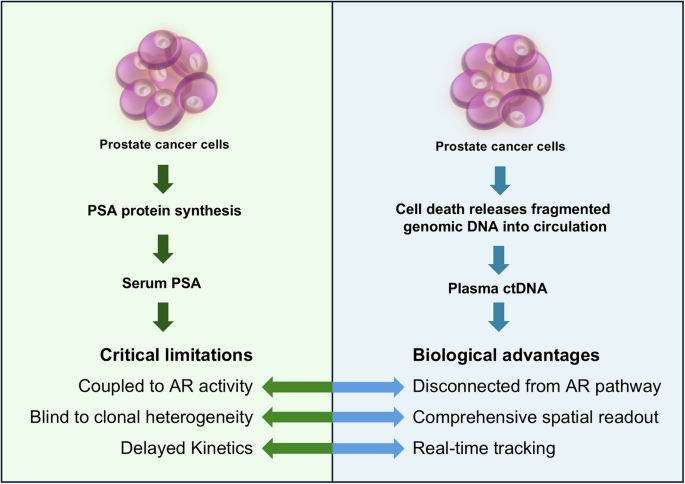
For decades, serum PSA has served as the cornerstone biomarker for monitoring prostate cancer response2 (Fig. 1). Its accessibility, low cost, and clinical familiarity make PSA indispensable in routine practice. However, PSA has important biological limitations3. As a downstream readout of androgen receptor signaling, PSA dynamics may incompletely reflect tumor behavior, particularly in tumors developing adaptive resistance or characterized by clonal heterogeneity. Moreover, clinically relevant prognostic information often emerges only after PSA nadir is achieved, delaying opportunities for intervention.
Fig. 1: Critical limitations of PSA and advantages of ctDNA
PSA secretion may lag behind true tumor adaptation and fails to capture aggressive non-PSA secreting or neuroendocrine-line clones. Furthermore, the prognostic value of PSA requires waiting for its nadir. On the other hand, ctDNA may capture tumor burden independently of hormone responsiveness and may reflect shedding from all distinct metastatic lesions and sub-clones simultaneously. In addition, ctDNA declines rapidly upon therapeutic exposure
In this context, the prospective PARADIGM study by Attard and colleagues1, recently published in Nature Cancer, provides compelling evidence that circulating tumor DNA (ctDNA) may redefine response assessment in metastatic castration-sensitive prostate cancer (mCSPC) by offering a more immediate and biologically informative measure of treatment effectiveness. Through serial blood sampling during first-line intensified treatment, the study demonstrates that persistent ctDNA detection after therapy initiation identifies patients with markedly worse outcomes and may predict prognosis earlier than PSA.
The biological rationale for ctDNA monitoring in prostate cancer is compelling4. Unlike PSA, ctDNA is not directly regulated by androgen receptor signaling and therefore reflects tumor burden and clonal dynamics independently of hormonal responsiveness. Across several malignancies, including colorectal, lung, and bladder cancers, ctDNA has emerged as a transformative biomarker for minimal residual disease detection, relapse prediction, and treatment adaptation5. In prostate cancer, however, ctDNA has largely remained confined to molecular profiling, particularly for identifying homologous recombination repair alterations predictive of sensitivity to PARP inhibitors. Its role as a dynamic biomarker during systemic treatment initiation has remained uncertain.
PARADIGM addresses this gap through a prospective national cohort of 114 patients with high-volume metastatic prostate cancer initiating androgen deprivation therapy (ADT) combined with either docetaxel or an androgen receptor pathway inhibitors. Importantly, serial ctDNA monitoring was performed during the first six treatment cycles, with cycles 3 or 4 pre-specified as the principal landmark for prognostic assessment, based on the rationale that this timepoint could still permit clinically meaningful treatment modification. This design reflects an important conceptual shift: biomarker assessment was intended not merely for prognostication, but potentially for actionable therapeutic decision-making.
The study revealed a substantial decline in ctDNA positivity after treatment initiation. Before ADT, ctDNA was detectable in 70% of evaluable patients, decreasing to 37% at cycle 1 and 29% by cycles 3 or 4. These findings underscore the biological sensitivity of ctDNA to treatment exposure and support its utility as an early molecular indicator of response. More importantly, persistent ctDNA positivity despite therapy emerged as a powerful marker of poor prognosis. Patients with detectable ctDNA at cycles 3 or 4 experienced substantially worse overall survival than ctDNA-negative patients, with 24-month survival rates of 50% versus 85%, respectively. In multivariable analyzes, ctDNA remained independently associated with mortality risk, reinforcing its prognostic robustness beyond conventional clinical variables.
One of the most intriguing observations concerns the temporal relationship between ctDNA and PSA. ctDNA appeared to acquire prognostic significance earlier than PSA kinetics. Already at cycle 1, ctDNA positivity identified patients with inferior survival outcomes, whereas PSA had not yet reached independent prognostic significance. This distinction is biologically plausible and clinically meaningful. PSA responses may lag behind tumor adaptation because they remain coupled to androgen receptor activity, whereas ctDNA may capture residual resistant disease before biochemical progression becomes evident. In this sense, ctDNA may offer an earlier molecular signal of therapeutic failure, potentially opening a window for intervention before overt progression.
Importantly, the key message emerging from PARADIGM may not be that ctDNA is superior to PSA, but rather that the two biomarkers are complementary. Integrating ctDNA with PSA substantially improved prognostic accuracy compared with PSA alone. Patients with both persistent ctDNA detection and elevated PSA represented an ultra-high-risk subgroup with dramatically worse outcomes, whereas those with favorable biomarker profiles experienced prolonged survival. These findings reinforce a broader principle increasingly recognized across oncology: multidimensional biomarker integration frequently outperforms reliance on a single surrogate endpoint. Rather than replacing PSA, ctDNA may refine and contextualize PSA kinetics, transforming disease monitoring into a more biologically informed process.
The translational implications are considerable. In mCSPC, therapeutic opportunities are greatest early in the disease course, before resistance mechanisms become fixed and disease burden escalates. Identifying poor responders within the first weeks of therapy could justify treatment intensification, prioritization for clinical trials, incorporation of emerging agents, or biomarker-driven adaptive strategies. Conversely, durable ctDNA clearance may ultimately support treatment de-escalation approaches in selected patients, potentially reducing toxicity and overtreatment. Although still speculative, such strategies align with the broader ambitions of precision oncology.
Nevertheless, caution is warranted before immediate clinical implementation. PARADIGM remains a prognostic rather than interventional study, and whether ctDNA-guided adaptation improves outcomes remains unknown. Persistent ctDNA positivity may simply identify aggressive disease without necessarily implying therapeutic modifiability. In addition, logistical and economic barriers to serial ctDNA testing remain relevant considerations for widespread adoption.
Despite these limitations, the conceptual advance introduced by PARADIGM is difficult to ignore. Historically, ctDNA in prostate cancer has functioned mainly as a molecular observer, useful for genomic characterization and therapeutic stratification. Attard and colleagues instead position ctDNA as a dynamic clinical instrument capable of monitoring treatment effectiveness in real time. Ultimately, the question may no longer be whether ctDNA predicts outcomes in metastatic prostate cancer, but whether clinicians should act when ctDNA trajectories signal emerging treatment resistance. In an era of increasingly individualized therapy, ctDNA may evolve from a promising biomarker into an early compass for treatment adaptation, particularly when PSA alone is no longer enough.
