


An anthracycline called doxorubicin is frequently used to treat and control a number of cancers, such as testicular, breast, and lung cancer30. Additionally, this medication is generally regarded as the most effective treatment for triple-negative breast cancer (TNBC). However, DOX is known to produce cardiac adverse effects in certain people, including acute coronary syndromes, heart failure, and altered ECGs31.
Therefore, researching novel natural compounds that may improve the benefits of DOX and potentially reduce its toxicity is one way to lessen its toxicity when treating patients with TNBC32.
By altering crucial signaling pathways in TNBC, BA is a well-known natural substance that can cause apoptosis and prevent tumorigenesis33. Additionally, BA can cause cancer cells to produce more reactive oxygen species (ROS), which can result in severe oxidative stress34.
To the best of our knowledge, however, no research has been done on the molecular targets suggesting such effect. In the current study, we use breast cancer cell line (MDA-MB-231) as a well-established model of triple negative breast cancer with its aggressive behavior and limited therapeutic effect.
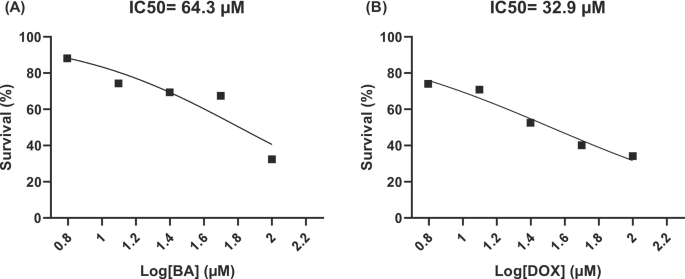
In the current study, we showed that treatment with BA and/or DOX was associated with anti-proliferative and cytotoxic effects in MDA-MB-231 cells with variable potency under the tested conditions. MDA-MB-231 cells were more responsive to DOX since the compound showed lower IC50 value compared with BA. This finding agrees with the fact that DOX is prescribed mainly in the treatment of triple-negative breast cancer35. Preliminary observations indicated that 48 h produced more pronounced effects compared to shorter exposure time. BA treatment showed anti-proliferative effect that agrees with previous studies which investigated a decrease in proliferation of MDA-MB-231 cells after treatment with BA organic salts36. Another study reported that BA suppressed proliferation of the SKOV3 and SW626 ovarian cell lines in a dose-dependent manner37.
Many recent reports, including the current study, indicated promising chemo-modulatory action of BA when combined with other chemotherapeutic agents used against various cancers38.
The strong anticancer activity of BA on cancer cells contrasts with its apparent lack of cytotoxicity on nonmalignant cells. Therefore, it has been noted that non-transformed cells of various origins, such as fibroblasts, melanocytes, neuronal cells, and peripheral blood lymphocytes, are significantly more resistant to the cytotoxic action of BA than cancer cells39. DOX well-established dose-dependent cardiotoxicity is attributed to its known cytotoxic effects on both malignant and non-cancerous cells40. This distinction emphasizes the potential benefit of mixing BA with traditional chemotherapeutic drugs to improve anticancer activity while perhaps lowering side effects.
Furthermore, we have investigated the potential changes associated with this anti-proliferative effect, such as modulation of apoptosis, necrosis, and genetic modifications, as no formal interaction analysis was performed.
We performed Annexin V/PI staining assay to investigate whether BA suppressed breast cancer cells proliferation by inducing apoptosis. Many reports have attributed the anticancer effects of BA; we have examined the apoptotic and necrotic cell death after individual and combined BA, and DOX treatment. Our results indicated that BA was associated with apoptotic features in breast cancer cells at the concentration corresponded to its IC50 value. In MDA-MB-231 cells, apoptotic cell death was prevalent in BA single treatment. Interestingly, a combination of BA with DOX increased the population of necrotic cells by 2.5 folds compared to control.
Such data might be important in future combination therapy studies aiming to bypass apoptosis as a major cell death mechanism in DOX-resistant cancer cells.
It is widely reported that BA exhibits apoptotic induction effect on various cancer cells. Wang et al. showed that BA induces apoptosis of gallbladder cancer cells via repressing SCD141. Liu’s study demonstrated that BA induces autophagy-mediated apoptosis through suppression of the PI3K/AKT/mTOR signaling pathway and inhibits hepatocellular carcinoma42. Shen also verified that BA induces ROS-dependent apoptosis and S-phase arrest by inhibiting the NF- κB pathway in human multiple myeloma42.
Numerous clinical conditions, such as inflammation, cardiovascular disease, cancer, neurological diseases, and even aging, are believed to be significantly influenced by oxidative stress. Moreover, oxidative stress contributes to a number of alterations in cell structure and function as well as DNA mutations that lead to cancer. Antioxidants may have a crucial role in preventing the onset of diseases like cancer43. Research and investigations have shown that BA offers promising antioxidant effects in the battle against oxidative stress44.
It’s interesting to note that BA increased the activity of antioxidant enzymes like SOD and CAT, indicating a possible function in regulating cellular redox balance. Contrarily, DOX decreased antioxidant defenses, which is in line with its well-known pro-oxidant properties. These results suggest that BA may have anticancer effects through mechanisms other than oxidative stress induction, such as redox regulation and alternate apoptotic pathways. The current research indicates that BA may control redox homeostasis instead of merely causing oxidative damage, despite the fact that oxidative stress has been linked to cancer cell death. Therefore, the relationship between antioxidant enzyme activity and cytotoxicity may be complex and context-dependent.
About 60% of human genes have their expression regulated by miRNA molecules, which are small, non-coding, single-stranded RNAs45. The activity of one or more genes can be concurrently regulated by distinct miRNAs. MiRNA molecules may play a significant role in the development of breast cancer, according to earlier research. By targeting tumor suppressor genes, they can increase invasion and metastasis while downregulating miRNAs crucial for preserving physiological state46.
miR-21 regulates breast cancer cell invasion and migration. To investigate the roles of miR21 in regulating breast cancer cell invasion and migration, we studied its molecular effect of genes such as PTEN, SMAD7, HIF1A, and PDCD4. After treatment with BA for 48 h, the miR-21 level was downregulated as compared to control followed by combined treatment with BA + DOX.
Breast, liver, prostate, colorectal, cervical, and pancreatic cancers are among the many tumors against which BA has demonstrated anticancer properties47. The bioactivities of BA have been linked to a number of targets, including NF-κB, P53, PI3K, ERBB2, STAT3, ERα, and HIF-1α.
A protein called Hypoxia-Inducible Factor 1-alpha (HIF-1α) functions as a transcription factor, assisting cells in responding to low oxygen (hypoxia) by activating particular genes that enable survival and adaptation. By activating genes including VEGF (vascular growth), EPO (red blood cell production), and MMPs (matrix metalloproteinases), which encourage cell migration and tissue invasion, HIF-1α plays a role in the onset and spread of breast cancer48. Our study showed that BA suppressed the expression of HIF-1α followed by combined treatment with BA + DOX as compared to control modulating cancer treatment.
A crucial intracellular modulator of the Transforming Growth Factor-beta (TGF-β) signaling pathway, SMAD7 belongs to the SMAD family of proteins. Its expression and activity vary greatly between normal and malignant tissues and may be influenced by the tumor setting as well as the balance of other signaling pathways49. In our study, treatment with BA + DOX showed the lowest expression level of SMAD7 in breast cancer cell line followed by treatment with BA.
The tumor suppressor gene PDCD4 (Programmed Cell Death 4) is essential for controlling cell division, apoptosis, and protein translation. It was initially discovered as a gene that was activated during programmed cell death. Since then, it has been found as a powerful tumor suppressor that is often downregulated in malignancies of the breast, lung, colon, stomach, and pancreas50. After treatment with DOX for 48 h followed by BA, the expression of PDCD4 was increased indicating the potent effect of BA in treatment of lung cancer.
The tumor suppressor gene phosphatase and tensin homolog (PTEN) regulates the PI3K/AKT signaling pathway and is essential for preserving the equilibrium between cell death and survival. Uncontrolled activation of the PI3K/AKT pathway results from the loss or mutation of PTEN, which eliminates its regulatory impact. Cellular expansion, resistance to apoptosis, and the cells’ capacity to avoid regular regulatory processes are the outcomes of this. Loss of PTEN is frequently linked to enhanced angiogenesis, metastasis, and cell migration—all of which aid in the growth and spread of malignancies51. DOX treatment for 48 h showed the highest expression of PTEN then BA.
Our in silico study predicted the interaction of BA with HIF1A, PDCD4, PTEN and SMAD7. The molecular docking results suggested potential binding interactions of BA with PTEN and PDCD4 followed by DOX. On the other hand, DOX showed potential binding interactions with SMAD7 than BA. BA and DOX indicated the same possible interaction with HIF1A.
Despite the fact that molecular docking study revealed putative interactions between BA and the targets under investigation, these conclusions are predicated on computational predictions, these findings are predictive and do not confirm biological effects or functional relevance. As a result, it is appropriate to interpret the docking results as generating hypotheses.
Betulinic acid’s pleiotropic nature—a feature exhibited with several natural compounds—may account for its capacity to interact with a variety of molecular targets. These substances frequently regulate several signaling pathways at once rather than just one particular protein, producing coordinated biological effects. The observed alterations in apoptosis, redox balance, and gene expression could be attributed to this multi-target behavior.
According to previous studies, BA can affect a variety of cellular processes, such as oxidative stress reactions, apoptotic control, and mitochondrial function52,53. This provides credibility to the concept that a network-based mechanism, instead of a single target interaction, may be responsible for its anticancer effects.
