


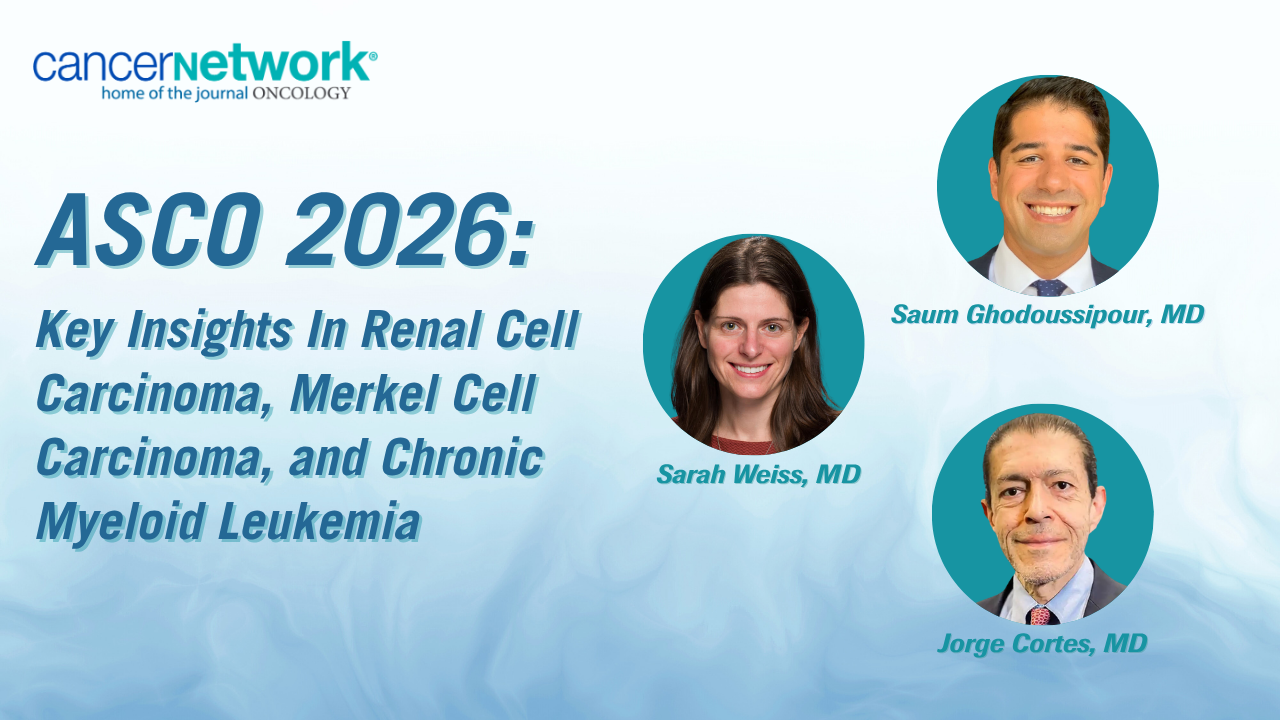
In an expert-led review of pivotal clinical trial data presented at the 2026 American Society of Clinical Oncology (ASCO) Annual Meeting, CancerNetwork® spoke with oncology experts in the renal cell carcinoma (RCC), Merkel cell carcinoma, and chronic myeloid leukemia (CML) spaces to break down key abstracts at the conference.
First, Saum Ghodoussipour, MD, director of the Bladder and Urothelial Cancer Program at Rutgers Cancer Institute and an associate professor of Surgery at Rutgers Robert Wood Johnson Medical School, discussed findings from the phase 3 RAMPART trial (NCT03288532). While the combination of durvalumab (Imfinzi) and tremelimumab (Imjudo) demonstrated a disease-free survival (DFS) benefit––primarily in those with high-risk disease––he noted that the monotherapy arm did not significantly improve outcomes. Ghodoussipour cautioned that the significant toxicity profile associated with this combination remains a hurdle for routine practice, suggesting that clinicians should continue to prioritize existing standards like pembrolizumab (Keytruda) while waiting for more refined biomarkers to guide therapy, but emphasizing that there was still a “conversation” for the RAMPART regimen.
Next, Sarah Weiss, MD, director of the Melanoma/Cutaneous Oncology Program, a medical oncologist, and an associate professor of medicine in the Division of Medical Oncology at Rutgers Cancer Institute, explored the evolving management of Merkel cell carcinoma. She emphasized that adjuvant immunotherapy remains an individualized decision, stressing the importance of close follow-up. Notably, she highlighted emerging data suggesting potentially better outcomes with sequential rather than concurrent immunotherapy and radiation. She underscored the need for further research to understand why this sequencing appears more effective, while also noting the growing potential of circulating tumor DNA (ctDNA) monitoring for recurrence prediction.
Finally, Jorge Cortes, MD, chief of hematology at University of Alabama at Birmingham (UAB) and deputy director of O’Neal Cancer Center at UAB, reviewed the 144-week follow-up data from the ASC4FIRST trial (NCT04971226), which evaluated asciminib (Scemblix) as a frontline therapy for CML. The data demonstrated sustained efficacy, with deep molecular responses continuing to climb even after 3 years. Beyond efficacy, Cortes highlighted the drug’s favorable tolerability profile. With significantly lower rates of treatment discontinuation due to adverse effects compared with traditional TKIs, he described how asciminib is redefining expectations for long-term adherence in CML.
