


HDAC inhibitors represent a significant advancement for the treatment of NHL.11 In the United States, vorinostat, romidepsin, belinostat, and panobinostat are FDA-approved for r/r T-cell lymphoma, whereas in China, chidamide has gained approval from the China NMPA for this indication. Abnormal expression of HDACs has been closely linked to the pathogenesis and proliferation of cancer cells.8 HDAC inhibitors can activate tumor suppressor genes and other cell cycle-regulating genes, thereby manifesting anti-cancer activities.24
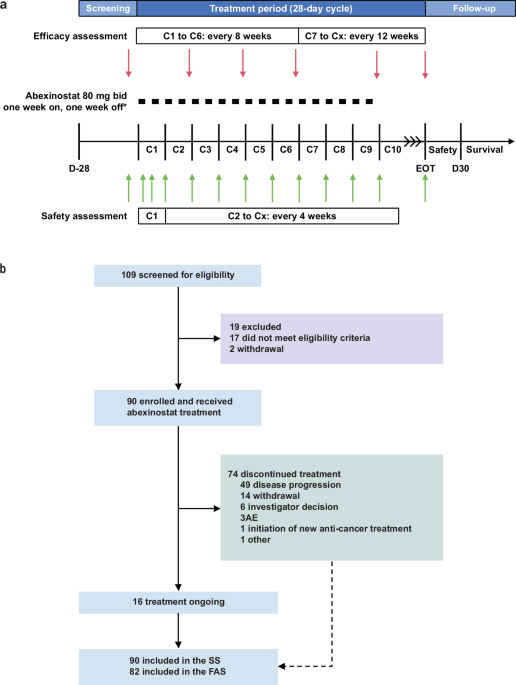
Abexinostat, a pan-HDAC inhibitor, facilitates sufficient pharmacodynamic activity while reducing peak drug concentrations to decrease toxicity.25,26,27 The terminal elimination half-life of abexinostat after oral administration was around 4 h. In previous clinical studies, the regimen of 80 mg BID orally and apart for 4 h can achieve ideal efficiency, what more important is that this regimen can greatly improve patients’ tolerance.23 Using pharmacokinetic modeling, investigators established that oral administration of abexinostat at 80 mg BID with a 4-h interval achieves sustained therapeutic exposure necessary for tumor cell eradication while limiting high peak plasma levels.23
The primary endpoint of this study was successfully achieved, indicating that abexinostat exhibits both promising efficacy and a manageable safety profile in r/r FL patients. The IRC-assessed ORR was 69.5% (57/82, 95% CI 58.4–79.2), aligning with the promising outcomes observed in previous phase I/Ⅱ studies. The ORR was 64.3% (9/14, 95% CI 35.1–87.2) for abexinostat among r/r FL patients in the Study 0403.26 The ORR was 56% (9/16, 95% CI 30–80) for abexinostat among r/r FL patients in the Study 1401.27
Abexinostat has shown efficacy in heavily pre-treated B-cell NHL due to several key factors that differentiate it from other HDAC inhibitors. One major advantage of abexinostat is its broad-spectrum activity, inhibiting a wide range of HDAC enzymes.28 This advantage allows abexinostat to impact a broader array of cancer cell survival mechanisms and epigenetic regulation pathways, which is particularly effective in the context of lymphomas that no longer respond adequately to prior lines of therapy.28
For patients with FL receiving third-line or later-line therapy, available treatment options include bispecific antibodies (mosunetuzumab and epcoritamab), chimeric antigen receptor (CAR) T-cell therapy (axicabtagene ciloleucel, tisagenlecleucel, and lisocabtagene maraleucel), the EZH2 inhibitor tazemetostat, and regimens combining a Bruton’s tyrosine kinase inhibitor with a CD20 mAb, such as zanubrutinib plus obinutuzumab.29 For bispecific antibodies, mosunetuzumab achieved an ORR of 80% (72/90, 95% CI 70.3–87.7) with the median PFS of 17.9 months (95% CI 10.1–NR),30 while epcoritamab demonstrated an ORR of 82% (105/128, 95% CI 74.3–88.3) and the 18-month PFS rate of 49.4% (95% CI 39.0–59.1).31 For CAR T-cell therapies, the ORR was 94% (119/127, 95% CI 88-97) for axicabtagene ciloleucel,32,33 86.2% (81/94, 95% CI 77.5–92.4) for tisagenlecleucel,34 and 97% (98/101, 95% CI 91.6–99.4) for lisocabtagene maraleucel.35 The ORR of tazemetostat was 69% (31/45, 95% CI 53–82) in EZH2 mutation r/r FL patients and 35% (19/54, 95% CI 23–49) in EZH2 wild type r/r FL patients, and the median PFS was 13.8 months (95% CI 10.7–22.0) in EZH2 mutation r/r FL patients and 11.1 months (3.7–14.6) in EZH2 wild type r/r FL patients.36 The ORR was 69% (100/145, 95% CI 61–76) for zanubrutinib plus obinutuzumab, while 46% (33/72, 95% CI 34–58) for obinutuzumab monotherapy in the third-line treatment of FL patients (p = 0.001).37 Zanubrutinib in combination with obinutuzumab significantly prolonged PFS compared to obinutuzumab monotherapy (median 28.0 months [95% CI 16.1–NE] vs 10.4 months [95% CI 6.5–13.8], respectively), with a HR of 0.50 (95% CI 0.33–0.75, p < 0.001).37 Among r/r FL patients, the TRS005, a CD20 antibody-drug conjugate, demonstrated an ORR of 21.4% (3/14).38 while the fusion protein amulirafusp alfa, which combines a CD20 mAb with the CD47-binding domain of signal-regulatory protein alpha, achieved an ORR of 41.2% (7/17, 95% CI 18.4–67.1).39 In this study, the ORR was 69.5% (57/82, 95% CI 58.4–79.2) and the median PFS was 13.80 months (95% CI 9.69–30.26) for abexinostat monotherapy, showing promising efficacy compared with above mentioned treatments. Furthermore, studies showed that HDAC inhibitors could decrease cytokine release by monocytes, macrophages, and airway epithelial cells 40,41, which offers a chance for abexinostat to be combined with bispecific antibody or CAR T-cell therapy.
Cytokine release syndrome (CRS) is one of the most significant safety concerns associated with bispecific antibody and CAR T-cell therapy.30,31,32,34,35 The incidence of CRS was 44% (40/90) for mosunetuzumab,30 49% (42/86) for epcoritamab,31 78% (97/124) for axicabtagene ciloleucel,32 48.5% (47/97) for tisagenlecleucel,34 58% (75/130) for lisocabtagene maraleucel35 in FL patients, while all were predominantly grade 1–2, with the incidence of 2% (2/90), 2% (2/128), 6% (8/124), 0 (0/97), and 1% (1/130) for ≥ grade 3, respectively.30,31,32,34,35 The most common ≥ grade 3 adverse events (AEs) were neutropenia for the 2 bispecific antibodies and the three CAR-T cell therapies, with the incidence of 27% (24/90), 25% (32/128), 27% (34/124), 32.0% (31/97), and 58% (76/130), respectively.30,31,32,34,35 For tazemetostat, the most frequently observed treatment-related adverse events (TRAEs) of ≥ grade 3 included thrombocytopenia (3/99, 3%), neutropenia (3/99, 3%), and anemia (2/99, 2%) among FL patients.36 Among patients with FL receiving zanubrutinib plus obinutuzumab, the most frequently reported AEs of any grade included thrombocytopenia (51/143, 36%), neutropenia (42/143, 29%), diarrhea (26/143, 18%), and fatigue (22/143, 15%).37 Among patients with B-cell NHL, of whom 22 had FL, neutropenia represented the most common ≥ grade 3 AE of TRS005 (19/48, 39.6%).38 Among patients with B-cell NHL receiving amulirafusp alfa (including 20 with FL), the most frequently ≥ grade 3 TRAEs included reductions in lymphocyte counts (28/48, 58.3%), white blood cell counts (10/48, 20.8%), and absolute neutrophil counts (9/48, 18.8%), as well as anemia (5/48, 10.4%).39 The safety results of this study showed that hematologic toxicities were the most common AEs of abexinostat, with thrombocytopenia being the most prevalent. The reversible nature of the hematologic AEs, especially thrombocytopenia, presents a manageable safety profile, ensuring that treatment can be sustained over longer periods with appropriate management.
This study was limited by having a single-arm, non-randomized design, which may introduce selection bias, as well as by the inclusion of only Chinese patients. Therefore, caution should be taken when explaining the results of this study.
In conclusion, the results of this study demonstrated that abexinostat had promising efficacy and manageable safety profile, supporting abexinostat as a new treatment option for the third-line or later-line treatment of r/r FL. An ongoing phase Ib/III trial (CTR20240881) is assessing the efficacy and safety of the combination of abexinostat with lenalidomide and rituximab versus the current standard of care in r/r FL patients previously treated with at least one regimen containing rituximab or other CD20 mAbs.
