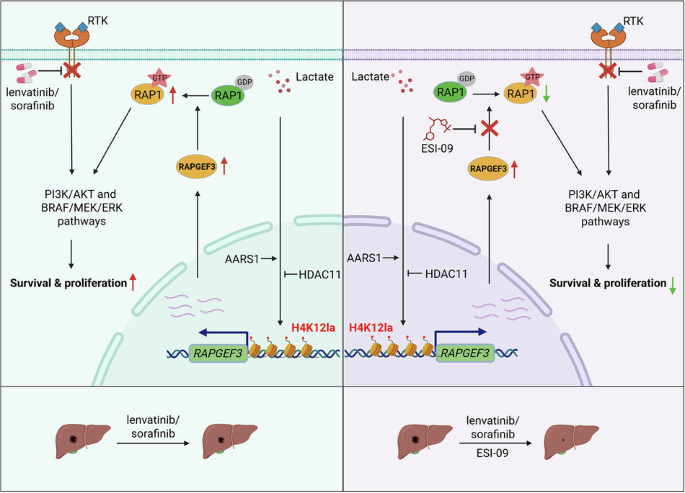
Although receptor tyrosine kinase inhibitors (sorafenib and lenvatinib) have been applied as a first-line targeted therapy for advanced unresectable hepatocellular carcinoma (HCC) for decades, their clinical efficacy is limited and the underlying mechanism remains unclear. HCC is a highly glycolytic malignancy characterized by excessive lactate accumulation in the tumor microenvironment (TME). Emerging evidences show that histone lactylation plays a critical role in various biological processes, but its function in receptor tyrosine kinase inhibitor resistance remains obscure. This study was designed to elucidate the role of histone lactylation in receptor tyrosine kinase inhibitor resistance in HCC. Clinical cohort analyses revealed that the increased nuclear pan-lysine lactylation (pan-Kla) predicts poor patient prognosis and high H4K12la level correlates with targeted drug resistance. Furthermore, lactate bidirectionally controls H4K12la through the opposing enzymatic activities of AARS1 (writer) and HDAC11 (eraser). Integrative CUT&Tag and ATAC-seq analyses demonstrated that H4K12la directly activates the promoter of RAPGEF3, a predominant upstream regulator of the RAP1 signaling pathway. Inhibition of RAPGEF3 reversed the lactate-induced targeted drug resistance both in vitro and in vivo, suggesting H4K12 lactylation modulates targeted drug resistance by activating RAPGEF3-RAP1 signaling. Notably, combining the RAPGEF3 inhibitor ESI-09 with lenvatinib synergistically suppressed HCC growth in mouse models. Clinico-pathological analyses revealed that elevated expression of the AARS1/H4K12la/RAPGEF3 axis correlated with inferior survival and sorafenib resistance in HCC patients, which was further confirmed in patient-derived xenograft (PDX) models. This study delineates a novel metabolic-epigenetic mechanism whereby lactate modulates hepatocellular carcinoma sensitivity to targeted therapies through histone lactylation and suggests AARS1-H4K12la-RAPGEF3 axis may serve as an interventional target to overcome targeted drug resistance, offering a promising strategy to enhance clinical outcomes in HCC patients.
Trending
- Optimal Sequencing of Bispecific Antibodies and CAR T Cells Remains Unclear
- Pelareorep Earns FDA Fast Track Designation in Second-Line Anal Cancer
- FDA Approves Zidesamtinib in Pretreated ROS1+ NSCLC
- How Center for Cancer and Blood Disorders Is Changing the Future of CAR-T Cancer Therapy | Health Care
- Ascites-derived lipid barrier at the T cell synapse
- Why It’s So Hard to Just Rest and Why We Need to Do It
- Ivonescimab/Chemotherapy Maintains OS Benefit in EGFR-Mutant NSCLC
- Managing Patient Preferences and Expectations in Frontline EGFR-Mutant NSCLC


Wednesday, July 22
AARS1-catalyzed H4K12 lactylation promotes HCC resistance to targeted therapy by activating RAPGEF3-RAP1 signaling
 By NewsCancer