


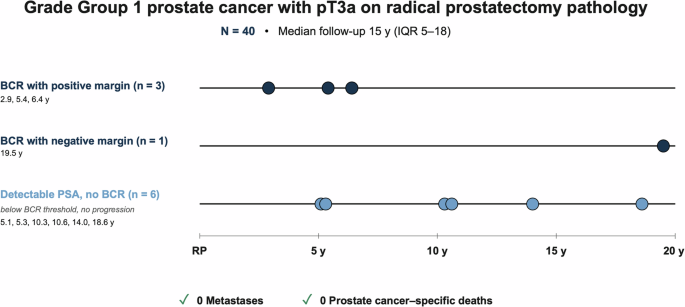
In this cohort with a median follow-up of 15 years, GG1 prostate cancer with pT3a pathology demonstrated highly favorable long-term oncologic outcomes. No patient developed metastatic disease or died from prostate cancer, despite positive margins or non-focal EPE in many. Rezaee et al. similarly observed zero metastasis or cancer-specific mortality in GG1 and EPE disease, though over a median follow-up of only 4 years [5]. Our 15-year median follow-up substantially extends this observation, suggesting that the pT3a stage may not confer meaningful oncologic risk in GG1 tumors.
The observed pattern of BCR, three events within the first 7 years, and a single late event at 19.5 years, is consistent with the indolent natural history characteristic of GG1 disease [4, 8] and aligns with prior evidence showing no significant difference in BCR-free survival between GG1 patients with and without EPE [5]. Moreover, the clustering of recurrences in margin-positive patients supports margin status as the primary driver of recurrence in this setting [9]. The very late single recurrence also aligns with Loeb et al.‘s observation that BCR beyond 15 years is uncommon and generally associated with favorable outcomes [10].
An important aspect of our findings is the pattern of PSA behavior below the BCR threshold. Detectable PSA accumulated gradually over follow-up, with no events in the first 5 years and no subsequent progression to BCR among affected patients, suggesting that low-level PSA detectability may remain stable rather than evolve into clinically meaningful recurrence. In the absence of metastasis or cancer-specific mortality, this is consistent with biologically indolent PSA production, potentially arising from residual benign tissue or non-progressive microscopic disease rather than clinically significant residual carcinoma [7]. Stable sub-BCR PSA plateaus in patients with final GG1 disease should therefore be interpreted cautiously and may not justify reflexive salvage radiation, given the indolent outcomes observed here and in prior series [5, 8].
Our findings support contemporary guideline recommendations favoring AS for most GG1 patients [3, 7], and align with long-term data, including ProtecT, showing low prostate cancer–specific mortality in appropriately selected patients [4, 8, 11]. Yet, some patients still undergo RP because of young age, preference, suspicious imaging findings, high-volume disease or concern for an undersampled higher-grade tumor. ProtecT also underscores the challenge of patient selection, as substantial upgrading and upstaging were observed among men who underwent prostatectomy [11]. This residual uncertainty helps explain why rare post-RP findings such as pT3a GG1 remain relevant in the AS era and create a counseling dilemma directly addressed by our findings. Patients in this scenario may be reassured that routine treatment escalation based on pT3a status alone is not warranted, consistent with evidence that unfavorable histology is the principal driver of adverse oncologic outcomes [6]. Importantly, these findings should not be generalized to higher‑grade tumors, in which adverse histologic features are most prognostic, and the pathological stage may play a more meaningful role [5, 6, 9].
Limitations of this study include the retrospective single-institution design, small sample size, and absence of a pT2 GG1 comparator. No patient had seminal vesicle invasion, limiting extrapolation to pT3b GG1 disease. Additionally, only one patient underwent pre-operative MRI, with no ECE identified, reflecting the predominance of pre-MRI-era cases in our cohort. Therefore, we could not assess the clinical significance of MRI-suspected non-organ-confined features in otherwise GG1 disease, including its relationship to pT3a pathology or its influence on management decisions such as repeat biopsy or treatment selection.
