


CICs predominantly occur between cancer cells and are associated with reduced cytotoxic T cell levels
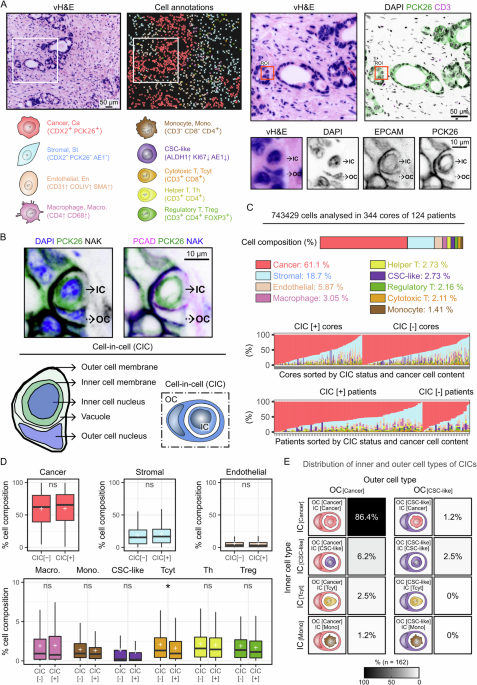
We performed Cell DIVE multiplex imaging to profile single-cell expression of 60 proteins (Table S1) in 344 regions of tumour cores from 124 colorectal cancer patients. Cells were classified based on marker expression into cancer, stromal, endothelial, macrophage, monocyte, cytotoxic T, helper T, regulatory T, and cancer stem cell–like (CSC-like) populations (Fig. 1A). Next, we manually annotated cell-in-cell structures (CICs) in HALO software if they exhibited evidence of a complete internalisation of an entire cell within another cell and if the event met at least five of the six following criteria: (1) nucleus of inner cell, (2) cytoplasm of inner cell, (3) membrane of inner cell, (4) nucleus of outer cell, (5) cytoplasm of outer cell, and (6) visible vacuolar space between inner and outer cells (Fig. 1A, B, Fig. S1), consistent with previous studies [16, 20, 42]. In total, 443 CICs were identified using virtual H&E images together with nuclear (DAPI), cytoplasmic (AE1, PCK26, EPCAM), and membrane (NAK, PCAD) markers.
Fig. 1: Characterisation of cell-in-cell (CIC) events and their association with cellular composition of colorectal tumours.
A Classification of cancer cells, stromal cells, endothelial cells, macrophages, monocytes, CSC-like cells, cytotoxic T cells, helper T cells, and regulatory T cells within CRC tumours. The region of interest (right) depicts a smaller area showing a CIC event between two cancer cells (red). B Characterisation of CIC events in CRC tissue sections. Combination of vH&E, nuclear (DAPI), cytoplasmic (PCK26, AE1) and membrane (PCAD, NAK) markers was used to detect CICs (IC: inner cell, OC: outer cell). A schematic representing the characteristics of a CIC was generated based on the staining. C Cellular composition of CRC tumours based on cell types classified in this study. In total, 743429 cells were analysed across 344 cores from 124 patients. Distribution of cellular composition in CIC positive (CIC [+]) and CIC negative (CIC [-]) cores and patients is shown. D Comparison of cancer, stromal, endothelial, macrophage, monocyte, CSC-like cell, cytotoxic T, helper T, and regulatory T cell compositions between CIC [-] (n = 189) and CIC [+] (n = 155) cores. Groups were compared using unpaired t-test, data are presented as median, interquartile range, and mean (+). *P < 0.05, **P < 0.01, ns: not significant. E Distribution of CICs (n = 162) by inner cell (IC) and outer cell (OC) types. Shades of grey indicate proportion of each group (darker colour represents higher value).
Among 743,429 cells analysed, cancer cells comprised 61.1% of the population, followed by stromal (18.7%), endothelial (5.87%), macrophages (3.05%), helper T cells (2.73%), CSC-like cells (2.73%), regulatory T cells (2.16%), cytotoxic T cells (2.11%), and monocytes (1.41%) (Fig. 1C). Cell composition varied substantially across tumour cores, indicating high intra- and inter-tumour heterogeneity within the cohort.
Comparison of CIC-positive (CIC > 0) and CIC-negative (CIC = 0) CRC cores revealed significantly lower proportions of cytotoxic T cells in CIC-positive regions, whereas other cell populations did not differ significantly (Fig. 1D). These results suggest that CIC formation is associated with tumour regions exhibiting reduced cytotoxic T cell infiltration.
We next characterised the cellular composition of inner cells (IC) and outer cells (OC) of CICs. All CICs contained cancer or CSC-like cells as outer cells. The majority of CICs (86.4%) occurred between cancer cells. Among outer cancer cells, 6.2% engulfed CSC-like cells, 2.5% engulfed cytotoxic T cells, and 1.2% engulfed monocytes. CSC-like outer cells accounted for 3.7% of CICs and engulfed either cancer cells (1.2%) or CSC-like cells (2.5%) (Fig. 1E).
Together, these findings indicate that CIC formation in colorectal cancer predominantly occurs through homotypic cancer cell interactions, while heterotypic events involving immune or CSC-like cells are relatively rare.
Inner and outer cells exhibit metabolic and apoptotic profiles consistent with cell competition
We compared the single-cell expression profiles of proteins involved in apoptosis, metabolism, and proliferation between CICs and non-engulfed cells (Fig. 2, Fig. S2). Inner and outer cancer cells were compared with non-engulfed cancer cells, and a similar approach was used for CSC-like cells. Inner cytotoxic T cells were also compared with non-internalised cytotoxic T cells to examine changes associated with emperipolesis [15, 29].
Fig. 2: Metabolic, apoptotic, and proliferation profiles of inner and outer cells.
A Volcano plots showing differential protein expression between inner cancer cells (IC [cancer], n = 171, left) and outer cancer cells (OC [cancer], n = 179, right) compared to other cancer cells (Ca, n = 444725). Proteins with significant changes are indicated as filled circles. The dashed horizontal line denotes P = 0.05. Colour and point size represent log2 fold change. B Comparison of log2 normalised mean fluorescence intensity (nMFI) values of selected differentially expressed proteins in IC [cancer] (n = 171), OC [cancer] (n = 179), and other cancer cells (Ca, n = 444725). Triangles indicate group means. Groups were compared using one-way ANOVA followed by Tukey’s HSD post-hoc test for multiple comparisons. *P < 0.05, **P < 0.01, ***P < 0.001, ns: not significant. C Comparison of log2 nMFI values of differentially expressed proteins in IC [CSC-like] (n = 13), OC [CSC-like] (n = 6), and other CSC-like cells (n = 20255). Triangles indicate group means. Groups were compared using one-way ANOVA followed by Tukey’s HSD post-hoc test for multiple comparisons. *P < 0.05, **P < 0.01, ***P < 0.001, ns: not significant. D Comparison of log2 nMFI values of differentially expressed proteins between IC [Tcyt] (n = 5) and other cytotoxic T cells (Tcyt, n = 15668). Triangles indicate group means. Groups were compared using an unpaired ttest. *P < 0.05, **P < 0.01, ***P < 0.001, ns: not significant.
Inner cancer cells exhibited significantly reduced expression of mitochondrial apoptosis regulators, with BAX and BAK showing the most pronounced decreases relative to other cancer cells. CASP3 and BCL2 were slightly reduced, whereas cleaved CASP3 (CL-CASP3) was elevated. Outer cancer cells showed similar but less pronounced changes and did not display increased CL-CASP3. Both inner and outer cancer cells exhibited elevated expression of metabolic and stress-associated proteins, including GLUT1, GRP78, PKM2, HK2, GAPDH, LDHA, and TIGAR. GLUT1 expression was slightly higher in outer cells than inner cells, although this difference was not statistically significant. Proliferation marker KI67 was reduced in both inner and outer cancer cells (Fig. 2A, B).
Approximately 10% of CICs involved CSC-like cells (Fig. 1E). Inner CSC-like cells displayed reduced BAK and CASP8 and increased CL-CASP3 and PKM2 compared with non-engulfed CSC-like cells. Outer CSC-like cells showed reduced FLIP expression. Inner CSC-like cells exhibited lower CASP8 and CMYC and higher CL-CASP3, consistent with loser-cell phenotype (Fig. 2C).
A small proportion of CICs contained cytotoxic T cells as inner cells (2.5%) (Fig. 1E). These cells exhibited increased expression of GRP78, LDHA, GAPDH, SMAC, and CMYC compared with non-engulfed cytotoxic T cells, whereas CL-CASP3 levels were unchanged (Fig. 2D).
Together, these results indicate that CIC-associated cancer and CSC-like cells display distinct apoptotic and metabolic states consistent with cell competition. Inner cells exhibited elevated CL-CASP3, consistent with loser-cell phenotype, whereas outer cancer cells showed higher GLUT1 expression, suggesting a metabolically fitter, winner-cell phenotype. CIC formation was therefore associated with apoptotic remodelling, altered glucose metabolism, and reduced proliferation in tumour cells, while inner cytotoxic T cells primarily displayed metabolic and ER stress without clear evidence of apoptosis.
CICs exhibit increased glucose uptake during lysosomal degradation of inner cells
To investigate glucose metabolism during CIC formation, we monitored uptake of the fluorescent glucose analogue 2-NBDG using live-cell time-lapse confocal microscopy in HCT116 colon cancer cells. Previous studies have shown that following CIC formation, most inner cells undergo lysosomal degradation within outer cells [16, 17, 31, 43]. Consistent with this, 2-NBDG accumulated specifically in inner cells undergoing lysosomal degradation (IC LT[+]), whereas during early CIC stages prior to Lysotracker accumulation (IC LT[-]) 2-NBDG levels remained similar to neighbouring cells (Fig. 3A, B). Quantification of 2-NBDG uptake revealed an approximately four-fold higher glucose uptake rate in degrading inner cells compared with neighbouring cancer cells (Fig. 3C).
Fig. 3: Glucose accumulates in inner cells during lysosomal degradation following cell engulfment.
A Representative confocal microscopy images of Hoechst (DNA), Lysotracker, and 2-NBDG (fluorescent glucose analogue) showing a late-stage inner cell undergoing degradation within an outer cell in HCT116 cells (left). Representative live-cell time-lapse confocal microscopy images showing accumulation of 2-NBDG in a field of view containing a CIC event with a late-stage inner cell. IC: inner cell, OC: outer cell. B Quantification of 2-NBDG mean fluorescence intensity (MFI) in early-stage CICs, late-stage CICs, and neighbouring cells in HCT116. Early-stage CICs contain inner cells without Lysotracker accumulation (LT [-]), whereas late-stage CICs contain inner cells undergoing lysosomal degradation (LT [+]). Numbers of analysed cells for each group were: nCIC_ICLT[-] = 18, nOC_ICLT[-] = 18, nICLT[-] = 19, nCIC_ICLT[+] = 15, nOC_ICLT[+] = 15, nICLT[+] = 17, Neigh. cells = 72. Groups were compared using one-way ANOVA followed by Tukey’s HSD post-hoc test for multiple comparisons. *P < 0.05, ***P < 0.001. C Comparison of 2-NBDG and Lysotracker accumulation kinetics in inner cells undergoing degradation within an outer cell (ICLT[+], n = 17) and neighbouring HCT116 cells (n = 16). 2-NBDG and Lysotracker uptake rates were calculated from the slopes of time-lapse measurements. Groups were compared using an unpaired t-test. **P < 0.01, ***P < 0.001. D Representative live-cell time-lapse confocal microscopy images of DNA, Lysotracker, and 2-NBDG at the onset of lysosomal degradation in an inner cell. IC: inner cell, OC: outer cell. Quantification of 2-NBDG and Lysotracker MFI for the corresponding IC is shown. E Representative live-cell time-lapse confocal microscopy images of DNA, Lysotracker, and 2-NBDG in multiple inner cells undergoing lysosomal degradation in a CIC event. IC inner cell, OC outer cell.
The onset of 2-NBDG accumulation partially coincided with Lysotracker signal. During early degradation, 2-NBDG was distributed throughout the inner cell, while Lysotracker signal was enriched at the cell periphery. Some Lysotracker-positive vesicles were also positive for 2-NBDG, indicating partial co-localisation (Fig. 3D). In CICs containing multiple inner cells, 2-NBDG accumulated in each inner cell undergoing lysosomal degradation (Fig. 3E). Inner cells progressively shrank and were ultimately degraded by the outer cells.
To assess glucose uptake in heterotypic CICs, we co-cultured HCT116 cells with Jurkat T lymphocytes and tracked LT[+] inner Jurkat cells within outer cancer cells. Similar to homotypic CICs, 2-NBDG accumulated at significantly higher levels in inner T cells undergoing lysosomal degradation (Fig. S3).
We next examined GLUT1 expression in HCT116 cells by immunofluorescence. Consistent with live-cell imaging results, inner cells undergoing lysosomal degradation exhibited higher GLUT1 levels compared to neighbouring cells. This increase was evident even in CICs where only one inner cell was Lysotracker[+] while another remained Lysotracker[-]. CICs and outer cells containing LT[+] inner cells showed slightly elevated GLUT1 expression, although this difference was not statistically significant (Fig. S3).
Together, these results indicate that initiation of inner cell degradation coincides with a rapid increase in glucose uptake within inner cells in both homotypic and heterotypic CICs. These metabolic changes appear transient and are consistent with previously reported rapid AMPK activation in loser (inner) cells during entosis [24]. Moreover, outer (winner) cells may acquire nutrients from the degraded inner (loser) cells.
CICs are associated with invasive and mesenchymal clinicopathological features in CRC
We examined associations between CICs and clinicopathological, molecular, and clinical features in a cohort of stage I-III CRC patients. Patient demographics and tumour characteristics are summarised in Table S2 and Fig. 4A. CIC distribution across tumours was highly heterogeneous and varied substantially between patients (Fig. 4A). Overall, CICs were detected in 112 of 148 patients (75.6%), consistent with our previous observations in an independent CRC cohort (121/196, 61.7%) [16].
Fig. 4: Association of CICs with clinicopathological and molecular features in colorectal cancer.
A Inter- and intra-patient heterogeneity in CIC counts (top) and overview of clinical, pathological, and molecular characteristics of the colorectal cancer cohort. Each column represents a patient and each row indicates a clinical or molecular feature (colour-coded). Patients are ordered along the x-axis by mean CIC counts (low to high). Missing data are shown in grey. B Comparison of CIC counts by tumour stage, CMS subtype, KRAS status, microsatellite status, mucinous features, lymphovascular invasion, and extramural vascular invasion in CRC patients. Groups were compared using one-way ANOVA followed by Tukey’s HSD post-hoc test for multiple comparisons or by unpaired t-test. *P < 0.05, ns: not significant. C Kaplan–Meier estimates of overall survival (OS) and disease-free survival (DFS) comparing the absence (CIC [-]) and presence (CIC [+]) of CICs in CRC patients. P values and hazard ratios (HR) from adjusted Cox proportional hazard models are shown.
In line with our previous study [16], CIC presence was not associated with age, sex, tumour stage, nodal count, differentiation, tumour location, chemotherapy status, MSI status, mutational profile, or molecular subtype. However, CICs were significantly more frequent in tumours exhibiting lymphovascular invasion (LVI) and extramural venous invasion (EMVI), and were enriched in CMS4 compared to CMS3 tumours. A trend toward reduced CIC numbers was observed in tumours with mucinous features (p = 0.065) (Fig. 4B). We next assessed the association between CIC presence and clinical outcomes using Kaplan–Meier estimates and Cox proportional hazard models adjusted for age and sex. Consistent with our previous CRC cohort [16], CIC presence (CIC > 0) was not associated with overall survival (OS) [HR = 0.9, 95% CI: 0.45–1.81, p = 0.77] or disease-free survival (DFS) [HR = 0.77, 95% CI: 0.32–1.84, p = 0.56] (Fig. 4C). Together, these results indicate that while CIC presence is not associated with survival outcomes, it is correlated with pathological features linked to tumour invasion and mesenchymal differentiation.
CIC neighbourhoods define spatial niches enriched in CSC-like cells and are associated with metabolic adaptations and T cell-dependent survival
To examine whether CICs occupy spatially distinct tumour microenvironments, we analysed the composition of cells located within 20 µm of the centre of a CIC, defined as the cell-in-cell (CIC) neighbourhood (Fig. 5A). CIC neighbourhoods consisted predominantly of cancer cells (84.0%), followed by stromal cells (6.44%), CSC-like cells (4.12%), endothelial cells (1.63%), macrophages (1.46%), cytotoxic T cells (0.95%), regulatory T cells (0.69%), monocytes (0.51%), and helper T cells (0.17%). Cellular composition of CIC neighbourhoods varied across tumour cores and patients (Fig. 5A).
Fig. 5: Spatial composition of cell-in-cell neighbourhoods and its association with patient survival.
A The term “cell-in-cell neighbourhood (CIC neigh.)” is used to define cell types that are in close proximity to a CIC (left). Cellular composition of CIC neighbourhoods based on cell types classified in this study (middle). In total, 1154 cells were analysed. Distribution of cellular composition in CIC neighbourhoods, entire cores (n = 155) and patients (n = 94) are shown (right). B Pairwise comparisons of cancer, stromal, endothelial, macrophage, monocyte, CSC-like cell, cytotoxic T, helper T, and regulatory T cell compositions between CIC neighbourhoods and entire cores or patients. Groups were compared using paired t-test, data presented as the median, interquartile range, and mean (+). *P < 0.05, **P < 0.01, ***P < 0.001, ns: not significant. C Co-occurrence probability and nearest-neighbour enrichment scores were calculated to analyse the spatial relationships of cell types within CIC neighbourhoods. Co-occurrence score estimates the likelihood that two cell types co-exist within the same spatial region, while nearest-neighbour enrichment score represents the likelihood that two cell types are immediate neighbours. Co-occurrence scores were plotted for each cell type as a function of distance from a CIC event. D Kaplan–Meier estimates comparing overall survival in CRC patients based on the cancer (left) and stromal (right) composition of CIC neighbourhoods, as well as the absence of CICs (CIC[-]). Cancer cells were compared as high (Ca[high]) vs. low (Ca[low]) abundance while stromal cells were compared by presence (St[+]) or absence (St[-]). P values and hazard ratios (HR) from Cox proportional hazard models adjusted for age and sex are shown. E Kaplan–Meier estimates comparing overall survival in CRC patients based on the presence ([+]) and absence ([-]) of macrophages (Mφ), CSC-like cells (CSC-like), cytotoxic T cells (Tcyt), and T cells (T cell), as well as the absence of CICs (CIC[-]). F Volcano plot showing differential protein expression between cytotoxic T cells (Tcyt) within CIC neighbourhood (n = 11) and distal Tcyts (n = 2567). Proteins with significant changes are indicated as filled circles. The dashed horizontal line denotes P = 0.05. Colour and point size represent log2 fold change. Groups were compared using an unpaired t-test.
Pairwise comparisons between CIC neighbourhoods and overall tumour composition within the same cores and patients revealed significantly higher proportions of cancer cells, macrophages, CSC-like cells, and cytotoxic T cells within CIC neighbourhoods (Fig. 5B), indicating that these regions represent spatially distinct tumour microenvironments.
To further assess spatial organisation, we computed co-occurrence and neighbourhood enrichment scores. As expected, cancer cells showed the strongest co-occurrence with CICs. Notably, CSC-like cells were the only additional population exhibiting high co-occurrence and nearest-neighbour enrichment scores, indicating non-random spatial association with CICs (Fig. 5C).
We next evaluated the clinical relevance of CIC neighbourhood composition. We grouped patients based on the presence or absence of cell types enriched in CIC neighbourhoods. Cancer or stromal cell presence within CIC neighbourhoods was not associated with clinical outcome (Fig. 5D). Similarly, macrophages and CSC-like cells showed no association with survival. Notably, no deaths occurred among patients with cytotoxic T cells present within CIC neighbourhoods. When the analysis was extended to include all T cells to increase sample size, no deaths were observed in this group during follow-up (Fig. 5E).
Because CICs exhibited increased glucose uptake, we hypothesised that they may deplete local glucose and influence cells within CIC neighbourhoods. We compared single-cell protein profiles of cytotoxic, helper, and regulatory T cells located within CIC neighbourhoods with those located more than 200 µm away. Significant changes were observed only in cytotoxic T cells, which displayed increased GRP78, CASP8, CMYC, KI67, GLUT1, and β-catenin compared with distal cytotoxic T cells (Fig. 5F).
We then analysed protein expression in cytotoxic T, helper T, regulatory T, cancer, and CSC-like cells as a function of distance from CICs (300 µm to near proximity). GRP78 and GLUT1 expression increased progressively with proximity to CICs across multiple cell types, suggesting a distance-dependent spatial gradient (Fig. 6). The largest increases were observed in cytotoxic T cells and CSC-like cells, beginning at approximately 180 µm and 100 µm from CICs, respectively, whereas other cell types showed more modest changes (Fig. 6A–E). Additional glycolytic markers exhibited similar spatial trends, except for PKM2 in cytotoxic T cells and G6PD across cell types. CL-CASP3 levels remained unchanged in cytotoxic T cells, while these cells showed elevated CMYC and KI67 expression. In CSC-like cells, glycolytic proteins increased with proximity to CICs together with reduced BAK and increased BAX and CL-CASP3 expression.
Fig. 6: Proximity to CIC structures correlates with metabolic stress.
Changes in apoptotic, metabolic, and proliferation markers in cytotoxic T cells A (Tcyt, n = 2902), CSC-like cells B (n = 3705), cancer cells C (n = 104543), helper T cells D (n = 3569), and regulatory T cells E (n = 3210) based on their proximity to a CIC event. Expression values were log2 normalised. Protein expression curves represent lowess fits computed across all analysed cells within each cell type.
Together, these findings indicate that CICs represent spatially distinct tumour microenvironments enriched in cancer and CSC-like cells. In a subset of patients, cytotoxic T cells were also present within CIC neighbourhoods and their presence was associated with improved long-term survival. Distance-dependent increases in metabolic stress markers, including GLUT1 and GRP78, suggest that CICs may function as local metabolic hubs that influence neighbouring cell states. CSC-like cells located near CICs also exhibited increased CL-CASP3 expression, consistent with a loser-cell phenotype. These findings suggest that cells residing within CIC neighbourhoods undergo distinct metabolic and apoptotic alterations that may influence their survival, functional state, and turnover in these regions.
Spatial co-occurrence of CICs and CSC-like cells is an independent predictor of improved clinical outcome
Although cancer cells and CSC-like cells frequently co-existed with CICs, their presence within CIC neighbourhoods alone was not associated with patient outcome. To determine whether spatial interactions within CIC neighbourhoods showed prognostic significance, we first constructed cell-cell interaction networks based on single-cell spatial coordinates (Fig. 7A). Closeness centrality and co-occurrence scores were calculated at the patient level for interactions between CICs and cancer cells, cytotoxic T cells, and CSC-like cells, and their associations with clinical outcomes were assessed using Cox proportional hazard models.
Fig. 7: Association between spatial interactions within CIC neighbourhoods and clinical outcomes in colorectal cancer.
A Representative colorectal cancer tissue section and region of interest containing CICs (black squares) showing vH&E, staining of DAPI, AE1, PCK26, NAK, PCAD, CD3 along with the corresponding cell-cell interaction network map derived from spatial analysis. B Univariate and multivariate analyses of spatial interactions within CIC neighbourhoods and age, sex, stage, adjuvant chemotherapy, and CSC-like cell counts in CRC patients (n = 94). To evaluate the prognostic significance of these features, Cox proportional hazard model was utilized to assess their impact on disease-free survival. Hazard ratios with 95% confidence intervals are shown. *P < 0.05, **P < 0.01. C Adjuvant chemotherapy remodels spatial interactions between CICs and CSC-like cells. Co-occurrence probability and nearest-neighbour enrichment scores were compared in patients with (n = 69) or without (n = 78) adjuvant chemotherapy. Co-occurrence scores between CICs and cancer cells or CSC-like cells were plotted as a function of distance from CICs in patients with or without adjuvant chemotherapy.
Higher closeness centrality of CICs was significantly associated with poor patient outcome independent of age, sex, and stage [HR = 1.46 (1.05–2.02), p = 0.023]. In contrast, increased co-occurrence between CICs and CSC-like cells was associated with improved clinical outcome [(HR = 0.04 (0.00–0.74), p = 0.031)], and showed stronger prognostic value than age, sex, stage or adjuvant chemotherapy in this cohort. Co-occurrence between CICs and cytotoxic T cells or cancer cells, as well as the absolute number of CSC-like cells, were not associated with patient outcome, indicating that the effect was specific to spatial co-occurrence between CICs and CSC-like cells (Fig. 7B).
We next examined the impact of adjuvant chemotherapy on CIC neighbourhood organisation by comparing nearest-neighbourhood enrichment and co-occurrence scores between CICs and each cell type. Adjuvant chemotherapy was associated with reduced co-occurrence between CICs and CSC-like cells at close proximity, whereas a more modest reduction was observed between CICs and cancer cells (Fig. 7C). In contrast, adjuvant chemotherapy had minimal impact on the nearest-neighbour composition of CICs. These results reflect the distinction between the two metrics. Co-occurrence captures the overall frequency of CSC-like cells near CICs across the tissue, while nearest-neighbour enrichment measures immediate adjacency, which may remain stable even when CSC-like cells are globally less frequent. These results suggest that adjuvant chemotherapy may remodel CIC neighbourhoods by disrupting spatial interactions between CICs and CSC-like cells.
