


Acute myeloid leukemia (AML) is a molecularly heterogeneous and aggressive hematologic malignancy and is characterized by the clonal expansion of immature myeloid progenitor cells within the bone marrow, peripheral blood, and extramedullary tissues [1]. Despite recent advances in molecular profiling, AML remains associated with poor long-term outcomes and a low 5-year overall survival of approximately 30% in adults [1, 2]. This prognosis is particularly poor in elderly patients as well as those with comorbidities, constituting the majority of newly diagnosed cases and are frequently ineligible for intensive induction therapy or allogeneic hematopoietic stem cell (HSC) transplantation [2].
Current standard-of-care for AML relies on intensive cytotoxic chemotherapy, including anthracycline- and cytarabine-based induction regimens, followed by allogeneic HSC transplantation [1]. These approaches are often associated with substantial morbidity along with cytopenias, infections, cardiotoxicity, and long-term organ damage [1, 2]. Moreover, relapse remains common even after initial response to therapy, underscoring the urgent need for novel and effective mechanism-based therapies to improve the longevity and durability of disease control, all while preserving normal hematopoiesis [2].
Canonically, AML arises from accumulated genetic and epigenetic alterations that result in the dysregulation of signaling networks governing proliferation, differentiation, and survival [2]. Interestingly, large-scale sequencing studies have revealed persistent mutations interfering with the somatic function of receptor tyrosine kinases, transcription factors, chromatin modifiers, and signaling pathways that drive heterogeneity and therapeutic resistance [2]. Among the most clinically actionable mutations are duplications that activate the FMS-like tyrosine kinase 3 (FLT), which are found present in 15-30% of AML cases and are associated with aggressive disease biology, high relapse rates, and inferior survival [3, 4].
The clinical development of inhibitors targeting the FLT3 oncogene has improved initial response rates in both frontline and relapsed or refractory settings [4]. However, long-lasting clinical benefit remains limited due in part to acquired resistance despite continued suppression of FLT3 kinase activity [5]. Resistance often reflects the reactivation of downstream MAPK/ERK signaling rather than restoration of FLT3 function [5]. These observations suggest that targeting downstream effectors that integrate oncogenic signaling within critical pathways may provide a more sustainable and biologically rational therapeutic strategy.
Within this context, the p90 ribosomal S6 kinase (RSK) family has emerged as an attractive downstream vulnerability in AML. RSK family kinases (i.e., RSK1-4) function downstream of MAPK/ERK signaling to regulate transcriptional and translational programs influencing cell-cycle progression, protein synthesis, stress adaptation, and survival [6]. Dysregulation of these outputs has been implicated in leukemic proliferation, therapy resistance, and disease persistence [6, 7].
Clinical proteomic data provide compelling evidence for aberrant RSK activation in human AML. Reverse-phase protein array analysis of leukemic blasts from 483 pediatric AML patients demonstrated significantly elevated levels of total RSK (RSK1, RSK2, and RSK3) and phosphorylated RSK at threonine 573 compared with normal CD34-positive hematopoietic stem and progenitor cells (HSPC) [7]. Importantly, increased phosphorylation of RSK correlated with shorter complete remission duration and inferior event-free survival, directly linking RSK activation to adverse clinical outcomes and suggesting RSK as a clinically relevant therapeutic target in AML [7].
Further, analysis of publicly available genome-scale CRISPR/Cas9 dependency datasets identifies RPS6KA1 (RSK1) as a selective functional dependency in AML [8]. Experimental studies demonstrate that RSK1 represents a functional dependency across AML, with enhanced dependence observed in FLT3-mutated AML, where loss of RSK1 impairs fitness more than FLT3 loss [9]. Together, these data position RSK1 as a central integrator of leukemogenic signaling and a broadly targetable vulnerability in AML, rather than a lineage-restricted or mutation-specific dependency.
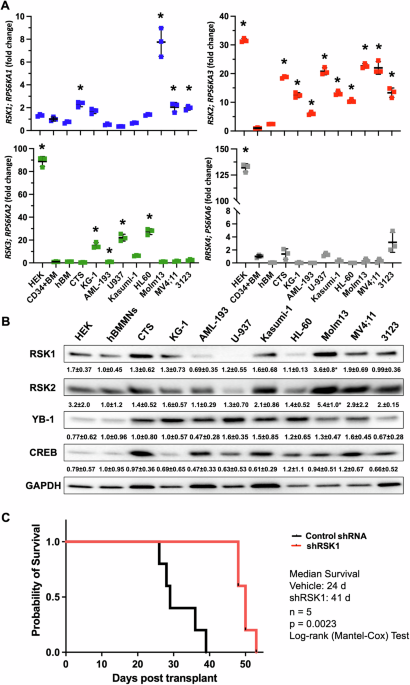
To define the therapeutically relevant isoforms, we assessed RSK isoform expression across AML cell lines, a patient primary AML sample, and healthy control CD34⁺ bone marrow HSCs. RT-qPCR analysis demonstrated elevated RSK1/3 and significantly elevated RSK2 mRNA expression in most AML models versus healthy control CD34⁺ bone marrow HSCs, with cell line-dependent variability (n = 3; p < 0.05) (Fig. 1A). In contrast, RSK4 did not significantly differ between AML models and healthy controls (n = 3; p > 0.05), but both RSK3/4 were significantly higher in HEK293 cells (n = 3; p < 0.0001), consistent with lineage-specific regulation. Immunoblot analysis confirmed robust RSK1 and RSK2 protein expression in AML cells, with cell line-specific differences (Fig. 1B). These findings suggest RSK1 and RSK2 as haematopoietically enriched isoforms with functional relevance in AML despite low levels of transcription from additional isoforms and support their prioritization for therapeutic targeting in corroboration with our previous findings [10]. Of note, FLT3-mutant AML cell lines Molm13 and MV4-11 exhibited significantly higher RSK1 expression compared to other non-FLT3-mutant AML models (n = 3; p < 0.001 and p < 0.05, respectively). As FLT3-ITD in Molm13 and MV4-11 occurs within a KMT2A-rearranged context, contribution from this molecular background cannot be fully excluded; however, published and present evidence support FLT3-driven MAPK/RSK signaling as the major mechanistic contributor to the enhanced sensitivities observed.
Fig. 1: RSK1 and RSK2 are predominantly expressed in AML and genetic suppression of RSK1 impairs leukemic progression in vivo.
A RNA expression of RSK isoforms in AML cell lines and primary AML samples. Total RNA was isolated from a panel of human AML cell lines and primary AML samples prior to RT-qPCR analysis for RSK isoform 1-4 expression. Transcript levels were normalized to 7SL-scRNA as an internal control, and CD34+ bone marrow cells (CD34+ BM) are shown as relative expression across models. RSK1 and RSK3 transcripts were moderately elevated while RSK2 transcripts were significantly elevated in most AML cell lines compared to healthy CD34⁺ bone marrow controls, whereas RSK4 expression was unchanged in AML but enriched in HEK293 cells. Values are mean ± SD (n = 3), *p < 0.05 by one-way ANOVA with Dunnett’s post hoc test. B Representative immunoblots showing the protein expression of prominent RSK isoforms 1-2 in AML cell lines and primary AML samples. Whole-cell lysates from the same AML cell line panel and primary AML samples were analyzed by immunoblotting for RSK1 and RSK2. Consistent with RNA expression, RSK1 and RSK2 proteins were readily detected. Targeted protein levels were normalized to corresponding GAPDH. Values are mean ± SD (n = 3), *p < 0.05, **p < 0.01, ****p < 0.0001 by one-way ANOVA with Dunnett post hoc test as compared to human bone marrow mononuclear cells (hBMMNs). C Kaplan-Meier survival analysis of mice transplanted with HL-60 AML cells expressing shRNA targeting RSK1 or a non-targeting control. Genetic suppression of RSK1 in HL60 cells significantly prolonged survival compared with control animals (median survival: 41 days vs. 24 days; n = 5 per group; p = 0.0023, log-rank [Mantel-Cox] test).
We next evaluated RSK regulation during multilineage differentiation of human cord blood CD34⁺ cells. RSK1 was initially elevated (n = 4; p < 0.001) and subsequently maintained throughout differentiation (n = 4; p > 0.05), whereas RSK2 progressively declined with maturation, reaching significance by day 8 (n = 4; p < 0.01) and further decreasing at days 11 and 14 (n = 4; p < 0.0001; Supplementary Fig. 1A, B), consistent with published analyses of healthy HSPCs demonstrating isoform-specific expression patterns within the RSK family [10]. These data indicate that AML cells selectively retain and modulate RSK1/2 expression in association with a differentiation-arrested phenotype.
Genetic validation further supported a non-redundant role for RSK1 in leukemic progression. shRNA-mediated suppression of RSK1 significantly prolonged survival in immunodeficient xenograft murine models derived from lentiviral transduced HL-60 AML cell lines (Fig. 1C). HL60 xenografts were selected as a well-established and reproducible in vivo model to evaluate the extent of RSK1 dependency beyond FLT3-mutant AML and to support RSK signaling as a broader leukemic vulnerability rather than a genotype-restricted dependency. Here, shRNA-mediated RSK1 knockdown in HL-60 cells significantly prolonged median survival from 24 to 41 days compared to control shRNA (n = 5; p = 0.0023, log-rank test). Although shRNA persistence in residual leukemic cells at the endpoint was not directly evaluated, the agreement between genetic knockdown and orthogonal pharmacologic inhibition supports an on-target, RSK-dependent effect. These results provide direct in vivo evidence that RSK1 is required for efficient leukemic propagation and disease progression. Of note, validation of RSK1-specific knockdown was assessed by RT-qPCR (n = 3; p < 0.001) and immunoblot analysis (Supplementary Fig. S2A, B).
RSK integrates MAPK/ERK signaling into transcriptional and translational outputs through phosphorylation of downstream effectors. These include Y-box binding protein 1 (YB-1), a post-transcriptional regulator implicated in oncogenic translation and in AML and breast cancer, and a specific dependency and therapeutic target in AML [11], as well as CREB-dependent transcriptional programs that promote leukemic proliferation and survival [12]. Importantly, RNA interference-mediated inhibition of RSK2 has been shown to induce apoptosis selectively in FLT3-mutant AML models while sparing FLT3 wild-type cells, highlighting enhanced vulnerability in the FLT3-mutant context downstream of oncogenic FLT3 signaling [13].
Building on this genetic framework, we evaluated pharmacologic RSK inhibition using PMD-026, an orally bioavailable pan-RSK inhibitor. PMD-026 suppressed cell viability across AML cell lines and primary AML samples in a dose-dependent manner, with IC50 values in the low micromolar to nanomolar range (Fig. 2A). To further determine on-target effects, we employed the tool compound PMD-028 as an orthogonal, structurally distinct RSK1 and RSK2 inhibitor. Consistent with their intended mechanism, biochemical kinase profiling demonstrated potent inhibition of RSK1 and RSK2 by both PMD-026 and PMD-028 in radiometric kinase assays (Supplementary Fig. S3). PMD-028 produced comparable suppression of viability in FLT3-mutant AML models, with similar IC50 values (Fig. 2B), supporting the conclusion that observed cytotoxicity to AML cells reflects RSK pathway inhibition rather than compound-specific off-target effects. Importantly, enhanced sensitivity in FLT3-mutant Molm13 and MV4;11 cells was independently recapitulated with PMD-028 and supports enhanced sensitivity in FLT3-activated AML within a broader context of RSK dependence across structurally distinct RSK inhibitors. Both PMD-026 and PMD-028 inhibited RSK phosphorylation and suppressed downstream signaling outputs, demonstrated by decreased CREB and YB-1 phosphorylation (Fig. 2C), consistent with their direct biochemical inhibition of RSK1 and RSK2 (Supplementary Fig. S3). Despite lower IC50 values for PMD-028 in both FLT3-mutant AML models, suppression of phosphorylation by PMD-026 was modestly greater under the tested conditions in the functional suppression of the RSK pathway output under these conditions. PMD-026 may be more effective at functionally reducing RSK signaling. This divergence likely reflects compound-specific differences in intracellular target engagement, inhibitor residence time, or signaling kinetics rather than divergent on-target biology.
Fig. 2: Pharmacologic inhibition of RSK suppresses FLT3-mutant AML viability and signaling, synergizes with chemotherapy, and preserves normal hematopoiesis.
Dose-response analysis of A PMD-026 or B PMD-028 in AML cell lines and a primary patient sample. AML cells were treated with increasing concentrations of PMD-026 or PMD-028 for 72 h and cell viability was assessed using CellTiter-Glo. Dose-response curves were used to calculate IC₅₀ values and summarized in tabular form. PMD-026 induced dose-dependent suppression of viability across models, with IC₅₀ values in the low micromolar to nanomolar range, reflecting underlying genetic and signaling heterogeneity. Parallel evaluation of PMD-028 demonstrated dose-dependent suppression of cell viability in FLT3-mutant AML models, with IC₅₀ values comparable to those observed with PMD-026, supporting its use as an orthogonal validation tool for RSK inhibition. Superscript letters denote compact letter display groupings derived from one-way ANOVA with Tukey multiple-comparisons testing. Values that do not share a letter differ significantly (p < 0.05) and represent mean ± SD (n = 3). FLT3-mutant Molm13 and MV4;11 were among the most sensitive AML models tested across both PMD-026 and PMD-028. § Independent subtype-level comparison by Mann–Whitney testing demonstrated significantly lower IC₅₀ values in FLT3-mutant versus comparator AML models for both PMD-026 (median 0.3327 vs 1.842 μM; exact two-tailed p = 0.0008) and PMD-028 (median 0.1230 vs 2.417 μM; exact two-tailed p < 0.0001). † Includes KG-1. ‡ Excludes KG-1 due to out-of-range IC₅₀ for PMD-028. C Representative immunoblots demonstrating the inhibition of RSK signaling following PMD-026 or PMD-028 treatment [0.5 \(\mu\)M] for 24 h. FLT3-mutant AML cells were treated with PMD-026 or PMD-028, and whole-cell lysates were analyzed by immunoblotting for phosphorylation of RSK and downstream signaling targets. Both compounds effectively suppressed RSK activation and downstream pathway signaling, confirming on-target inhibition of RSK signaling. Targeted protein levels were normalized by phospho/total ratio relative to DMSO. Values represent mean ± SD (n = 3), *p < 0.05 by one-way ANOVA with Tukey multiple-comparisons testing. D PMD-026 synergizes with daunorubicin in FLT3-activated AML cell line, MV4;11. MV4;11 cells were treated with PMD-026 and daunorubicin in a fixed-ratio combination for 72 h. Log combination index (CI) value and confidence interval were calculated using Compusyn software across multiple fraction-affected (Fa) levels. Log(CI) values < 0 indicate synergistic interactions. Values represent mean ± SD (n = 3). E Effects of PMD-026 on normal hematopoietic progenitor colony formation. Colony-forming unit (CFU) assays were performed using healthy human bone marrow mononuclear cells cultured in methylcellulose in the presence of increasing concentrations of PMD-026. PMD-026 demonstrated lineage-dependent effects on progenitor colony output, with no significant impairment of CFU-E or CFU-GEMM formation across concentrations tested, modest effects on BFU-E at select concentrations, and dose-dependent reduction in CFU-GM colonies, particularly at concentrations ≥3 μM. Statistical comparisons were performed by one-way ANOVA with Dunnett’s multiple-comparisons test compared to vehicle control, where A = p < 0.05, B = p < 0.01, and C = p < 0.0001 within each color-coded progenitor subtype. These findings support a therapeutic window of 3.44- to 40.96-fold for PMD-026 treatment and the feasibility of sustained RSK targeting without global suppression of progenitor function despite lineage-specific progenitor sensitivity.
Given the continued reliance on anthracycline-based regimens in AML treatment, we assessed potential synergy between RSK inhibition and daunorubicin in a combination study. As daunorubicin remains a clinically established cytotoxic treatment for AML, it was selected as a therapeutically relevant partner to test whether RSK inhibition could enhance antileukemic activity in combination. In the MV4;11 FLT3-mutated AML cell line, PMD-026 synergized with daunorubicin across multiple effect levels by combination index analysis (n = 3; logCI<1; Fig. 2D), supporting a model in which RSK inhibition lowers the apoptotic threshold and enhances cytotoxic efficacy. Synergy studies were performed as proof-of-principle in a representative FLT3-mutant model of enhanced sensitivity and were not designed to establish subtype specificity of combination effects and warrant future investigation through broader genotype-stratified combination studies. Given the position of RSK downstream of MAPK/ERK signaling, combinations involving FLT3 or MEK inhibitors may represent rational extensions of this therapeutic framework. Through methylcellulose colony-forming unit assays, PMD-026 revealed selective lineage-dependent effects rather than global suppression of normal hematopoiesis (Fig. 2E). CFU-E and multipotent CFU-GEMM colony formation were preserved, whereas BFU-E colonies showed modest reductions at select concentrations and CFU-GMM colonies exhibited greater dose-dependent sensitivity, particularly at higher concentrations. Importantly, concentrations associated with potent antileukemic activity largely preserved normal hematopoietic progenitor function, supporting a therapeutic window of 3.44- to 40.96-fold as well as the feasibility of sustained RSK targeting without global suppression of hematopoietic progenitor function.
This safety profile of PMD-026 reveals a distinct improvement to current FLT3 inhibitors (e.g., quizartinib), which are typically associated with neutropenia and QTc prolongation that complicate sustained dosing and combination strategies [14]. Available clinical safety reporting indicates that PMD-026 is associated with no myelosuppression or QTcF prolongation, suggesting that targeting RSK downstream of FLT3 may offer a more favorable therapeutic index while circumventing common resistance mechanisms associated with receptor-level inhibition [14]. Notably, first-in-human phase 1/1b data in metastatic breast cancer (NCT04115306) demonstrate that PMD-026 achieves sustained target engagement, favorable pharmacokinetics, biomarker-linked clinical activity, and a tolerable safety profile, providing clinical proof-of-mechanism that strengthens its translational potential in RSK-dependent AML [15].
In summary, by integrating published large-scale patient proteomics and functional genomic dependency data with novel isoform-specific expression analyses, genetic validation in vivo, and pharmacologic inhibition, our findings establish RSK1 and RSK2 signaling as a broadly targetable vulnerability in AML, with evidence for enhanced sensitivity in FLT3-activated disease. Although not designed as a formal subtype-stratification study, multiple convergent observations support this model, including elevated RSK1 expression, comparable sensitivity across two structurally distinct RSK inhibitors, subtype-level significance by Mann-Whitney analysis, and published genetic dependency data [8]. Moreover, PMD-026 demonstrates potent antileukemic activity, synergy with standard chemotherapy, preservation of normal hematopoietic progenitors, and a favorable safety profile. Parallel activity of PMD-028 corroborates on-target pathway suppression and strengthens biological interpretation. Together, these data support clinical evaluation of sustained RSK inhibition as a mechanism-based therapeutic strategy to improve outcomes for patients with AML.
