


Single-nucleus multimodal analysis of a longitudinal cohort of IDH-G
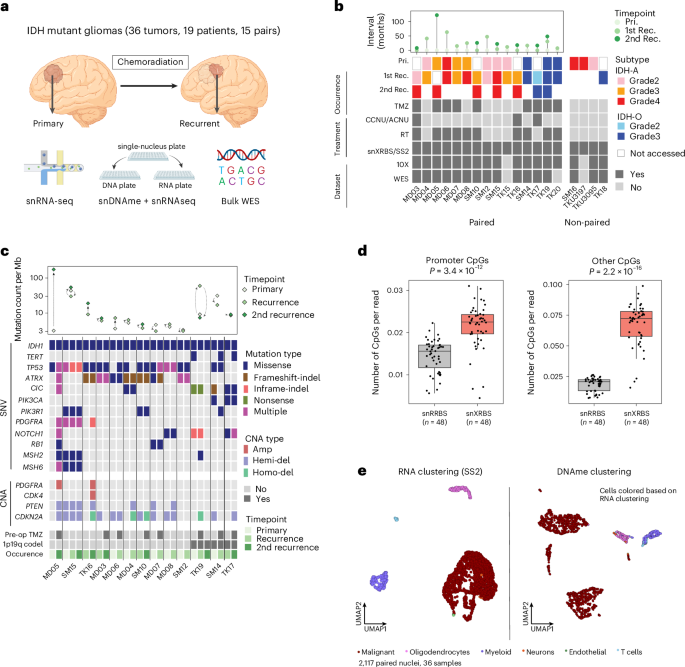
We collected 36 frozen tumor samples with detailed clinical metadata, resected in three hospitals (Fig. 1a,b); 32 matched samples were collected from 15 patients (11 IDH-mutant astrocytoma (IDH-A) and four IDH-mutant oligodendroglioma (IDH-O), while the remaining four tumors were non-matched primary or recurrent specimens (Fig. 1b and Supplementary Table 1). Most grade 3 or 4 tumors (high grade) received radiation and alkylating agent therapy after surgical resection (Fig. 1b and Supplementary Table 1). Each sample was profiled by bulk whole-exome sequencing (WES), 3′-end snRNA-seq (10x Genomics Chromium) for high-throughput expression data and joint multimodal single-nucleus profiling by SS2 and XRBS (Extended Data Fig. 1a,b).
Fig. 1: Dataset and study workflow.
a, Scheme depicting the workflow of this study. snDNAme, single-nucleus DNA methylation sequencing. Created in BioRender; Nomura, M. https://BioRender.com/ju18r6e (2026). b, Clinical characteristics and dataset information of the cohort in this study. Pri., primary; Rec., recurrence; TMZ, temozolomide; RT, radiotherapy. c, Genomic information of the matched-pair samples analyzed by WES. The top panel shows the number of somatic mutations. Each diamond reflects a sample. The color reflects the timepoint. The middle panel shows whether known driver mutations and CNAs exist or not in the early timepoint and late timepoint. Color reflects the type of mutation and CNA. The bottom panel shows the clinical information. SNV, single nucleotide variant; indel, insertion and deletion; Homo-del, homozygous deletion; hemi-del, hemizygous deletion; amp, amplification; pre-op, pre-operative; codel, co-deletion. d, Captured promoter CpGs normalized by reads (left) and captured non-promoter CpGs normalized by reads (right). Each dot reflects a cell. Boxplots span from the first to third quartiles, with the median indicated by a horizontal line and whiskers extending to 1.5× the interquartile range (IQR). Statistical significance was estimated using a two-sided Mann–Whitney U-test. e, Clustering of snRNA-seq data based on variable genes (left) and DNA methylation based on 100 kb bins (right). Cell type labels were determined based on correlation with normal brain cell types and CNAs in malignant cells.
Mutation and CNA analysis from bulk WES data showed that most pairs acquired additional genomic alterations upon recurrence (Fig. 1c bottom). Although most cases display shared CNA patterns, in some instances, CNA patterns may diverge, especially in some IDH-A cases. We attribute this pattern to sampling and the lack of canonical CNA events in IDH-A. However, even in those cases, many single nucleotide variant mutations were shared, supporting a common ancestor and a phylogenetic process (Extended Data Figs. 2 and 3a). Four out of 12 pairs acquired CDKN2A homozygous deletion, but other acquired events were variable between patients, highlighting the diverse genomic evolutionary trajectories of IDH-G progression (Fig. 1c bottom). Mutational burden analysis showed a drastic increase in the number of C to T alterations with acquired mismatch-repair gene alterations following temozolomide treatment in two cases (MD05R and TK19R) (Fig. 1c top and Extended Data Fig. 3b). In addition to these temozolomide-induced hypermutators, we identified four de novo hypermutated tumors (two pairs) unrelated to treatment (Fig. 1c top and Extended Data Fig. 3b)27,28,29.
Direct comparison of snXRBS with single-nucleus reduced-representation bisulfite sequencing (snRRBS) demonstrated that snXRBS achieved higher coverage in non-promoter regions (P = 2.2 × 10⁻¹⁶, Mann–Whitney U-test; Fig. 1d right and Extended Data Fig. 3c) as well as in promoter regions (P = 3.4 ×10⁻¹², Mann–Whitney U-test; Fig. 1d left). This superior coverage across different genomic regions is critical, as DNA methylation changes in IDH-G progression occur preferentially in non-promoter regions23,24,25. We profiled one plate (96 cells) per sample for dual sequencing (n = 36 samples), then included cells that passed our quality control metrics (Methods), both for DNA methylation and transcriptome, retaining a mean of 58.8 (range, 24–85) cells per sample. We also retained cells profiled by snXRBS from one sample (TKU3095) that was used for snXRBS and snRRBS comparisons (Fig. 1d). snXRBS captured a mean (±s.e.m.) of 378,888 ± 3,587 unique CpGs per nucleus (Extended Data Fig. 3d and Supplementary Table 2), higher than the number of unique CpGs profiled by scRRBS in a prior study by our group (mean ± s.e.m., 198,345.1 ± 4,307, P = 2.2 × 10⁻¹⁶, Mann–Whitney U-test; Extended Data Fig. 3d)26. The number of detected genes from the matched transcriptomic data (mean ± s.e.m., 2,987 ± 27 genes per nucleus, 889,254 ± 6,624 reads per nucleus, n = 2,117) was comparable to that of a stand-alone snRNA-seq SS2 dataset we recently published (mean ± s.e.m., 3,124 ± 13 genes per nucleus, 966,210 ± 7,170 reads per nucleus, n = 7264)31,32.
We leveraged this dataset to first classify cells as malignant or non-malignant based on clustering of gene expression profiles and DNA methylation (100 kb bins), and validated our classification based on CNA events (Fig. 1e, Extended Data Fig. 3e and Methods). snXRBS-based CNA inference provided greater resolution than snRNA-seq and enabled detection of focal amplification of oncogenes (for example, PDGFRA and CDK4 amplification in TK16R2) (Extended Data Fig. 3e), orthogonally validated by WES (Extended Data Fig. 2). For larger-scale profiling of cellular diversity, we complemented our dataset with 10x 3′-end snRNA-seq in n = 32 samples, retaining a total of 158,143 nuclei that passed quality control (Methods). Integrated clustering was performed using Seurat across all samples33. We identified non-malignant cell types based on their signatures and correlations with snRNA-seq brain datasets (Extended Data Fig. 3f). Malignant cells were identified based on the presence of CNAs or co-clustering with other malignant cells (Methods).
Interrogating DNA methylation loss in single cells
We focused on a set of CpG sites (n = 684) that were previously identified in bulk studies as differentially methylated during IDH-G progression23 and that defined G-CIMP-low IDH-G tumors. To address coverage sparsity, we used genomic bins to compare methylation levels across cells, as previously reported26. As a quantitative measure of progression from G-CIMP-high to G-CIMP-low, we assigned a ‘G-CIMP score’ per cell based on the mean DNA methylation across CpGs captured within 1,000 bp bins around each of these 684 CpG sites susceptible to methylation loss. (Fig. 2a, Extended Data Fig. 4a, Supplementary Table 2 and Methods). We calculated the G-CIMP score for malignant cells and classified individual cells as G-CIMP-high or G-CIMP-low using a two-state mixture model (Fig. 2b). The G-CIMP score correlated with global DNA methylation level (R = 0.81) but had higher variability, consistent with preferentially capturing loci that are differentially methylated during IDH-G progression (Extended Data Fig. 4b). Additionally, clustering based on mean DNA methylation of 100 kb bins also separated malignant cells primarily based on the G-CIMP score (Extended Data Fig. 4c). When computing this score in bulk DNA methylation arrays from The Cancer Genome Atlas (TCGA), G-CIMP-low samples showed a significantly lower score than G-CIMP-high samples (P = 8.1 × 10⁻¹⁶, Mann–Whitney U-test), confirming that we recapitulated TCGA G-CIMP tumor classification (Extended Data Fig. 4d).
Fig. 2: G-CIMP score measured at the single-cell level in IDH-mutant glioma progression.
a, Schematic of the approach to define the G-CIMP score with snXRBS data. ME, methylation. Red and blue dots represent methylated and unmethylated CpGs, respectively; 1,000 bp windows were created around 684 CpGs that showed lower methylation values in G-CIMP-low progressive samples in a previous study23. The average methylation value of all CpGs in all 684 windows was defined as the G-CIMP score in this study. b, Histogram of G-CIMP scores across malignant cells from all tumors. c, G-CIMP scores for each single nucleus annotated to malignant cells across samples. Each dot reflects a nucleus. The number of dots per sample is indicated in the figure. Boxplots show the median and IQR, and whiskers extend to 1.5× the IQR for G-CIMP scores per sample. The color of the box reflects the pathological subgroup and grade. G-CIMP scores were compared between timepoints (P, primary; R, recurrence; R2, 2nd recurrence) within each patient, using a two-sided Mann–Whitney U-test; *P < 0.05. Top panel, barplot of intra-tumor variation of G-CIMP score across malignant cells (red line indicates variance across all tumors). A2, IDH-A grade 2; A3, IDH-A grade 3; A4, IDH-A grade 4; O2, IDH-O grade 2; O3, IDH-O grade 3. d, Sample level average G-CIMP scores of malignant cells comparing between early timepoint and late timepoint. Each dot reflects a sample. The color of the dot reflects the pathological subgroup and grade. Boxplots show the median and IQR, and whiskers extend to 1.5× the IQR for G-CIMP scores per timepoint. P values represent two-sided paired Wilcoxon rank-sum test. e, Pie charts show the proportion of G-CIMP-high samples and G-CIMP-low samples per grade for IDH-A. Left panels show the proportion in a TCGA study24, defined based on the bulk DNA methylation array analysis. The right panels show the fraction in our cohort, defined based on the average G-CIMP score per patient inferred by snXRBS analysis. f, Dot and boxplots show the G-CIMP score for IDH-O (‘codel’) samples in a TCGA study. The IDH-O samples were divided into two groups (‘codel-ME (methylation)-high’ and ‘codel-ME-low’) based on the score. g, Kaplan–Meier curve depicting the overall survival time according to G-CIMP score for the TCGA IDH-O samples. Statistical significance of the survival difference between the groups in each panel was computed using the log-rank test.
We leveraged our G-CIMP score to assess inter-tumor and intra-tumor heterogeneity of G-CIMP status. We observed that the mean G-CIMP score across malignant cells per tumor is significantly decreased at recurrence (P = 0.01, Mann–Whitney U-test; Fig. 2c,d and Extended Data Fig. 4e), consistent with expectations from prior bulk studies21,23,25. Additionally, the fraction of G-CIMP-high and G-CIMP-low tumors as a function of tumor grade is similar in our cohort and in the TCGA cohort (Fig. 2e)24. Importantly, the G-CIMP score in non-malignant cells was stable across timepoints, supporting that the variability observed in malignant cells is not driven by technical factors (Extended Data Fig. 4f–h). We wondered whether the decrease in DNA methylation in malignant cells across timepoints is uniform across cells in a given sample or is driven by a subset of cells. We observed that in most tumors, the G-CIMP score has low variance across malignant cells, suggesting that G-CIMP status is similar between malignant cells within a tumor sample (Fig. 2c).
Although our observations were concordant with prior studies, we detected a few outliers in our cohort: a G-CIMP-low grade 2 IDH-A (Fig. 2e) that notably displayed a very aggressive clinical phenotype (Extended Data Fig. 4i), and two recurring IDH-O tumors as G-CIMP-low (Fig. 2c,d), an unexpected observation given that prior studies had limited the G-CIMP-low phenotype to IDH-A24. In a reanalysis of the TCGA cohort by G-CIMP score, we detected subsets of IDH-O with relatively lower G-CIMP scores (<0.7) (Fig. 2f). These tumors were enriched in grade 3 tumors (Fig. 2f) and showed significantly worse overall survival (P = 0.0022, log-rank; Fig. 2g). Moreover, these IDH-O with low methylation showed worse prognosis than IDH-A with high methylation (G-CIMP-high vs codel-ME-low, P = 0.0143; Extended Data Fig. 4j). These results suggest that hypomethylation is associated in both IDH-A and IDH-O with recurrence and a more aggressive clinical trajectory and may serve as an additional prognostic marker across all IDH-G subsets34.
Hypomethylation, increase in stem-like states in progressed IDH-G
We and others have previously leveraged scRNA-seq to characterize the cellular composition and putative differentiation trajectories of IDH-G15,19. Our studies identified three major compartments consisting of stem-like states enriched in cycling cells and more differentiated cells along either the AC-like or OC-like lineages15,17,19. Given technical differences in tissue processing and profiling (snRNA-seq vs scRNA-seq), we first tested whether an unbiased analysis of our dataset would recapitulate the previously described signatures. We applied non-negative matrix factorization to expression data from 10x and SS2 datasets (Extended Data Fig. 5a,b) and derived robust expression programs that were consistently detected across multiple parameters, as previously described35,36. Consistent with our prior studies, we identified major clusters of programs that correlated with the AC-like state, stem-like or OC-like state and a cycling state (Extended Data Fig. 5a and Methods) and classified malignant cell states accordingly in both our 10x and SS2 datasets (Fig. 3a, Extended Data Fig. 5c and Supplementary Table 2)17,19. We then assessed the longitudinal changes in state proportion and observed an increase in stem-like cells and a decrease in differentiated-like cells in recurrent tumors (P = 0.039) (Extended Data Fig. 5d), consistent with prior scRNA-seq studies performed in non-matched samples15,19.
Fig. 3: G-CIMP loss reshapes cell states hierarchies.
a, Left, lineage plot based on transcriptome profiles of dual protocol data. Cells were classified as stem-like, AC-like or OC-like based on a previously described method17. Right, bar plot of proportion of stem-like, differentiated-like (AC-like and OC-like) and non-malignant cells per tumor. b, Scatter plots showing the proportions of stem-like cells (left) and cycling cells (right) versus the mean G-CIMP score. Each dot represents a sample. Color reflects pathological grade and subgroup. Shown is the Pearson’s correlation coefficient and associated P value; shaded area, confidence intervals. c, IDH-A (top) and IDH-O (bottom) cells (columns) were ordered by the G-CIMP score calculated by XRBS data. Cycling scores (G1S and G2M) and cell state scores (stemness, AC-like and OC-like) inferred by SS2 were shown. Additional rows were for the clinical information (patient, occurrence and pathological grade) of the samples from which the cells were derived.
Our results so far indicate that IDH-G progression and transition to G-CIMP-low is associated transcriptionally with an increase in stem-like cells (P = 3.4 × 10⁻⁴, R = −0.56; Fig. 3b left) and cycling cells (P = 0.0001, R = −0.62; Fig. 3b right), and epigenetically with a decrease in G-CIMP score (Fig. 3c). We therefore generated two hypotheses: glioma stem-like cells display a lower G-CIMP level and their expansion leads to tumors with overall lower G-CIMP; or tumors that transition to a G-CIMP-low skew cell state composition by hypomethylating regions that are important in cell state determination. In line with our observation of low intra-tumor variance in G-CIMP scores, we observe no correlation between G-CIMP score and stemness score (Extended Data Fig. 5e). This suggests that G-CIMP status is similar in different IDH-G cell states and would not support our first hypothesis. To test our second hypothesis, we performed three independent analyses, described below.
Putative mechanistic links between methylation loss and increase in stem-like states
We first focused on DNA methylation and identified genomic regions that are consistently hypomethylated in G-CIMP-low cells across tumors. We generated 1 kb bins to increase the number of regions that could be evaluated across cells (Extended Data Fig. 6a,b) and then compared the mean DNA methylation levels of these regions between G-CIMP-high and G-CIMP-low cells (cells with intermediate G-CIMP scores were excluded; Methods). This approach detected 2,803 hypomethylated bins and 11 hypermethylated bins in G-CIMP-low tumors (Fig. 4a). Scoring cells using this broader set of differentially methylated regions showed a strong correlation with the G-CIMP scores calculated from the previously reported 684 regions (Extended Data Fig. 6c). Consistent with previous studies, we observed that hypomethylated bins are enriched in regions outside of CpG islands and shores (<2 kb from CpG islands) (Extended Data Fig. 6d). Additionally, we also detected several hypomethylated bins within introns (Extended Data Fig. 6e). We annotated hypomethylated bins based on chromHMM labels37 from IDH-G tumors and observed an enrichment in PRC-associated domains, enhancers and ZNF/repeat regions (Fig. 4b and Extended Data Fig. 6f). Interestingly, our previous single-cell multi-omics analysis of IDH-wildtype glioblastoma demonstrated hypomethylation of PRC-associated genes in stem-like cells, and suggested that PRC2 may serve as a critical switch in glioma cell differentiation26. This observation is consistent with studies demonstrating the role of PRC2 in glioma stem-like cells and further supports the parallels between glioma differentiation and neurodevelopment38,39. Therefore, in G-CIMP-low tumors, the decrease in methylation may preferentially lead to PRC2 target hypomethylation, which may help preserve IDH-G stemness potential.
Fig. 4: Hypomethylated regions in G-CIMP-low tumors are enriched for stem-like features.
a, Volcano plot of differentially methylated 1 kb bins between G-CIMP-high and G-CIMP-low cells across all tumors (false discovery rate-adjusted P value values based on two-sided Student’s t-test). b, Annotation of differentially methylated bins based on overlap with chromHMM labels from IDH-G. The P value was calculated using a permutation test by comparing the observed overlap between the region of interest and matched random regions (n = 1,000) to the null distribution generated from those permutations. Enh, enhancer; PRC, polycomb repressed complex; ZNF/Rpts, zinc finger genes/repeats; Het, heterochromatin; Tx, transcription. c, Hypomethylated bins that overlap with upregulated genes in G-CIMP-low tumors compared to G-CIMP-high tumors. Gene features of the bins are shown on the left. UTR, untranslated region. d, Top three enriched transcription factor motifs in hypomethylated bins (top panel). Location of 1 kb bins that are hypomethylated across the SOX10 gene (bottom panel). TSS, transcription start site; chr, chromosome.
As a second analysis, we leveraged the use of the multimodal protocol to associate gene expression changes with DNA methylation. We first performed differential gene expression analysis between G-CIMP-high and G-CIMP-low tumors (Extended Data Fig. 6g and Supplementary Table 3–4). We observed upregulation of known stemness genes, such as HOXD10, HOXD9 and PROM1, in G-CIMP-low tumors, which are potential PRC2 targets40,41,42. Additionally, we observed a subset of cycling genes that were upregulated in G-CIMP-low tumors (Extended Data Fig. 6h). Next, we assessed the overlap between hypomethylated promoters and changes in gene expression between G-CIMP-high and G-CIMP-low cells. Importantly, among the differentially expressed genes, only a limited number showed decreased promoter methylation; these comprised 11 genes, including HOXD9 and EPHB2, potential mediators of glioma progression (Fig. 4c)43,44,45. There can be several explanations for this discrepancy. First, enhancers are particularly susceptible to hypermethylation in IDH-G and may contribute to gene expression dysregulation26. Second, stochastic epimutations may accumulate in cancer, leading to a decoupling of the anti-correlation between gene expression and promoter methylation26. Third, hypermethylation of CTCF binding sites may cause aberrant gene activation through loss of gene insulation9. Previous studies based on bulk assays have also demonstrated a weak association between DNA methylation and transcriptional alterations in gliomas and attribute changes primarily to changes in PRC-dependent H3K27me3 (ref. 43). Therefore, transcriptional deregulation in G-CIMP-low tumors may result from direct hypomethylation of cognate gene promoters or from indirect expression dysregulation.
Finally, as a third analysis, we interrogated hypomethylated regions for enrichment in transcription factor binding motifs, as methylation loss may affect transcription factor binding46,47. Motif analysis of hypomethylated bins showed enrichment for binding motifs of BATF, the NFI family and SOX10, a master regulator of glioma lineages (Fig. 4d)37. Of note, SOX10 itself is hypomethylated and moderately increased in expression in a subset of G-CIMP-low tumors (Extended Data Fig. 6i). Collectively, our multimodal single-cell analysis does not provide support for the hypothesis that intercellular variability in G-CIMP status underlies DNA methylation changes of IDH-G progression; rather, the data show that G-CIMP status is stable between different cell states of the same tumor. However, we identify three putative mechanistic links between DNA methylation loss and an increase in stem-like cell state: hypomethylation of PRC2 targets; the increased expression of stem-cell genes; and the enrichment in binding motifs of key stem-cell transcription factors. These observations lend support to the hypothesis that G-CIMP-low tumors may skew the cellular state composition by hypomethylating regions that are important in cell state determination.
Increased heritability of stem-like state in IDH-G progression
Malignant cells in gliomas display a spectrum of hierarchical versus plastic organization26, but elucidating their precise organization in clinical samples remains challenging. Given the increase in stem-like cells in high-grade IDH-G, we reasoned that tumor progression may lead to differences in cell state transition dynamics. To address this possibility, we leveraged phylodynamics and characterized the lineage organization of malignant cells within each tumor, comparing G-CIMP-low versus G-CIMP-high samples. First, we constructed phylogenetic trees for each tumor based on DNA methylation epimutations as previously described26,30. We validated the trees using CNAs and observed that sub-clonal populations defined solely based on CNAs aligned to different clades on the trees constructed from epimutations (Fig. 5a and Extended Data Fig. 7).
Fig. 5: High-resolution DNA methylation lineage trees enable the assessment of cell state dynamics in G-CIMP-high versus G-CIMP-low tumors.
a, Lineage tree based on DNA methylation sites across the genome in the SM14R tumor. Annotation of cells includes stemness score, G-CIMP score and CNA profiles based on DNA methylation data. b, Heritability score based on DNA methylation lineage trees per tumor (each point in boxplot). For each feature, tumors with sufficient heterogeneity were used to ensure that heritability could be measured (Methods). Significance between G-CIMP score, stemness score and CNA compared to total reads based on a Fisher’s exact test for the number of samples with a z-score of >2. Boxplot spans the IQR, with the median line displayed and the whiskers extending 1.5× the IQR. STEM, stemness. c, Paired analysis comparing the heritability of the stemness score between primary and recurrent tumors from the same patient. Patients with a difference of less than 0.3 in the G-CIMP score between primary and recurrent were classified as G-CIMP stable. Fisher’s test was performed based on increase or a decrease/no change in heritability (no change defined as delta heritability less than 0.5). d, Example of a DNA methylation lineage tree in which the stemness score is more heritable in the recurrent G-CIMP-low tumor compared to the primary G-CIMP-high tumor. e, Lineage plots of all malignant cells separated based on G-CIMP categories. Cells are colored based on the G-CIMP score. f, Overall model of G-CIMP-high to G-CIMP-low transition that is accompanied by changes in cell state proportions (mean values of cell state transition probabilities displayed in right panels; error bars, s.d.). Diff-like, differentiated-like.
We then used the Phylogenetic Analysis of Trait Heritability (PATH) framework to calculate the heritability versus plasticity of malignant cell states48. PATH quantifies the extent to which cells cluster by phenotype or state on a phylogeny with phylogenetic correlations and transforms these measurements into inferences of cell state transition dynamics. We applied PATH to our cohort and first assessed the heritability of the G-CIMP score and stemness score in tumors with sufficient heterogeneity of these features. As expected, we observed that the G-CIMP score and stemness score are each heritable within a tumor, with significant clustering on the phylogenetic tree, as compared to non-heritable programs such as total reads (Fig. 5a,b). Next, we performed a paired analysis of matched primary and recurrent tumors that differ in G-CIMP status and observed an increase in heritability of stem-like state in four out of five patients that transitioned from G-CIMP-high to G-CIMP-low (Fig. 5c). The only outlier (MD05) was a hypermutated case with 95% of the cells being assigned as stem-like, reducing our ability to accurately quantify heritability based on tree distribution of cell states.
Importantly, PATH quantifies cell state transition dynamics by measuring how frequently different transcriptional states occur phylogenetically adjacent to one another. We first applied PATH to five patients with matched primary and recurrent tumors that became G-CIMP-low, allowing us to assess how cellular transitions change with tumor progression while controlling for inter-patient variability. In all five cases, recurrent tumors showed a lower probability of transitioning from stem-like to differentiated-like states than the matched primary tumors, indicating reduced differentiation in G-CIMP-low recurrences (Extended Data Fig. 8a). To evaluate this relationship more broadly, we next assessed the association between PATH-inferred differentiation and de-differentiation rates and tumor G-CIMP scores across a larger cohort of unmatched tumors, using correlation analysis. Differentiation rates showed a significant correlation with G-CIMP score, with G-CIMP-low tumors consistently exhibiting diminished stem-cell differentiation, whereas de-differentiation rates showed weaker and less consistent associations (Extended Data Fig. 8b,c and Methods). This can also be observed based on the organization of cells along the phylogenetic tree for patient MD08 that transitions from G-CIMP-high to G-CIMP-low, in which we observed a more structured organization of stem-like cells in the recurrent G-CIMP-low tumor (Fig. 5d). Interestingly, we also observed that differentiated-like cells in G-CIMP-low tumors express higher stemness scores, are cycling at higher rate and express lower levels of lineage differentiation scores (Fig. 5e and Extended Data Fig. 8d). This suggests that both the frequency of differentiation and the extent to which differentiation programs are fully deployed in IDH-G cells is impacted by G-CIMP status. We finally leveraged SM14R, a tumor in which we observe distinct G-CIMP sub-clones, to investigate the impact of G-CIMP status on cell state dynamics within a single tumor (Fig. 5a). When calculating heritability for the G-CIMP sub-clones in the SM14R tumor, we confirmed an increase in heritability of stemness in the G-CIMP-low sub-clone compared to G-CIMP-high (Extended Data Fig. 7e). Collectively, our findings support a model in which cell state dynamics are disrupted in G-CIMP-low tumors, with fewer transitions towards differentiated-like cells, higher cell cycle rate and retention of malignant cells in a stem-like state, leading to an increase in proportion of stem-like cells (Fig. 5f).
