


Myelofibrosis (MF) is the clinically most severe subcategory of myeloproliferative neoplasms (MPN), which can present as primary MF (PMF), or develop from the progression of polycythemia vera (PV) and essential thrombocythemia (ET; post-PV MF [PPV-MF] or post-ET MF [PET-MF]) [1]. Prominent clinical features in MF include bone marrow fibrous tissue hyperplasia, anemia, splenomegaly, and constitutional symptoms [1]. Patients with intermediate-2 risk and high-risk MF harbor a poor prognosis, and allogeneic hematopoietic stem cell transplant (allo-HSCT) currently remains the only curative treatment in MF, but allo-HSCT-related complications might result in death or substantial morbidity.
The discovery of the JAK2V617F mutation and the role of the JAK-signal transducer and activator of transcription (JAK-STAT) pathway in the pathogenesis of MF have facilitated the development of JAK inhibitors [2]. Ruxolitinib, the first approved JAK inhibitor for intermediate/high-risk MF, reduced spleen size and symptom burden [3, 4], but resistance and suboptimal responses have prompted the development of novel JAK inhibitors, including momelotinib, pacritinib, fedratinib, and gecacitinib (also known as jaktinib) [5]. Rovadicitinib is a first-in-class, oral, small-molecule JAK/Rho-associated kinase (ROCK) inhibitor yielding strong inhibitory activity against JAK1, JAK2, ROCK1, ROCK2, and tyrosine kinase 2 (TYK2) [6].
Herein, we conducted preclinical studies and a first-in-human, open-label, multicenter, phase I study (including 3 + 3 dose-escalation and dose-expansion) to evaluate the efficacy and safety of rovadicitinib in patients with intermediate-risk or high-risk MF. Preclinical studies were performed on primary MPN patient samples, JAK2V617F-mutant cell lines, and JAK2V617F/VAV1-Cre mouse models. From November 27, 2018, to December 11, 2020, a total of 64 patients diagnosed with PMF according to the World Health Organization criteria (2016), or those with PPV-MF or PET-MF based on the International Working Group for MF Research and Treatment recommendations, were enrolled in the phase I study across 9 centers in China. In the expansion phase, patients with MF were additionally required to meet at least one of the following criteria: (a) be JAK inhibitor–naïve and have an inadequate response to available therapies or be deemed unsuitable for existing treatment options by the investigator; or (b) have prior exposure to JAK inhibitors, with a washout period of at least 14 days before the first dose of study treatment. Efficacy was defined as patients with at least one baseline assessment and at least one post-baseline efficacy assessment. All experimental procedures were approved by the Ethics Committee of the Institute of Hematology and Blood Diseases Hospital (No. XY2018030-EC-1), and the phase I study (NCT04339400) was approved by the Institutional Review Board/Independent Ethics Committee at each participating site, with written informed consent obtained from all participants. Full methodological details are provided in the Supplementary Appendix.
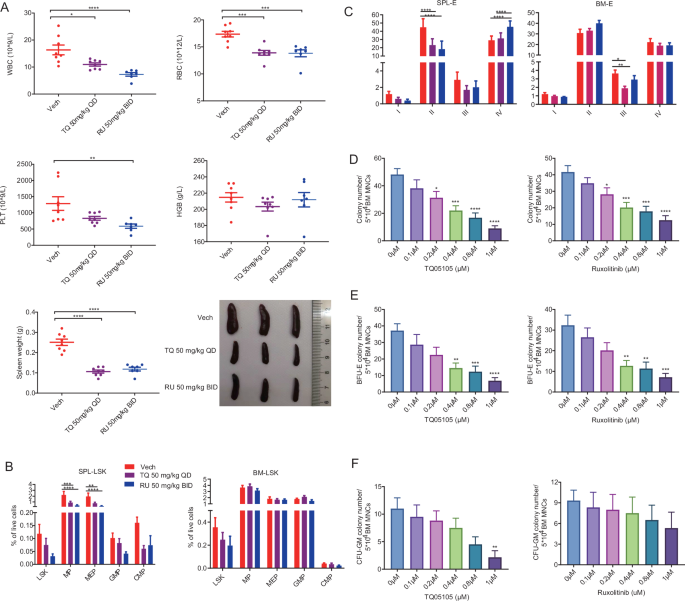
In preclinical studies, rovadicitinib significantly inhibited the proliferation of JAK2V617F-mutant UKE1 and SET2 cells in a dose-dependent manner (0.05–10 μM) and significantly reduced colony-forming capacity at concentrations ≥ 5 μM, while concomitantly inducing apoptosis as assessed by flow cytometry (FCM; Suppl. Fig. 1A–C, Suppl. Figs. 2, 3). Consistently, western blot analysis demonstrated dose-dependent inhibition of STAT1/3/5 phosphorylation in both cell lines, indicating significant inhibition of JAK/STAT signaling (Suppl. Fig. 1D). We next assessed the therapeutic efficacy of rovadicitinib in inhibiting myeloproliferation in vivo and in vitro. In the JAK2V617F mouse model, all mice developed an MPN phenotype eight weeks after transplantation, and four weeks of treatment, three randomly treated groups, vehicle (control), rovadicitinib, and ruxolitinib, were well tolerated with no differences in body weight. Peripheral blood analysis revealed that rovadicitinib significantly reduced white blood cell (WBC) and red blood cell (RBC) counts compared to vehicle, with effects comparable to ruxolitinib. While rovadicitinib only slightly reduced platelet (PLT) counts and had minimal changes in Hemoglobin (HGB) levels. Both rovadicitinib and ruxolitinib significantly decreased spleen weight and size (Fig. 1A). FCM analysis indicated no obvious alterations in hematopoietic stem/progenitor cells (HSPCs), except for a slight decrease in Lin-Sca1+c-kit+ (LSK) cells and common myeloid progenitors (CMPs; Fig. 1B). In contrast, splenic HSPCs showed significant reductions in myeloid progenitors (MPs) and megakaryocyte-erythrocyte progenitors (MEPs), accompanied by modest decreases in LSK cells, granulocyte-macrophage progenitors (GMPs), and CMPs (Fig. 1B). Both drugs significantly reduced early erythroid precursor cells in spleen but not in bone marrow (Fig. 1C). In vitro, after 14 days of co-culture, rovadicitinib and ruxolitinib significantly decreased total colony numbers (Fig. 1D), with pronounced inhibition of burst-forming units-erythroid (BFU-E) formation (Fig. 1E); at higher concentrations, modest inhibition of colony-forming units-granulocyte macrophage (CFU-GM) formation by rovadicitinib (Fig. 1F).
Fig. 1: Rovadicitinib demonstrates therapeutic efficacy in Jak2V617F-driven polycythemia vera and inhibits colony formation of hematopoietic stem/progenitor cells from MPN patients.
A Recipient mice with Jak2V617F-expressing were randomly divided into three groups: received vehicle (Control), rovadicitinib (TQ), or ruxolitinib (RU) therapy (n = 7–8 per group). After 4 weeks, white blood cell (WBC), red blood cell (RBC), platelet (PLT), and hemoglobin (HGB) in peripheral blood were assessed. Spleen weights (left) and representative images of spleens from each treatment group after 4 weeks are shown. B The proportions of Lin-Sca1+c-kit+ (LSK) cells, myeloid progenitors (MP), common myeloid progenitors (CMP), granulocyte/macrophage progenitors (GMP), and megakaryocyte/erythroid progenitors (MEP) in spleens and bone marrow of recipient mice in each treatment group after 4 weeks are analyzed (n = 7–8 per group). C Analyzed the proportions of early erythroid precursors in spleens and bone marrow of recipient mice after 4 weeks in each treatment group (n = 7, 8 per group). D–F Bone marrow mononuclear cells (BMMNCs) from primary samples of patients with myelofibrosis were sorted and seeded in methylcellulose (MethoCultTM H4435, Stem Cell Technologies) in triplicate, supplemented with rovadicitinib (TQ05105) and/or ruxolitinib. After 14 days of co-culture, the number of colony-forming units-erythroid (BFU-E) and colony-forming units-granulocyte, macrophage (CFU-GM) was counted. Data are presented as the mean ± SD/SEM. *P < 0.05, ** P < 0.01, ***P < 0.001, ****P < 0.0001.
Rovadicitinib demonstrated potent inhibition of JAK2 (IC₅₀ = 0.432 nM) and JAK1 (IC₅₀ = 0.878 nM), while showing substantially lower potency against JAK3 (IC₅₀ = 15.31 nM). Furthermore, the compound exhibited inhibitory activity against TYK2 (IC₅₀ = 0.85 nM), ROCK1 (IC₅₀ = 2.029 nM), and ROCK2 (IC₅₀ = 1.435 nM). These data indicate that rovadicitinib preferentially targets JAK2 and JAK1 over JAK3. Kinase profiling further revealed that rovadicitinib primarily bound TYKs, with comparatively weaker bioactivity against AGC kinases and minimal interaction with CAMK and other TYKs (Supplementary Fig. 4). Collectively, the IC₅₀ values and kinase interaction map support a selective inhibitory profile for rovadicitinib, highlighting its potential therapeutic relevance in JAK2-driven diseases, with a favorable safety profile.
In the phase I study, among 64 patients, 15 were included in the dose-escalation phase (5 mg BID, n = 3; 10 mg BID, n = 4; 15 mg BID, n = 3; 20 mg BID, n = 4; a pilot cohort initiated with 5 mg QD in the first patient), and 49 were included in the dose-expansion phase (Suppl. Fig. 5). The data cutoff date was March 17, 2023. Most patients had PMF subtype (43/49, 87.8%), intermediate-1 risk (38/43, 77.6%), and bone marrow fibrosis grades were predominantly MF-3 (26/43, 54.2%) and MF-2 (17/43, 35.4%; Suppl. Table 1).
Regarding the safety, in the dose-escalation period, two dose-limiting toxicities (DLTs) occurred at the 20 mg BID level, including one grade 3 platelet count decreased with bleeding and one grade 4 platelet count decreased. Thus, the 15 mg BID dose of rovadicitinib was selected as the maximally tolerated dose (MTD). In the dose-expansion phase (n = 49), the median duration of rovadicitinib exposure was 504 days (range: 18–926). Forty-seven (95.9%) patients experienced rovadicitinib-related AEs, with 20 (40.8%) reporting grade ≥ 3 events (Suppl. Table 2). The most frequent grade ≥ 3 rovadicitinib-related AEs were platelet count decreased (20.4%). Serious AEs occurred in 21 (36.7%) patients, with 9 (18.4%) deemed drug-related. Dose reductions, interruptions, and discontinuations occurred in occurred in 42.9%, 36.7%, and 16.3% of patients, respectively. No AEs led to death.
PK analysis demonstrated that rovadicitinib was rapidly absorbed following a single-dose oral administration (n = 12), with Cmax attained approximately 0.5–1 h across all dose levels. The highest Cmax was 367.8 ng/mL and was observed at the 20 mg dose. Following seven days of BID dosing (n = 15), Tmax remained consistent with the single-dose profile, occurring within 0.5–1 h post-administration. In the 20 mg BID cohort under steady-state conditions, mean (SD) peak and trough concentrations were 463.3 (160.7) ng/mL and 8.4 (6.8) ng/mL, respectively. With multiple dosing regimens, the time to reach undetectable drug concentrations was comparable to that observed after a single dose, indicating minimal drug accumulation (Suppl. Fig. 6).
Forty-five patients (four patients were excluded from spleen volume analysis due to missing baseline [n = 1] or post-baseline [n = 3] spleen volume measurements) were included in the efficacy analysis during the dose expansion phase. The waterfall plot demonstrated the best changes in spleen volume of individual patients in Fig. 2A. The proportion of patients reaching SVR35 at 24 weeks was 28.9% (13/45; 95% CI: 16.4–44.3; Supplementary Fig. 7A). The efficacy endpoint of best SVR35 ( ≥ 35% spleen volume reduction) response was achieved in 26 (57.8%; 95% CI: 42.2–72.3) of 45 patients. After a median follow-up of 9.2 months (95% CI: 2.9–19.4), the median duration of maintenance spleen response (DoMSR) of patients was not reached (NR; 95% CI: 6.6–NR) in SVR35 responders (Fig. 2B). The mean percentage change of spleen volume from baseline showed a continuous and sustained reduction over time in patients with MF (Supplementary Fig. 7B). Forty-five patients evaluable (four patients were excluded from TSS analysis due to baseline TSS of 0 [n = 3] or missing post-baseline assessments [n = 1]) for total symptom score (TSS), the mean (SD) changes from baseline at week 12, 24, 48, and 96 were −54.1% (48.6%), −59.5% (67.0%), −72.4% (30.2%), and −70.3% (32.8%), respectively. Rovadicitinib improved the disease-related symptoms of TSS in most patients, and the improvement persisted over time, with a median duration of NR (6.6-NR; Fig. 2C). The median follow-up was 17.5 months (95% CI: 9.9–23.9), and 32 (71.1%; 95% CI: 55.7–83.6) of 45 patients with a ≥ 50% reduction in TSS at week 24 (Suppl. Fig. 8), and the median duration of maintenance TSS reduction (DoMTSS) was NR (95% CI: 5.5–NR) in TSS50 responders (Fig. 2D). Forty (88.9%, 95% CI: 80.0-9.3) of 45 patients had the best TSS50 ( ≥ 50% TSS reduction).
Fig. 2: Percent change in spleen volume and total symptom score, and long-term effects of rovadicitinib.
A Waterfall plot of the best percent change in spleen volume at any time from the baseline (n = 45). B DoMSR in patients who achieved the best SVR35 from baseline (n = 26). C The percent change in MPN-SAF TSS from the baseline over time (n = 45). D Duration of maintenance rate of patients who achieved best TSS50 (n = 40). DoMSR was calculated from the date when SVR35 was achieved until the date of the loss of SVR35. DoMTSS was calculated from the date when TSS50 was achieved until the date of the loss of TSS50; DoMSR, duration of maintenance spleen response; SVR35, spleen volume reduction ≥ 35% from baseline; TSS50, ≥ 50% TSS reduction; MPN-SAF TSS, Myeloproliferative Neoplasm Symptom Assessment Form Total Symptom Score.
At week 24, as an exploratory analysis in a limited subset of patients, reductions in JAK2V617F mutation burden (assessed in 23 patients) were observed; detailed results are presented in Supplementary Fig. 9. Regarding the blood count changes (n = 49), mean (SD) HGB increased to 120.8 (22.3) g/L at week 2, followed by a decline at week 8 (mean decrease from baseline, 111.1 [19.7] g/L) and subsequent stabilization around 113.7 g/L (20.7) through week 24. Mean (SD) PLT counts decreased early from 351.6 (187.8) ×10⁹/L at baseline to 222.2 (213.1) × 10⁹/L at week 2 and then remained stable, reaching 239.6 (202.7) × 10⁹/L at week 24. Similarly, mean (SD) WBC counts declined from 17.2 (10.4) × 10⁹/L at baseline to a nadir of 12.8 (9.1) at week 2 and subsequently stabilized between approximately 13.4 (11.0) and 13.8 × 10⁹/L through week 24 (Supplementary Fig. 10A–C).
Currently, successful clinical applications of JAK-specific small molecule inhibitors have expanded the therapeutic options for the treatment of patients with MPN, including ruxolitinib as the first-in-class agent, followed by fedratinib, pacritinib, and momelotinib approved by the Food and Drug Administration or the European Medicines Agency [7,8,9]. In China, gecacitinib has been approved based on phase III evidence, further expanding treatment options [5]. However, effective therapies after ruxolitinib discontinuation remain limited, and outcomes remain poor. Our study, by preclinical studies, demonstrated the activity of rovadicitinib in the treatment of MF, highlighting its potential as a novel therapeutic option and exploring opportunities beyond the scope of the current JAK inhibitors. In preclinical models of MF, rovadicitinib exhibited antitumor activity, including inhibition of JAK2V617F-mutant cell proliferation, colony formation, and JAK-STAT signaling, as well as reduction of splenomegaly and abnormal hematopoiesis in vivo, in a pattern consistent with established JAK inhibitors, supporting its potential therapeutic efficacy [7]. Notably, only rovadicitinib slightly decreased HGB, suggesting potential differences in hematologic toxicity or lineage‑specific effects between dual JAK/ROCK inhibition and classical JAK1/JAK2 blockade.
In parallel, our phase I study identified 15 mg q12h as the optimal dose. The drug was generally tolerated, with most AEs of rovadicitinib being grade 1-2, and grade ≥ 3 AEs, including thrombocytopenia (20.4%) and anemia (12.2%), were managed through dose reductions or interruptions without treatment-related deaths. Hematological toxicity was among the most frequently observed events and should be carefully monitored in clinical practice [10, 11]. Encouragingly, our exploratory efficacy data demonstrated preliminary reductions in splenomegaly and symptom burden, suggesting the potential clinical benefit of rovadicitinib in patients with MF. Among 45 evaluable patients, the proportion achieving SVR35 at week 24 was 28.9%, with the best SVR35 response rate of 57.8%, and the median DoMSR was not reached, suggesting sustained clinical benefit with continued dosing that warrants confirmation in larger controlled studies. For patients previously treated with ruxolitinib, spleen volume reductions of approximately 20% at week 24 suggested retained responsiveness to rovadicitinib in this challenging subgroup. Regarding symptom improvement, the proportion of patients achieving TSS50 at week 24 was 71.1%, with a best TSS50 response rate of 88.9%, reflecting promising symptomatic benefit. Hemoglobin levels exhibited an early peak followed by stabilization, and platelet and WBC counts decreased early and then stabilized, consistent with the myelosuppressive effects that are typical of JAK inhibitors and reflective of effective disease control rather than overt toxicity. These findings were consistent with the JAK inhibitor, indicative of effective disease control [10, 11]. Therefore, this study provides preliminary and exploratory evidence that rovadicitinib may effectively reduce splenomegaly, rapidly alleviate constitutional symptoms, and elicit potentially durable therapeutic effects in patients with MF, though these findings should be interpreted with caution given the single-arm design, small sample size, and limited follow-up.
Several limitations must be acknowledged, including the relatively small sample size, single-arm design, and insufficient long-term follow-up. Nevertheless, this phase I study determined the recommended phase II dose of rovadicitinib (15 mg BID) and demonstrated encouraging efficacy, accompanied by supportive preclinical data. Additionally, the enrolled population was predominantly DIPSS intermediate-1 risk, and no high-risk patients were included. Accordingly, caution should be exercised in extrapolating the current findings to patients with high-risk MF, who may have more aggressive disease biology and higher symptom burden. Dedicated evaluation of rovadicitinib in higher-risk populations is warranted in future studies. Although week 24 fixed-timepoint responses were pre-specified and have been reported, the reduction in evaluable patient numbers at later timepoints, attributable to early withdrawal and incomplete assessments, limits the interpretability of longer-term efficacy data. Larger studies with longer follow-up durations are warranted to better characterize the efficacy of rovadicitinib.
These preclinical and clinical findings provide a mechanistic and translational rationale for further development of rovadicitinib, and preliminary data suggest that it may offer a novel and effective treatment option for patients with MF.
