


Ethics approval
This study was conducted in compliance with all relevant ethical regulations. All animal experiments were approved by local government authorities (Landesamt für Verbraucherschutz und Ernährung, Nordrhein-Westfalen, LAVE, Germany, license numbers: 2017.A433; 2017.A477; 2022.A364) and were conducted in compliance with European, national and institutional guidelines on animal welfare at the University of Cologne, Germany. All people involved in animal experiments received prior training and have passed the additionally required personal licensing course (FELASA B). Mice were closely monitored and sacrificed at the indicated experimental endpoint (time) or later at humane endpoint when reaching a score 10 (moderate burden) within a scale of 20 (severe burden) to minimise animal suffering as approved by local authorities. The maximum burden was not exceeded in any experiment. The primary human PDO models were established and analysed in accordance with the Declaration of Helsinki; were approved by the local ethical committee of Technical University Munich (TUM), Klinikum rechts der Isar and LMU, Klinikum der Universität München (projects 207/15, 1946/07, 330/19S, 80/17S, 5542/12, and 17-648); and written informed consent from the patients for research was obtained prior to the investigation. Publicly available TCGA and other cited RNA-sequencing datasets were used; prior ethics approval has been obtained for these studies, and no additional approval is required.
Antibodies
The following antibodies for Western Blots were used: AKT (Cell Signaling, 4691 1:1000), Caspase 8 (AdipoGen, AG-20B-0057-C050 1:1000), Caspase 8 (Enzo Life Sciences, ALX-804-447-C100 1:1000), ERK (Cell Signaling, 9102 1:1000), GAPDH (Cell Signaling, 97166 1:2000), IKBα (Santa Cruz, sc-1643 1:1000), IRF3 (Abcam, ab68481 1:1000), IRF7 (Cell Signaling, 72073 1:1000), IRF9 (Cell Signaling, 28845 1:1000), JAK1 (Cell Signaling, 3344 1:1000), JAK2 (Cell Signaling, 3230 1:1000), MK2 (Cell Signaling, 3042 1:1000), MLKL (Cell Signaling, 14993 1:1000), MLKL (Millipore, MABC604 1:1000), p-AKT (Ser473) (Cell Signaling, 4060 1:1000), p-ERK (Thr202/Tyr204) (Cell Signaling, 4307 1:1000), p-IKBα (Cell Signaling, 9246 1:1000), p-MK2 (Thr334) (Cell Signaling, 3007 1:1000), p-MLKL (Ser345) (Cell Signaling, 37333 1:1000), p-MLKL (Ser358) (Cell Signaling, 91689 1:1000), p-p38 (Cell Signaling, 4511 1:1000), p-RIPK1 (Ser166) (Cell Signaling, 65746 1:1000), p-RIPK3 (Thr231/Ser232) (Cell Signaling, 91702 1:1000), p-STAT1 (Tyr701) (Cell Signaling, 9167 1:500), p-STAT2 (Tyr689) (Sigma-Aldrich, 07-224 1:500), p-STAT3 (Tyr705) (Cell Signaling, 9145 1:500), p38 (Cell Signaling, 9212 1:1000), RIPK1 (Cell Signaling, 3493 1:1000), RIPK3 (Cell Signaling, 15828 1:1000), RIPK3 (Enzo Life Sciences, ADI-905-242 1:1000), ß-Actin (Sigma, A1978, 1:10,000), STAT1 (Cell Signaling, 14995 1:1000), STAT2 (Sigma-Aldrich, 07-140 1:1000), STAT3 (Cell Signaling, 9139 1:1000), STING (Cell Signaling, 13647 1:1000), pSTING (Cell Signaling, 19781 1:1000), Vinculin (Cell Signaling, 13901 1:2000), ZBP1 (Adipogen, A42342106 1:1000)); HRP-conjugated secondary antibodies: goat-anti-mouse-HRP (Linaris GmBH, 20400, 1:10,000), goat-anti-rabbit-HRP (Linaris GmBH, 20402, 1:10,000), goat-anti-rat-HRP (Sigma, A9037, 1:10,000). The following antibodies were used for tissue stainings: Cytokeratin 19 (1:100, AHP1846, Bio rad antibodies (discontinued) and TROMA-III from Developmental Studies Hybridoma Bank Iowa University), CD45 (1:100, 14-0451-82, Invitrogen), Caspase 8 (1:200, ALX-804-447-C100, Enzo), cleaved caspase 3 (1:500, 9661, Cell Signaling), p-STAT1 (1:50, 9167, Cell Signaling). The following antibodies were used for micronuclei microscopy: DAPI (D1306, InvitrogenTM), Anti-DNA Antibody (CBL186, Sigma), ProLong Gold antifade (P36934, InvitrogenTM). Fluorescence-activated cell sorting (FACS) antibodies: Fc block (CD16/32, clone 93, 101301, biolegend, 1:50), CD45-BV421 (30.F11, 1:1000, 103133, biolegend), CD45-FITC (30.F11, 1:1000, 103107, biolegend), NK1.1- BV421 (PK136, 1:1000, 156537, biolegend), CD4-V450 (RM4-5, 1:1000, 560470, BD Horizon), CD11b-PE (M1/70, 1:1000, 12-0112-81, ebioscience), CD8a-PE (53-6.7, 1:1000, 100707, biolegend), CD19- PE (1D3, 1:1000, 12-0193-82, ebioscience), CD11c-BV421 (N418, 1:1000, 117329, biolegend), Ly-6G/Ly-6C-FITC (RB6-BC5, 1:1000, 108435, ebioscience), Gr1-BV-711 (RB6-8C5, 1:1000, 108443, biolegend), CD14-FITC (Sa14-2, 1:1000, 123307, biolegend), CCR3-FITC (J073E5, 1:1000, 144509, biolegend), CD206-BV421 (MMR, C068C2, 1:50, 141717, biolegend), Rat IgG2a, κ-isotype Ctrl -BV-421 (RTK-2758, 1:50, 400501, biolegend).
Reagents
Birinapant (S/SM, S7015, sellekchem), Emricasan (HY-10396, Hölzel), zVAD (BML-P416-0001, ENZO), Ripk1i (nec1s, ab221984, Abcam), Ripk3i (GSK872, 530389, Millipore), PF-3644022 hydrate (PZ0188, Sigma Aldrich), G12Di (MRTX1133, HY-134813, sellekchem), TBK1i (GSK8612, S8872, sellekchem), IKKßi (BI 605906, Boehringer Ingelheim Opnme), IFNß1 (581302, biolegend), TRAIL (1121-TL-010/CF, R&D systems), Fas Ligand (6128-SA-025/CF, R&D systems), PD184352 (PZ0181, Sigma Aldrich), MK2206 (S1078, Sellekchem), Ruxolitinib (S1378, Selleckchem), STINGi (C-178, S6667, Selleckchem), Palbociclib (S1116, Sellekchem), IMT1B (HY-137067, MedChemExpress), 2′,3′-Didesoxycytidin / Zalcitabine / ddC (HY-17392, MedChemExpress), DRAQ7 (424001, Biolegend), Dharmafect I (T-2005-01, Dharmacon), Puromycin (P8833, Sigma), Doxycycline hydrochloride (J67043, Alfa Aesar), 4-hydroxy-tamoxifen (4OHT) (T5648, Sigma), HBS (H3162, Sigma Aldrich), propidium iodide (P4170, Sigma), AnnexinV (29005, Biotium), Matrigel (Growth Factor Reduced, Phenol Red Free; 356231, Corning), PancreaCult™ Organoid Growth Medium (06040, Stemcell). Knockdowns were performed using SMARTpool ON-TARGETplus: siJak1 (L-040117-00-0005, Horizon), siJak2 (L-040118-00-0005, Horizon), siMlkl (L-061420-00-0005, Horizon), siSTING (L-055528-00-0005, Horizon), siGAS (L-055608-01-0005, Horizon). Collagenase II (17101015, Thermo Fisher Scientific), RBC lysis buffer (A1049201, Thermo Fisher Scientific), TrypLE (12604039, Thermo Fisher Scientific), D-glucose (G8270, Sigma-Aldrich), ITS Premix (354350, Thermo Fisher Scientific), 3,3,5-triiodo-L-thyronine (T0821, Sigma-Aldrich), Dexamethasone (D175, Sigma-Aldrich), Cholera toxin (C9903, Sigma-Aldrich), Penicillin/streptomycin (15140122, Thermo Fisher Scientific), NU-Serum IV (355500, Thermo Fisher Scientific), Bovine pituitary extract (P1167, Sigma-Aldrich), Nicotinamide (N3376, Sigma-Aldrich), Primocin (ant-pm-2, InvivoGen), A83-01 (2939, Tocris), Recombinant Human Heregulin-1 (100-03, PeproTech), Rho Kinase Inhibitor (TB1254-GMP, Tocris).
Mice
Male and female mice were used in all experiments with balanced sex ratios maintained across experimental groups to avoid sex-related confounding effects. For scRNA-seq analysis, sex ratios were unintentionally unbalanced between compared groups due to sample availability at the time of collection; sex-specific genes (Xist, Ddx3y) were therefore excluded from the analysis to account for this. Sex-disaggregated numbers (male/female breakdown per group) are provided in the Source Data file for all in vivo experiments. LSL-KRASG12D-23 and LSL-Trp53R172H are on mixed 129/SvJae/C57Bl/6 J background PDX-Cre mice on C57Bl/6 J were purchased from the Jackson Laboratory. Casp8fl/fl mice98 on a C57BL/6 N background were obtained under a material transfer agreement (MTA) from Stephen Hedrick. MLKL−/− mice on C57BL/6 N were newly generated in the Pasparakis lab and described in Körner et al99., RIPK3−/− mice on C57BL/6 N background were obtained from Genentech under an existing MTA as part of the Pasparakis lab48. All mice were maintained on a 12-hour light/dark cycle at 20–22 °C ambient temperature and 50–60% humidity, with water and food ad libitum. For four consecutive weeks, 5-month-old mice were injected i.p. 2 x per week either with vehicle (PBS with 40% PEG-4000, 0.4% DMSO) or emricasan [2.5 mg/kg] with birinapant [5 mg/kg]. KC mice were sacrificed four weeks after the last treatment and the pathologist was blinded to the group allocation while performing the progression analysis. 8-week-old KPC mice were treated as described above and kept until humane experimental endpoint. For all Kaplan-Meier experiments experimental endpoints were chosen based upon a scoring system quantifying animal well-being based upon weight loss, general condition, abnormal behaviour as common practice in German animal experimentation. Animals were euthanised once the cumulative score reached 20. Scoring was performed by a person blinded to the study.
Pathological Inspection and quantification of PanINs
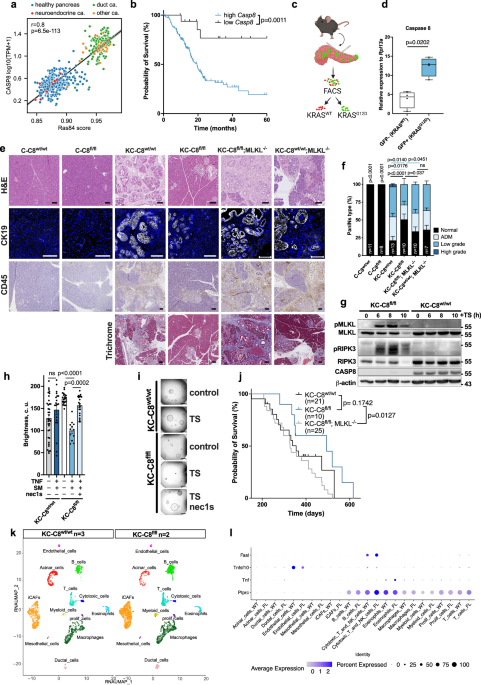
All Samples were fixed in 4% buffered formalin for a minimum of 24 hours and a maximum of 72 hours, then transferred to paraffin. Three micrometer thin sections were prepared according to the standardised procedures at the Institute of Pathology and haematoxylin-eosin stained (H&E). A histopathologist with experience in the field of gastroenteropathology (AQ) evaluated all sections in a blinded manner. All primary ductal structures were identified and their various forms of intraepithelial Neoplasia of the pancreas (PanIN). PanINs were determined according to the current WHO classification (2019) and classified into low grade pancreatic intraepithelial neoplasia versus high grade pancreatic intraepithelial neoplasia. The extent of the PanINs relative to the total of available ductules was also quantified. The majority of the low grade PanINs found corresponded to the classic, simple mucin-filled columnar cells that completely or partially replaced the ductal epithelia. Furthermore, other histomorphological changes were determined: a) duct ectasia b) periductular fibrosis/stroma reaction c) extent and type of inflammation (low versus marked inflammation) (lymphocyte-dominated versus neutrophil-granulocyte dominated inflammation) d) invasive carcinoma.
FACS analysis on pancreatic immune cell infiltrates
In order to isolate immune cells from the pancreas, whole tissue was dissected and minced with scalpels into fragments small enough to be aspirated into a 5 ml pipette at RT. 45 ml of tissue suspension was incubated with 5 ml of a 10× Triple Enzyme Mix (1 g Collagenase IV, 100 mg Hyaluronidase and 20,000 Units DNase IV into 80 ml HBSS) at RT for 30 min on a shaker at 80 rpm. Cell suspension was repeatedly pipetted to further dissociate cells, centrifuged at 50 x g at RT for 10 min and the supernatant was collected by passing it through a 70 μm nylon strainer. The bigger pellets at the bottom of the tube were then discarded and the filtered supernatant was centrifuged at 200 × g for 5 min. Cell pellets were washed with 10 ml Wash Buffer (1 g BSA and 2 ml 0.5 M EDTA in 800 ml HBSS) at 200 × g for 5 min once and were resuspended with 2 ml ACK lysis buffer (Gibco) for 1 min to deplete red blood cells. Cells were washed with PBS and immediately stained for live/dead cells using the viability dye eFluor660 (eBioscience) (1:1000) in PBS for 30 min, at 4 °C. Cells were then washed twice with FACS buffer (PBS, 2% FCS) and Fc block (CD16/32, biolegend, 1:50) was used 15 min. Cells were then stained with CD45-BV421 (30.F11) or CD45-FITC (30.F11) (biolegend), NK1.1- BV421 (PK136) (biolegend), CD4-V450 (RM4-5) (BD Horizon), CD11b-PE (M1/70) (ebioscience), CD8-PE (53-6.7) (biolegend), CD19- PE (1D3) (ebioscience), CD11c-BV421 (N418) (biolegend), Ly-6G/Ly-6C-FITC (RB6-BC5) (ebioscience), Gr1-BV-711 (RB6-8C5) (biolegend), CD14-FITC (Sa14-2) (biolegend), CCR3-FITC (J073E5) (biolegend), all at 1:1000 for another 30 min, at 4 °C. For subsequent intracellular stainings, cell pellets were resuspended in 200 μl Fixation/Permeabilization buffer (eBioscience) and incubated overnight at 4 °C. The next day, cells were washed with 1× permeabilisation buffer (eBioscience) and incubated for 15 min with 2% goat serum before adding CD206-BV421 (MMR) (C068C2) or Rat IgG2a, κ-isotype Ctrl -BV-421 (RTK-2758) (biolegend)1:50 for 30 min at 4 °C in 1× permeabilisation buffer. After washing twice with 1× permeabilisation buffer cells were resuspended in FACS buffer. Measurements were acquired using a BD LSR Fortessa flow cytometer and data were analysed using the FlowJo (10.6.1) software.
Cells
LSL-KRASG12D inducible MEFs were generated as described previously46. “Rasless” MEFs reconstituted with either WT KRAS4B or KRASG12D (RPZ25854, RPZ26198) were generated and kindly provided by the RAS Initiative at the Frederick National Laboratory for Cancer Research (FNLCR), US. Rasless MEFs were grown in Dulbecco’s modified Eagle’s (DMEM) + GlutaMAX™ medium (Gibco) with 4 µg/ml of blasticidin. Freshly isolated LSL-KRASG12D inducible MEFs and IFNAR1−/− MEFs were cultured in DMEM (Gibco) supplied with 1% L-Glutamine (Sigma) and 1% Sodium Pyruvate (Sigma). Control, STAT1, STAT2 and IRF9-deficient MEFs were previously published73 and kindly provided by Thomas Decker. Mouse PDAC cell lines (dox-KRASG12D mPDAC) derived from KC mice and engineered to express a doxycycline‑inducible additional KRASG12D allele66 were kindly provided by Roland Rad. Inducible human pancreatic duct epithelial cells (HPDE) pCW-KRASG12D were described previously11 and cultured in 75% RPMI 1640/ medium in presence of 25% keratinocyte growth medium 2 (PromoCell) + 0.5 µg Puromycin, BxPC-3 pCW-KRASG12D46 in RPMI 1640 GlutaMAX™ + 1% Sodium Pyruvate (Sigma) + 2.5 µg Puromycin. Human PDAC cell lines BxPC-3, A818-6, HPAF-II, Capan-1, AsPC1, PancTul, Colo 357, Capan-2, PANC-1, PANC-89, MIA PaCa-2, PT45 were cultured in RPMI 1640 GlutaMAX™ + 1% Sodium Pyruvate (Sigma). All media were supplemented with 10% fetal calf serum (FCS) (Sigma Aldrich) and 1000 U/mL of both penicillin and streptomycin (Pen/Strep) (Sigma Aldrich). All cells were kept at 37 °C with 5% CO2 and tested for mycoplasma at regular intervals (mycoplasma barcodes, Eurofins Genomics). Human PDAC cell lines BxPC-3 (ATCC CRL-1687), HPAF-II (ATCC CRL-1997), Capan-1 (ATCC HTB-79), AsPC1 (ATCC CRL-1682), PANC-1 (ATCC CRL-1469), MIA PaCa-2 (ATCC CRL-1420), Capan-2 (ATCC HTB-80) were obtained from ATCC. A818-6 was kindly provided by A. Trauzold and described previously100. PancTul, Colo357, PANC-89 and PT45 were kindly provided by A. Trauzold and described previously101.
Cell death assays (flow cytometry)
Four days before treatment 120,000 LSL-KRASG12D inducible MEFs (with or without 4OHT [1 µg/ml]), one day before treatment 500,000 cells (“Rasless” MEFs) were plated in each well of a 6-well plate. To determine cell death, adherent and detached cells were harvested and stained with propidium iodide (PI) [1 μg/ml] (Sigma Aldrich) or with Fixable Viability Dye eFluor™ 660 (eBioscience™) [1:1000] in PBS (Thermo Fisher) supplemented with 2% FBS. For staining with Annexin V (Biotium) [1 μg/ml] we used manufacturer’s protocol. Staining-positive cells were quantified by flow cytometry using an LSR-FACS Fortessa (BD Bioscience) and FlowJo software (BD Bioscience).
Cytotoxicity/viability assay NYONE®
The cells were seeded at 1 × 10⁴ cells/well in 96-well plates. After 24 h, the cells were pretreated with Birinapant (1 µM; Selleck Chemicals, Houston, Texas, United States) or Birinapant (1 µM) and zVAD-fmk (20 µM, Bachem Holding, Bubendorf, Switzerland) for 1 h, followed by treatment with 100 ng/ml TRAIL (PeproTech, Hamburg, Germany). After 24 h cell viability and cell death were assessed by triple-fluorescence staining with Propidium Iodide (PI) (10 μg/ml, Invitrogen, Karlsruhe, Germany), Calcein AM (0.1 μg/ml, BioLegend, San Diego, California, United States) and Hoechst 33342 (2.5 μg/ml, Invitrogen). PI/Calcein AM/Hoechst 33342 staining was performed by diluting the substances in PBS and adding to the wells. The cells were incubated in the dark at 37 °C and 5% CO2 for 20 min and subsequently centrifuged for 5 min at 400 × g. Fluorescence imaging was performed by NYONE® SCIENTIFIC (SYNENTEC GmbH, Elmshorn, Germany) and the images were quantified using YT-software® (SYNENTEC GmbH): Cells stained with Hoechst 33342 and Calcein AM were considered living cells, whereas PI stained cells were counted as dead cells due to the loss of membrane integrity.
Live cell imaging (IncuCyte)
Five thousand (“Rasless” MEFs) per 96-well plate were seeded 24 h in advance. Treatments were added in two parts: “pretreatment” everything except TNF or TRAIL or Fas Ligand and 30 minutes later cells are treated with ligands. Cells were imaged using the ×10 objective within the IncuCyte SX5 live cell imaging system (Sartorius). For dead cell quantification, 100 nM DRAQ7 (Thermofisher) were added to each well. Cells were imaged for the indicated timepoints every 2 h. Analysis for confluence, DRAQ7- positive (dead) cells was performed using the Software IncuCyte 2021 A (Sartorius).
Mouse organoids
KC-organoids were generated from PDX1-Cre KRASG12D mice. The pancreas was washed with cold wash medium (DMEM high glucose, Pen/Strep, 1% FCS) and cut into 1–2 mm pieces. Pieces were digested in digestion medium (200 ml wash medium, 25 mg Collagenase P (C9407, Sigma-Aldrich), 25 mg Dispase II (17105041, Thermo Fisher) at 130 rpm at 37 °C in repeated cycles until wash fractions contained mainly pancreatic ducts. Duct-enriched fractions were centrifuged at 1200 rpm for 5 min, resuspended in ice-cold Matrigel (356231, Corning) and seeded as 30 µl domes in pre-warmed 24-well plates. After 15 min, 500 µl PancreaCult™ Organoid Growth Medium (06040, Stemcell) was added. Organoids were maintained with weekly splitting and twice-weekly medium changes. For treatment experiments, single cells from organoids were seeded at 250 cells in 100 µl of 10% Matrigel PancreaCult™ Organoid Growth Medium supplemented with Rho Kinase Inhibitor 10.5 µM (TB1254-GMP, Tocris) on solidified layer of 30 µM Matrigel:DPBS (1:1) per well in 96-well plates and grown for 6 days before treatment. Organoid viability was assessed using organoid brightness as a proxy using the BZ-X800E microscope and BZ-H4M/Measurement Application Software (Keyence).
Patient-derived pancreatic cancer organoids (PDOs)
To evaluate the therapeutic strategy in patient-derived pancreatic cancer organoids, three distinct organoid lines were generated from EUS-guided fine needle aspiration/biopsy and surgical resection102. Biopsies were minced and surgery specimens were incubated rotating for collagen digestion using DMEM-F12, 1× Primocin and 6 mg/mL collagenase II. Tissue pellets were incubated with RBC lysis buffer and further digested using TrypLE. Cell pellets were resuspended in 50 µL Matrigel/well and PDO medium was added after Matrigel solidification. PDO medium consisted of DMEM-F12 supplemented with d-glucose, ITS Premix, triiodo-l-thyronine, dexamethasone, cholera toxin, penicillin/streptomycin, NU-Serum IV, bovine pituitary extract, nicotinamide, Primocin, A83-01, RSPO1-conditioned medium, Recombinant Human Heregulin-1 and Rho Kinase Inhibitor. The two male PDOs (#2 and #3) were previously established and published103 the additional female PDO (#1) was not published previously. All available clinical data on all PDOs are in the Supplementary Table 1. For organoid seeding, 500 single cells were plated in 30 µl of PDO medium containing 5% Matrigel in a 384-well white plate (#3570, Corning). After 24 hours, treatments were added in a total volume of 5 µl. Following an additional 30 minutes, 5 µl of medium—with or without 500 ng/ml human TRAIL—was added to each well. After 72 hours of incubation, cell viability was assessed using the CellTiter-Glo® 3D Cell Viability Assay (#G9681, Promega). For this, 8 µl of the reagent was added to each well containing 40 µl of total volume. Plates were shaken for 10 minutes and then incubated at room temperature for 20 minutes to stabilise the luminescent signal. Luminescence was measured using the VantaStar microplate reader (BMG Labtech).
Western Blotting
The cells were washed with PBS and lysed with RIPA buffer (89901, Thermo Fisher), which was supplemented with phosphatase and protease inhibitors (Roche). The protein lysate concentrations were determined using the bicinchoninic acid (BCA) protein assay (50000113, Bio-Rad) and subsequently adjusted to the same concentration. Equal amounts of protein were mixed with a final concentration of 1× LDS sample buffer (NP0008, NuPAGE) and DTT (200 mM) and then heated to 80 °C for 10 min. The samples were separated via gel electrophoresis and transferred to nitrocellulose membranes (Bio-Rad). The membranes were blocked in PBS with 0.1% Tween 20 (PBST) with 5% BSA (Sigma-Aldrich) for at least 1 h and incubated with primary antibodies overnight at 4 °C. After washing with PBST, membranes were incubated with 1:10,000 diluted horse radish peroxidase (HRP)-coupled secondary antibodies for at least 1 h at room temperature. After another washing step, bound antibodies were detected using chemiluminescent Amersham ECL Prime Western Blotting Detection Reagent (RPN2235, Cytiva) or SuperSignalTM West Femto Maximum Sensitivity Substrate (34095, Thermo Fisher). The FUSION Solo S system and software (Vilber) were used to image the membranes.
ELISA
CXCL2 (DY452-05, R&D systems), IFN-α (MFNAS0, R&D systems), IFN-ß (DY8234-05, R&D systems), IFN-γ (DY485-05, R&D systems), TNF (DY410-05, R&D systems), Fas ligand (DY526, R&D systems), TRAIL (DY1121, R&D systems) were used following the manufacturer’s instructions. Cell culture supernatants and murine pancreatic extracts were analysed after storage at − 80 °C. For mouse samples amounts of released protein was normalised to total protein level in the sample measured by DC protein assay kit (774985, Bio-rad). For the IFN-detecting ELISAs, cell culture supernatants were 16-fold concentrated using 3 kDa molecular weight cut-off spin columns (VS2092, Sartorius).
Tissue stainings (immunohistochemistry and immunofluorescence)
Pancreatic tissues were fixed in 4% paraformaldehyde, embedded in paraffin, and cut into 3–5 µm sections. Paraffin sections were rehydrated by passing the slides through xylene and descending grades of alcohol then rinsed in water. The slides for IHC were incubated for 15 minutes with Peroxidase Blocking Solution (SP-6000, Vector Laboratories). Then heat-induced antigen retrieval was performed in citrate buffer (H-3300, Vector Laboratories) in a pressure cooker (110 °C) for 1.5 h or by proteinase K treatment for 15 min at 37 °C (only CD45). Slides were then immediately cooled under running water and rinsed in PBS. 100 μl of Protein Block (ab64226, Abcam) was added to each slide for 45 minutes. After washing 3× with 0.05% PBS/Tween 20 solution for 5 minutes, the slides were incubated with 100 μl of the primary antibody at 4 °C overnight in a humidity chamber. Following overnight incubation, slides were washed with 0.05% PBS/Tween 20 solution. The sections were then incubated with secondary antibody for 1 h at room temperature and again washed three times. For IHC, the sections were developed using the ABC kit (PK-6100, Biozol) and consequently incubated with DAB substrate before being counterstained with haematoxylin and rinsed in water for 1 minute. Slides were then dehydrated in ascending grades of alcohol and cleared in xylene (IHC). Finally, the sections were mounted using Di-N-Butyl Phthalate in Xylene (DPX) mounting solution and covered with a glass coverslip (IHC) or mounted in DAPI (ProLong® Golds antifade reagent with DAPI, Invitrogen) (IF). For negative controls, adjacent duplicate slides from each case were used. These slides were incubated with 100 μl antibody diluent instead of primary antibody/secondary antibody. H&E stainings were examined by an experienced pathologist (A.Q.) who was blinded to the study design. TUNEL stainings were performed according to manufacturer’s protocol (Promega, G3250) for paraffin embedded tissue. The propidium iodide step was omitted, and slides were instead covered with ProLong™ Gold Antifade mounting medium with DAPI (Invitrogen™, P36941). The Trichrome staining was performed according to the manufacturer’s protocol of the Trichrome Stain (Masson) Kit (HT15-1KT, Sigma-Aldrich). Fluorescence pictures were acquired using the Keyence BZ-X800 microscope and analysed with the BZ-X800 Analyser software. Cytokeratin 19 and CD45 IHC stainings were analysed and quantified using the QuPath software.
Immunofluorescence microscopy
Ten thousand MEFs per well were seeded in 24 well plates on top of a sterilised glass coverslip and incubated for 24 hours with or without 10 nM of the KRAS inhibitor MRTX1133. After the incubation the cells were washed with PBS and fixed with 4% paraformaldehyde for 15 min in room temperature. After fixation cells were treated with DAPI (1:5000) for 1 hour in room temperature and washed three times with PBS. Fluorescence pictures were acquired using confocal microscopy (SP8 Confocal Microscope, Leica).
siRNA transfections
Two hundred microliters Opti-MEM (Gibco) and 1.5 µL Dharmafect Reagent I (Dharmacon) were mixed and incubated for 5–10 min at room temperature. 2.8 µL of siRNA (Stock 20 mM) (Dharmacon) were added to the mixture and incubated for another 30 min at room temperature. After incubation, 200 µL of the mixture was added to each well (6-well) plate and cells were plated on top. Knockdowns were incubated for 72 h, as indicated.
Quantitative real-time PCR (qPCR)
The NucleoSpin RNA kit (740955.5, Macherey-Nagel) was used to isolate total RNA following the manufacturer’s instructions. The isolated RNA was then converted to cDNA using the LunaScript RT SuperMix Kit (E3010L, New England Biolabs). For qPCR each reaction contained 5 µl of Luna Universal qPCR Master Mix (M3003E, New England Biolabs), 2 µl of nuclease-free water, 1 µl (10 µM) of primer mix (forward and reverse primers), and 2 µl of cDNA (10 ng/µl). qPCR was performed in quadruplicates on the Quant Studio5 qRT PCR cycler. All results were normalised to the expression of the housekeeping gene control Rpl13a. Primer sequences used can be found in Supplementary Data 3.
Bulk RNA-seq analysis
The RNA-seq datasets were analysed on the CHEOPS HPC cluster of the University of Cologne using the RNA-Seq pipeline of the nf-core suite v3.7104 with default parameters and Nextflow v21.10.6105. For instance, the reads were aligned to the mm10 reference genome sequence using STAR v2.7.10a106 with default parameters. In the quantification step, reads were counted with the quasi-mapping quantification tool Salmon v1.5.2107 Differential expression analysis (DEA) was then performed in R using the DESeq function of the DESeq2 v1.36.0 package108, with default parameters. Genes with absolute value of log2 fold change ≥0.56 and adjusted p value ≤ 0.05 were considered differentially expressed.
Bioinformatic analysis of human TCGA datasets
Processed RNA-sequencing data of TCGA patient cohorts was downloaded using the R packages GenomicsDataCommons and TCGAutils on 2023-01-12. Interferon-stimulated gene (ISG) expression signatures were calculated using a published approach and Interferon gene set68. In brief, to derive Interferon signature scores, median absolute deviation (MAD) Z-scores of log2-transformed and Transcript Per Million (TPM)-normalised mRNA expression values were calculated per gene. The mean of all signature genes’ Z-scores per sample was subsequently defined as the ISG score. Categories of high or low ISG score were defined by the mean ISG score +/− 1 standard deviation, remaining samples were considered having medium ISG score and log2-TPM expression of candidate genes compared between groups. For survival analysis of PAncreatic ADenocarcinoma (PAAD), patients were grouped by Caspase 8 expression as low (lowest 10%) or high Caspase 8 (highest 90%). Kaplan–Meier analysis was performed between both groups. Events after 5 years of follow-up were censored to minimise artifacts by competing risks. The Ras84 gene set was downloaded from East et al.38 and every gene within the gene set was assigned a value corresponding to the rank of its expression level within each sample. For each sample, the Ras84 score is then calculated as the median of the ranks of the 84 genes. For each tumour cohort, the Ras84 score was calculated as the median of the Ras84 scores of individual samples. The necroptosis score was calculated as the sum of the expression levels of Mlkl, Ripk3, and Zbp1 after log10 (TPM + 1) transformation. For each tumour cohort, the necroptosis score was calculated as the median of the necroptosis score of individual samples. Pearson correlation was used to assess the relationship between computationally derived scores across TCGA datasets. Mutation data was downloaded from the TCGA repository on 2023-05-03 and cohorts with a frequency of missense mutations in KRAS greater than 25% were marked as high-frequency KRAS tumour types.
TCGA analyses included 10,534 samples across 33 cancer types for pan-cancer analyses, 507 samples for PAAD/GTEx correlation analyses, and 178 patients for survival analyses. Cell line Ras84 scores were computed for 12 human PDAC cell lines. Sample sizes separated for each cancer type for all TCGA analyses are provided in the Source Data file.
Single-cell sample preparation for scRNA-seq of KC mice samples and fluorescent cell sorting
Mouse pancreata harvested from 5-month-old mice was cut into ~3 mm pieces, incubated with 5 ml of digestion medium (200 mg/l Dispase (17105041, Thermo Fisher), 200 mg/l collagenase P (11249002001, Merck) in DMEM (Gibco) containing Pen/Strep and 1% FCS) for 20 min 37 °C while shaking at 150 rpm. Tissue was processed with gentleMACS™ Octo Dissociator imp.tumor3 program. Then cells were strained through a 70 µm strainer, spun down at 300 × g for 7 minutes. Blood cells were removed with Red Blood Cell Lysis Solution (Miltenyi Biotec 130-094-183). Cells were then washed with 0.04% BSA (9048-46-8, Thermo Fisher) in PBS, strained through a 40 µm tissue strainer and resuspended in 0.04% BSA in PBS for scRNA-seq. For fluorescent cell sorting, single cells were prepared as described above, washed in PBS and immediately stained for live/dead cells using the viability dye eFluor660 (eBioscience) (1:1000) in PBS for 30 min, at 4 °C. Cells were then washed twice with FACS buffer (PBS, 2% FCS) and incubated with Fc block (CD16/32, biolegend, 1:50) for 15 min. Then cells were stained with CD45-APC-Cy7 (30.F11) (biolegend), washed and CD45- cells with or without GFP signal were sorted to obtain KRASG12D- or KRASWT-expressing cells, respectively. Cells were spun down at 200 × g for 5 min and the cell pellet was used for RNA extraction (according to manufacture instructions 740902.10, Macherey Nagel) and further qPCR analysis.
Single cell RNA-sequencing (scRNA-seq) bioinformatic pipeline for KC mice samples
Preprocessing
Bioinformatics analysis of single-cell RNA sequencing data was conducted as described previously109 using the reproducible Common Workflow Language pipelines available on Scientific Data Analysis Platform (SciDAP). Briefly, raw FASTQ files (PRJNA975357) were independently mapped to the mm10 (2020-A from July 7, 2020) reference genome by the Cell Ranger Count (version 4.0.0) pipeline. Produced gene expression profiles per sample were aggregated into a single feature-barcode matrix by running Cell Ranger Aggregate (version 4.0.0) pipeline with disabled depth normalization parameter. All other data analysis workflows described below used the Seurat (version 4.1.0) R package.
Low quality cell removal
Low quality cells were removed in two iterations. First, the following filtering thresholds were applied per cell – from 80 to 6000 genes, minimum 500 uniquely mapped fragments, maximum 5 percent of transcripts mapped to mitochondrial genes. Preliminary filtered data were run through the dimensionality reduction pipeline to integrate all samples into a single UMAP. The latter allowed us to identify the red blood cells based on the expression of the marker genes (gene names) and manually exclude them on the next iteration of the filtering pipeline.
Datasets integration and clustering
High quality cells from all samples were first processed by dimensionality reduction pipeline. On this step gene expression data from each sample were normalised and scaled using SCTransform function. When scaling, the expression levels of the following genes – Xist and Ddx3y, were set as variables to regress out. Normalised data were then integrated following the instructions from the official Seurat vignette using the first 20 dimensions for principal component analysis (PCA) and UMAP projection. Next, cluster analysis workflow was run on the PCA reduced data using 20 dimensions and 0.1 clustering resolution. Gene markers were identified for each cluster using FindAllMarkers function with default parameters (Wilcoxon rank-sum test, two-sided, with Bonferroni correction for multiple comparisons), returning only upregulated genes. Based on the identified gene markers the cell types were assigned. For the analysis of only immune cells, dimensionality reduction and clustering pipelines were run on the prefiltered cells using 0.2 clustering resolution.
Pseudobulk differential gene expression analysis
To identify differences in gene expression profiles between two groups of samples (KC-C8wt/wt and KC-C8fl/fl) pseudobulk differential gene expression pipeline was run for each identified cell type. Cells were first prefiltered to belong only to the specific cell type, then aggregated to a pseudobulk form within each sample. Ribosomal, mitochondrial, as well as Xist and Ddx3y genes were excluded from the analysis. Aggregated raw reads counts were processed by DESeq2 as bulk RNA sequencing data. The results were filtered to include only differentially expressed genes with p adjusted values not bigger than 0.05.
Single cell analysis of published human scRNA-seq data
The human primary PDAC and normal pancreas scRNA-seq dataset67 was downloaded from GSA: CRA001160. For all samples, only ductal cell 1 and 2 were extracted based on cell type annotation. Data was then normalised by SCTransform. The first 15 PCAs are used for clustering and UMAP projection. Expression of each gene is plotted by Seurat FeaturePlot function.
Statistics & reproducibility
All data were analysed by GraphPad Prism Software using t test, one-way ANOVA or two-way ANOVA as indicated. Results were considered significant at p < 0.05. For RNA-seq differential expression analysis, genes with adjusted p value ≤ 0.05 and fold change ≥ 0.56 were considered differentially expressed. In vitro and in vivo results are presented as means ± SEM calculated from at least three independent biological repeats (each performed with at least two technical replicates) unless otherwise noted. All statistical tests used were two-sided. Numbers are indicated in the figure legends and in Source Data file. Numbers of mice are stated within figures or figure legends in all cases. No statistical method was used to predetermine sample size. Mitochondrial genes and sex-specific genes (Xist, Ddx3y) were excluded from scRNA-seq analysis to account for mixed-sex samples; no other data were excluded from the analyses. In vivo experiments were randomized with mice randomly assigned to treatment groups while maintaining balanced sex ratios; randomization was not applicable to cell-based experiments. The investigators were not blinded to allocation during experiments and outcome assessment, except for histological analysis which was performed by a pathologist blinded to the experimental groups. Western blot, immunofluorescence, immunohistochemistry, and organoid images shown are representative of at least three independent experiments with similar results unless otherwise stated in the figure legend. Molecular weight markers in kDa are indicated on all Western blot panels.
Reporting summary
Further information on research design is available in the Nature Portfolio Reporting Summary linked to this article.
