


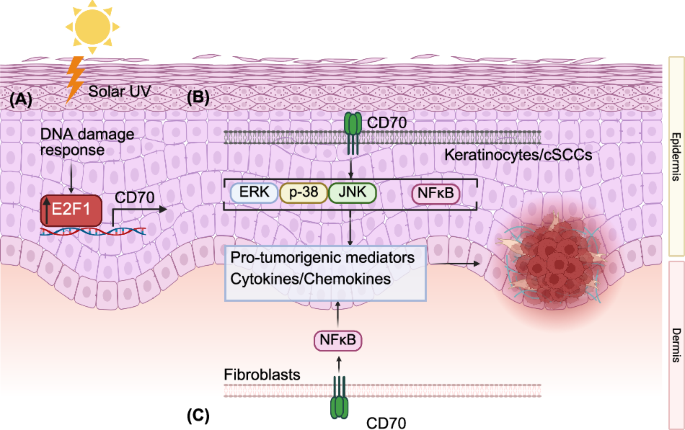
Chronic ultraviolet (UV) exposure drives the development of non-melanoma skin cancers (NMSCs), particularly cutaneous squamous cell carcinoma (cSCC), through persistent DNA damage and inflammation. However, how UV-induced epithelial damage is coupled to inflammatory signaling and tumor–stromal communication during skin carcinogenesis remains incompletely understood. Here, we identify CD70, a TNF superfamily member, as a UV- and DNA damage–inducible regulator that links epithelial stress responses to stromal activation and tumor-promoting signaling. Integrative analyses of transcriptomic (GTEx, GSE2503, GSE42677), proteomic (RPPA), and immunostaining datasets reveal robust upregulation of CD70 in sun-exposed skin, actinic keratoses, and cSCC lesions. Functionally, CD70 silencing suppresses cSCC proliferation and xenograft growth, whereas solar UV or DMBA exposure induces CD70 expression. CD70 depletion disrupts cytokine–receptor signaling and MAPK/NF-κB pathways and alters inflammatory gene expression in UV-irradiated keratinocytes. In dermal fibroblasts, CD70 enhances NF-κB activation and secretion of IL-6 and MCP3 in TGF-β–activated fibroblasts, thereby reinforcing paracrine inflammatory loops that support cSCC spheroid expansion and tumor progression. CD70 knockdown in fibroblasts abrogates these effects and reduces tumor proliferation and cytokine expression in vivo. Mechanistically, E2F1 directly binds and activates the CD70 promoter, linking the DNA damage response to CD70 upregulation. Collectively, our findings identify CD70 as a stress-inducible signaling hub that links DNA damage, inflammation, and tumor–stromal communication in skin carcinogenesis. Targeting CD70 may disrupt this feed-forward inflammatory circuit and provide a therapeutic strategy for UV-driven and inflammation-associated cSCC.
The alternative text for this image may have been generated using AI.
