


Ethics Statement
All research procedures were conducted in accordance with institutional guidelines and approved protocols. Collection and use of human ascites fluid, ascites-derived cells, and ovarian tumor tissue for organoid generation were approved by the Duke University Institutional Review Board, and written informed consent was obtained from all participants prior to sample collection. All animal experiments were performed in accordance with the Guide for the Care and Use of Laboratory Animals and were approved by the Duke University Institutional Animal Care and Use Committee (IACUC). Approved protocol numbers are provided in the corresponding Methods sections.
Cell culture
The CAOV3, TYKNU, TOV21G, and TOV112D cell lines were a gift from Zhiqing Huang. HEK293T cells (ATCC CRL-11268) were obtained through the American Type Culture Collection (ATCC) and used for viral packaging. All cell lines were authenticated via short tandem repeat (STR-10) profiling and regularly tested for mycoplasma contamination and tested negative via the Duke Cell Culture Facility (CCF), now known as the Duke Life Science Facility (LSF). Cells were maintained in a humidified incubator at 37 °C with 5% CO2. Unless otherwise indicated, the Dulbecco’s Modified Eagle Medium (DMEM) (Gibco, 11995065) that was supplemented with 10% fetal bovine serum (FBS) (Cytiva, SH30071.03HI-LSF) and 1% streptomycin-penicillin (Gibco, 15140122) was used for all cell lines. All cells were trypsinized using trypsin-EDTA (Gibco, 25200072).
Ovarian patient-derived cell line establishment, maintenance, and treatment
Patient-derived OVCA tumor cells were obtained through Alessandro Santin (Yale University) under protocol ID 1110009149 and the Duke University School of Medicine Ovarian Cancer Research Biobank under protocol ID Pro00013710. Upon receipt, cells were validated as epithelial via EpCAM western blot analysis. Cells were then maintained in a humidified incubator at 37 °C with 5% CO2. The Dulbecco’s Modified Eagle Medium (DMEM) (Gibco, 11995065) that was supplemented with 10% fetal bovine serum (FBS) (Cytiva, SH30071.03HI-LSF) and 1% streptomycin-penicillin (Gibco, 15140122) was used for cell lines received through Duke University. Cells received via Yale University were cultured with RPMI-1640 (Gibco, 11875093) that was supplemented with 10% fetal bovine serum (FBS) (Cytiva, SH30071.03HI-LSF), 1% streptomycin-penicillin (Gibco, 15140122), and 0.3% amphotericin B (Gibco, 15290018). All cells were trypsinized using trypsin-EDTA (Gibco, 25200072). The pathology information of each tumor cell sample is provided in Supplementary Data 1.
Ovarian patient-derived organoid establishment, maintenance, and treatment
OVCA tissue samples were collected at the Duke University Hospital through the Duke BioRepository and Precision Pathology Center (BRPC), which is part of the National Cancer Institute’s Cooperative Human Tissue Network. Samples were collected with written informed consent under a Duke Institutional Review Board approved protocol (Pro000089222). Tissue samples were cut into pieces ~2 mm3 with a sterile scalpel and enzymatically digested in 5 mL tubes with 4.7 mL DMEM F12 media (Gibco, 11320033) and manufacturer-recommended amounts of H, R, and A enzymes in the Tumor Dissociation Kit, human (Miltenyi Biotec, 130-095-929). Samples were digested for 60 min at 37 °C in the Roto-Therm Plus (Ward’s Science). Cells and tissue fragments were then filtered through a 70 µm filter and centrifuged at 500 × g for five min. The supernatant was aspirated, and 1.25 × 10⁵ cells were plated per 50 µL dome of Matrigel (Corning, 356234).
Ovarian patient-derived organoids (PDO) were maintained in ovarian media, which consisted of DMEM F12 media supplemented with the following components: 10 mM HEPES, 1X GlutaMax, 100 U/mL Penicillin/Streptomycin, 10 nM 17-B-Estradiol, 500 nM A83-01, 1X B27 without Vitamin A, 50 ng/mL EGF, 25 ng/mL FGF7, 100 ng/mL FGF10, 10 nM [Leu15]-Gastrin I, 10 ng/mL HGF, 20 ng/mL IGF, 1X N2, 1 mM N-Acetylcysteine, 10 ng/mL Neuregulin I, 10 mM Nicotinamide, 100 ng/mL Noggin, 100 µg/mL Primocin, 10 nM Prostaglandin E2, 100 ng/mL R-Spondin 1, 3 µM SB202190, and 10 µM SB203580 (p38i). All PDOs were maintained in a 37 °C humidified incubator at 5% CO2.
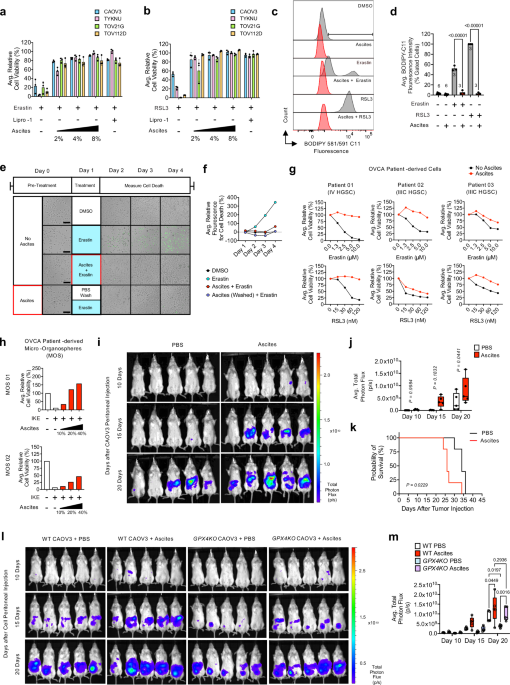
Once the PDOs were confluent, media was aspirated, and 1 mL of PBS was added to each well to detach the Matrigel domes. The solution was centrifuged at 500 × g for five min. 1 mL of TrypLE Express (Gibco, 12604013) was used to dissolve Matrigel and dissociate organoids. These mixtures were incubated for five min at 37 °C, and TrypLE was neutralized by adding 5 mL of DMEM F12 media with 10% FBS and 1% penicillin/streptomycin. After centrifuging at 500 × g for five min, supernatants were aspirated. PDO cell suspensions were used to make micro-organospheres (MOS)24 at a concentration of 50 cells per MOS. MOS were then plated at a concentration of 100 MOS in 50 µL of media per well in a 96-well plate and treated with DMSO control, IKE (50 µM), and 10, 20, and 40% ascites with or without IKE (50 µM). Cell viability was assessed using the Cell Titer-Glo® luminescent cell viability assay kit (Promega, G7570) after 72 h. Samples that were the most responsive to ascites treatment were subsequently made into MOS and treated with the following conditions: DMSO control, 20% ascites, IKE (50 µM), IKE (50 µM) and 20% ascites, bezafibrate (1 mM), bezafibrate (1 mM) and 20% ascites, bezafibrate (1 mM) and IKE (50 µM), and bezafibrate (1 mM) and IKE (50 µM) and 20% ascites. The same experimental design was repeated with ciprofibrate (1 mM) in place of bezafibrate. MOS plates were imaged daily for three days using an ImageXpress Pico (Molecular Devices) cell imaging system, and cell viability was measured as described above after 72 h. The pathology information of each organoid line is provided in Supplementary Data 1.
Mouse studies
CAOV3 cells were transduced with a GFP-luciferase reporter (System Biosciences, pGreenFire1-CMV Positive Control, TR011PA-1), and GFP+ cells were isolated by flow cytometry. For the first set of experiments, 0.5 × 10⁶ or 1.25 × 10⁵ sorted cells were resuspended in 100 µL PBS or human ovarian cancer (OVCA) ascites and injected intraperitoneally (IP) into 10-12 six-week-old female immunodeficient mice (Mus musculus; Taconic Biosciences, CBSCBG-F). Beginning five days after tumor cell injection, 100 µL of cell-free PBS or human OVCA ascites was administered IP every five days for up to 20 days.
For the second set of experiments, sorted CAOV3 cells were transduced with a GPX4 knockout construct22 and selected with puromycin (1 µg/mL; Sigma, P8833) prior to IP injection into 20 eight-week-old female immunodeficient mice (Mus musculus; Duke DLAR Rodent Breeding Core, NOD.Cg-Prkdcscid Il2rgtm1Wjl/SzJ (NSG)). Cells were counted using a hemocytometer and stained with trypan blue to exclude dead cells, and 1.0 × 10⁵ live cells from each treatment group were resuspended in 100 µL PBS or human ascites before injection. Cell-free PBS or ascites (100 µL) was administered IP every five days for up to 20 days.
For the third set of experiments, sorted CAOV3 cells were treated with bezafibrate (800 µM), JKE-1674 (10 µM), or both for 5 h prior to injection. After exclusion of dead cells by trypan blue staining, 2.0 × 10⁶ or 1.25 × 10⁵ live cells were resuspended in 100 µL PBS and injected IP into 20–28 six-week-old female immunodeficient mice (Taconic Biosciences, CBSCBG-F for high-density injections; Duke DLAR Rodent Breeding Core, NSG for low-density injections). Injections were performed randomly, and mice were subsequently marked on the tail to track treatment groups. Peritoneal tumor growth was monitored by bioluminescent imaging at 7 and 10 days or at 10, 15, and 20 days after injection.
All mice were maintained on a standard normal chow diet (PicoLab® Rodent Diet 20, 5R53; LabDiet) and provided food and water ad libitum. Environmental conditions were maintained in accordance with the Guide for the Care and Use of Laboratory Animals. Mice were housed under a 12-h light/12-h dark cycle (lights on from 7:00 AM to 7:00 PM), at an ambient temperature of 21–23 °C and relative humidity maintained between 30–70%. Mice were euthanized either 7 or 10 days after tumor injection or monitored until reaching predefined humane endpoints for survival analyses. Euthanasia was performed by carbon dioxide inhalation, and tumors and ascites were collected on the same day for molecular analyses. Mice were euthanized if they became moribund or met other IACUC-defined criteria indicating pain or distress (including primary tumor size reaching 2000 mm3, >15% weight loss, ruffled fur, visible ascites accumulation, or ascites-associated weight gain >2.5 g), in accordance with approved Duke IACUC protocols (Registry Numbers A118-21-06, A115-22-06, A88-24-04, and A115-22-06-25).
Bioluminescent imaging
Peritoneal tumor growth was assessed via bioluminescent imaging. 10 minutes before the imaging, mice were anesthetized with isoflurane (Covetrus, 029405) and injected IP with D-luciferin potassium (MedChemExpress, HY-12591B) dissolved in PBS (150 mg/kg). The mice were then imaged using an IVIS Kinetic Imaging System (Caliper Life Sciences). The exposure time was set at 1 s. Tumor growth was quantified as the bioluminescence signal (total photon flux) calculated with ‘region of interest’ (ROI) measurement tools in the Living Image software (4.8, Revvity).
Ascites samples
Human ascites samples from ovarian cancer patients were obtained through the Duke University School of Medicine Ovarian Cancer Research Biobank under protocol IDs Pro00013703 and Pro00013710. Human ascites samples from liver cirrhosis patients were obtained through the BRPC under protocol ID Pro00111040. Upon receipt, samples were centrifuged at 200 × g for 15 min and filter sterilized via 0.2 μm PES filters. All samples were stored at -80 °C. The pathology information of each ascites sample is provided in Supplementary Data 2. Mouse ascites samples were collected via post-mortem paracentesis from seven to eight-week-old SCID-beige or NSG mice 7-10 days after tumor cell injection. Samples were pooled together and centrifuged at 200 × g for 5 min and filter sterilized via 0.2 μm PES filters.
Ascites delipidation, dialysis, and heat inactivation
The ascites delipidation protocol was adapted from a lipid-stripped serum protocol29. Briefly, 3 mL of ascites was stirred with 0.6 mL of n-butanol (Sigma, 34867) and 2.4 mL of di-isopropyl ether (Sigma, 296856) for 30 min followed by centrifugation at 4,000 × g at 4 °C for 15 min. The lower phase was separated using a glass Pasteur pipette (VWR) and stirred with 3 mL of di-isopropyl ether for 30 min, followed again by centrifugation at 4,000 × g at 4 °C for 15 min. The lower phase was separated and put in a SpeedVac Concentrator (Savant) and spun at top speed for 1 h. Then, the sample was dialyzed in a 10,000 MWCO Slide-A-LyzerTM Dialysis cassette (ThermoFisher Scientific, 66380) in a beaker containing 2 L saline solution (9 g/L NaCl) for 3 days at 4 °C. A control ascites sample of the same volume was added to the beaker, and the saline solution was changed daily. After the dialysis process, triglyceride (Promega, J3160), cholesterol (ThermoFisher Scientific, A12216), and protein (ThermoFisher Scientific, 23225) levels were measured using a FLUOstar Optima plate reader (BMG Labtech). Protein concentrations of dialyzed and delipidated ascites samples were determined using a bovine serum albumin (BSA) standard curve and normalized to the corresponding unprocessed ascites prior to use in subsequent experiments. To equalize total protein input across conditions, sample volumes were adjusted based on measured protein concentrations. For example, if a dialyzed ascites sample contained half the protein concentration of its matched untreated sample, twice the volume of the dialyzed ascites was used in parallel experiments. For heat inactivation of ascites albumin, samples were incubated at 56 °C for 30 min, followed by incubation at 70 °C for 10 min.
Cell viability and cytotoxic assays
Cell viability assays were done with the CellTiter-Glo® luminescent cell viability assay (Promega, G7570) following manufacturer’s instructions. 2.5–3.0 × 10³ cells were seeded in white 96-well plates (Corning, 3903) for the assay. After treatment, 10 μl of CellTiter-Glo® reagent was added to each well (containing 100 µl of media), and plates were covered and shaken for 2 min and then incubated for 10 min. The resulting luminescent signal was then quantified using a FLUOstar Optima plate reader. The CellTox™ Green cytotoxicity assay (Promega, G8741) was used for the visualization and measurement of cell death at multiple timepoints. The CellTox™ reagent was added to the media in a 1:1,000 dilution, and the fluorescent signal was read using a FLUOstar Optima plate reader.
Fluorescence microscopy imaging
Cells incubated with CellTox™ Green reagent were imaged using an EVOS FL Imaging System (Thermo Fisher Scientific) at 0, 24, 48, and 72 h after treatment. Images were acquired using a 10× objective (scale bar = 80 µm).
Confocal microscopy imaging
Lipid droplet visualization
After treatment, cells were washed once with PBS and fixed with 3.7% formaldehyde (Sigma) for 10 min, followed by incubation with 10 µM BODIPY™ 493/503 (MedChemExpress, HY-W090090) diluted in PBS for 30 min at 25 °C. Cells were then washed three times with PBS, counterstained with DAPI, and mounted using Fluoromount-G™ mounting medium (Invitrogen, 00-4959-52). 4% FBS was used in the treatment medium.
Transferrin uptake visualization
After treatment, cells were washed once with PBS and incubated with human transferrin-Alexa Fluor™ 647 conjugate (5 µg/mL; Invitrogen, T23366) diluted in HBSS (Gibco, 14025092) for 15 min at 37 °C. Cells were then washed once with PBS, fixed, washed three times with PBS, counterstained with DAPI, and mounted as described above.
All images were acquired on a Zeiss LSM 780 inverted confocal microscope using 60× or 100× oil-immersion objectives. Fluorophores were excited using 405 nm (DAPI), 488 nm (BODIPY™ 493/503), and 633 nm (Alexa Fluor™ 647) laser lines, and emission was collected using standard DAPI, FITC/GFP, and Cy5 detection channels. Images were acquired as single optical sections, with line averaging (2×) applied and sequential acquisition used when necessary to minimize spectral overlap. Identical acquisition settings were applied across conditions. Scale bars represent 40 µm and 20 µm for the ×60 and ×100 objectives, respectively. Image analysis was performed using ImageJ2 (v2.14.0/1.54 f).
Constructs and lentivirus viral infections
Small interfering RNAs (siRNAs)
Nontargeting siRNA (siNT) was purchased from Qiagen (AllStars Negative Control siRNA, SI03650318). All other siRNAs were purchased from Dharmacon. siCD36 (M-010206-01-0005), siSCARB1 (M-010592-01-0005), siPLIN2 (M-019204-00-0005), siPPARA (D-003434-03-0002, D-003434-02-0002), siHMGCS2 (D-010179-03-0002, D010179-04-0002), and siTFRC (D-003941-07-0002, D-003941-05-0002) were all used at 50 nM working concentrations. Silencing was induced using the reverse transfection method. Briefly, siRNAs were diluted in 20 µL of Opti-MEM™ I reduced serum medium (Gibco, 11058021) at the indicated concentrations. 0.2 µL of Lipofectamine™ RNAiMAX transfection reagent (ThermoFisher Scientific, 13778150) was added, and the resulting mix was incubated for 20 min before 2.5 × 10³ cells were added to the mix in a 96-well plate. Cells were incubated with the siRNA for at least 24 h before additional treatments or silencing validations.
Stable and transient overexpression
DNA purification of all plasmids was conducted using the Qiagen Plasmid Midi kit (12145). For transient overexpression of HMGCS2, 100 ng of mouse hmgcs2 ORF clone with a pCMV6-Entry backbone (Origene, MG208162) was diluted in Opti-MEM™ I (9 µL). 0.3 µL of the TransIT®-LT1 transfection reagent (Mirus, MIR2305) was added before the mix was incubated for 15 min in a 96-well plate. After the incubation time, 2.5 × 10³ CAOV3 cells were added to the mix. The cells were incubated with the DNA for at least 24 h before additional treatments. For generating a stable HMGCS2 overexpressing cell line, the human HMGCS2 ORF clone with a pCMV6-Entry backbone (Origene, RC208128) was cut and ligated into a lentiviral vector (Origene, PS100069) according to the manufacturer’s guidelines. The successfully ligated construct was validated via restriction digestion, as well as DNA sequencing through the Duke Life Science Facility with a V2 forward primer (5’ AGCAGAGCTCGTTTAGTGAACC 3’). The pLenti-HMGCS2 and the pLenti-empty vectors were each diluted with the pMD2.G (Addgene, 12259) and psPAX2 (Addgene, 12260) vectors at a ratio of 1:1:0.1 in Opti-MEM™ I and packaged with the TransIT-LT1 transfection reagent with 2 × 10⁵ HEK293T cells. The virus supernatant was collected at 48 and 72 h post transduction, filtered through a cellulose acetate membrane (0.45 µm, VWR, 28145481), and pooled together. 1 mL of the collection with 1 µg/ml of polybrene transfection reagent (Sigma, TR-1003-G) was added to 1.5 × 10⁵ CAOV3 cells. Transduced CAOV3 cells were selected with 1 µg/mL of puromycin (Sigma, P8833) for at least 4 days. For generating cells containing a PPRE reporter, the pGreenFire1-PPRE Lentivector (System Bioscience, TR101PA-P) was transduced in CAOV3 cells using the same transduction method described above.
CRISPR-mediated knockout
The sgRNA GPX4 lentiCRISPR v2 plasmid was a gift from Masafumi Takahashi (Jichi Medical University)22, and the sgRNA HMGCS2 lentiCRISPR v2 plasmid was constructed for us by the Duke Functional Genomics Core Facility (sgRNA sequence: sense 5’ GATACTTGGCCAAAGGACGT 3’). CAOV3 cells were transduced with the plasmid using the same transduction method described above.
Chemicals
Ferroptosis reagents
Erastin and JKE-1647 were purchased from the Duke Small Molecule Synthesis Facility. Imidazole Ketone Erastin (IKE) was purchased from MedChemExpress (HY-114481), and RSL3 was purchased from Cayman Chemical (19288). Liproxstatin-1 was purchased from MedChemExpress (HY-12726).
Non-ferroptosis cell death reagents
Staurosporine (STS) was purchased from ThermoFisher Scientific (328530010). Actinomycin D (AMD) (A1410) and rapamycin (553210) were purchased from Sigma. Cisplatin was purchased from MedChemExpress (HY-17394) and diluted in N, N-Dimethylformamide (DMF).
Lipid-lowering drugs
Bezafibrate was purchased from Sigma (B7273). Ciprofibrate, fenofibrate, sulfosuccinimidyl oleate sodium (SSO) (HY-112847A), BMS-309403 (HY-101903), C-75 Trans (HY-12364A), MF-438 (HY-15822), and GW7647 (HY-13861) were purchased from MedChemExpress.
Fatty acids
Oleic acid (90260) and linoleic acid (90150) were purchased from Cayman Chemical.
Fatty acid oxidation reagents
Baicalin (HY-N0197) and malonyl CoA lithium (HY-136408) were purchased from MedChemExpress.
Iron chelator
Deferoxamine mesylate (DFO) was purchased from Sigma (D9533).
Luciferase reporter assay
After treatment, 2.5 × 10³ cells were washed 1× with PBS and incubated with 1 mM D-luciferin diluted in DMEM media for 5 min at 37 °C. Luminescence signal was quantified via a Varioskan Lux plate reader (ThermoFisher Scientific).
Flow cytometry analysis
For lipid peroxidation staining, 1.5 × 10⁵ CAOV3 cells were washed once with PBS after treatment and stained with 10 µM BODIPY™ 581/591 C11 (Invitrogen, D3861) diluted in DMEM at 37 °C for 1 h. Cells were then washed once with PBS, resuspended in 300 µL EDTA-trypsin and 500 µL PBS, and transferred to flow cytometry tubes (Corning, 352235) for analysis on a BD FACSCanto™ II (BD Biosciences). For neutral lipid staining, 1.5 × 10⁵ CAOV3 cells were washed once with PBS after treatment and stained with 10 µM BODIPY™ 493/503 (MedChemExpress, HY-W090090) diluted in DMEM supplemented at 25 °C for 30 min, followed by resuspension and analysis as described above. 4% FBS was used in the treatment medium.
For antibody staining, after treatment, 2.5 × 10⁵ CAOV3 cells were resuspended in antibody dilution buffer (Cell Signaling Technology, 13616) containing a 1:50 dilution of PE-conjugated anti-TFRC antibody (Cell Signaling Technology, 82582), transferred to a 96-well round-bottom plate (Corning, 3799), and incubated with shaking at 25 °C for 1 h. Cells were then washed three times with PBS, resuspended in 500 µL PBS, and analyzed by flow cytometry as described above.
Calcein-AM staining was conducted per Chen et al. (2020)65. In brief, after treatment, 2.5 × 10⁵ CAOV3 cells were incubated with 0.05 µM Calcein-AM (Thermo Fisher Scientific, C3099) for 15 min at 37 °C, washed once with PBS, and incubated with either 100 µM deferoxamine (DFO) or no treatment for 1 h at 37 °C. Cells were then washed again with PBS, trypsinized, and analyzed by flow cytometry. Labile iron (FΔ) was calculated by subtracting the mean fluorescence intensity (MFI) of Calcein-AM and DFO-treated cells (F1) from the MFI of Calcein-AM–only treated cells (F0). For FerroOrange staining, cells were stained according to the manufacturer’s protocol. Briefly, after treatment, 2.5 × 10⁵ CAOV3 cells were washed once with PBS and incubated with 1 µM FerroOrange (Sigma, SCT210) diluted in HBSS (Gibco, 14025092) for 30 min at 37 °C, followed by resuspension and analysis as described above. All flow cytometry data were analyzed using FlowJo™ software (v10.10.0). Gating strategies for all flow cytometry assays are provided in Supplementary Fig. 6.
Western blot analysis
Cells
CAOV3 cells (2.5 × 10⁵) were lysed in 200 µL of RIPA buffer (Sigma, R02778) supplemented with protease inhibitor cocktail (Roche, 04693159001) and mixed at 1500 rpm for 30 min at 4 °C using a MixMate® (Eppendorf).
Tumor tissues
Tumor tissues harvested from mice were snap-frozen in liquid nitrogen and homogenized using a mortar and pestle in RIPA buffer (300 µL per 5 mg tissue), followed by mixing as described above. Lysates were clarified by centrifugation at 16,000 × g for 20 min at 4 °C, and protein concentrations were determined using the Pierce™ BCA Protein Assay Kit (Thermo Fisher Scientific). Samples were diluted in 4× Laemmli sample buffer (Bio-Rad, 1610747) and denatured at 95 °C for 5 min. Equal amounts of protein (15–20 µg) were resolved on 10–12% SDS-PAGE gels and transferred to 0.45 µm PVDF membranes (Thermo Fisher Scientific, 88518) using a semi-dry transfer system. Membranes were blocked in 5% non-fat milk for 1 h at room temperature and incubated overnight at 4 °C with primary antibodies diluted in 5% BSA. After three washes in 1× TBST (5 min each), membranes were incubated with horseradish peroxidase-conjugated secondary antibodies (Cell Signaling Technology, 7074 and 7076) for 1-1.5 h at room temperature, followed by three washes in 1× TBST (15 min each). Signals were developed using SuperSignal™ West Pico (Thermo Fisher Scientific, 34577) or West Femto (Thermo Fisher Scientific, 34096) chemiluminescent substrates and imaged on a ChemiDoc™ Imaging System (Bio-Rad). Primary antibodies used were GPX4 (1:1,000; Cell Signaling Technology, 52455), CHAC1 (1:1,000; ThermoFisher Scientific, MA5-26311; clone OTI1E2), malondialdehyde (1:1,000; Abcam, ab27642), HMGCS2 (1:1,000; Cell Signaling Technology, 20940), ACSL4 (1:1,000; Cell Signaling Technology, 38493; clone F6T3Z), FSP1 (1:1,000; Cell Signaling Technology, 24972), EpCAM (1:1,000; Cell Signaling Technology, 2929; clone VU1D9), β-tubulin (1:1,000; Cell Signaling Technology, 2128; clone 9F3), GAPDH (1:1,000; Cell Signaling Technology, 97166; clone D4C6R), and PE-conjugated TFRC (1:100; Cell Signaling Technology, 82582; clone D7G9X).
qRT-PCR analysis
Cells
In all, 1.5 × 10⁵ CAOV3 cells were lysed in 350 µL of RLT buffer containing 1% β-ME.
Tumor tissues
Tumors harvested from mice 20 h after the last PBS or ascites injection were snap-frozen in liquid nitrogen and homogenized using a mortar and pestle with RLT buffer (350 µL/20 mg of tissue). The homogenized lysate was then run through QIAshredder columns (Qiagen, 79656). RNA from cells and tissues was extracted using the RNeasy® Mini Kit (Qiagen, 74104) following manufacturer’s guidelines. RNA was reverse transcribed using SuperScript™ IV (Invitrogen, 18090200). qRT–PCR was performed using Power SYBR Green PCR Mix (Applied Biosystems) and a StepOnePlus™ Real-Time PCR System (ThermoFisher Scientific).
Primers
hCHAC1 – Fwd, 5’ GAACCCTGGTTACCTGGGC 3’, Rev, 5’ CGCAGCAAGTATTCAAGGTTGT 3’; hSLC7A11 – Fwd, 5’ TCCTGCTTTGGCTCCATGAACG 3’, Rev, 5’ AGAGGAGTGTGCTTGCGGACAT 3’; hKi-67 – Fwd, 5’ GAAAGAGTGGCAACCTGCCTTC 3’, Rev, 5’ GCACCAAGTTTTACTACATCTGCC 3’; hPCNA – Fwd, 5’ CAAGTAATGTCGATAAAGAGGAGG 3’, Rev, 5’ GTGTCACCGTTGAAGAGAGTGG 3’; hCD36 – Fwd, 5’ CAGGTCAACCTATTGGTCAAGCC 3’, Rev 5’ GCCTTCTCATCACCAATGGTCC 3’; hSCARB1 – Fwd, 5’ GGTCCAGAACATCAGCAGGATC 3’, Rev, 5’ GCCACATTTGCCCAGAAGTTCC 3’; hPLIN2 – Fwd, 5’ GATGGCAGAGAACGGTGTGAAG 3’, Rev, 5’ CAGGCATAGGTATTGGCAACTGC 3’; hPPARA – Fwd, 5’ TCGGCGAGGATAGTTCTGGAAG 3’, Rev, 5’ GACCACAGGATAAGTCACCGAG 3’; hHMGCS2 – Fwd, 5’ AAGTCTCTGGCTCGCCTGATGT 3’, Rev, 5’ TCCAGGTCCTTGTTGGTGTAGG 3’; hTFRC – Fwd, 5’ ATCGGTTGGTGCCACTGAATGG 3’, Rev, 5’ ACAACAGTGGGCTGGCAGAAAC 3’; hACTB – Fwd, 5’ CACCATTGGCAATGAGCGGTTC 3’, Rev, 5’ AGGTCTTTGCGGATGTCCACGT 3’; hGAPDH – Fwd, 5’ GTCTCCTCTGACTTCAACAGCG 3’, Rev, 5’ ACCACCCTGTTGCTGTAGCCAA 3’.
RNA sequencing and analysis
Total RNA was isolated using the RNeasy Mini Kit (Qiagen), and samples (n = 3 per condition) were submitted to the Duke Sequencing and Genomic Technologies (SGT) Facility for RNA sequencing on an Illumina NovaSeq 6000 platform. Data processing and analysis were performed independently by the Duke Analytics Core and Solvuu Inc.
Duke Analytics Core pipeline
Raw reads were processed using Trim Galore, which employs Cutadapt to remove low-quality bases and Illumina adapter sequences, retaining reads ≥20 nucleotides in length. Reads were aligned to the human reference genome and transcriptome (GRCh38, Ensembl v93) using STAR, and only uniquely mapped reads were retained. Gene-level counts were generated using HTSeq, and genes with fewer than 10 reads in any library were excluded from downstream analysis. Normalization and differential expression analysis were performed using DESeq2 in R, with false discovery rate (FDR) correction applied to control for multiple hypothesis testing. Gene set enrichment analysis (GSEA) was performed to identify gene ontology terms and pathways associated with differential gene expression. This pipeline was used for the analyses presented in Fig. 2b, c and Supplementary Fig. 2f, g.
Solvuu Inc. pipeline
Raw reads were trimmed using Trimmomatic (v0.39) and aligned to the human genome and transcriptome (GRCh38, GENCODE v39) using STAR (v2.7.9a). Gene-level counts, transcripts per million (TPM), and fragments per kilobase per million (FPKM) values were generated using RSEM (v1.3.3). Differential expression analysis was performed using DESeq2 (v1.28.1), and pathway enrichment analysis was conducted using GSEA (v4.2.3) with MSigDB (v7.4). This pipeline was used for the analyses presented in Fig. 4a. Venn diagram comparison in Fig. 4b was performed using differential expression results obtained from both analysis pipelines. Raw and processed sequencing data have been deposited in the NCBI Gene Expression Omnibus (GEO) under accession numbers GSE281415 and GSE281433.
Lipidomic profiling
Structural lipidomic
In all, 0.5 × 10⁶ or 1.0 × 10⁶ CAOV3 cells were treated with the following conditions for 0, 2, 8, and 16 h (n = 3) with DMSO control, ascites (10%), or 16 h (n = 5) with DMSO control, erastin (5 µM), ascites (10%), erastin and ascites, bezafibrate (200 µM), bezafibrate and ascites. After treatment, cells were washed 3× with PBS, trypsinized, and resuspended in 200 µL of PBS. A set of T0 samples was also collected before treatment. Cell samples and the corresponding ascites sample used for their treatment were sent to BPGbio for lipidomic profiling. Semiquantitative concentration (nmol lipid/mg protein) of lipids was measured via UHPLC-MS/MS, provided in Supplementary Data 3. In brief, lipids were extracted using the Bligh-Dyer method, in the presence of known amounts of isotopically-labeled internal standards (Equisplash Lipidomix, Avanti Polar Lipids). Extracts in chloroform were dried fully under nitrogen gas, reconstituted in 100 µL isopropanol, and stored in an autosampler-compatible 96-well plate at 4 °C until analysis. Nontargeted lipidomic analysis was completed using an Agilent 1290 LC pump equipped with an Acquity Premier CSH C18 column (2.1 mm × 150 mm, 1.7 µM; Waters), coupled to a Thermo Q-Exactive Plus mass spectrometer. The mobile phase consisted of A: 60:40 acetonitrile:water (v/v) and B: 90:10 isoproanol:acetonitrile (v/v), both with 10 mM ammonium formate, 0.1% formic acid and 0.1 µM reserpine (lock mass). The flow rate was 230 µL/min and the column compartment temperature was 55 °C. The gradient elution program was as follows: starting at 32% B, linear increase to 55% B from 0-5 min, followed by linear increase to 65% from 5-8 min, hold at 65% B from 8-10 min, linear increase to 80% B from 10-14 min, linear increase to 90% B from 14-25 min, linear increase to 100% B from 25-25.5 min, hold at 100% B until 27 min, drop to 32% B at 27.1 min and equilibration until the 30 min mark. The samples were analyzed using a polarity-switching full-scan mass spectrometry method at 17,500 resolution with spray voltages +3.5 kV and -2.5 kV in the positive and negative ion modes, respectively, with scan range m/z 120 – 1600. Centroided spectra were automatically lock-mass corrected during acquisition (reserpine [M + H]+ m/z 609.28121 and [M+formate]- m/z 653.27104). Representative pools were used as targets in pseudo top-40 data-dependent tandem mass spectrometry (DDA) experiments with iterative exclusion lists using IE-Omics66. Lipids were putatively identified using LipidMatch software67 using the following search settings: retention time window 0.25 min; precursor ion mass tolerance 0.01 Da; product ion mass tolerance 10ppm; MS/MS intensity threshold 1,000. Peak areas were normalized using appropriate isotopically labeled internal standards (matched by lipid subclass and/or chromatographic retention time)68 and by protein content measurement using a Pierce™ BCA assay. In total, these analyses comprised 94 biological or technical replicates including control and treated samples, 6 extraction blank injections used for background subtraction, 7 injections of a quality control plasma sample, 42 injections of representative pools used for the generation of peak lists (targets) and lipid annotations based on MS/MS. A study report was generated following recommendations from the Lipidomics Standards Initiative69 and can be downloaded from https://sftp.bpgbio.com/public/folder/t7lzkto88uoie9wigadyng/NatureComm_AscitesNontargetedLipidomics_RawLCMSData.
Long-chain free fatty acid lipidomic
Long-chain fatty acids from eight OVCA and eight LC ascites samples were quantified by a custom ultra-performance liquid chromatography-tandem mass spectrometry (UPLC–MS/MS) at the Duke Proteomics and Metabolomics Core Facility. Ascites samples (20 µL) were thawed on ice and extracted with 60 µL methanol, incubated at −20 °C for 20 min, and centrifuged at 2000 × g for 5 min at 10 °C. Supernatants (40 µL) were combined with 10 µL of an internal standard mixture containing isotopically labeled fatty acids and transferred to glass vials for analysis. Calibration standards and quality control samples were prepared in parallel by serial dilution in 80% methanol and processed identically. Samples were analyzed on a Sciex QTrap 6500+ mass spectrometer coupled to a Waters Acquity I-Class Plus UPLC system using negative electrospray ionization and scheduled multiple reaction monitoring (MRM). Chromatographic separation was performed on a Waters Acquity BEH column (2.1 × 50 mm, 1.7 µm) using a linear gradient of 0.1% formic acid in water (mobile phase A) and 0.1% formic acid in acetonitrile (mobile phase B) at a flow rate of 0.35 mL/min. The injection volume was 10 µL, the autosampler temperature was maintained at 10 °C, and the column temperature at 45 °C. Ion source parameters included an ion spray voltage of -4.5 kV, source temperature of 500 °C, and curtain and source gases set to 32, 60, and 60 psi, respectively. Quantification of 22 long-chain fatty acids (C12-C24) was performed using calibration curves generated for each analyte in accordance with FDA bioanalytical validation guidelines. Data processing, peak integration, and linear regression (1/x weighting) were performed using Skyline (daily version 22.2.1.278). Final concentrations were reported from validated calibration ranges with internal standard normalization. Skyline output files and calibration range tables are provided in the Source Data file.
Structural lipidomic analysis
Pairwise differences in lipid abundance between treatment groups were determined using two-tailed Student’s t-tests with calculation of log₂ fold change. P values were adjusted for multiple hypothesis testing using the Benjamini-Hochberg false discovery rate (FDR) method (n = 5, adjusted P < 0.01). For pie chart analyses, based on pairwise comparison groups, significantly increased lipid species were grouped by lipid class, and the total abundance and percentage composition of each class were calculated and visualized using Prism 10 (GraphPad). To calculate semiquantitative concentration changes of lipid species or lipid classes after ascites exposure, semiquantitative values of each significantly increased lipid were subtracted from the corresponding value in untreated control samples. Heat maps were generated using Prism. To determine the total number of unsaturated fatty acids (UFAs) detected in increased triglycerides after ascites exposure, significantly increased triglyceride species (relative to untreated control) were isolated, and individual UFAs were manually counted and summed. For comparison of lipid species between ascites samples and ascites-treated cells, undetected lipids were filtered out and overlapping lipid species were identified between ascites samples and significantly increased lipids (relative to untreated control) using Microsoft Excel. Additional Venn diagram analyses were performed using the same approach by comparing common lipid species between groups.
Membrane lipid extraction and LC-MS/MS analysis
Membrane lipid extraction
The protocol was adopted from Bezrukov et al. (2009)70. Briefly, Pyrex® glass petri dishes (Corning, CLS3160102BO) were soaked in 1:1 hydrochloric acid:methanol for 30 min at 25 °C, washed five times with sterile water and once with ethanol, and coated with 0.25 µg/mL poly-L-lysine (Sigma, P2636) dissolved in 0.15 M borate buffer (pH 8.3). CAOV3 cells (1.0 × 10⁶) were seeded in DMEM containing 4% FBS and incubated overnight, followed by treatment with 10% ascites for 16 h at 37 °C. Cells were washed once with TBS and incubated with cold sterile water for 10 min to induce hypotonic lysis. Intracellular debris was removed by washing with TBS, and the procedure was repeated twice. The remaining plasma membrane material was extracted with chloroform:methanol (2:1, v/v) for 1 h at 25 °C with gentle shaking. Extracts were collected in glass vials, vortexed, and centrifuged for 15 min at 400 × g, and the lower organic phase was transferred to fresh glass vials for lipidomic analysis.
LC-MS/MS analysis
Membrane lipid extracts of six samples were dried under nitrogen and resuspended in 50 µL of 90% methanol supplemented with 10 µL of an internal standard mixture containing d17-oleic acid (50 µg/mL) and d4-linoleic acid (1.25 µg/mL). Samples were vortexed for 10 min at 700 rpm (ThermoMixer) and centrifuged for 2 min at 150 × g before transfer to the LC autosampler. Samples were analyzed on a Sciex QTrap 6500+ mass spectrometer coupled to a Waters Acquity I-Class Plus UPLC system. Chromatographic separation was performed on a Waters Acquity BEH column (2.1 × 50 mm, 1.7 µm) using mobile phase A (0.1% formic acid in water) and mobile phase B (0.1% formic acid in acetonitrile) at a flow rate of 0.35 mL/min with a linear gradient (0-2 min, 70% A; 16-18.3 min, 0% A; 18.4-19.9 min, 70% A). The injection volume was 5 µL, the autosampler temperature was maintained at 10 °C, and the column temperature at 45 °C. Mass spectra were acquired in negative electrospray ionization mode with an ion spray voltage of −4.5 kV, a source temperature of 500 °C, and curtain and source gases set to 32, 60, and 60 psi, respectively. Oleic acid and linoleic acid were quantified using scheduled multiple reaction monitoring (MRM) with isotopically labeled internal standards. Data acquisition was performed using Analyst 1.7.1, and peak integration and quantification were performed using Skyline (daily version 23.1.0.455). Skyline output files are provided in the Source Data file.
Statistics
Unless otherwise indicated in the figure legends, n represents the number of biologically independent replicates, which are reported in each figure legend and illustrated by individual data points in each panel. Biologically independent replicates were defined as samples derived from (a) different ascites samples or cells treated with different ascites, (b) different cell models (established cell lines or primary patient-derived cultures), or (c) different animals (mice). In addition, biologically independent replicates also include independently performed experiments using the same biological source (e.g., the same ascites sample or cell model processed in separate experimental runs). Sample sizes were chosen based on previous experience and published literature. Specific statistical tests are described in the corresponding figure legends, and analyses were performed using Prism 10 (GraphPad). Except for box-and-whisker plots, all data are presented as mean ± s.d. For box-and-whisker plots, boxes indicate the 25th and 75th percentiles, center lines indicate the median, and whiskers indicate minimum and maximum values. Statistical significance for experiments containing more than two groups was assessed using repeated-measures one-way analysis of variance (ANOVA), and experiments containing more than two groups across multiple time points were analyzed using repeated-measures two-way ANOVA. Multiple comparisons were adjusted using either Dunnett’s test or Holm-Šídák’s method, as appropriate for the comparison design. Statistical significance for experiments containing two groups was assessed using two-tailed Student’s t-tests. For pairwise comparisons of RNA-seq data, differential expression was assessed using DESeq2 with Wald tests and false discovery rate (FDR) correction applied using the Benjamini-Hochberg method. For pairwise comparisons of lipidomic data, P values were adjusted using the Benjamini-Hochberg correction method. Kaplan-Meier survival curves were analyzed using the log-rank (Mantel-Cox) test. All statistical tests were two-tailed where applicable. All other relevant statistical information, including exact P values where possible and replicate numbers, is provided in the Source Data file.
Materials availability
All newly generated cell lines and reagents described in this study are available from the corresponding author, subject to institutional material transfer agreements.
Reporting summary
Further information on research design is available in the Nature Portfolio Reporting Summary linked to this article.
