


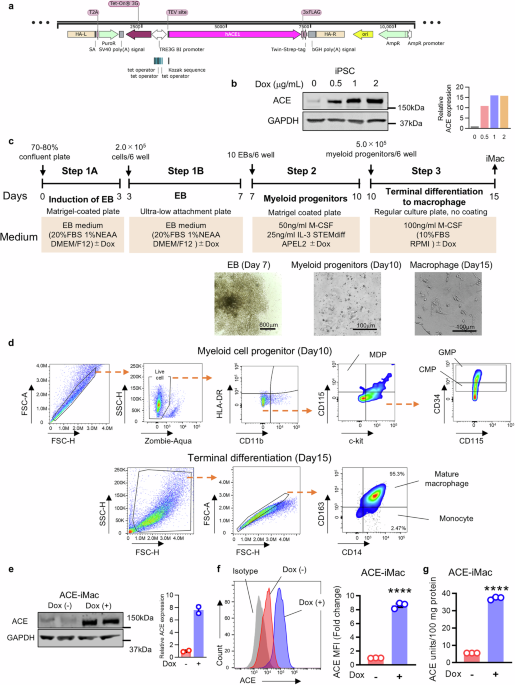
Designing of doxycycline (dox)-inducible human ACE cDNA construct
The plasmid expressing doxycycline-inducible human ACE (Tet-On-hACE) was designed by introducing hACE cDNA into the AAVS1_Puro_Tet3G_3xFLAG_Twin_Strep vector (Addgene, Cat. 92099). The hACE cDNA was synthesized and integrated at the NcoI site under the control of the Tet-On 3G System through gene synthesis from Vector Builder (VectorBuilder ID: VB231104-1002hyg). The complete sequence and annotation are provided in supplementary text. Cas9 protein expression is achieved by co-transfecting the targeting plasmid with the Cas9-expressing plasmid, pXAT2 (Addgene, Cat. 80494). The intended construct integrates into genomic DNA via Cas9-mediated stable integration into the AAVS1 “safe harbor” locus.
Human iPSC culture, transfection, and selection
An established hiPSC line derived from human fibroblasts was obtained from the Induced Pluripotent Stem Cell (iPSC) Core at Cedars-Sinai Biomanufacturing Center (ID: CS88iCTR-nxx). These cells were cultured at 37 °C in a humidified atmosphere with 5% CO2 and maintained using Matrigel (BD, Cat. 35427) matrix and mTeSR™ Plus medium (STEMCELL Technologies, Cat.100-0276), which required fresh replacement every 2 days.
hiPSCs were transfected using Lipofectamine Stem Transfection Reagent (ThermoFisher Scientific) following the manufacturer’s protocol. Puromycin selection was performed 72 h after transfection, when the iPSCs reached 70% confluency. To establish stable transfectants, iPSCs were cultured in mTeSR™ Plus medium with 0.5 μg/ml puromycin for 6 days, with medium changes every two days. After 6 days, the puromycin concentration was increased to 1 μg/ml. iPSCs were then cultured under 1 μg/ml puromycin until distinct colonies appeared, large enough for colony picking. Colonies were picked by tracing a circle around the colony border with a sterile 200 μl pipet tip. The picked colonies were placed in a 24-well plate and incubated overnight. The following day, the medium was refreshed, and the cells were cultured until they reached 70% confluency. Finally, the cells were passaged from the 24-well plate to a 6-well plate. Stable ACE-iPSCs were then tested for ACE expression with Dox treatment ranging from 100 ng to 2 μg/ml.
Cancer cell lines culture
The triple negative breast (TNB) cancer cell line HCC1806 and the melanoma cell line SK-MEL-28 were obtained from ATCC. These cell lines were cultured at 37 °C in Roswell Park Memorial Institute (RPMI) 1640 medium, supplemented with 10% fetal bovine serum (FBS), in a humidified atmosphere containing 5% CO2.
The 5-Fluorouracil and platinum drug resistant FaDu subline (FaDu/FP-R) was developed by continuously exposing the parental cells to a combination of cisplatin (Millipore-Sigma) and 5-FU (Millipore-Sigma) using a stepwise dose incremental strategy, as previously described.47 The FaDu/FP-R cell line was cultured in Dulbecco’s modified Eagle’s medium (DMEM) supplemented with 10% FBS.
iPSC-ACE macrophage (iMac) differentiation
Mature macrophages were derived from iPSCs (passage a minimum of three times before setting up for differentiation process) using a feeder-free embryoid body (EB) based differentiation protocol, modified from previous methods.48,49 Specifically, the EBs were incubated in 20% FBS + 1% NEAA DMEM/F12 on ultra-low attachment plates for 4 days to obtain a large number of attached EBs. At this step restrain strong pipetting to avoid colonies break-up into single cells. These EBs were then transferred to Matrigel-coated adherent culture conditions to generate macrophage progenitor cells.
Briefly, confluent iPSCs on Matrigel-coated plates (0.1 mg/ml) were cultured in EB medium (20% FBS, 1% NEAA DMEM) for 3 days. After 3 days, the cells were washed and incubated with Versene solution (Gibco, Cat. 15040066) for 5 minutes. Following centrifugation, the cells were resuspended in EB medium and seeded in 6-well ultra-low attachment plates (Corning, Cat. CLS3471) at a density of 2 × 10⁵ cells/well, typically yielding ~40 embryoid bodies (EBs) within 4 days. Subsequently, 10 EBs were transferred to each well of a Matrigel-coated 6-well plate and cultured in STEMDiff APEL2 culture media (STEMCELL Technologies, Cat. 05275) supplemented with 25 ng/ml hIL-3 (PeproTech, Cat. 200-03) and 50 ng/ml hM-CSF (PeproTech, Cat. 300-25). The EBs attached to the Matrigel-coated plates and generated hematopoietic progenitors in the culture media. Myeloid progenitors and precursors were harvested from the culture supernatant every 3 days, with a total of 4–5 collection points yielding approximately 5 × 10⁵ cells per harvest. For terminal differentiation into mature macrophages, pooled myeloid progenitors were cultured in RPMI medium supplemented with 10% tetracycline-free FBS (Omega Scientific, Cat. FB-15) and 100 ng/ml hM-CSF for an additional 5 days. As a control, myeloid progenitors were differentiated in the absence of Dox to maintain baseline ACE expression, whereas treatment with 1 µg/ml Dox was used to induce ACE expression in iMac.
Flow cytometry analysis
Cells were stained using fluorescent-conjugated primary antibodies as listed in Supplementary Table 2. For ACE immunostaining, cells were first treated with a mouse anti-ACE primary antibody (R&D Systems, MAB9291, 1:100), followed by an Alexa Fluor 647 anti-mouse secondary antibody (Invitrogen, A-21235, 1:500). After staining with antibodies, cells were resuspended in flow cytometry buffer and immediately analyzed using the CYTEK NL-3000 flow cytometer. Data analysis was conducted with FlowJo software, presenting flow cytometry data as histograms and mean fluorescence intensity (MFI).
Western blot analysis
Cells were washed twice with cold PBS and lysed with RIPA buffer containing Halt Protease and Phosphatase Inhibitor Cocktail (ThermoFisher Scientific, Cat. 78440). The polyvinylidene difluoride (PVDF) membranes were incubated with specific primary antibodies against ACE (R&D Systems, MAB9291, 1:1,000), GAPDH (Sigma-Aldrich, SAB5600208, 1:2,000), β-actin (Sigma-Aldrich, A3854; 1:1000), phosphorylated NF-kB p65 (Novus, NB100-82086, 1:500), phosphorylated STAT1 (R&D Systems, AF2894, 1 μg/ml), phosphorylated STAT3 (Novus, NBP2-24463, 0.5 μg/ml), or phosphorylated STAT6 (Millipore, 06-937, 1:1000). The membranes were then incubated with IRDye® 680RD Goat anti-Rabbit IgG Antibody (LI-COR Biosciences, 926-68071; 1:5000), IRDye® 800CW Goat anti-Mouse IgG Antibody (LI-COR Biosciences, 926-32210; 1:5000), or IRDye® 800CW Donkey anti-Goat IgG Antibody (LI-COR Biosciences, 926-32214; 1:5000). Protein bands were measured using an Odyssey Infrared Imaging System (ODYSSEY CLx, Li-COR). The fluorescence intensity was evaluated using Image Studio Lite version 5.2.
ACE activity measurement
Samples were prepared using an ACE assay buffer containing 50 mM HEPES (pH 7.5), 150 mM NaCl, 25 μM ZnCl2, and 0.5% Triton X-100. Following protein quantification, ACE activity was measured in total protein homogenates as previously described.16
Cytokine measurement
Macrophage culture supernatants were collected and stored at −80 °C for cytokine measurement. We used a commercial solid-phase ELISA kit protocol to measure IL-1β (Invitrogen, BMS224-2), TNFα (R&D Systems, DY210-05), IL-6 (R&D Systems, DY206-05), IL-8 (R&D Systems, DY208-05), IL-4 (R&D Systems, DY204-05), IL-10 (R&D Systems, DY217B-05), IL-13 (R&D Systems, DY213-05), CCL5 (R&D Systems, DY278-05), CCL17 (R&D Systems, DY364-05), and CCL20 (R&D Systems, DY360-05).
In vitro in-direct co-culture assay
iMac and cancer cell lines were co-cultured using a non-contact co-culture transwell system with 3.0 µm pore polyester membrane inserts (Corning, USA). To generate M1-like macrophages, iMac was treated with LPS (75 ng/ml) and IFN-γ (20 ng/ml) for 72 h. M1-iMac (5 × 10⁵ cells/well) were seeded in inserts, which were then transferred to a 24-well plate pre-seeded with cancer cells (1 × 10⁵ cells/well) for co-culture. After 1, 3, and 5 days of co-culture, cancer cells were counted using the Countess Automated Cell Counter (Invitrogen).
Measurement of ROS, iNOS and NO production in vitro
To measure ROS, 1 × 10⁶ cells were treated with LPS (1 μg/ml) for 30 min. After LPS stimulation, the cells were resuspended in RPMI 1640 with 1% FBS and stained with 20 mM dichlorodihydrofluorescein diacetate dye (DCFDA; ab186028, Abcam) for 30 min at 37 °C. Following incubation, the cells were washed and stained with macrophage-specific antibodies: APC/Fire750 anti-CD11b antibody (Biolegend, 101262, 1:200) and APC anti-HLA-DR antibody (Biolegend, 307609, 1:100) at 4 °C for 30 min. The cells were then washed with FACS buffer (PBS with 2% FBS, 0.1% sodium azide, and 1 mM EDTA) and analyzed using a CYTEK NL-3000 flow cytometer.
To measure iNOS, 1 × 10⁶ cells were treated with LPS (500 ng/ml) for 12 h. After LPS stimulation, the cells were washed with FACS buffer and stained with the following antibodies: PE anti-Nos2 (iNOS) antibody (Biolegend, 696805, 1:200), APC/Fire750 anti-CD11b antibody, and APC anti-HLA-DR antibody at 4 °C for 30 min. The cells were then washed with FACS buffer and analyzed using a flow cytometer.
For measuring NO, iMac cells were exposed to LPS (75 ng/ml) and IFN-γ (20 ng/ml), or SK-MEL-28 cell supernatant for 24 h. The culture supernatants were then collected and analyzed for nitric oxide (NO) levels using the Nitric Oxide Detection Kit (OZ Biosciences, NOS0500).
Human peripheral blood cell and iMac co-culture assay
Peripheral blood (PB) samples (10 ml) were collected into tubes containing 0.5 mM EDTA in PBS. After centrifugation at 300 × g for 5 min, the PB cells were resuspended in RBC lysis buffer (BioLegend, Cat. 420301) and incubated at room temperature for 10 min. The cells were subsequently washed with PBS and centrifuged again at 300 × g for 5 min. The resulting pellet was designated as the peripheral blood leukocyte fraction. For the co-culture assay, iMac were pre-activated with LPS (100 ng/ml) for 24 h, as described in Fig. 3g. Peripheral blood leukocytes were washed in RPMI-1640 medium supplemented with 10% FBS, and viable cells were counted using the trypan blue exclusion method. The cell concentration was adjusted to approximately 2 × 10⁶ cells/ml. To initiate co-culture, the culture medium from iMac was carefully removed, and 5 × 10⁶ PB cells (per well) were directly added to six-well plates containing iMac. The cells were incubated for 24 h at 37 °C in a humidified incubator with 5% CO₂, either in the presence or absence of SK-MEL-28 conditioned medium. Following incubation, the cultures were washed with FACS buffer, and the cells were analyzed by flow cytometry.
Mice
All animal experimental protocols were approved by the Cedars-Sinai Institutional Animal Care and Usage Committee (IACUC#010170). Male BALB/c nu/nu athymic nude mice (aged 6–7 weeks) were purchased from Jackson Lab (Strain 002019). To study the human immune system, humanized mice (referred to as BLT-NSG) were created by transplanting human fetal Bone marrow cells, Liver, and Thymus (BLT) tissue fragments into 8-week-old immunodeficient NOD/SCID Il2g−/− (NSG) mice at the UCLA CFAR Humanized Mouse Core facility, following established protocol.21,22 After 2 months, these mice were analyzed for the presence of human leukocytes in their peripheral blood using flow cytometry. Only those humanized mice with more than 60% human leukocytes were selected for the tumor xenograft study. The mice were housed in microisolator cages with a 12-h light/dark cycle. Water and food were supplied ad libitum. Observations for tumor growth, activity, feeding, and pain were conducted following the guidelines of the Harvard Medical Area Standing Committee on Animals.
Tumor xenograft study
In the nude mice xenograft study, SK-MEL-28 (3 × 10⁶ cells/i.d injection), HCC1806 (1 × 10⁶ cells/s.c. injection), and FaDu/FP-R (5 × 10⁶ cells/s.c. injection) cells were injected either intradermally (i.d.) or subcutaneously (s.c.) into the flanks of 8-week-old male (for SK-MEL-28 and FaDu/FP-R)47 or female (for HCC1806) nude mice. Tumor sizes were measured, and volumes (mm3) were calculated using the formula: length × width2 × 0.5. Once tumors reached 50 mm3, mice were randomly divided into three groups (n = 5–10 per group). PBS (Untreated), iMac (Dox-), or ACE-iMac (Dox+) were injected intratumorally (2 × 10⁶ cells/50 µl/tumor) weekly. To minimize confounding effects of Dox itself, mice were administered minimal dose of Dox (150 µg/ml) in drinking water, previously reported to induce Tet-on promotor.50 ACE-iMac were found to express elevated levels of ACE after three days following intratumoral injection (Fig. 5d). Tumors were harvested 24 h after iMac injection (28–35 days post-inoculation), stored at 4 °C for flow cytometry analysis, at −80 °C, or fixed in 10% paraformaldehyde overnight at 4 °C. For flow cytometry analysis, tumors were minced and digested for 30 min in RPMI medium with 1.5 mg/ml collagenase IV (Worthington Biochemical Corp., LS004182) and 0.1 mg/ml DNase I (Promega, M6101) at 37 °C. Collagenase was neutralized with RPMI medium supplemented with 10% FBS and 1 mM EDTA. After filtering through a 100 µm filter, cells were centrifuged and resuspended in FACS buffer. For surface marker staining, cells were stained for 30 min at 4 °C. For intracellular staining, cells were fixed with fixation buffer (eBioscience, 00-8222-49) for 15 min at 4 °C, permeabilized with permeabilization buffer (eBioscience, 00-8333-56) for 10 min at 4 °C, and stained for 30 min at 4 °C.
In the humanized mice xenograft study, 3 × 10⁶ SK-MEL-28 cells were injected intradermally into the flanks of 12–16-week-old BLT-NSG mice. The iMac treatment and tumor analysis were performed as described above for the nude mice study.
RNA-seq analysis
After treatment with SK-MEL-28 conditioned medium for 12 h, iMac cells were washed with PBS twice, then used for total RNA isolation by using the RNeasy Plus Mini Kit (Venlo, Netherlands) following the product manual. The RNA samples with A260/280 = 1.8–2.0 were subjected to RNA sequencing. The RNA sequencing data have been deposited with links to BioProject accession number PRJDB40211 in the DDBJ BioProject database. The RNA sequencing was performed by BGI (https://www.bgi.com/global), and the data were analyzed by Ingenuity Pathway Analysis (IPA). In the pathway analysis, differentially expressed genes (p < 0.01 and fold change > 5.0) were analyzed for their functional enrichment and biological processes using IPA and Gene Ontology (GO) pathway analysis. For IPA, significantly different RNA (p < 0.01 and fold change > 5.0) between Dox- and Dox+ iMac were imported to the IPA Tool (Ingenuity Systems, Redwood City, CA, USA; http://www.ingenuity.com, Access date: 8/20/2025), and then mapped to well-known biological networks using the Ingenuity Pathway Knowledge Base (IPKB) derived from known functions and interactions of genes published in the literature. For GO analysis, we used DAVID database (https://davidbioinformatics.nih.gov, Access date: 8/19/2025), an online tool for gene annotation, function visualization, and large volume data integration. To describe gene product attributes, GO clusters included three complementary biological concepts (Biological Process, Molecular Function, and Cellular Component). To generate heatmaps, we calculated z-scores from log2(TPM) values, and z-scores were used to visualize gene expression differences in the heatmaps.
