


Mouse experiments
All experiments were conducted in compliance with the UK Home Office-approved project licences and personal licences (Animals Scientific Procedures Act 1986) and within institutional welfare guidelines of the Francis Crick Institute (reviewed and approved by the Francis Crick Animal Welfare Ethical Review Body), the CRUK Scotland Institute (reviewed and approved by the University of Glasgow and UK Home Office) and the CRUK Cambridge Institute (with approval from CRUK-CI Animal Welfare Ethical Review Body). In accordance with these project licences, tumour size never exceeded 1.2 cm in diameter. Mice (three to five per cage, individually ventilated cages, Tecniplast) had ad libitum access to food (2018 Teklad global diet (Envigo) autoclaved before use) and water and were kept in a 12 h day/night cycle (7:00 to 19:00) in rooms at 22 °C and 55% humidity. Mice were acclimatized to their environment for at least 1 week before experimentation. Both male and female mice between 8 and 12 weeks of age (Extended Data Table 1) were used in the experiments and were randomly assigned to experimental groups and data were collected in a blinded manner. C57BL/6 were obtained from the in-house breeding facilities. Tigar KO, Tigar KO pancreatic cancer models and Aldh1l2 KO mice were obtained as previously described28,40. For Fig. 4d,e and Extended Data Fig. 4d, Ptf1aCre/+ Kras LSL-G12D mice (KC mice) were provided by Prof. Brindle (CRUK-CI). For Figs. 3 and 4 and Extended Data Figs. 3 and 4, unless indicated otherwise, Trp53+/LSL-R172H, Kras+/LSL-G12D, Trp53+/fl, Ptf1aCre strains were crossed to obtain KFC (Ptf1aCre; Kras+/LSL-G12D; T rp53+/fl) and KPC (Ptf1aCre, Kras+/LSL-G12D, Trp53+/LSL-R172H) mice55,56. For Aldh1l2 knock outs, the Aldh1l2 KO strain was used to breed into the KFC to obtain KPC and KFC mice bearing Aldh1l2 deletion in C57Bl/6 background. For Fig. 3j, the acinar cancer model, B6.Cg-Tg(Ela1-TAg*)289Mjt/J was obtained from the Jackson laboratory (no. 008247) and crossed with the Aldh1l2 KO strain. Mice were kept to a maximum of 18 weeks of age.
For acute pancreatitis experiments, mice received an injection each hour over 6 h of 75 μg kg−1 Caerulein (Sigma) or endotoxin-free PBS intraperitoneally per day for 2 days. At the end of day 2, blood was collected from the saphenous vein. For NAC treatment, mice were given a 1% NAC solution in the drinking water ad libitum 1 week before pancreatitis onset. Mice were then killed either on day 4 or day 7.
For the glucose tolerance test (Extended Data Fig. 2a), mice were moved to a fresh cage and fasted for 6 h. Mice were then administered an oral gavage of 2 mg kg−1 of glucose (Merck, 158968) at 30 s/1 min intervals. Blood glucose was measured using a glucometer (Accu-CHEK) at the following timepoints: 0 (before injection), 15, 30, 60 and 120 min. Blood glucose was obtained by cutting the tip of the tail and collecting about 5 μl of blood.
For Extended Data Figs. 3h and 4a,c, 5 × 10⁵ cells from a KPC PDAC cell line were injected subcutaneously in syngeneic C57BL/6 mice. Tumours were collected after 15 days of growth to obtain TIF.
Cell culture
For Extended Data Fig. 3b, PATU-8988T, BxPc3, PANC-1 and ASPC-1 PATU-8902 pancreatic cancer cell lines and MDA-MB-468 breast cancer cell line were obtained from the Francis Crick Institute Cell Services Science Technology Platform. The QGP-1 pancreatic cancer cell line was purchased from Generon and deposited at the Francis Crick Institute Cell Services, which ensures various quality controls such as mycoplasma testing, STR profiling and species validation of all cell lines. All cell lines were kept in DMEM (Thermo Fisher) supplemented with 10% fetal bovine serum (FBS) and penicillin–streptomycin at 37 °C in a humidified atmosphere of 5% CO2.
Mouse pancreatic cancer cell lines were obtained from Ptf1aCre+, Kras+/LSL-G12D, Trp53+/LSL-R172H mouse tumours collected in PBS with 1% penicillin–streptomycin and then finely minced. Minced tissues were then incubated with collagenase type 1 (200 U ml−1, Gibco) and dispase (2.4 U ml−1, Gibco) in HBSS for 1 h at 37 °C for cell dissociation. After washing 2× in HBSS, cell pellets were resuspended and grown in DMEM containing 10% FBS, 2 mM l-glutamine and 1% penicillin–streptomycin.
For stable OE of ALDH1L2 in the KPC-7 cell line. HEK293T cells were transfected with lentiviral plasmids containing the Aldh1l2 ORF pLV[Exp]-Puro-CMV>mAldh1l2:P2A:EGFP (VB210527-1256nfw) together with psPAX2 (Addgene, 12260) and VSV.G (Addgene, 14888) using jet-PRIME reagent (Polyplus transfection). After 24 h incubation, medium was changed and 48 h later, the viral particle containing-medium was filtered (0.45 mm) and mixed with polybrene (4 mg ml−1, Sigma-Aldrich). The medium containing lentiviruses was incubated with the target cells for 24 h. Cells were then selected for 3 weeks in puromycin. OE-ALDH1L2 and equivalent empty vector cells were single-cell cloned in 96-well plate and selected on the basis of GFP expression by flow cytometry
For ex vivo 2D cultures of acinar cells, pancreata were collected from Aldh1l2 KO or WT mice and immediately put in ice-cold, calcium-free, HBSS. Tissues were washed with calcium-free HBSS, then digested in 200 U ml−1 collagenase type 1 (Gibco) solution containing trypsin inhibitor 0.25 mg ml−1 (Sigma) and 10 mM HEPES (Lonza). The cell suspension was washed three times using HBSS containing 10 mM HEPES and 2.5% FBS. Finally, the cells were resuspended in Waymouth medium (containing 2.5% FBS, 1% penicillin–streptomycin, 0.25 mg ml−1 trypsin inhibitor and 25 ng ml−1 EGF (Preprotech)) and filtered through a 100 µm cell strainer then plated in 6-well plate. The next day, the cell suspension was transferred to a collagen-coated 6-well plate with 50 µg ml−1 PureCol solution (Sigma). Media were replenished every 2 days to avoid loss due to evaporation. On the day of collection, cells were scraped, washed with PBS and stored at −80 °C until further analysis.
For ex vivo 3D cultures of acinar cells57, 12-well plates were precoated with 240 μl of Matrigel Membrane Matrix Growth factor reduced (Corning). Pancreata from mice were collected and rinsed twice in 5 ml ice-cold calcium-free HBSS (Gibco). Tissues were minced then centrifuged for 2 mins at 450g and 4 °C. HBSS was discarded and tissues were digested using 200 U ml−1 collagenase type 1 (Gibco) solution containing trypsin inhibitor 0.25 mg ml−1 (Sigma) and 10 mM HEPES (Lonza) for 15–20 min at 37 °C. Digestion was stopped by adding 10 ml of ice-cold HBSS with 2.5% FBS. Cells were washed three times using HBSS containing 10 mM HEPES and 2.5% FBS, then resuspended in HBSS with 30% FBS and centrifuged at 233g for 2 min. Following resuspension in 7 ml Waymouth medium (containing 2.5% FBS, 1% penicillin–streptomycin, 0.25 mg ml−1 trypsin inhibitor and 25 ng ml−1 EGF (Preprotech)), the cells were filtered through a 100 μm cell strainer. The cell suspension was then mixed in 2:1 ratio with Matrigel and 1 ml was added per well. After 30 min incubation at 37 °C Waymouth media was added on top. Cells were treated either with 300 μM N-acetyl cysteine (Sigma) or vehicle (water) and media were changed every day. The size of ductal structures was quantified at day 3 using Fiji ImageJ v1.54.
Western blot
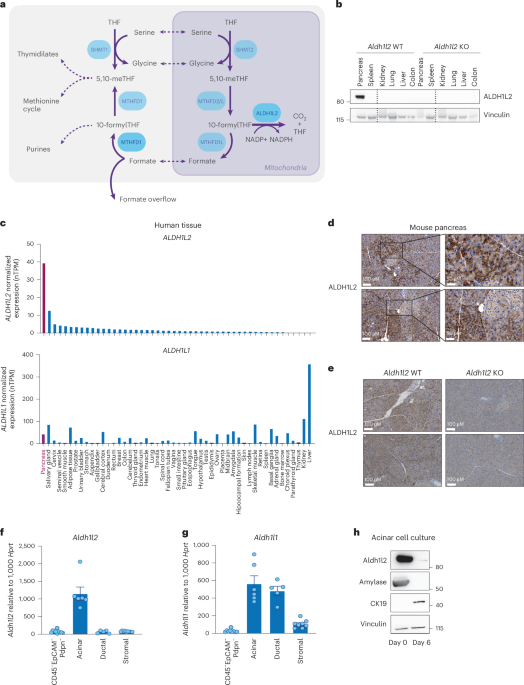
Cells were lysed with RIPA buffer (Millipore) supplemented with phosphatase inhibitor cocktail (Thermo Fisher Scientific) and complete protease inhibitors (Roche) after pelleting. Then, proteins were separated using precast 4–12% Bis–Tris gels (Invitrogen) and transferred to nitrocellulose by dry transfer (iBlot, Thermo Fisher Scientific). Transfer and loading were assessed by rouge ponceau. Membranes were probed with the following primary antibodies: ALDH1L2 (HPA039481) from Atlas Antibodies, vinculin (sc-73614) from Santa Cruz Biotechnology, amylase (D55H10, 3796) from Cell Signaling, CK19 from Abcam (AB52625) and actin (4970) from Cell Signaling. For Extended Fig. 2h, Revert 700 Total Protein stain (Licor) was used as indicated by the manufacturer. All antibodies were used at a dilution of 1:1,000 and were developed with ECL chemiluminescence kits (Pierce) after incubation with the appropriate species-specific horseradish peroxidase-conjugated antibodies. All antibodies were verified and confirmed for species as per the manufacturers’ disclosures. Where appropriate filters were stripped and reprobed with different antibodies.
For Fig. 2h, serum was collected from mice undergoing acute pancreatitis, 1 h after the last injection on day 2 and diluted 1/150. Circulating amylase was measured with the Amylase Assay Kit from Abcam (ab102523) according to the manufacturer’s instructions. The assay was read on a spectramax Plus 384.
NMR
Nuclear magnetic resonance (NMR) was used to measure formate and valine in cell culture supernatants, plasma, normal interstitial fluid and TIF. For formate quantification in cell culture supernatant as shown in Fig. 4c and Extended Data Fig. 4b, 160 μl of supernatant was collected. As shown in Fig. 4a,b,f,g and Extended Data Fig. 4a,f,g, plasma and TIF were collected and 20 μl were diluted up to 10× in PBS. A solution of 10 mM sodium 2,2-dimethyl-2-silapentane-5-sulfonate (DSS; Sigma) diluted in D2O was added to the samples to obtain a final concentration of 1 mM DSS. NMR spectra were acquired at 25 °C with a Bruker Avance III HD instrument with a nominal 1H frequency of 700 MHz using 3 mm tubes in a 5 mm CPTCI cryoprobe. For 1H 1D profiling spectra, the Bruker pulse program zgesgppe for excitation sculpting with pure echo58 was used with a 20 ppm sweep width, 1 s relaxation delay and 4 s acquisition time. Typically, 128 or 256 (for plasma and TIF) transients were acquired. Data were processed and analysed using the Chenomx NMR Suite (Chenomx). Free induction decays were zero filled, apodized with exponential multiplication (line-broadening factor LB of 1 Hz), Fourier transformed and the resulting spectra were then phase corrected before baseline correction, all in the Processor component of the Chenomx software. Formate quantitation was performed based on the chemical shift reference (DSS) assumed to be at 1 mM concentration and with line width adjusted to obtain a good fit to the Chenomx library spectra for multiple metabolites in the spectrum.
LC–MS
For liquid chromatography–mass spectrometry (LC–MS) detection of plasma formate in Fig. 4h–l and Extended Data Fig. 4c,h–l, 10 μl of plasma was extracted with 390 μl of ice-cold extraction buffer (methanol/acetonitrile/water in the ratio, 50:30:20, v/v/v) containing 13C,D-formate (CDLM-6203) from Cambridge Isotope Laboratories, vortexed and spun down at 15,000g for 12 min at 4 °C. The supernatant was then dried in a SpeedVac. Dry samples were resuspended in 100 μl of a cold derivatization mix (1/1/3) containing 1,2-13C2-acetate (CLM440-1) from Cambridge Isotope Laboratories and composed of EDC (11.5 mg ml−1 in MeOH; Sigma, E1769) 3-nitrophenylhydrazine (23.5 mg ml−1 in MeOH; Sigma, N21804) and Pyridine (40 μl in 1 ml of MeOH), which was incubated for 1 h at 4 °C with three cycles of 10 min sonication. Samples were then centrifuged at 15,000g for 12 min and 20 μl of the supernatant was added to 200 μl of β-mercaptoethanol (500 mM). Samples were centrifuged again at 15,000g for 12 min before being transferred to vials.
Metabolite analysis was performed by injecting 5 µl sample into a Vanquish Flex UHPLC system (Thermo Scientific) coupled to a Q Exactive Plus Orbitrap mass spectrometer (Thermo Scientific). Analytes were separated using a Waters Acquity BEH C18 column (2.1 × 100 mm, 1.7 μm particle size). The temperature of the column was kept at 60 °C and the flow rate was set to 0.2 ml min−1.The elution buffers were water for buffer A and methanol for buffer B. Gradient elution started from 10% of buffer B and was programmed as follows: 0–1 min: 10% B; 2–4 min: 15% to 30% B; 4–5 min: 20% to 100%; 5–7 min: 100% B; 7–7.2 min: 100% to 15% B at a flow rate of 0.2 ml min−1. The MS experiment was performed using electrospray ionization in negative mode. Source parameters were applied as follows: sheath gas flow rate, 55; aux gas flow rate, 10; sweep gas flow rate, 0; spray voltage, 3.2 kV (−); capillary temperature, 325 °C; S-lense RF level, 50; aux gas heater temperature, 100 °C. The Orbitrap mass analyser was operated at a resolving power of 70,000 (at 200 m/z) in selective ion monitoring (SIM) mode (mass targeted: m/z 180.0414 (formate), 196.0638 (1,2-13C2-acetate)) and normalized gain control target set to 70% with a maximum injection time of 200 ms. All data were acquired in profile mode with the Thermo Xcalibur software (Version 4.2.47).
Data were processed using XCMS, using the centWave algorithm for peak detection. To correct for batch effects, the LOESS algorithm59 was applied using a span parameter of 0.6.
For detection of GSH and GSSG by UPLC–MS (Fig. 2c and Extended Data Figs. 2e–g), pancreatic tissues were dried overnight using a freeze dryer and ground the next morning using disposable pestles. Then samples were extracted using a ratio of 100 μl of extraction mix (methanol/acetonitrile/water in the ratio 50:30:20, v/v/v) for 1 mg of dry tissue. Samples were vortexed, sonicated three times (8 min pulse) and centrifuged (16,000g, 20 min, 4 °C) and the supernatant was collected. Pellets were re-extracted using the same protocol with a ratio of 150 μl extraction mix for 3 mg of tissue. Supernatants were then pooled, dried and resuspended in 30 μl of extraction mix before the analysis. Metabolite analysis was performed the same instrumentation as above, using an Agilent Infinity Poroshell 120 HILIC (2.1 × 150 mm, 1.7 µm) for chromatographic separation. The following LC parameters were used: injection volume, 5 μl; column oven temperature, 25 °C; autosampler temperature, 4 °C. Chromatographic separation was achieved using gradient elution at a constant flow rate of 300 μl min−1 over a total run time of 19 min. An initial mobile phase of 80% solvent B was held for 2 min, decreased to 5% over 10 min, held 5% for 2 min and finally re-equilibrated to 80% B for 5 min. Solvent A was 0.01% of formic acid and solvent B was acetonitrile. MS was performed in positive ion mode with the following parameters: spray voltage 3.5 kV; probe temperature 320 °C; sheath and auxiliary gases were 30 and 5 arbitrary units, respectively; full scan range: 80–1,000 m/z with an AGC target set at 1e6 and resolution at 70,000. SIM was performed to detect reduced and oxidized glutathione and their respective isotopologues. The parameters used for SIM were as follows: resolution 70,000, AGC target 3e6, maximum IT 200 ms, isolation window 0.4 m/z, spectra were centroid and collision energies were set individually in high-energy collisional dissociation mode. Reduced and oxidized glutathione standards were prepared and analysed in the same batch. Metabolites were identified by comparison of accurate mass, fragmentation and retention time to authentic chemical standards. Data were processed using TraceFinder 4.1 EFS software (Thermo Scientific).
Human samples
The collection of samples was overseen by Tissue Solutions. Ethical approval for collection of plasma samples from human participants, under the study title ‘Genomics, proteomics and biomarker research of human diseases using human biospecimens’ was obtained from the Independent Ethical Committee of The State health institution of Nizhny Novgorod Region ‘City Clinical Hospital No12’ Nizhny Novgorod, research contract no. NZN12/1 2015 dated 14 October 2015. All patients provided informed consent.
To allow for a relatively equal age and sex distribution across the three groups, we collected an excess number of healthy control and symptomatic controls. Once the n = 100 pancreatic cancer samples were collected we selected n = 100 samples each from the two control populations, which represented an overall match to age and sex distribution in the pancreatic cancer group.
Pancreatic cancer group inclusion criteria: PDAC at time of diagnosis or pancreatic acinar cell adenocarcinoma at time of diagnosis. Exclusion criteria: has received treatment (radiotherapy, chemotherapy or surgery) for pancreatic cancer or any other cancer, previous history of diagnosed cancer/malignant disease of any type, neuroendocrine pancreas tumours or non-epithelial pancreas tumours.
Symptomatic control group inclusion criteria: chronic pancreatitis at time of diagnosis, acute pancreatitis at time of diagnosis, benign pancreatic pseudo cyst at time of diagnosis, biliary obstruction due to non-malignant disease at time of diagnosis, acute non-malignant cholangitis at time of diagnosis or chronic non-malignant cholangitis at time of diagnosis. Exclusion criteria: history or recent diagnosis of any form of cancer/malignant disease, has received any treatment for pancreas-related disease or family history of pancreas cancer.
Healthy control group inclusion criteria: healthy and within age range of diagnostic population (estimated to be 35–75 years of age). Exclusion criteria: history or recent diagnosis of any form of cancer or malignant disease, diabetes (type I or II), cardiovascular diseases neurodegenerative diseases, any disease/condition of the pancreas or family history of pancreas cancer.
Blood samples were collected in 6 ml lithium–heparin tubes (Greiner Bio-One). Samples were gently mixed, kept at 4 °C and processed within 1 h after collection. Blood was centrifuged for 10 min at 1,500g, 4 °C in a horizontal rotor centrifuge to remove erythrocytes. Plasma was then transferred to 15 ml plastic tubes, taking care not to mix blood cells. Tubes with plasma were centrifuged at 2.500g, 4 °C in a horizontal rotor centrifuge to remove platelets. Finally, 1 ml aliquots of the plasma were transferred to Eppendorf tubes and stored at −80°C.
Statistical analysis
All statistical analyses were performed using GraphPad Prism 10 software. An unpaired Student’s t-test was performed to compare two groups to each other. If the variance, determined by the F test, between the two groups was unequal, a Welch’s correction was applied. For multiple comparisons, a one-way analysis of variance (ANOVA) was used. If the variance between groups, determined by the Brown–Forsythe test, was unequal, a Brown–Forsythe and Welch correction was applied. A P value below 0.05 was considered statistically significant. Significance is indicated as follows: *P < 0.05, **P < 0.01, ***P < 0.001 and ****P < 0.0001. The statistical test is mentioned in each figure legend and all test are two sided. All measurements were taken from distinct samples, as noted in the figure legends. In Fig. 4c,g, one and two data points, respectively, were identified as outliers by an outlier test and removed from the dataset.
No statistical methods were used to predetermine sample sizes but our sample sizes are similar to those reported in previous publications. Sample sizes were based on standard protocols in the field. Metabolic data were assigned in a random order before analysis by LC–MS. Mice were randomly assigned to a treatment and mouse experiments were blinded to the person performing metabolomic or immunohistology analysis.
Immunohistochemistry
Tissues were fixed in 10% neutral buffered formalin for 24 h. The fixed tissues were processed using Sakura Tissue-Tek VIP 6 AI Tissue Processor and paraffin embedded. For H&E staining, 3 μm sections were cut on to microscope slides. The slides were baked at 60 °C for 1 h and stained with Harris Haematoxylin and Eosin using a Sakura Tissue-Tek Prisma auto stainer. For immunohistochemistry, tissues were fixed and embedded as above and 3 μm sections cut on to Plus+ Frost positive charged slides (MSS51012BU, Solmedia). The slides were baked at 60 °C for 1 h and then deparaffinized in xylene and rehydrated using a series of graded industrial methylated spirit solutions and distilled water. Heat-mediated antigen retrieval was performed using pH 6 citrate buffer for 20 min in a microwave. Endogenous peroxidase and alkaline phosphatase blocking was performed by incubating the slides in Bloxall (SP-6000-100, Vector) for 10 min at room temperature.
For amylase/CK19 double labelling, protein blocking was performed using a blocking buffer of TBS-T, 10% bovine serum albumin (A3294, Sigma-Aldrich) and 4% milk for 1 h at room temperature. Primary antibody amylase (D55H10, Cell Signaling) was diluted in 1% BSA at a 1:2,000 dilution and incubated for 1 h at room temperature. The slides were then incubated with horse anti-rabbit IgG (BA1100, Vector) for 30 min at room temperature, followed by the VECTASTAIN Elite ABC-HRP kit, peroxidase (PK6100, Vector) for 30 min at room temperature. Slides were then incubated with 3,3-diaminobenzidine (DAB) chromatin (SK-4105, Vector) for 10 min at room temperature. Following this, primary antibody CK19 (Sigma-Aldrich, MABT913) was diluted at a 1:500 dilution and applied to the slides for 1 h at room temperature. The slides were then incubated with the ImmPRESS-AP Goat Anti-Rat IgG Polymer Detection kit, alkaline phosphatase (MP-5404-15) for 30 min at room temperature. The slides were then incubated with the Vector Red Substrate kit, alkaline phosphatase (Vector, SK-5105) for 20 min at room temperature and then counterstained using Harris Haematoxylin and dehydrated, cleared and mounted using Sakura Tissue-Tek Prisma auto stainer. Quantification of ADM in Fig. 2l and Extended Data Fig. 2m was performed on CK19/amylase double staining. The number of double-positive acinar cells and acinar cell losing amylase staining were counted. Total amount of cells in the field of view were counted by the cell detection algorithm in QuPath. For each pancreas, three to six fields of view randomly chosen throughout the slide were quantified in a double blind manner.
For MDA staining, slides were incubated with 2.5% normal horse serum blocking reagent (MP-740) for 30 min at room temperature. Primary antibody MDA (Abcam, ab243066) was diluted at a 1:500 dilution and incubated for 1 h at room temperature, then slides were incubated with ImmPRESS HRP Horse Anti-Rabbit IgG Polymer reagent, peroxidase (Vector, MP-7401) followed by DAB chromatin (SK-4105, Vector) for 10 min at room temperature. Slides were then counterstained using Harris Haematoxylin and dehydrated, cleared and mounted using the Sakura Tissue-Tek Prisma auto stainer. All slides were scanned with a Zeiss AxioScan Z1 and images were generated and quantified with FiJi ImageJ v1.54.
For Picrosirius Red staining, 3 μm sections were cut on to microscope slides. The slides were baked at 60 °C for 1 h then deparaffinized in xylene and rehydrated using a series of graded industrial methylated spirit solutions and distilled water. Slides were incubated in freshly filtered Weigert’s iron haematoxylin solution (Sigma-Aldrich, HT1079) for 10 min. The slides were washed with warm running water for 5 min and then rinsed with distilled water. The slides were incubated in Picrosirius Red solution (Abcam, ab150681) for 1 h and then drained on absorbent paper. The slides were then rinsed with agitation in 0.5% acetic acid, rinsed in 100% ethanol for 2× 1 min, cleared in xylene for 2× 1 min and mounted using Sakura Tissue-Tek glass.
For Fig. 2j, sample embedding, sectioning and staining were conducted by the CRUK-CI Histology Core. ADM area was quantified on H&E sections using Halo Software (Indica Labs).
RNAscope
For RNAscope, 5 μm sections were cut onto Plus+ Frost positive charged slides (MSS51012BU, Solmedia) and baked at 60 °C for 1 h. Slides were pretreated using the RNAscope 2.5 HD Brown kit pretreatment reagents (ACD, 322300). Following pretreatment, the slides were incubated with the ALDH1L2-specific target probe. For mouse samples, the Aldh1l2 probe (ACD, 447671) was utilized, while for human samples, the corresponding ALDH1L2 probe (ACD, 1175261-C1) was employed. Slides were then incubated in a series of RNAscope 2.5 HD Brown Kit Detection reagents (ACD, 322300) and counterstained in Harris Haematoxylin, dehydrated, cleared and mounted using Sakura Tissue-Tek Prisma auto stainer. Slides were scanned with a Zeiss AxioScan Z1 at 20× magnification.
Flow cytometry
For Figs. 1f,g and Extended Data Figs. 1b,c and 3k, pancreata were weighed, then mechanically dissociated, followed by digestion in 5 ml of HBSS containing collagenase I (375 U ml−1), DNase I (0.15 mg ml−1) and Soybean Trypsin inhibitor (Sigma, 0.05 mg ml−1) for 30 min at 37 °C on a shaker (220 rpm), followed by dissociation with a syringe and needle, filtration through a 70-μm strainer to exclude Langerhans islets and red blood cell lysis. Single-cell suspensions from pancreata were used to isolate acinar cells (LiveCD45−EpCAM+ CD133lo SCChi), ductal cells (LiveCD45−EpCAM+CD133+SSClo) and fibroblasts (LiveCD45−EpCAM−CD90+Podoplanin+) by flow cytometry using a FACS Aria instrument. The following antibodies were used in this study with clones, venders and fluorochrome as indicated: CD45 (30-F11, Biolegend, BV510), EpCAM (G8.8, Biolegend, BV711), CD133 (315-2C11, Biolegend, PEDazzle594) and Podoplanin (8.1.1, Biolegend, PE-Cy7). Dead cells were excluded with the fixable viability dye UV455 or eFluor780 (eBioscience). Data were analysed using FlowJo X (Tree Star).
For Fig. 2a, cells were incubated with 5 mM of MitoSox Red mitochondrial superoxide indicator (M36008, Thermo Fisher Scientific) for 10 min at 37 °C. Cells were washed with PBS 1 mM, EDTA 2.5% FBS and filtered into FACS tubes. Samples were run on a FACS Fortessa with data acquired with FACSdiva and analysed with FlowJo (10.7.2).
RT–qPCR
For Fig. 1f,g and Extended Data Figs. 1b,c and 3k, RNA from single-cell suspensions of acinar, ductal and stromal cells was extracted using Tri-Reagent (Sigma) followed by 1-bromo-3-chloropropane extraction and clean-up on RNeasy columns. For Fig. 4d,e and Extended Data Fig. 4d RNA from total pancreas lysates was prepared. After killing, pancreata were perfused with 500 μl RNA Later (Ambion) and snap frozen in liquid nitrogen. Upon thawing, tissue was directly transferred into CK28 tubes (Precellys) filled with 5 ml Tri-Reagent (Sigma) and homogenized for 1× 30 s at 7,200 rpm using a Precellys homogenizer. RNA extraction from homogenates was performed following the Tri-Reagent protocol, with the addition of an isopropanol washing step before ethanol precipitation. RNA quality was assessed using the Agilent Tapestation. RNA was converted into cDNA using the High-Capacity RNA-to-cDNA kit (Thermo Scientific), followed by qPCR using the Takyon Low Rox Probe Master mix dTTP Blue (Eurogentec) and the following primers/probe predesigned assays (Integrated DNA Technologies): Hprt (Mm.PT.39a.22214828), Cpa1 (Mm.PT.58.15958828), Krt19 (Mm.PT.58.7322803), Pdgfra (Mm.PT.56a.5639577), Aldh1l2 (Mm.PT.56a.12885445), Aldh1l1 (Mm.PT.58.7775479), Shmt2 (Mm.PT.58.41661954), Mthfd2 (Mm.PT.58.43172230), Mthfd1l (Mm.PT.58.23357428) and Tigar (Mm.PT.56a.16927616).
Reporting summary
Further information on research design is available in the Nature Portfolio Reporting Summary linked to this article.
