


Patients
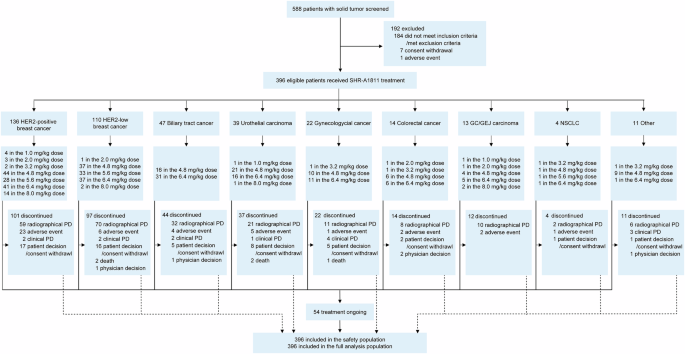
From September 7, 2020, to June 4, 2024, 588 patients underwent screening, among whom 396 eligible patients were enrolled in the study, including 35 and 361 patients in the dose escalation and study expansion (pharmacokinetics expansion and indication expansion) stages, respectively. Following the previous report,27 89 newly enrolled patients were allocated to the 4.8 mg/kg, 5.6 mg/kg, or 6.4 mg/kg dose groups. In total, the tumor type cohorts in this final analysis included HER2-positive breast cancers (n = 136), HER2-low expressing breast cancers (n = 110), biliary tract cancers (n = 47), urothelial carcinomas (n = 39), gynecological cancers (n = 22, including 8 ovarian cancers, 7 cervical cancers, 5 endometrial cancers, 1 fallopian tube cancer, and 1 primary peritoneal cancer), colorectal cancers (n = 14), gastric or gastro-esophageal junction adenocarcinomas (n = 13), non-small cell lung cancers (n = 4), and other cancer types (n = 11, including 3 pancreatic cancers, 2 esophageal squamous-cell carcinomas, 2 major salivary gland cancers, 1 head and neck cancer, 1 appendiceal cancer, 1 duodenal cancer, and 1 extramammary paget’s disease).
The patient population had a median age of 55 years (IQR 49–62), with females comprising the majority (79.0%). With respect to the Eastern Cooperative Oncology Group performance status, 33.3% of the patients had a score of 0, and 66.7% had a score of 1. Prior to the study, patients had received a median of 4 (IQR 2–6) treatment regimens in the metastatic setting for HER2-positive breast cancer, 3 (IQR 2–5) for HER2-low expressing breast cancer, and 2–3.5 for non-breast cancers (Table 1 and supplementary Table 1). In the HER2-positive breast cancer cohort, 99.3%, 43.4%, and 14.7% of patients had received prior trastuzumab, pertuzumab, and trastuzumab emtansine, respectively; in the HER2-low breast cancer cohort, the percentages were 13.6%, 5.5%, and 2.7%, respectively (supplementary Table 2). In the gastric or gastroesophageal junction carcinoma cohort, all patients had previously received HER2-targeted therapy. As of the data cutoff date on March 12, 2025, the median follow-up duration was 17.1 months (IQR 9.7–28.1) in HER2-positive breast cancer patients, 10.6 months (IQR 6.9–22.1) in HER2 low-expression breast cancer patients, and ranged from 4.3 to 8.2 months in non-breast cancer patients. Treatment was discontinued in 342 patients (86.4%), primarily because of radiographic progression (n = 219, 55.3%; Fig. 1).
Fig. 1
Patient disposition. HER2-low HER2-low expression, GC/GEJ gastric or gastroesophageal junction carcinoma, NSCLC non-small cell lung cancer, PD progressive disease. “Other” tumors included 3 pancreatic cancers, 2 esophageal squamous-cell carcinomas, 2 major salivary gland cancers, 1 head and neck cancer, 1 appendiceal cancer, 1 duodenal cancer, and 1 extramammary paget’s disease
Table 1 Baseline characteristics by tumor type
Safety
The median duration of drug exposure to SHR-A1811 (trastuzumab rezetecan) was 13.9 months (IQR 6.1–26.3) in HER2-positive breast cancer, 8.3 months (IQR 4.5–19.3) in HER2-low expressing breast cancer, and ranged from 2.8 to 5.9 months in non-breast cancers. The safety profile in this final analysis, as of the data cutoff on March 12, 2025, remained consistent with that of the previous report up to February 28, 2023, in terms of the frequency, severity, and specificity of adverse events. The extended follow-up period, which included newly enrolled patients, revealed no emergent safety signals.
Among the 396 patients, 395 (99.7%) experienced adverse events (Table 2), with grade 3–5 adverse events occurring in 289 patients (73.0%; Table 2). Treatment-related adverse events of any grade were reported in 391 patients (98.7%), with the most common being decreased neutrophil count (308 patients, 77.8%), anemia (292 patients, 73.7%), and decreased white blood cell count (273 patients, 68.9%; supplementary Table 3). Grade 3–5 treatment-related adverse events were noted in 261 patients (65.9%; supplementary Table 4), with serious adverse events reported in 80 patients (20.2%), primarily decreased platelet count (36 patients, 9.1%), anemia (17 patients, 4.3%), and decreased neutrophil count (15 patients, 3.8%; supplementary Table 5).
Adverse events led to dose reductions in 138 patients (34.8%) and treatment interruptions in 226 patients (57.1%). Treatment-related adverse events caused dose reductions in 138 patients (34.8%) and treatment interruptions in 162 patients (40.9%). Forty-two patients (10.6%) discontinued treatment due to adverse events, 34 (8.6%) of whom discontinued treatment related to SHR-A1811 (supplementary Table 6). Additionally, 12 patients (3.0%) died from adverse events, with 4 (1.0%) attributable to treatment-related events (supplementary Table 7).
Interstitial lung disease occurred in 10 patients (2.5%), with 7 patients classified as having low-grade disease (grades 1–2; Table 2 and supplementary Table 8). The remaining 3 patients consisted of one grade 3 event in the 4.8 mg/kg group, one grade 3 event in the 5.6 mg/kg group, and one fatal event in the 8.0 mg/kg group.
The immunogenicity analysis revealed that no patient had positive results for treatment-induced anti-drug antibody after the baseline assessment.
Efficacy
The median progression-free survival in the total 396 HER2 expressing or mutated advanced solid tumor population was 11.1 months (95% CI 10.3–13.8), varying by tumor type: 25.0 months (95% CI 17.2–33.6) for HER2-positive breast cancer, 11.0 months (95% CI 8.2–13.8) for HER2-low expressing breast cancer, 5.5 months (95% CI 4.2–8.2) for biliary tract cancer, 8.1 months (95% CI 4.4–12.4) for urothelial carcinoma, 8.5 months (95% CI 5.5–16.4) for gynecological cancer, 7.4 months (95% CI 1.2–16.8) for colorectal cancer, 3.5 months (95% CI 1.2–16.7) for gastric or gastroesophageal junction adenocarcinoma, 17.2 months (95% CI 4.0–17.2) for non-small cell lung cancer, and 5.5 months (95% CI 2.5–not evaluable) for other cancers (Table 3, Fig. 2, Fig. 3). The 12-month progression-free survival rates were 66.5%, 45.3%, 19.5%, 36.7%, 38.6%, 37.5%, 30.8%, 66.7%, and 30.7%, respectively.
Fig. 2
Kaplan‒Meier estimates of progression-free survival and duration of response in patients with breast cancer. a Kaplan‒Meier estimates of the duration of response in HER2-positive breast cancer patients. b Kaplan‒Meier estimates of progression-free survival in HER2-positive breast cancer patients. c Kaplan‒Meier estimates of the duration of response in HER2-low-expressing breast cancer patients. d Kaplan‒Meier estimates of progression-free survival in HER2-low breast cancer patients. The blue shading indicates the 95% confidence interval. HER2-low, HER2-low expression
Fig. 3
Kaplan‒Meier estimates of progression-free survival and duration of response in non-breast cancer patients. a Kaplan‒Meier estimates of the duration of response in patients with biliary tract cancer. b Kaplan‒Meier estimates of progression-free survival in biliary tract cancer patients. c Kaplan‒Meier estimates of the duration of response in urothelial carcinoma patients. d Kaplan‒Meier estimates of progression-free survival in urothelial carcinoma patients. The blue shading indicates the 95% confidence interval
Table 3 Efficacy across tumor types
For HER2-positive non-breast cancers, the progression-free survival was 7.9 months (95% CI 4.3–11.0) in biliary tract cancer, 7.0 months (95% CI 1.3–12.4) in urothelial carcinoma, 13.6 months (95% CI 5.5–not evaluable) in gynecological cancer, 14.4 months (95% CI 0.6–23.6) in colorectal cancer, 3.4 months (95% CI 1.2–16.7) in gastric or gastroesophageal junction adenocarcinoma, not reached (95% CI 4.0–not evaluable) in non-small cell lung cancer, and 11.1 months (95% CI 2.5–not evaluable) in other tumor cohorts, with 12-month progression-free survival rates of 25.8%, 29.6%, 60.0%, 60.0%, 30.8%, not reached, and 37.5%, respectively (Supplementary Tables 9 and Table 10).
Among the 246 enrolled breast cancer patients, 205 underwent central laboratory HER2 testing. The median progression-free survival was 26.3 months (95% CI 19.6–38.7) for HER2-positive patients (n = 108), 11.3 months (95% CI 8.5–24.7) for HER2-low patients (n = 43), and 9.8 months (95% CI 7.2–13.8) for patients with HER2-ultralow or HER2-null disease (n = 54; supplementary Table 11).
The tumor response duration was durable, with a median duration of response of 16.2 months (95% CI 12.6–20.6) in the total population, 25.1 months (95% CI 16.8–37.5) in HER2-positive breast cancer, 12.4 months (95% CI 8.1–22.1) in HER2-low expressing breast cancer, 9.7 months (95% CI 4.2–14.7) in biliary tract cancer, 10.1 months (95% CI 6.1–17.0) in urothelial carcinoma, 7.3 months (95% CI 4.4–not evaluable) in gynecological cancer, 17.5 months (95% CI 10.9–not evaluable) in colorectal cancer, 15.9 months (95% CI 4.4–not evaluable) in gastric or gastroesophageal junction adenocarcinoma, and 14.3 months (95% CI not evaluable-not evaluable) in non-small cell lung cancer. The median duration of response was not reached for the other tumor cohorts (Table 3, Fig. 2, Fig. 3).
In breast cancer patients with liver metastases, a condition associated with a high risk of disease progression, the tumor response is also durable. This was notably demonstrated by the sustained duration of response (30.4 months [95% CI 11.5–not evaluable] for HER2-positive breast cancer patients and 10.8 months [95% CI 8.1–22.1] for HER2-low expressing breast cancer patients; supplementary Fig. 1a, c) and progression-free survival (27.8 months [95% CI 11.0–38.7] for HER2-positive breast cancer patients and 10.9 months [95% CI 7.8–13.6] for HER2-low expressing breast cancer patients; supplementary Fig. 1b, d), which closely aligns with the outcomes observed in the total breast cancer cohort.
The objective response rates of the total population and each tumor type in this final analysis were generally consistent with those in the previous report. Across the total population, 232 patients (58.6%, 95% CI 53.6–63.5) achieved confirmed objective responses, with complete responses in 12 patients (3.0%) and partial responses in 220 patients (55.6%). The confirmed objective response rate was 78.7% (95% CI 70.8–85.2) in HER2-positive breast cancer patients and 61.8% (95% CI 52.1–70.9) in HER2-low-expressing breast cancer patients. Among the 150 non-breast cancer patients, the confirmed objective response rate varied by tumor type: 38.3% (95% CI 24.5–53.6) for biliary tract cancer, 46.2% (95% CI 30.1–62.8) for urothelial carcinoma, 28.6% (95% CI 8.4–58.1) for colorectal cancer, 46.2% (95% CI 19.2–74.9) for gastric or gastroesophageal junction adenocarcinoma, 31.8% (95% CI 13.9–54.9) for gynecological cancer, and 50.0% (95% CI 6.8–93.2) for non-small cell lung cancer (Table 3 and supplementary Fig. 2). The best percent change from baseline in the sum of the diameters of the target lesions in HER2-positive breast cancer, HER2-low-expressing breast cancer, and HER2-overexpressing or HER2-mutated non-breast solid tumors is shown in supplementary Fig. 3.
